Within Mythcraft
Why the 10 Percent Brain Myth Endures
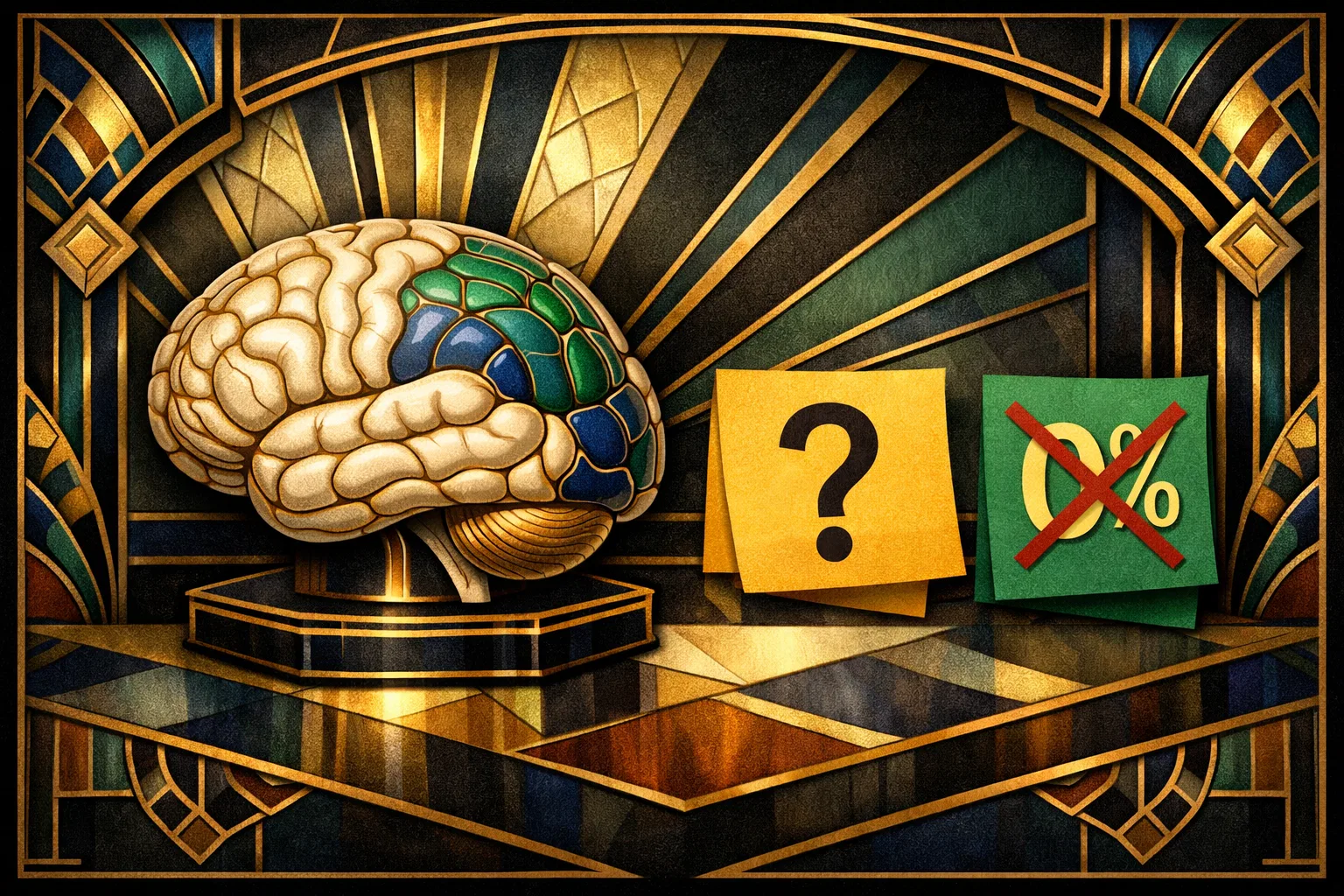
The 10 percent brain claim survives because it turns complex neuroscience into an appealing promise of untapped ability.
On this page
- The appeal of hidden potential
- What brain activity actually shows
- Why the slogan keeps returning
Page outline Jump by section
Introduction
The idea that humans use only 10 per cent of their brains is one of the most successful modern myths. It survives because it combines two powerful messages: that science has uncovered a hidden truth about the mind, and that almost everyone possesses vast unrealised abilities waiting to be unlocked. The claim appears in self-help culture, advertising, motivational speeches and popular films, often accompanied by the promise that extraordinary intelligence, creativity or mental powers lie dormant inside ordinary people.
The problem is that the slogan is not supported by neuroscience. Modern brain research shows that the brain is active across many interconnected regions throughout the day, even during sleep. The myth persists not because the evidence is strong, but because the story is emotionally attractive. It turns the complexity of human development into a simple narrative of hidden potential. MIT McGovern Institute[Scientific American]scientificamerican.comdo people only use 10 percent of their brains?7 Feb 2008 The "10 percent myth" is so wrong it is almost laughable, says neurologist Barry Gordon at Johns Hopkins School of Medicine…
The appeal of hidden potential
The enduring power of the 10 per cent myth comes from what it offers psychologically rather than scientifically.
Most people have experienced moments when they performed better than expected, learned a difficult skill or discovered a talent later in life. The myth provides a dramatic explanation for those experiences. Instead of viewing growth as the result of learning, practice, opportunity and adaptation, it suggests that success comes from accessing previously unused brain capacity.
This idea is especially appealing because it avoids uncomfortable limits. If the brain is already operating near its functional capacity, improvement usually requires effort, time and favourable conditions. If 90 per cent of the brain is supposedly inactive, however, improvement appears almost limitless. The promise becomes transformational rather than incremental.
Psychologists and science communicators have noted that the myth is often linked to broader claims about self-optimisation and untapped human potential. It has been used to support programmes that promise accelerated learning, enhanced memory, psychic abilities or dramatic intellectual breakthroughs. The attraction is not simply that people want to become better; it is that they want to believe there is a hidden reserve waiting to be released. Association for Psychological Science[Educational Neuroscience]educationalneuroscience.org.ukEducational NeuroscienceWe only use 10% of our brainsIt seems that the 10% myth persists for two primary reasons: firstly, its intuitive…
The myth also flatters its audience. It implies that current performance is not a reflection of present abilities but merely evidence that most of the mind remains inaccessible. That message is far easier to sell than the more ordinary reality that human improvement usually comes through education, training, health, environment and sustained practice.
How the myth developed
One reason the myth has survived is that it does not appear to have a single origin. Instead, several ideas gradually merged into a memorable slogan.
A commonly cited source is the psychologist William James. In the late nineteenth and early twentieth centuries, James argued that people often fail to reach their full mental and physical potential. He was discussing human capability and motivation, not unused brain tissue. Over time, however, comments about unrealised potential were transformed into a numerical claim about brain usage.[Wikipedia]WikipediaTen-percent-of-the-brain mythTen-percent-of-the-brain myth PMC The myth gained further momentum through popular culture and self-improvement literature. A frequently repeated story claims that Albert Eins[pmc.ncbi.nlm.nih.gov]pmc.ncbi.nlm.nih.govIt has survived more than a century. In 1907, Williams James…Read more… tein endorsed the idea, although there is no reliable evidence that he did. Motivational writers, advertisers and speakers found the claim useful because it sounded scientific while remaining easy to understand. By the mid-twentieth century, the number itself had become more important than its origin.[Wikipedia]WikipediaTen-percent-of-the-brain mythTen-percent-of-the-brain myth
Science fiction also helped keep the concept alive. Stories about hidden mental powers, enhanced intelligence and extraordinary cognitive abilities often used the idea that most of the brain was inactive. More recently, films such as Lucy and Limitless introduced the myth to new audiences by treating increased brain use as a route to superhuman abilities. Even when presented as fiction, such stories reinforce the basic assumption that the brain contains vast dormant regions waiting to be activated.[BrainFacts]brainfacts.orglucy and the 10 percent brain mythThe crazy thing about this belief is that despite being totally false, it is so well-known,…Read more…[MIT McGovern Institute]mcgovern.mit.edudo we use only 10 percent of our brainMIT McGovern InstituteDo we only use 10 percent of our brain?Jan 26, 2024 The idea that we use 10 percent of our brain is 100 percent a…
What brain activity actually shows
Modern neuroscience provides several independent reasons for rejecting the 10 per cent claim.
Brain imaging does not reveal large unused regions
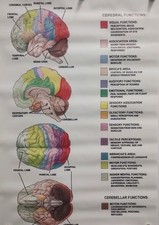
Technologies such as functional magnetic resonance imaging (fMRI) and positron emission tomography (PET) allow researchers to observe patterns of activity across the living brain. Different tasks activate different networks, but the evidence does not show huge silent areas waiting for future use.
A common misunderstanding comes from looking at colourful brain-scan images. In many images, only selected regions appear highlighted. This can create the impression that the rest of the brain is inactive. In reality, those highlighted areas simply show greater activity relative to a comparison condition. Much of the rest of the brain is still functioning.[Educational Neuroscience]educationalneuroscience.org.ukEducational NeuroscienceWe only use 10% of our brainsIt seems that the 10% myth persists for two primary reasons: firstly, its intuitive…[Encyclopedia Britannica]britannica.comEncyclopedia BritannicaDo We Really Use Only 10 Percent of Our Brain?The data clearly shows that large areas of the brainfar more than 1…
Even during sleep, extensive neural activity continues. The brain remains engaged in processes related to memory, regulation, sensory monitoring and internal communication. Neuroscientists therefore describe the brain as continuously active rather than partly switched off. MIT McGovern Institute[Scientific American]scientificamerican.comdo people only use 10 percent of their brains?7 Feb 2008 The "10 percent myth" is so wrong it is almost laughable, says neurologist Barry Gordon at Johns Hopkins School of Medicine…

Brain damage tells a different story
Evidence from injury and disease also contradicts the myth.
If 90 per cent of the brain were genuinely unnecessary, damage to large areas would often have little effect. Instead, neurological injuries can produce highly specific losses involving language, memory, movement, perception, emotion or decision-making. Even relatively small areas can play important roles. Decades of clinical neurology have repeatedly shown that brain regions contribute to behaviour in ways that become visible when those regions are damaged.[Wikipedia]WikipediaTen-percent-of-the-brain mythTen-percent-of-the-brain myth
Researchers still debate many details of how brain systems interact, but uncertainty about precise mechanisms is not evidence that most of the brain is unused. There is a major difference between saying “scientists do not fully understand everything the brain does” and saying “most of the brain does nothing”.
The brain is too expensive to waste
Another argument comes from evolution and metabolism.
The human brain accounts for roughly 2 per cent of body weight but consumes about 20 per cent of the body’s energy. Maintaining neural tissue is metabolically costly. From an evolutionary perspective, it would make little sense for natural selection to preserve a massive organ if most of it served no purpose. MIT McGovern Institute[Scientific American]scientificamerican.comdo people only use 10 percent of their brains?7 Feb 2008 The "10 percent myth" is so wrong it is almost laughable, says neurologist Barry Gordon at Johns Hopkins School of Medicine…
The existence of a large, energy-demanding brain is itself evidence that its structures contribute to survival and function. The precise role of every neuron may not be known, but the idea that 90 per cent of the organ remains idle is difficult to reconcile with what is known about biology.
Why the slogan keeps returning
The 10 per cent myth survives partly because it contains a grain of truth wrapped inside a false conclusion.
People genuinely differ in how effectively they use their abilities. Skills can improve. Learning changes the brain. Experience can reshape neural connections. Recovery after injury is sometimes possible. Neuroplasticitythe brain’s capacity to adapt and reorganisehas become one of the most important findings in modern neuroscience.[Wikipedia]WikipediaTen-percent-of-the-brain mythTen-percent-of-the-brain myth
The myth takes these real observations and converts them into a much stronger claim. Instead of saying that brains can change through experience, it says that most of the brain is dormant. Instead of saying that people can develop abilities, it implies that extraordinary powers are waiting behind a biological lock.
This distinction matters because the real story is actually more interesting. Human development is not driven by activating unused brain sectors. It emerges from changes in networks that are already active. Learning a language, mastering an instrument or improving memory does not involve switching on hidden brain regions. It involves modifying patterns of activity and connectivity across systems that are already functioning.[Educational Neuroscience]educationalneuroscience.org.ukEducational NeuroscienceWe only use 10% of our brainsIt seems that the 10% myth persists for two primary reasons: firstly, its intuitive…[Medical News Today]medicalnewstoday.comfMRI scans show that even simple activities require almost all of the brain to be active…Read more…
The slogan also benefits from repetition. Surveys have found that belief in the myth remains surprisingly widespread, including among some educators and trainee teachers. Once a claim becomes culturally familiar, people often remember the statement while forgetting where it came from or whether it was ever supported by evidence.[Educational Neuroscience]educationalneuroscience.org.ukEducational NeuroscienceWe only use 10% of our brainsIt seems that the 10% myth persists for two primary reasons: firstly, its intuitive…
The real lesson about human potential
The popularity of the 10 per cent myth reveals something important about how people think about intelligence and achievement. Most individuals do not want to hear that improvement is impossible. They want evidence that growth remains achievable.
The mistake lies in assuming that hope requires a false biological claim.
Modern neuroscience does not support the idea of vast unused brain regions waiting to be awakened. What it does support is a picture of a brain that remains adaptable throughout life. People can acquire new skills, recover functions, strengthen knowledge and change behaviour without discovering hidden neurological reserves. The evidence points toward development through plasticity, learning and experience rather than through unlocking a mysterious 90 per cent of the mind. MIT McGovern Institute[Center for BrainHealth]centerforbrainhealth.orgonly 10 of our brainsReflecting on that age-old myth, this article explores present-day understanding of the brain's interconnectedness…Read more…
That reality may be less dramatic than the myth, but it is also more empowering. Human potential does not depend on accessing an unused brain. It depends on what people do with the brain they already use every day.
Amazon book picks
Further Reading
Books and field guides related to Why the 10 Percent Brain Myth Endures. Use these as the next step if you want deeper reading beyond the article.
The Brain That Changes Itself
Explains adaptation without invoking unused brain regions.
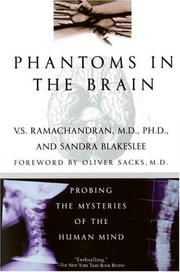
Phantoms in the brain : probing the mysteries of the human mind
First published 1999. Subjects: Neurosciences, Brain, Neurology, Popular works, Mind and body.

Livewired
First published 2020. Subjects: Physiology, Internal medicine, Brain, Neuroplasticity, Learning.
eBay marketplace picks
Marketplace Samples
Example marketplace items related to this page. Use the search link to explore similar finds on eBay.
Endnotes
1.
Source: mcgovern.mit.edu
Title: do we use only 10 percent of our brain
Link:https://mcgovern.mit.edu/2024/01/26/do-we-use-only-10-percent-of-our-brain/
Source snippet
MIT McGovern InstituteDo we only use 10 percent of our brain?Jan 26, 2024 The idea that we use 10 percent of our brain is 100 percent a...
2.
Source: britannica.com
Link:https://www.britannica.com/story/do-we-really-use-only-10-percent-of-our-brain
Source snippet
Encyclopedia BritannicaDo We Really Use Only 10 Percent of Our Brain?The data clearly shows that large areas of the brainfar more than 1...
3.
Source: Wikipedia
Title: Ten-percent-of-the-brain myth
Link:https://en.wikipedia.org/wiki/Ten-percent-of-the-brain_myth
4.
Source: pmc.ncbi.nlm.nih.gov
Link:https://pmc.ncbi.nlm.nih.gov/articles/PMC7835631/
Source snippet
It has survived more than a century. In 1907, Williams James...Read more...
5.
Source: brainfacts.org
Title: lucy and the 10 percent brain myth
Link:https://www.brainfacts.org/brain-anatomy-and-function/anatomy/2014/lucy-and-the-10-percent-brain-myth
Source snippet
The crazy thing about this belief is that despite being totally false, it is so well-known,...Read more...
6.
Source: brainfacts.org
Title: debunked the 10 percent brain myth 061719
Link:https://www.brainfacts.org/thinking-sensing-and-behaving/thinking-and-awareness/2019/debunked-the-10-percent-brain-myth-061719
Source snippet
Debunked: The 10 Percent Brain MythJun 19, 2019 Don't let the movies fool you. Neuroscientist Nick Spitzer debunks the myth that people...
7.
Source: scientificamerican.com
Title: do people only use 10 percent of their brains
Link:https://www.scientificamerican.com/article/do-people-only-use-10-percent-of-their-brains/
Source snippet
?7 Feb 2008 The "10 percent myth" is so wrong it is almost laughable, says neurologist Barry Gordon at Johns Hopkins School of Medicine...
8.
Source: educationalneuroscience.org.uk
Link:https://educationalneuroscience.org.uk/wordpress/resources/neuromyth-or-neurofact/we-only-use-10-of-our-brains/
Source snippet
Educational NeuroscienceWe only use 10% of our brainsIt seems that the 10% myth persists for two primary reasons: firstly, its intuitive...
9.
Source: educationalneuroscience.org.uk
Link:https://www.educationalneuroscience.org.uk/resources/neuromyth-or-neurofact/we-only-use-10-of-our-brains/
Source snippet
The advent of functional magnetic...Read more...
10.
Source: medicalnewstoday.com
Link:https://www.medicalnewstoday.com/articles/321060
Source snippet
fMRI scans show that even simple activities require almost all of the brain to be active...Read more...
11.
Source: centerforbrainhealth.org
Title: only 10 of our brains
Link:https://centerforbrainhealth.org/article/only-10-of-our-brains
Source snippet
Reflecting on that age-old myth, this article explores present-day understanding of the brain's interconnectedness...Read more...
12.
Source: pmc.ncbi.nlm.nih.gov
Link:https://pmc.ncbi.nlm.nih.gov/articles/PMC5834348/
Source snippet
This includes claims of how many cells compose the human brain.Read more...
Additional References
13.
Source: wired.com
Title: everything you need to know about the 10 brain myth explained in 60 seconds
Link:https://www.wired.com/2014/07/everything-you-need-to-know-about-the-10-brain-myth-explained-in-60-seconds/
Source snippet
All You Need To Know About the 10 Percent Brain Myth, in...24 Jul 2014 It's based on the premise that we use only 10 percent of our br...
14.
Source: sociostudies.org
Link:https://www.sociostudies.org/journal/articles/3776772/
Source snippet
ted to 10 % of brain's capacity; initially James stated that it was the use of 10 % of our gray matter for those...
15.
Source: psychologicalscience.org
Title: myth we only use 10 of our brains
Link:https://www.psychologicalscience.org/uncategorized/myth-we-only-use-10-of-our-brains.html
Source snippet
Association for Psychological ScienceMyth: We Only Use 10% of Our BrainsAug 29, 2018 It was the basis of the movie Lucy (2014), which d...
16.
Source: medium.com
Title: history rewinded origins of the 10 myth 23202a97866b
Link:https://medium.com/%40neuro_nuggets/history-rewinded-origins-of-the-10-myth-23202a97866b
Source snippet
History Rewinded: Origins of the 10% Myth[Debunking]({{ 'debunking/' | relative_url }}) the 10% Brain Myth. YouTube, 2013,([https://www.youtube.com/watch?v=4VqbzWGiW-k](https://www.youtube.com/watch?v=4VqbzWGiW-k))...
17.
Source: bakadesuyo.com
Link:https://bakadesuyo.com/2012/06/is-it-true-you-only-use-10-of-your-brainpower/
Source snippet
as laughably false, adding, we use virtually every part of the brain.Read more...
18.
Source: bps.org.uk
Title: great myths brain we only use 10 cent
Link:https://www.bps.org.uk/psychologist/great-myths-brain-we-only-use-10-cent
Source snippet
Great myths of the brain: We only use 10 per cent1 Dec 2014 He supposedly explained to a reporter that the secret to his genius was tha...
19.
Source: communicatingpsychologicalscience.com
Title: In reality, the human brain is a highly complex organ.Read more
Link:https://www.communicatingpsychologicalscience.com/blog/misconceptions-the-truth-about-brain-usage-debunking-the-10-myth
Source snippet
[Communicating]({{ 'communicating/' | relative_url }}) Psychological ScienceMisconceptions: The Truth About Brain Usage: Debunking...Nov 7, 2023 The belief that you use only 1...
20.
Source: schoolofeducation.blogs.bristol.ac.uk
Title: no we dont use only 10 of our brains
Link:https://schoolofeducation.blogs.bristol.ac.uk/2020/09/17/no-we-dont-use-only-10-of-our-brains/
Source snippet
bristol.ac.ukNo, we don't use only 10% of our brains!17 Sept 2020 No, we do not use just 10 or 15% of our brain capacities. In fact, we...
21.
Source: uamshealth.com
Link:https://uamshealth.com/medical-myths/do-people-only-use-10-percent-of-our-brains/
Source snippet
UAMS HealthDo People Only Use 10 Percent of our Brains?Mar 8, 2019 Unfortunately, the idea that people only use 10% of our brains and c...
22.
Source: medium.com
Link:https://medium.com/apollo-medical-myths-debunked/do-we-really-use-only-10-of-our-brains-ad9a59fba0ec
Source snippet
parts of our brain, and each area has an...Read more...
Topic Tree