Within 10 Brain
Why the 10 Percent Myth Feels True
The myth works because it turns ordinary learning and effort into a tempting story about hidden reserves waiting to be unlocked.
On this page
- The promise of hidden mental reserves
- Why effortless transformation is easier to sell
- How self improvement culture keeps the idea alive
Page outline Jump by section
Introduction
The 10 per cent brain myth survives for a simple reason: it tells a story many people want to believe. Rather than suggesting that intelligence, creativity and skill develop through practice, education and experience, it promises that extraordinary abilities are already inside us, waiting to be unlocked. The claim offers a shortcut between ordinary life and exceptional potential.
 That emotional appeal matters more than the science. Modern neuroscience has repeatedly shown that the brain is active across interconnected regions throughout the day and night, not sitting mostly dormant. Yet the myth remains popular because it explains frustration, ambition and self-imvement in a hopeful way. It turns the difficult work of growth into a tale of hidden reserves and untapped power.[MIT McGovern Institute]mcgovern.mit.edudo we use only 10 percent of our brainMIT McGovern InstituteDo we only use 10 percent of our brain?26 Jan 2024 The idea that we use 10 percent of our brain is 100 percent a…[Scientific]scientificamerican.comdo people only use 10 percent of their brainsScientific AmericanDo People Only Use 10 Percent of Their Brains?7 Feb 2008 Another mystery hidden within our crinkled cortices is that…
The Promise of Hidden Mental Reserves
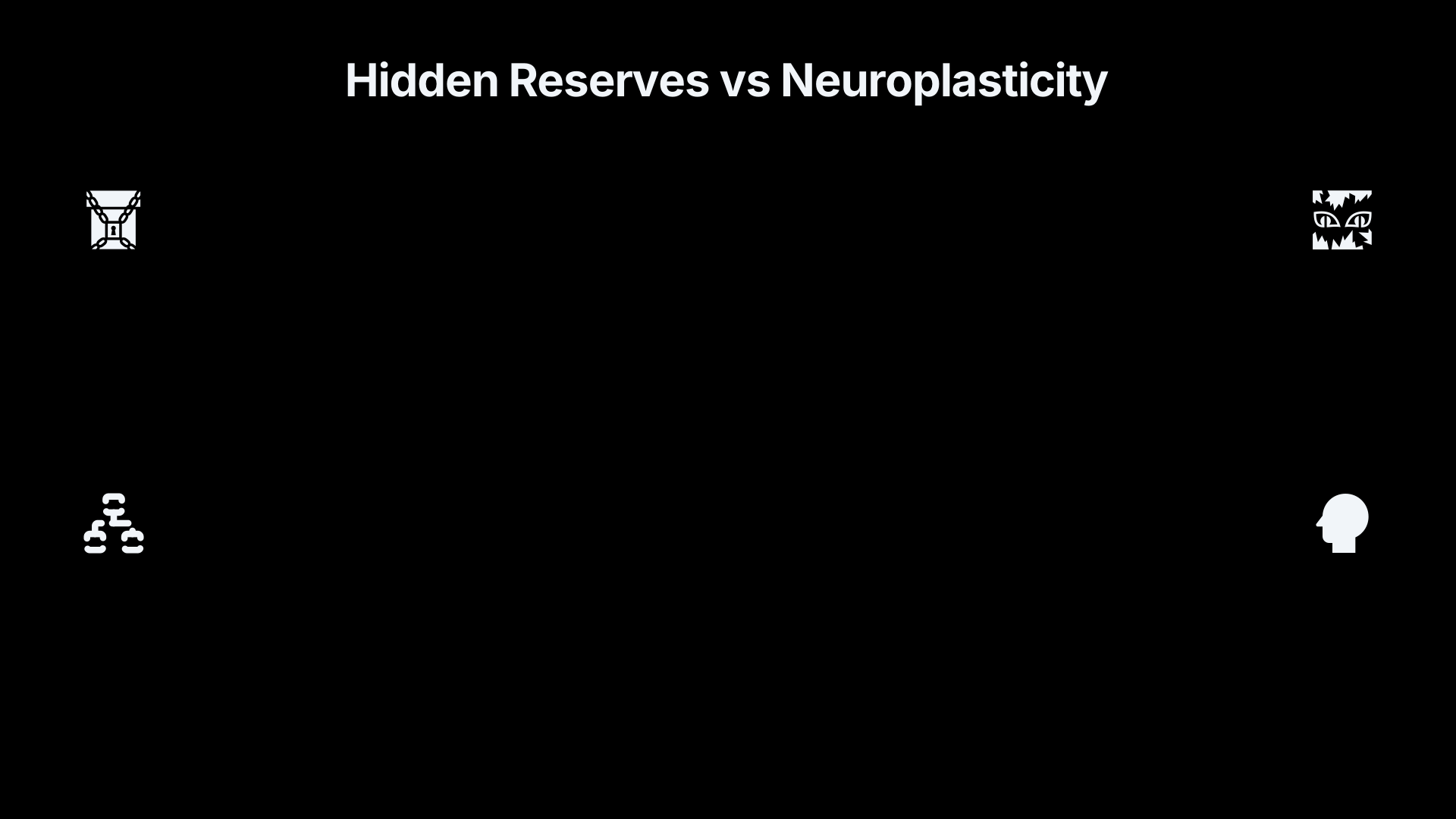
One reason the myth feels believable is that it fits common human experience. Most people have had moments when they surprised themselves: learning a language faster than expected, mastering a skill they once thought impossible or discovering a talent later in life. The idea of an unused mental reservoir seems to explain those breakthroughs.
In reality, such changes usually reflect learning, adaptation and neuroplasticity the brain’s ability to reorganise and strengthen connections through experience. But the 10 per cent story offers a more dramatic explanation. Instead of saying that people improve because the brain changes through use, it suggests they improve because they have finally accessed previously inactive mental territory.[Educational Neuroscience]educationalneuroscience.org.ukEducational NeuroscienceWe only use 10% of our brainsIt seems that the 10% myth persists for two primary reasons: firstly, its intuitive…
The myth also benefits from a confusion between potential and capacity. Psychologists have long argued that people rarely reach the limits of what they could achieve under ideal conditions. Over time, that observation became transformed into a claim about unused brain tissue. The shift is subtle but powerful. Saying “people often underperform relative to their potential” sounds realistic. Saying “90 per cent of the brain is unused” sounds revolutionary.[Wikipedia]WikipediaTen-percent-of-the-brain mythTen-percent-of-the-brain myth
Why Effortless Transformation Is Easier to Sell
The myth offers something that evidence-based explanations often do not: effortless transformation.
Most genuine improvement is gradual. Better memory comes from practice, repetition and strategy. Greater expertise comes from years of learning. Improved concentration often depends on sleep, health and sustained effort. These explanations are accurate but rarely exciting.
The 10 per cent claim replaces that slow process with a hidden switch. If most of the brain is inactive, then extraordinary change appears possible through activation rather than development. The promise becomes less about training and more about unlocking. This makes the idea especially attractive in self-help culture, where audiences are often searching for rapid breakthroughs rather than incremental progress.[Scientific American]scientificamerican.comdo people only use 10 percent of their brainsScientific AmericanDo People Only Use 10 Percent of Their Brains?7 Feb 2008 Another mystery hidden within our crinkled cortices is that…
Popular films have repeatedly reinforced this narrative. Stories such as Limitless and Lucy present intelligence as something that can be dramatically expanded by accessing previously unavailable mental power. These stories are fictional, but they build on a belief that already feels intuitively plausible to many viewers. The audience does not need to understand neuroscience for the premise to work. They only need to recognise the fantasy of becoming vastly more capable overnight.[MIT McGovern Institute]mcgovern.mit.edudo we use only 10 percent of our brainMIT McGovern InstituteDo we only use 10 percent of our brain?26 Jan 2024 The idea that we use 10 percent of our brain is 100 percent a…[Scientific]scientificamerican.comdo people only use 10 percent of their brainsScientific AmericanDo People Only Use 10 Percent of Their Brains?7 Feb 2008 Another mystery hidden within our crinkled cortices is that…
The myth also protects self-esteem. If someone struggles academically, professionally or creatively, it is more comforting to believe that hidden abilities remain dormant than to accept that improvement requires long-term effort or that some limits may exist. The story shifts the problem from development to access.

Why the Number Sounds Scientific
Another reason the claim feels credible is that it uses a precise number.
People tend to trust statements that sound quantitative. “You use only 10 per cent of your brain” feels more authoritative than a vague claim about unrealised potential. The figure creates an illusion of measurement, as though neuroscientists have calculated exactly how much of the brain is active.
In reality, there is no scientific basis for the number. Researchers have proposed several historical routes through which the idea emerged, including misunderstandings of early psychology, confusion about the function of different brain cells and exaggerations of comments about human potential. Yet the numerical precision helps the myth survive because it resembles a scientific finding rather than a motivational slogan.[Wikipedia]WikipediaTen-percent-of-the-brain mythTen-percent-of-the-brain myth
This effect is strengthened by the public’s awareness that many aspects of the brain remain mysterious. People know that consciousness, memory and intelligence are not fully understood. That genuine uncertainty can make unsupported claims seem more plausible. If science still has unanswered questions about the brain, some assume that vast unused regions might be among them. Neuroscience does contain mysteries, but unused brain capacity is not one of them.[Scientific American]scientificamerican.comdo people only use 10 percent of their brainsScientific AmericanDo People Only Use 10 Percent of Their Brains?7 Feb 2008 Another mystery hidden within our crinkled cortices is that…
How Self-Improvement Culture Keeps the Idea Alive
The 10 per cent myth fits neatly into a broader culture of optimisation. Many books, courses and motivational programmes promise to help people become smarter, more productive or more creative. A claim about hidden mental reserves provides a compelling foundation for those promises.
The myth suggests that success depends less on changing habits and more on releasing abilities that already exist. That message is attractive because it frames improvement as discovery rather than discipline. Instead of asking people to spend years building expertise, it implies that exceptional performance is already present beneath the surface.[Educational Neuroscience]educationalneuroscience.org.ukEducational NeuroscienceWe only use 10% of our brainsIt seems that the 10% myth persists for two primary reasons: firstly, its intuitive…
Research on “neuromyths” misconceptions about the brain that persist despite scientific evidence suggests that such ideas can remain influential even among educated audiences. Brain-related claims often gain credibility simply because they sound connected to neuroscience. References to neurons, brain regions or hidden cognitive powers can make weak ideas appear more scientific than they are.[PMC]pmc.ncbi.nlm.nih.govDispelling the Myth: Training in Education or Neuroscience…by K Macdonald 2017 Cited by 455 These findings suggest that train…
The persistence of the 10 per cent myth therefore reflects more than a misunderstanding of biology. It reflects a demand for hopeful narratives. People are naturally drawn to explanations that promise extraordinary possibilities, especially when those explanations seem to carry scientific authority.

The Real Source of the Myth’s Appeal
At its core, the myth survives because it combines optimism with simplicity.
The real story of human improvement is complicated. People grow through learning, practice, social support, health, opportunity and countless interactions between biology and environment. The 10 per cent myth compresses all of that into a single appealing message: you are already far more capable than you realise.
That promise feels emotionally true even when it is scientifically false. The myth transforms ordinary human potential into a hidden treasure waiting to be uncovered. For many people, that story is more satisfying than the less dramatic reality that meaningful change usually comes from using the brain more effectively, not from activating a part that was never being used in the first place.[Scientific American]scientificamerican.comdo people only use 10 percent of their brainsScientific AmericanDo People Only Use 10 Percent of Their Brains?7 Feb 2008 Another mystery hidden within our crinkled cortices is that… 2psychologytoday.com
eBay marketplace picks
Marketplace Samples
Example marketplace items related to this page. Use the search link to explore similar finds on eBay.


Endnotes
1.
Source: mcgovern.mit.edu
Title: do we use only 10 percent of our brain
Link:https://mcgovern.mit.edu/2024/01/26/do-we-use-only-10-percent-of-our-brain/
Source snippet
MIT McGovern InstituteDo we only use 10 percent of our brain?26 Jan 2024 The idea that we use 10 percent of our brain is 100 percent a...
2.
Source: pmc.ncbi.nlm.nih.gov
Link:https://pmc.ncbi.nlm.nih.gov/articles/PMC5554523/
Source snippet
Dispelling the Myth: Training in Education or Neuroscience...by K Macdonald 2017 Cited by 455 These findings suggest that train...
3.
Source: Wikipedia
Title: Ten-percent-of-the-brain myth
Link:https://en.wikipedia.org/wiki/Ten-percent-of-the-brain_myth
4.
Source: psychologytoday.com
Title: beyond the myth that we use only 10 percent of our brains
Link:https://www.psychologytoday.com/us/blog/common-sense-science/202505/beyond-the-myth-that-we-use-only-10-percent-of-our-brains
Source snippet
We use our entire brain. Neuroscience points to several actual methods of enhancing brain efficiency...
5.
Source: psychologytoday.com
Title: beyond the myth that we use only 10 percent of our brains
Link:https://www.psychologytoday.com/gb/blog/common-sense-science/202505/beyond-the-myth-that-we-use-only-10-percent-of-our-brains
Source snippet
We use our entire brain. Neuroscience points to several actual methods of enhancing brain efficiency...
6.
Source: scientificamerican.com
Title: do people only use 10 percent of their brains
Link:https://www.scientificamerican.com/article/do-people-only-use-10-percent-of-their-brains/
Source snippet
Scientific AmericanDo People Only Use 10 Percent of Their Brains?7 Feb 2008 Another mystery hidden within our crinkled cortices is that...
7.
Source: educationalneuroscience.org.uk
Link:https://educationalneuroscience.org.uk/wordpress/resources/neuromyth-or-neurofact/we-only-use-10-of-our-brains/
Source snippet
Educational NeuroscienceWe only use 10% of our brainsIt seems that the 10% myth persists for two primary reasons: firstly, its intuitive...
8.
Source: scientificamerican.com
Title: do we really use only 10
Link:https://www.scientificamerican.com/article/do-we-really-use-only-10/
Source snippet
Scientific AmericanDo we really use only 10 percent of our brains?8 Mar 2004 The 10-percent myth has undoubtedly motivated many people...
9.
Source: scientificamerican.com
Title: 5 common myths about the brain
Link:https://www.scientificamerican.com/article/5-common-myths-about-the-brain/
Source snippet
1 Jan 2015 FACT The 10 percent myth (sometimes elevated to 20) is mere urban legend, one perpetrated by the plot of the 2011 movie Limi...
10.
Source: scientificamerican.com
Link:https://www.scientificamerican.com/article/you-use-only-10andpercnt-of-your-br/
Source snippet
You use only 10% of your brainReality: No matter what you're doing, your brain is always active. [Brain scans]({{ 'brain-scans/' | relative_url }}) show that at times some area...
11.
Source: facebook.com
Link:https://www.facebook.com/psychologytoday/posts/its-a-myth-that-we-only-use-10-percent-of-our-brains-but-the-truth-is-more-inter/10155657261633845/
Source snippet
Scientific American that completely debunks the 10% brain myth...
Additional References
12.
Source: nm.org
Link:https://www.nm.org/healthbeat/healthy-tips/ten-surprising-facts-about-your-brain
Source snippet
10 Surprising Facts About Your BrainScientists at the University of Utah have debunked the myth that people predominantly use one side of...
13.
Source: linkedin.com
Link:https://www.linkedin.com/pulse/why-10-brain-usage-myth-persists-rakesh-kr-1ntyc
Source snippet
Why the 10% Brain Usage Myth PersistsThe myth suggests we possess vast reservoirs of hidden ability, fueling fantasies about unlocking su...
14.
Source: facebook.com
Link:https://www.facebook.com/plymouthuni/posts/we-only-use-around-10-of-our-brain-at-any-moment-is-this-a-fact-or-a-myththe-hum/783102453862326/
Source snippet
University of PlymouthIn conclusion, the idea that humans only use 10% of their brains is a myth that does not align with our current und...
15.
Source: youtube.com
Link:https://www.youtube.com/watch?v=VwrdPEdJv9g
Source snippet
The Ten Percent Brain MythHave you heard that we only use 10% of our brains? It's a myth! We use 100% of our brains, and they're active e...
16.
Source: dana.org
Link:https://dana.org/article/when-the-myth-is-the-message-neuromyths-and-education/
Source snippet
Neuromyth #2: Eating sugary snacks results in hyperactivity and reduced focus and attention.Read more...
17.
Source: dana.org
Link:https://dana.org/resources/the-ten-percent-brain-myth/
Source snippet
Dana FoundationThe Ten Percent Brain MythIt's a myth! We use 100% of our brains, and they're active even when we're asleep. Learn more ab...
18.
Source: consensus.app
Link:https://consensus.app/search/are-there-any-scientific-studies-[debunking
Source snippet
Scientific research strongly rejects this claim, showing that nearly all...
19.
Source: schoolofeducation.blogs.bristol.ac.uk
Title: no we dont use only 10 of our brains
Link:https://schoolofeducation.blogs.bristol.ac.uk/2020/09/17/no-we-dont-use-only-10-of-our-brains/
Source snippet
bristol.ac.ukNo, we don't use only 10% of our brains!17 Sept 2020 No, we do not use just 10 or 15% of our brain capacities. In fact, we...
20.
Source: medium.com
Link:https://medium.com/apollo-medical-myths-debunked/do-we-really-use-only-10-of-our-brains-ad9a59fba0ec
Source snippet
parts of our brain, and each area has an...Read more...
21.
Source: faculty.washington.edu
Title: UW Faculty Neuroscience For Kids
Link:https://faculty.washington.edu/chudler/tenper.html
Source snippet
For Kids - 10% of the Brain MythDo We Use Only 10% of Our Brains? Let me state this very clearly: There is no scientific evidence to sugg...
Topic Tree