Within Politics
How Online Crowds Make Myths Feel True
Likes, shares, replies, and silence can make a false claim feel socially approved before anyone checks the evidence.
On this page
- How approval signals shape belief
- Why silence can look like agreement
- How polarized communities define fake news
Page outline Jump by section
Introduction
Online political myths often spread through social signals before they spread through evidence. A claim does not need to be proven to feel credible inside a digital community. If thousands of people appear to like, share, repeat or defend it, many users begin to treat it as socially established knowledge rather than a disputed assertion. The effect is especially powerful when political identity is involved because people are not only evaluating information; they are also reading cues about loyalty, belonging and group norms.
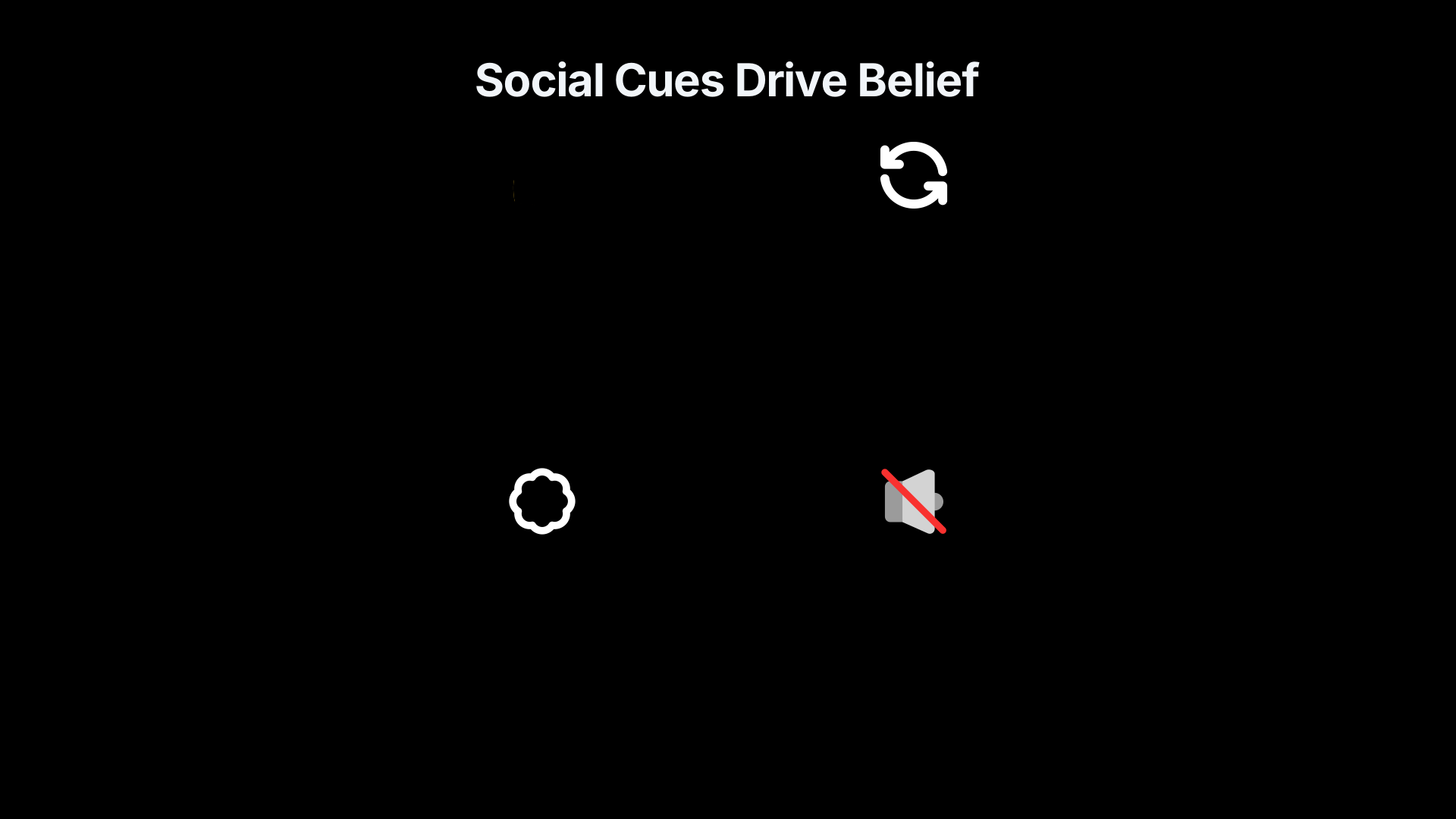 Research on misinformation increasingly shows that online engagement signals influence how people interpret political claims. Likes, reposts, supportive comments and visible endorsement can create impressions of consensus, while silence or hesitation can make disagreement seem rare. In polarised communities, these signals help transform questionable claims into accepted group narratives, even when factual disputes remain unresolved.[PMC]pmc.ncbi.nlm.nih.govPMCThe persuasive effects of social cues and sourceNIHby CS Traberg · 2024 · Cited by 65 — Specifically, high and low engagement cues ('likes') reduced misinformation susceptibility…[ScienceDirect]sciencedirect.comInside the funhouse mirror factory: How social media…by CE Robertson · 2024 · Cited by 102 — We argue the funhouse mirror…
How Approval Signals Shape Belief
Most people cannot independently verify every political claim they encounter. As a result, they often use social shortcuts when judging credibility. Online platforms are built around these shortcuts.
A post with thousands of likes or shares communicates more than popularity. It can imply that many other people have already evaluated the claim and found it convincing. Researchers describe these reactions as social cues or endorsement cues because they provide information about how others appear to be responding.[PMC]pmc.ncbi.nlm.nih.govPMCThe persuasive effects of social cues and sourceNIHby CS Traberg · 2024 · Cited by 65 — Specifically, high and low engagement cues ('likes') reduced misinformation susceptibility… ScienceDirect This matters because people frequently interpret popularity as evidence. The reasoning is often unconscious:[sciencedirect.com]sciencedirect.comInside the funhouse mirror factory: How social media…by CE Robertson · 2024 · Cited by 102 — We argue the funhouse mirror…
- If many people support the claim, perhaps it has already been checked.
- If trusted members of the group are repeating it, perhaps it is safe to accept.
- If the claim keeps appearing across multiple accounts, perhaps it reflects a broader reality.
Experiments have found that social endorsement affects how people evaluate information, particularly when it changes their perception of what other people believe. Researchers studying misinformation susceptibility found that social cues become influential when they shape perceptions of wider social consensus. In other words, the cue matters less as a number and more as a signal that “people like us believe this”.[PMC]pmc.ncbi.nlm.nih.govPMCThe persuasive effects of social cues and sourceNIHby CS Traberg · 2024 · Cited by 65 — Specifically, high and low engagement cues ('likes') reduced misinformation susceptibility…
Political myths benefit from this dynamic because they often arrive wrapped in visible social approval. A user may encounter a false claim alongside supportive comments, repeated reposts and positive reactions before encountering any fact-check. The social environment creates a sense that the claim is already accepted.
Loyalty Signals Often Matter More Than Accuracy
In highly political online spaces, sharing can function as a declaration of identity as much as a transfer of information.
Research on misinformation sharing suggests that platform rewards such as likes, comments and reposts can shift attention away from accuracy and toward social engagement. People may post material because it performs well within their network, not because they have carefully evaluated its truthfulness.[Yale Insights]insights.som.yale.eduYale InsightsHow Social Media Rewards Misinformation | Yale Insights31 Mar 2023 — They post simply because the platform rewards posting w…
This creates a feedback loop:
- A politically useful claim appears.
- Group members reward it with engagement.
- High engagement makes the claim appear more accepted.
- More users interpret that acceptance as credibility.[sciencedirect.com]sciencedirect.comHow perceptions of Twitter's helpfulness influence news…by B Millet · 2024 · Cited by 19 — Contrary to previous findings, social endor…
- The claim becomes increasingly normal within the community.
Over time, the myth acquires social legitimacy independent of its factual basis.
Why Silence Can Look Like Agreement
Online political environments are shaped not only by what people say but also by what they choose not to say.
A common psychological phenomenon known as pluralistic ignorance occurs when people misjudge what others actually believe. Individuals may privately doubt a claim while assuming that everyone else accepts it. Because they think they are in the minority, they remain silent. Their silence then reinforces the appearance of consensus.[Sage Journals]journals.sagepub.comSage Journals Do Heuristic Cues Affect Misinformation Sharing?21 Oct 2024 — These endorsement cues have been shown to be effective in increasing people's trust in content supported by others in onlin…[Frontiers]frontiersin.orgFrontiersA century of pluralistic ignorance: what we have learned…by DT Miller · 2023 · Cited by 76 — Pluralistic ignorance is a situa…
This process can be particularly powerful online.
Imagine a political community where many members have reservations about a viral claim. If only the most enthusiastic supporters post comments while sceptics stay quiet, the visible conversation becomes distorted. Newcomers see overwhelming apparent support and conclude that the claim is widely accepted.
Researchers studying social media’s effects on public perception argue that platforms can create what they describe as a distorted social mirror. Highly visible voices may appear representative even when they are not. This can generate false impressions about what most people think, a pattern linked to pluralistic ignorance and false polarisation. ScienceDirect[PubMed]pubmed.ncbi.nlm.nih.govHow social media distorts perceptions of normsby CE Robertson · 2024 · Cited by 102 — We argue the funhouse mirror nature of social…

The Silent Majority Problem
The distortion becomes stronger when people fear social penalties.
In politically charged spaces, questioning a popular narrative can bring ridicule, exclusion or accusations of disloyalty. Even mild scepticism may attract hostile replies. As a result, many users conclude that remaining silent is safer than challenging the group.[Frontiers]frontiersin.orgFrontiersA century of pluralistic ignorance: what we have learned…by DT Miller · 2023 · Cited by 76 — Pluralistic ignorance is a situa…
The outcome is a misleading information environment:
- Supporters appear more numerous than they are.
- Doubters appear rarer than they are.
- Neutral observers misread the balance of opinion.
- The myth gains the appearance of community consensus.
The important point is that this process does not require widespread belief. Sometimes the appearance of widespread belief is enough.
How Polarised Communities Define “Fake News”
Political myths often survive because communities do not merely disagree about facts. They disagree about which institutions deserve trust.
Within strongly polarised groups, members frequently develop shared assumptions about who counts as a reliable source and who counts as an enemy. Once these boundaries are established, social cues help enforce them.
A correction from an outside source may be dismissed not because members carefully reviewed the evidence and found it weak, but because accepting it would mean granting legitimacy to an out-group institution. At the same time, claims from in-group figures may receive automatic social reinforcement.[PMC]pmc.ncbi.nlm.nih.govPMCThe persuasive effects of social cues and sourceNIHby CS Traberg · 2024 · Cited by 65 — Specifically, high and low engagement cues ('likes') reduced misinformation susceptibility…
This helps explain why the phrase “fake news” often functions as a group marker rather than a neutral assessment of accuracy. Different communities may use the label to signal which information sources belong inside or outside their trusted network.
When users repeatedly see respected group members treating certain journalists, academics, fact-checkers or media organisations as illegitimate, they learn a social lesson: rejecting those sources is part of belonging. The question shifts from “Is this claim true?” to “Which side is this information helping?” This makes myth correction substantially harder because evidence is filtered through group identity before it is evaluated.
Alternative Information Ecosystems
Online communities can also create their own information ecosystems.
Members share screenshots, clips, influencers, commentators and niche media sources that reinforce common narratives. Repetition across multiple accounts creates the impression of independent confirmation even when the information ultimately originates from a small number of sources.
Research on misinformation networks has shown that tightly connected communities can strengthen collective narratives and create powerful counter-publics that challenge mainstream accounts of events. The more frequently members encounter the same claim within trusted networks, the more familiar and socially normal it becomes.[The Guardian]theguardian.comThe research, which analyzed tweets from 8,198 MPs in 26 countries and compared them with fact-checking databases, showed far-right popul…
The result is not necessarily that members become unable to recognise disagreement. Rather, they may come to see disagreement itself as evidence that outsiders are misinformed, biased or hostile.
Why Group Cues Feel Stronger Than Fact-Checks
Fact-checks typically arrive as informational interventions. Group cues arrive as social experiences.
A correction asks people to reconsider a claim. Social approval signals tell people how their community appears to feel about that claim. Because humans are highly sensitive to social belonging, visible group reactions can shape interpretation before any detailed reasoning occurs.[PMC]pmc.ncbi.nlm.nih.govPMCThe persuasive effects of social cues and sourceNIHby CS Traberg · 2024 · Cited by 65 — Specifically, high and low engagement cues ('likes') reduced misinformation susceptibility…
Research on corrected misinformation has found that social endorsement can influence how people respond even after corrective information is introduced. This suggests that belief persistence is not simply a problem of missing facts. It is also a problem of social context.[the UWA Profiles and Research Repository]research-repository.uwa.edu.authe UWA Profiles and Research RepositorySocial Endorsement Influences the Continued Belief in…by LH Butler · 2023 · Cited by 35 — In t…
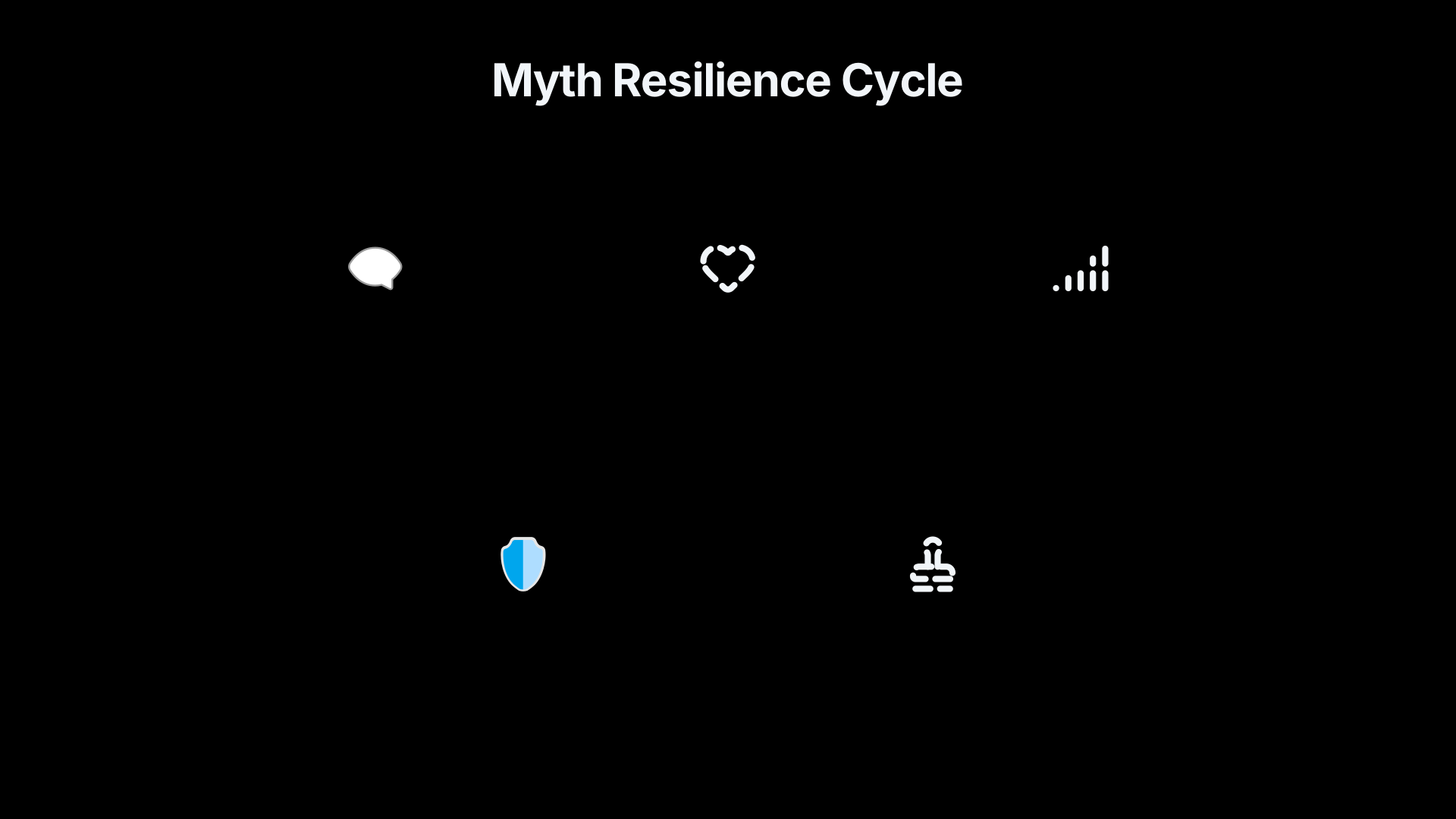
Political myths therefore become resilient when they are embedded within a network of social rewards:
- Repeating the myth earns approval.
- Challenging it risks conflict.
- Silence allows apparent consensus to grow.
- Community identity becomes linked to the narrative.
Under those conditions, the myth feels normal not because everyone has investigated it, but because online group cues continually signal that acceptance is what people like us do.[PMC]pmc.ncbi.nlm.nih.govPMCThe persuasive effects of social cues and sourceNIHby CS Traberg · 2024 · Cited by 65 — Specifically, high and low engagement cues ('likes') reduced misinformation susceptibility…[Frontiers]frontiersin.orgFrontiersA century of pluralistic ignorance: what we have learned…by DT Miller · 2023 · Cited by 76 — Pluralistic ignorance is a situa…
Amazon book picks
Further Reading
Books and field guides related to How Online Crowds Make Myths Feel True. Use these as the next step if you want deeper reading beyond the article.
The Chaos Machine
Examines how online platforms amplify group signals and misinformation.


The Righteous Mind
First published 2012. Subjects: Political psychology, Social psychology, Ethics, Religious Psychology, nyt:combined-print-and-e-book-nonf...
eBay marketplace picks
Marketplace Samples
Example marketplace items related to this page. Use the search link to explore similar finds on eBay.


Endnotes
1.
Source: pmc.ncbi.nlm.nih.gov
Title: PMCThe persuasive effects of social cues and source
Link:https://pmc.ncbi.nlm.nih.gov/articles/PMC10879158/
Source snippet
NIHby CS Traberg · 2024 · Cited by 65 — Specifically, high and low engagement cues ('likes') reduced misinformation susceptibility...
2.
Source: sciencedirect.com
Link:https://www.sciencedirect.com/science/article/abs/pii/S2352250X24001313
Source snippet
Inside the funhouse mirror factory: How social media...by CE Robertson · 2024 · Cited by 102 — We argue the funhouse mirror...
3.
Source: sciencedirect.com
Link:https://www.sciencedirect.com/science/article/pii/S2451958825003082
Source snippet
Social media virality metrics as interpretive cuesby K Na · 2026 — Virality metrics—such as the number of likes, shares, and comments—are...
4.
Source: insights.som.yale.edu
Link:https://insights.som.yale.edu/insights/how-social-media-rewards-misinformation
Source snippet
Yale InsightsHow Social Media Rewards Misinformation | Yale Insights31 Mar 2023 — They post simply because the platform rewards posting w...
5.
Source: sciencedirect.com
Link:https://www.sciencedirect.com/org/science/article/pii/S1438887123006532
Source snippet
Impact of Social Reference Cues on Misinformation...by CM Jones · 2023 · Cited by 25 — Social reference cues combined with misinformatio...
6.
Source: sciencedirect.com
Link:https://www.sciencedirect.com/science/article/abs/pii/S2352250X21000749
Source snippet
A century of pluralistic ignorance: what we have learned about its origins, forms, and consequences.Read m...
7.
Source: sciencedirect.com
Link:https://www.sciencedirect.com/science/article/abs/pii/S0747563224000530
Source snippet
How perceptions of Twitter's helpfulness influence news...by B Millet · 2024 · Cited by 19 — Contrary to previous findings, social endor...
8.
Source: frontiersin.org
Link:https://www.frontiersin.org/journals/social-psychology/articles/10.3389/frsps.2023.1260896/full
Source snippet
FrontiersA century of pluralistic ignorance: what we have learned...by DT Miller · 2023 · Cited by 76 — Pluralistic ignorance is a situa...
9.
Source: journals.sagepub.com
Title: Sage Journals Do Heuristic Cues Affect Misinformation Sharing?
Link:https://journals.sagepub.com/doi/10.1177/10776990241284597
Source snippet
21 Oct 2024 — These endorsement cues have been shown to be effective in increasing people's trust in content supported by others in onlin...
10.
Source: api.repository.cam.ac.uk
Link:https://api.repository.cam.ac.uk/server/api/core/bitstreams/eb23aa61-44b4-4d05-9641-86acbc2e01e5/content
Source snippet
The persuasive effects of social cues and source...by CS Traberg · 2024 · Cited by 69 — We find that social cues only impact individual...
11.
Source: journals.sagepub.com
Link:https://journals.sagepub.com/doi/10.1177/1089268021995168
Source snippet
Sage JournalsPluralistic Ignorance Research in Psychology: A Scoping...26 Mar 2021 — Pluralistic ignorance occurs when group members mis...
12.
Source: nature.com
Link:https://www.nature.com/articles/s41467-022-32412-y
Source snippet
Americans experience a false social reality by...by G Sparkman · 2022 · Cited by 307 — We find a form of pluralistic ignorance that we d...
13.
Source: pubmed.ncbi.nlm.nih.gov
Link:https://pubmed.ncbi.nlm.nih.gov/39369456/
Source snippet
How social media distorts perceptions of normsby CE Robertson · 2024 · Cited by 102 — We argue the funhouse mirror nature of social...
14.
Source: frontiersin.org
Link:https://www.frontiersin.org/journals/communication/articles/10.3389/fcomm.2025.1547489/full
Source snippet
FrontiersIgnorance of the crowd: dysfunctional thinking in social...by F Seeme · 2025 · Cited by 7 — Some studies suggest that the spira...
15.
Source: theguardian.com
Link:https://www.theguardian.com/world/2025/feb/11/far-right-mps-fake-news-misinformation-left-study
Source snippet
The research, which analyzed tweets from 8,198 MPs in 26 countries and compared them with fact-checking databases, showed far-right popul...
16.
Source: research-repository.uwa.edu.au
Link:https://research-repository.uwa.edu.au/en/publications/social-endorsement-influences-the-continued-belief-in-corrected-m/
Source snippet
the UWA Profiles and Research RepositorySocial Endorsement Influences the Continued Belief in...by LH Butler · 2023 · Cited by 35 — In t...
17.
Source: nature.com
Link:https://www.nature.com/articles/s41598-024-54030-y
Source snippet
The persuasive effects of social cues and source effects on...by CS Traberg · 2024 · Cited by 64 — Specifically, high and low engagement...
18.
Source: Wikipedia
Title: Pluralistic ignorance
Link:https://en.wikipedia.org/wiki/Pluralistic_ignorance
Source snippet
Pluralistic ignorancePluralistic ignorance encompasses situations in which a minority position on a given topic is wrongly perceived t...
Additional References
19.
Source: researchgate.net
Link:https://www.researchgate.net/publication/378340217_The_persuasive_effects_of_social_cues_and_source_effects_on_misinformation_susceptibility
Source snippet
(PDF) The persuasive effects of social cues and source...7 Feb 2024 — We find that social cues only impact individual judgements when th...
20.
Source: merriam-webster.com
Link:https://www.merriam-webster.com/dictionary/pluralistic
Source snippet
PLURALISTIC Definition & MeaningThe meaning of PLURALISTIC is of, relating to, or characterized by pluralism. How to use pluralistic in a...
21.
Source: ouci.dntb.gov.ua
Link:https://ouci.dntb.gov.ua/en/works/lmL0axn4/
Source snippet
persuasive effects of social cues and source...We find that social cues only impact individual judgements when they influence perception...
22.
Source: osf.io
Link:https://osf.io/download/fw3zq
Source snippet
Effects of fact-checking [warning labels]({{ 'warning-labels/' | relative_url }}) and social...by TK Koch · 2023 · Cited by 113 — the social endorsement condition saw a post with...
23.
Source: researchgate.net
Link:https://www.researchgate.net/publication/349770225_The_Impact_of_Social_Endorsement_Cues_and_Manipulability_Concerns_on_Perceptions_of_News_Credibility
Source snippet
of political news on social media, and how the salience of concerns that SEC can be...Read more...
24.
Source: jeremyperson.com
Title: With false consensus, we overestimate how many others
Link:https://jeremyperson.com/pluralistic-ignorance-the-false-consenus-effect/
Source snippet
Pluralistic Ignorance & The False Consensus EffectMar 24, 2010 — With pluralistic ignorance, we underestimate how many others share our p...
25.
Source: online.ucpress.edu
Title: An Illusory Consensus Effect The Mere Repetition
Link:https://online.ucpress.edu/collabra/article/10/1/124533/203541/An-Illusory-Consensus-Effect-The-Mere-Repetition
Source snippet
Illusory Consensus Effect: The Mere Repetition of...17 Oct 2024 — Here, we examine the hypothesis that mere repetition of information in...
26.
Source: researchgate.net
Title: 388421154 Polarization as Pluralistic Ignorance
Link:https://www.researchgate.net/publication/388421154_Polarization_as_Pluralistic_Ignorance
Source snippet
(PDF) Polarization as Pluralistic Ignorance23 Oct 2025 — We show that false polarization may arise as pluralistic ignorance even when the...
27.
Source: pnas.org
Link:https://www.pnas.org/doi/10.1073/pnas.2522998123
Source snippet
The cultural evolution of pluralistic ignoranceThis widespread misperception, called pluralistic ignorance, can trap societies in harmful...
28.
Source: youtube.com
Title: The Anatomy of an Online Conspiracy Theory
Link:https://www.youtube.com/watch?v=XnS9sH9M190
Source snippet
This collection of videos explores the psychological mechanisms of social media environments, specifically how engagement metrics, algori...
Topic Tree