Within Key Terms
When Repeated Claims Shape Understanding
A repeated claim can become the starting point for a larger mistaken model about health, intelligence, history or science.
On this page
- How a shared story seeds a private explanation
- Why famous claims can reorganise reasoning
- How to spot a myth that has become a misconception
Page outline Jump by section
Introduction
A myth does not stay confined to a single false claim. Once a repeated story becomes familiar enough, people often begin using it as a building block for understanding other things. At that point, the myth stops functioning merely as a rumour or cultural clich and starts acting as a misconception: a mistaken model that shapes reasoning, expectations and decisions.
 This transition matters because correcting one factual error is usually easier than correcting an entire explanatory framework. A person who has absorbed a famous myth may not simply believe one false statement. They may use that statement to explain intelligence, health, history, human behaviour or scientific evidence. The result is a deeper misunderstanding that feels coherent from the inside, even when its foundations are wrong. Research on the illusory truth effect shows that repeated claims become more believable through familiarity alone, helping myths acquire the authority needed to reorganise reasoning.[Wikipedia]WikipediaIllusory truth effectIllusory truth effect[ScienceDirect]sciencedirect.comThe illusory truth effect: A review of how repetition…by J Udry 2024 Cited by 122 Repetition increases belief in in…
How a Shared Story Seeds a Private Explanation
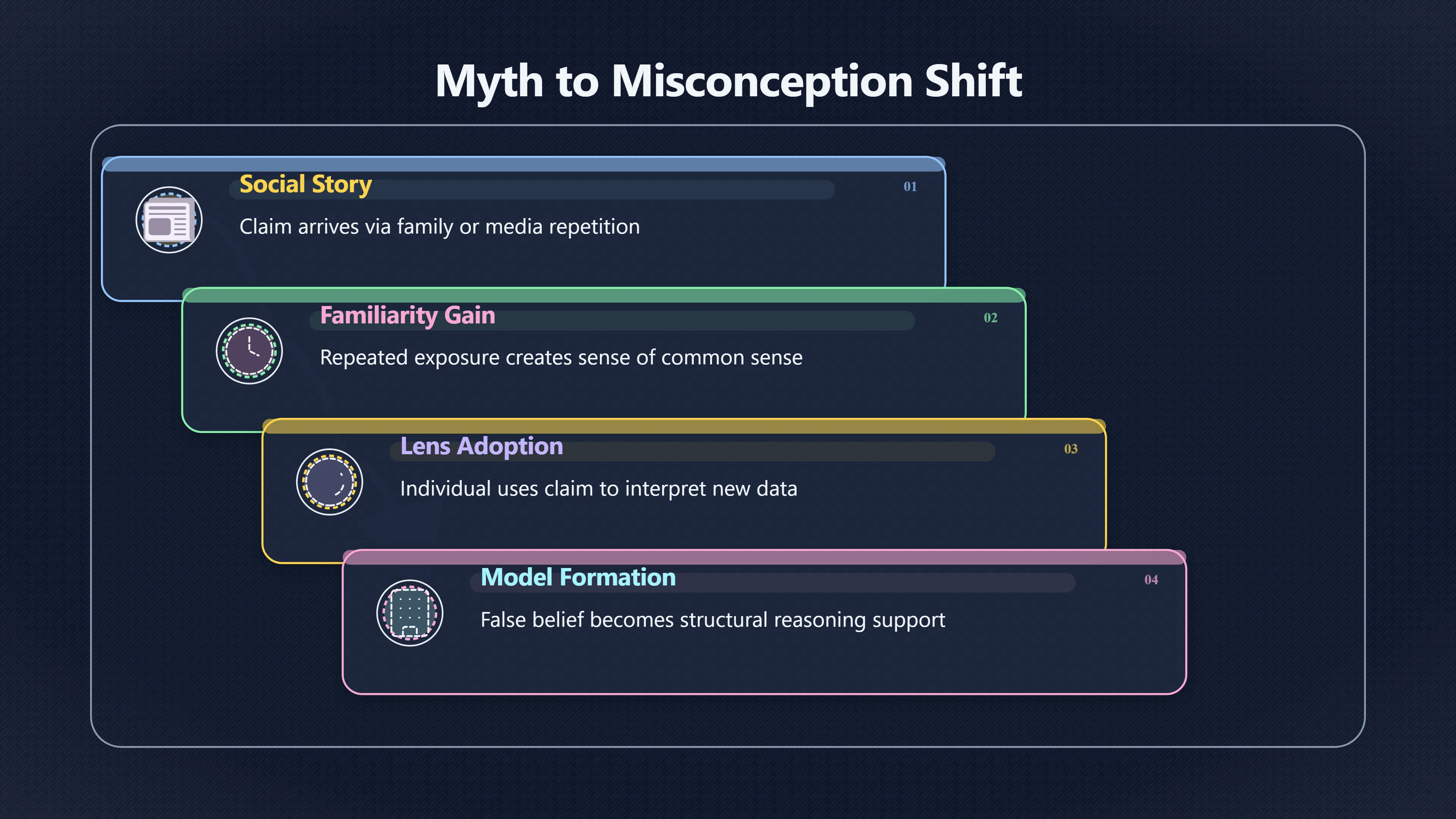
The shift from myth to misconception usually happens in stages.
A person first encounters a claim socially. It may arrive through family conversations, school lessons, media, advertising or online repetition. At this stage, the claim functions mainly as a cultural story: something many people say.
Later, the claim becomes part of an individual’s explanatory system. Instead of merely repeating it, they begin using it to interpret new information. The myth becomes a lens.
Consider the famous claim that humans use only 10 per cent of their brains. As a myth, it is simply a repeated statement. As a misconception, it becomes a framework for understanding intelligence and human potential. People may conclude that hidden mental powers exist, that genius comes from activating unused brain regions, or that extraordinary cognitive abilities remain dormant in most people. The original claim generates an entire network of mistaken conclusions.[Association for Psychological Science]psychologicalscience.orgmyth we only use 10 of our brainsAssociation for Psychological ScienceMyth: We Only Use 10% of Our Brains29 Aug 2018 It was the basis of the movie Lucy (2014), which de…
This process helps explain why some false beliefs prove remarkably durable. They are no longer isolated facts waiting to be corrected. They have become structural supports inside a larger mental model.
Educational researchers have long noted that misconceptions often function as coherent systems rather than disconnected errors. Once a myth becomes part of such a system, removing it can create a gap in how a person explains the world.[PMC]pmc.ncbi.nlm.nih.govPMCMisconceptions Yesterday, Today, and TomorrowNIHby MJ Leonard 2014 Cited by 175 We review the use and meaning of the term misconceptions in education research today, desc…
Why Repetition Changes More Than Belief
The power of repetition is often misunderstood. People assume that repeated claims merely increase agreement. In reality, repetition can alter the way people organise information.
Research on the illusory truth effect shows that familiar statements feel easier to process, and that ease can be mistaken for evidence of accuracy. Importantly, this effect appears even when people possess relevant knowledge and even when the repeated information is false.[The Decision Lab]thedecisionlab.comThe Decision Lab Illusory truth effectIllusory truth effect - The Decision…The illusory truth effect, also known as the illusion of truth, describes how when we hear the sa… [3Wikipedia 3ScienceDirect]
When a claim becomes cognitively familiar, several things can happen:
- It starts to feel like common sense.
- Alternative explanations seem less intuitive.
- New information is interpreted through the repeated claim.
- Contradictory evidence appears unusual or suspicious.
In other words, repetition does not simply strengthen a belief. It can change the architecture of reasoning around that belief.
This is why myth correction campaigns often face difficulties. A myth may survive not because people have never encountered the correct information, but because the myth already provides an organising framework. Facts compete not only with the original claim but with the broader explanatory system that has grown around it.
When Famous Claims Become Worldviews
Some myths become influential because they appear to explain complex subjects with a single memorable idea.
Health and Human Potential
Claims about hidden bodily capacities often evolve into larger misconceptions about medicine and performance. The 10 per cent brain myth is one example, but similar patterns appear in claims about unlocking unused abilities, miracle cures or detoxification processes.
The attraction lies partly in narrative simplicity. A difficult problemlearning, intelligence, illness or ageingreceives an apparently straightforward explanation. Once accepted, the claim encourages people to interpret future experiences through that framework. A temporary improvement in mood may become evidence of activated brain power. A subjective feeling after a treatment may be interpreted as proof that toxins were removed.
The myth thus expands into a broader theory of how the body works.
Science and Everyday Observation
Many scientific misconceptions originate in observations that seem obvious.
For centuries, people commonly assumed that heavier objects fall faster than lighter ones because ordinary experience appeared to support the idea. Similar intuitive explanations survive in modern contexts. People often prefer explanations that match direct experience, even when scientific evidence reveals more complex mechanisms.
When these explanations become culturally repeated, they gain the status of myths. When individuals then use them to interpret new situations, they become misconceptions.
The distinction matters because the resulting misunderstanding is no longer about a single experiment or fact. It concerns the underlying rules people think govern reality.
History and National Memory
Historical myths often create especially powerful misconceptions because they help explain identity and social belonging.
A repeated story about a nation’s past can gradually become a framework through which people interpret present events. The original historical claim may be simplified, exaggerated or selectively remembered. Over time, however, it starts shaping assumptions about politics, culture and social groups.
In these cases, the misconception is not merely factual. It becomes interpretive. People use the myth to decide what events mean.

Why Corrections Often Fail
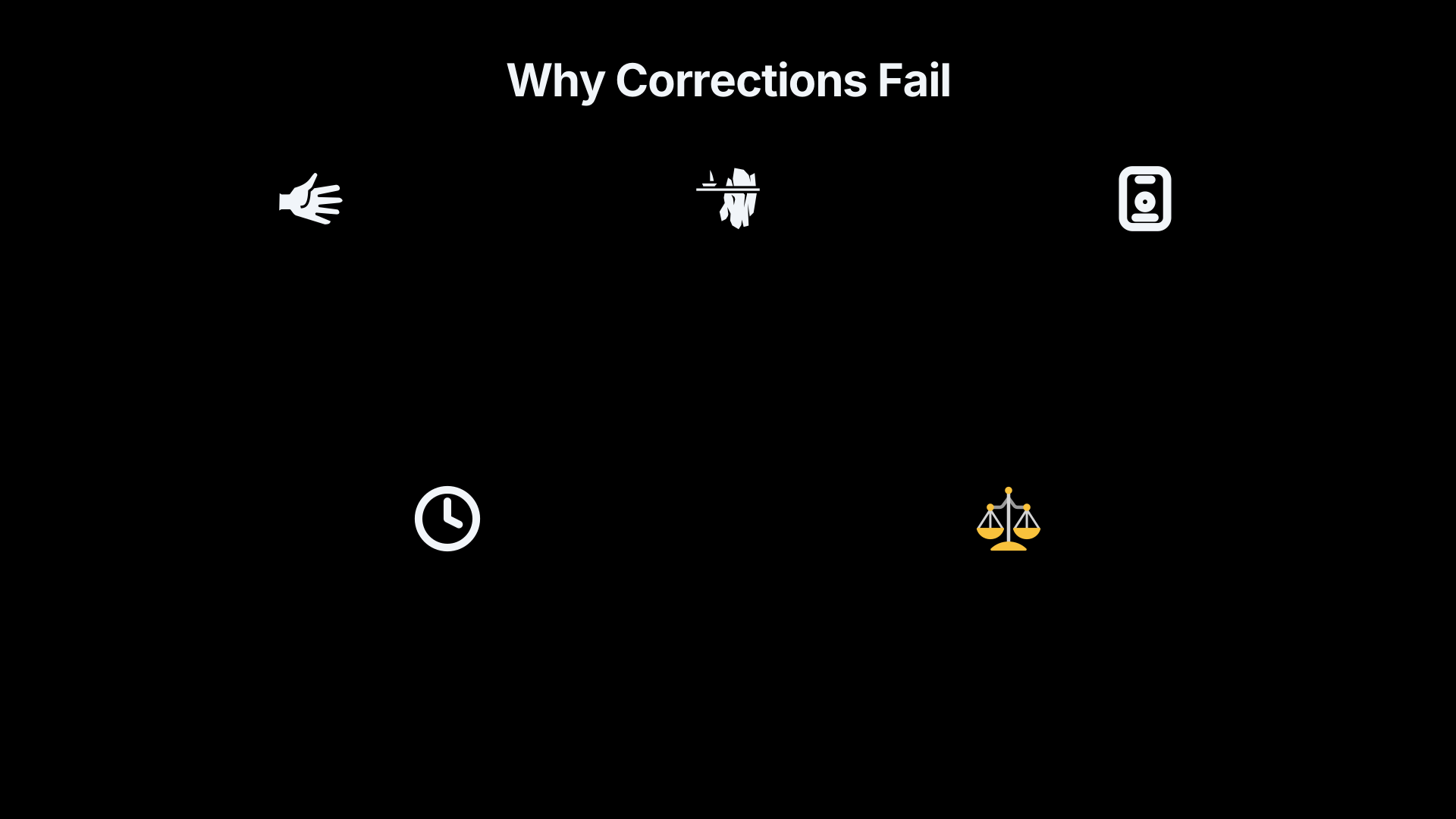
A common assumption is that misconceptions disappear once accurate information becomes available. Yet many famous myths remain influential despite decades of correction.
Part of the reason is psychological familiarity. Repetition increases perceived truthfulness even when people are warned about the effect. Experimental research has repeatedly shown that familiar statements gain credibility simply through repeated exposure.[Journal of Cognition]journalofcognition.orgillusory truth effect is measured by comparing truth ratings for repeated versus new statements…. Source recollection, statement famil…
Another reason is explanatory usefulness.
A misconception often survives because it answers questions. It explains why someone succeeded, why a disease occurred, why a historical event happened or why society works a certain way. Correct information may remove the error without immediately replacing the explanation.
For example, telling someone that humans use far more than 10 per cent of their brains addresses the myth itself. It does not automatically replace the larger belief that exceptional abilities are hidden and waiting to be unlocked. Unless an alternative explanation is offered, parts of the old model may remain intact.[Wikipedia]WikipediaTen-percent-of-the-brain mythTen-percent-of-the-brain myth
Researchers studying misconceptions in education frequently find that learners can memorise correct answers while continuing to rely on older intuitive models in practice. The misconception persists beneath the surface because it still feels explanatory.[PMC]pmc.ncbi.nlm.nih.govPMCMisconceptions Yesterday, Today, and TomorrowNIHby MJ Leonard 2014 Cited by 175 We review the use and meaning of the term misconceptions in education research today, desc…
How to Spot a Myth That Has Become a Misconception
One useful question is whether the claim merely exists as a slogan or whether it actively guides reasoning.
Signs that a myth has become a deeper misconception include:
- It explains multiple things at once. The claim is used to interpret unrelated events or observations.
- It generates predictions. People expect future outcomes based on the belief.
- Contradictory evidence gets reinterpreted. Instead of weakening the belief, new information is absorbed into it.
- The claim connects to identity or values. Rejecting it feels like abandoning a broader worldview.
- People rely on it without consciously citing it. The myth has become part of their default assumptions.
A repeated claim about intelligence, health or history is most dangerous when it stops sounding like a claim at all. It becomes an invisible premise.
Myth to Model
The most significant misunderstandings often begin with surprisingly simple ideas. A catchy phrase, memorable statistic or widely repeated story gains familiarity through repetition. Over time, familiarity creates credibility. Credibility allows the claim to function as an explanation. Eventually, that explanation becomes a model for understanding the world.
This is the point where myths and misconceptions overlap most strongly. The myth supplies the socially repeated narrative. The misconception emerges when that narrative becomes part of a person’s reasoning system.
Understanding this transition helps explain why some false beliefs survive correction efforts for generations. People are not only defending a claim. They are defending a model that helps make sense of their experience. Changing the belief therefore requires more than disproving a statement; it often requires replacing an entire way of understanding.
Amazon book picks
Further Reading
Books and field guides related to When Repeated Claims Shape Understanding. Use these as the next step if you want deeper reading beyond the article.
Thinking, Fast and Slow
Explains how repeated claims become part of reasoning frameworks.
The Believing Brain
Directly explores how people construct explanations from accepted claims.
Mistakes Were Made (but Not by Me) Third Edition
Explains why people integrate false ideas into coherent belief systems.
eBay marketplace picks
Marketplace Samples
Example marketplace items related to this page. Use the search link to explore similar finds on eBay.

Endnotes
1.
Source: Wikipedia
Title: Illusory truth effect
Link:https://en.wikipedia.org/wiki/Illusory_truth_effect
2.
Source: sciencedirect.com
Link:https://www.sciencedirect.com/science/article/abs/pii/S2352250X23001811
Source snippet
The illusory truth effect: A review of how repetition...by J Udry 2024 Cited by 122 Repetition increases belief in in...
3.
Source: Wikipedia
Title: Ten-percent-of-the-brain myth
Link:https://en.wikipedia.org/wiki/Ten-percent-of-the-brain_myth
4.
Source: pmc.ncbi.nlm.nih.gov
Title: PMCMisconceptions Yesterday, Today, and Tomorrow
Link:https://pmc.ncbi.nlm.nih.gov/articles/PMC4041497/
Source snippet
NIHby MJ Leonard 2014 Cited by 175 We review the use and meaning of the term misconceptions in education research today, desc...
5.
Source: sciencedirect.com
Link:https://www.sciencedirect.com/science/article/pii/S2211949325000146
Source snippet
Pre-service teachers' misconceptions about brain and mind...by D Opre 2025 Cited by 4 We investigate educational misconceptions th...
6.
Source: Wikipedia
Link:https://en.wikipedia.org/wiki/Psychology
Source snippet
PsychologyPsychology is the scientific study of the mind and behavior.... Its subject matter includes the behavior of humans and nonh...
7.
Source: psychologicalscience.org
Title: myth we only use 10 of our brains
Link:https://www.psychologicalscience.org/uncategorized/myth-we-only-use-10-of-our-brains.html
Source snippet
Association for Psychological ScienceMyth: We Only Use 10% of Our Brains29 Aug 2018 It was the basis of the movie Lucy (2014), which de...
8.
Source: thedecisionlab.com
Title: The Decision Lab Illusory truth effect
Link:https://thedecisionlab.com/biases/illusory-truth-effect
Source snippet
Illusory truth effect - The Decision...The illusory truth effect, also known as the illusion of truth, describes how when we hear the sa...
9.
Source: journalofcognition.org
Link:https://journalofcognition.org/articles/10.5334/joc.161
Source snippet
illusory truth effect is measured by comparing truth ratings for repeated versus new statements.... Source recollection, statement famil...
10.
Source: ebsco.com
Link:https://www.ebsco.com/research-starters/psychology/illusory-truth-effect
Source snippet
Illusory truth effect | Psychology | Research StartersThe illusory truth effect is a cognitive phenomenon where repeated exposure to fals...
Additional References
11.
Source: educationalneuroscience.org.uk
Link:https://educationalneuroscience.org.uk/wordpress/resources/neuromyth-or-neurofact/
12.
Source: pubmed.ncbi.nlm.nih.gov
Link:https://pubmed.ncbi.nlm.nih.gov/38113667/
Source snippet
The illusory truth effect: A review of how repetition...by J Udry 2024 Cited by 122 Repetition increases belief in informati...
13.
Source: plymouth.ac.uk
Link:https://www.plymouth.ac.uk/discover/myths-of-the-brain
14.
Source: merriam-webster.com
Link:https://www.merriam-webster.com/dictionary/illusory
Source snippet
ILLUSORY Definition & Meaningillusory implies a false impression based on deceptive resemblance or faulty observation, or influenced by e...
15.
Source: psychologytoday.com
Link:https://www.psychologytoday.com/us/basics/illusory-truth-effect
Source snippet
Illusory Truth EffectStudies show that repetition increases the perception of validityeven when people start out knowing that the inform...
16.
Source: psychologytoday.com
Link:https://www.psychologytoday.com/gb/basics/illusory-truth-effect
Source snippet
Illusory Truth EffectThe illusory truth effect is the tendency for any statement that is repeated frequentlywhether it is factually true...
17.
Source: apa.org
Link:https://www.apa.org/ed/precollege/topss/science/myths-misconceptions
Source snippet
Myths and Misconceptions About PsychologyExplores common misperceptions that lead people to believe that psychology is not a science. For...
18.
Source: news.vanderbilt.edu
Link:https://news.vanderbilt.edu/2020/10/06/study-shows-that-repeated-statements-are-more-often-judged-to-be-true-regardless-of-a-persons-age-or-prior-knowledge/
Source snippet
shows that repeated statements are more often...6 Oct 2020 This has been replicated many times in existing research studies and is kno...
19.
Source: communicatingpsychologicalscience.com
Link:https://www.communicatingpsychologicalscience.com/blog/misconceptions-research-project-the-myth-that-we-only-use-10-of-our-brains
Source snippet
wer stems from the notion that using 100% of one's brain power will give people psychic...Read more...
20.
Source: researchgate.net
Link:https://www.researchgate.net/publication/235927308_Misconceptions_about_Psychological_Science_A_Review
Source snippet
Misconceptions about Psychological Science: A ReviewThis article provides an overview of the available evidence on psychological misconce...
Topic Tree