Within Vaccines
When The Claim Changes Its Target
Claims often move from MMR to thimerosal, mercury or aluminium, but broader reviews still do not support a vaccine-autism link.
On this page
- Why myths shift after a correction
- MMR, thimerosal and mercury confusion
- How reviews test broader ingredient claims
Page outline Jump by section
Introduction
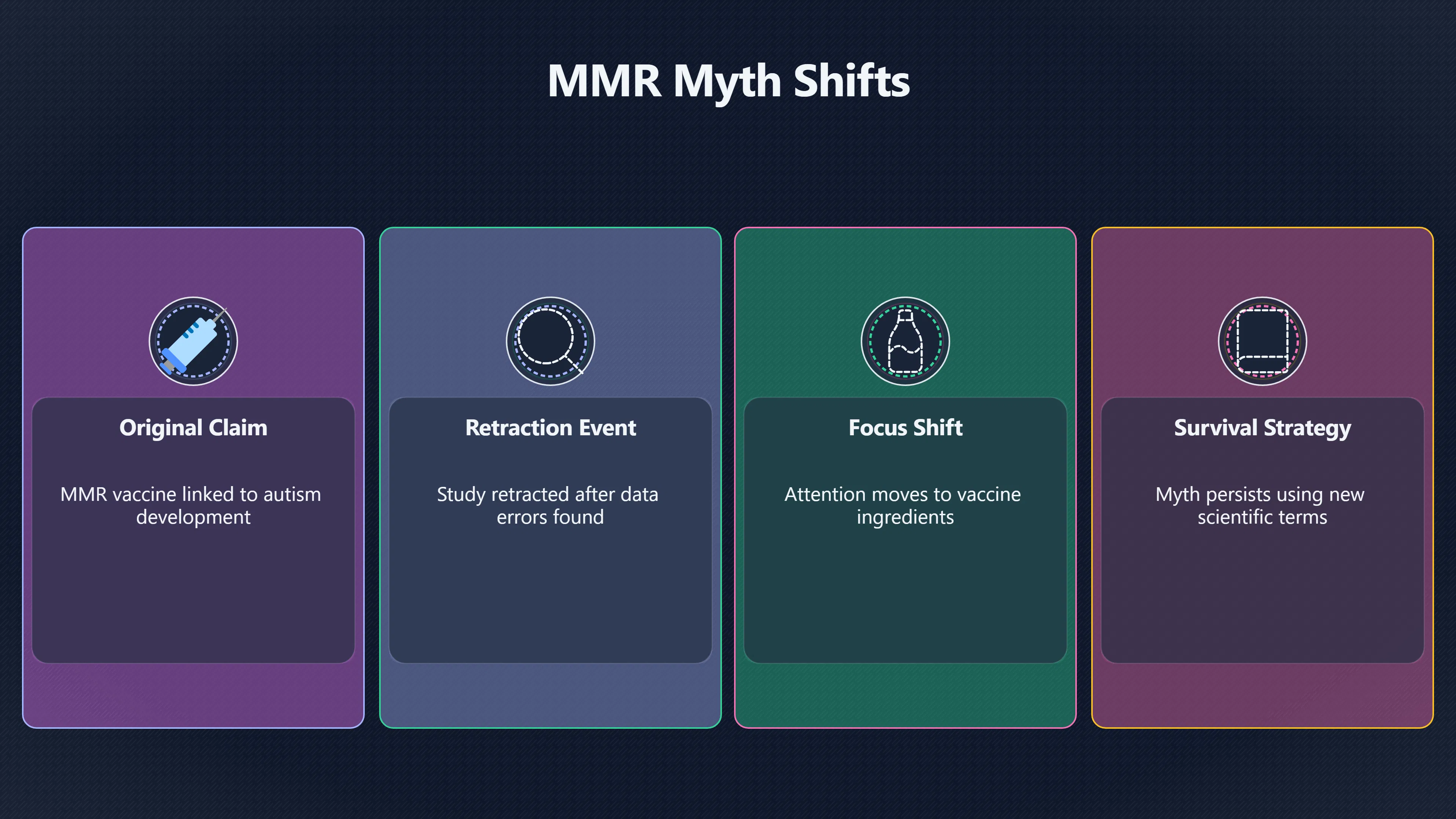
One reason the vaccine-autism myth has proved unusually durable is that it rarely disappears when a specific claim is disproved. Instead, the focus often shifts. After the original MMR-autism narrative lost credibility, public discussion frequently moved toward vaccine ingredients such as thimerosal, mercury or aluminium. The wording changed, but the emotional conclusion often stayed the same: autism must have been caused by something hidden inside vaccines.
 This shift matters because it shows how myths can survive correction. Rather than defending the original claim, supporters may adopt a new mechanism that seems more scientifically plausible to non-specialists. Yet large reviews examining both vaccines themselves and specific ingredients have repeatedly failed to find evidence that these substances cause autism. The pattern is less about a single ingredient than about how a belief adapts when earlier versions become difficult to defend.[WHO Center]cdn.who.intWHO CenterVaccines, thimerosal and autism spectrum disorderThe Global Advisory Committee on Vaccine Safety has reviewed the evidence rega…[NCBI]ncbi.nlm.nih.govNCBIImmunization Safety Review: Vaccines and AutismNIHThis eighth and final report of the Immunization Safety Review Committee examines the hypothesis that vaccines, specifically th…
Why myths shift after a correction
When a public-health myth is strongly tied to a personal fear, correcting one factual claim does not necessarily remove the underlying concern. In the vaccine-autism case, the emotional core is often the belief that a child’s development changed suddenly and that an external trigger must explain it.
Once the original MMR narrative became associated with a retracted study and repeated negative findings, attention often moved toward a different question: perhaps it was not the vaccine itself but an ingredient inside it. This shift allowed the broader suspicion to survive while avoiding direct reliance on the discredited MMR argument.
From a misinformation perspective, this is a common adaptation pattern. A claim can preserve its central conclusion by changing the proposed mechanism. Instead of saying “MMR causes autism”, the revised version becomes “mercury causes autism”, “thimerosal causes autism” or “aluminium causes autism”. The target changes, but the underlying story remains familiar: vaccines contain something harmful that was overlooked by authorities.
This is one reason simple debunking can fail. A correction aimed only at one version of the claim may leave people prepared to accept a replacement version that feels newer, more technical or more sophisticated.
MMR, thimerosal and mercury confusion
How thimerosal became the next focus
Thimerosal is a preservative that was used in some vaccines to prevent bacterial contamination, particularly in multi-dose vials. It contains ethylmercury, a form of mercury that is processed differently by the body from methylmercury, the type associated with environmental poisoning concerns.[New England Journal of Medicine]nejm.orgNew England Journal of MedicineThimerosal and Vaccines A Cautionary Taleby PA Offit 2007 Cited by 121 The use of mercury in vacci…
As public concern about MMR intensified in the late 1990s and early 2000s, attention increasingly shifted toward thimerosal. The word “mercury” carried strong emotional weight because many people already associated mercury with neurological damage. For critics of vaccination, this created a new explanatory narrative that seemed more biologically plausible than the original MMR claim.
A key complication is that MMR never contained thimerosal. The ingredient-focused claim therefore represented a partial shift away from the original theory. Even if concerns about MMR were addressed, suspicion could continue through a separate argument about mercury exposure.[NCBI]ncbi.nlm.nih.govSummary - Immunization Safety Review - NCBI - NIHThe committee concludes that the evidence favors rejection of a causal relationship betw…
Why the mercury argument persisted
The thimerosal controversy was strengthened by a precautionary policy decision that was often misunderstood. In the United States and several other countries, thimerosal was removed or reduced in most childhood vaccines beginning around 19992001. Public-health agencies described this as a precautionary measure intended to reduce overall mercury exposure, not as evidence that harm had been demonstrated.[New England Journal of Medicine]nejm.orgNew England Journal of MedicineThimerosal and Vaccines A Cautionary Taleby PA Offit 2007 Cited by 121 The use of mercury in vacci…
However, many people interpreted the removal differently. If an ingredient was taken out, they reasoned, it must have been dangerous. That interpretation became part of the myth’s survival strategy.
The difficulty for the ingredient hypothesis is that autism diagnoses continued to rise after thimerosal exposure in childhood vaccines declined sharply. If thimerosal had been a major cause, a corresponding reduction in autism rates would have been expected. Large epidemiological studies did not show that pattern. Reviews by the Institute of Medicine, later renamed the National Academy of Medicine, concluded that the evidence favoured rejection of a causal relationship between thimerosal-containing vaccines and autism.[NCBI]ncbi.nlm.nih.govNCBIImmunization Safety Review: Vaccines and AutismNIHThis eighth and final report of the Immunization Safety Review Committee examines the hypothesis that vaccines, specifically th…[National Academies]nationalacademies.orgImmunization Safety Review: Vaccines and Autism 2004Immunization Safety Review: Vaccines and Autism finds that the body of epidemiologica…

How reviews test broader ingredient claims
Looking beyond one vaccine
Researchers eventually examined a broader question than the original MMR controversy. Instead of asking whether one vaccine caused autism, they investigated whether vaccine exposure in general, specific ingredients, vaccination schedules or cumulative exposure patterns were associated with autism diagnoses.
This matters because myths often expand after a correction. If one vaccine appears cleared, suspicion can move to another vaccine or another ingredient. A broader review strategy tests whether the proposed problem survives when examined across different populations, products and exposure levels.
A major meta-analysis published in 2014 combined evidence from multiple cohort and case-control studies involving more than a million children. It found no relationship between autism and vaccination, MMR vaccination or thimerosal exposure.[PubMed]pubmed.ncbi.nlm.nih.govVaccines are not associated with autism: an evidence…by LE Taylor 2014 Cited by 1055 There has been enormous debate regard…
The Institute of Medicine’s vaccine safety review reached similar conclusions after examining both epidemiological evidence and proposed biological mechanisms. The committee found that available evidence favoured rejecting a causal relationship between autism and either MMR vaccine or thimerosal-containing vaccines.[NCBI]ncbi.nlm.nih.govSummary - Immunization Safety Review - NCBI - NIHThe committee concludes that the evidence favors rejection of a causal relationship betw…
The recurring aluminium claim
As concerns about thimerosal became harder to sustain scientifically, attention increasingly shifted again, this time toward aluminium-containing adjuvants. Adjuvants are substances added to some vaccines to improve the immune response.
The argument follows a familiar pattern. Because aluminium can be toxic at sufficiently high exposures in certain contexts, critics suggest that aluminium adjuvants might contribute to autism or other neurological disorders. Some papers have proposed such links, and these studies are frequently cited in vaccine-sceptical communities.[PubMed]pubmed.ncbi.nlm.nih.govVaccines are not associated with autism: an evidence…by LE Taylor 2014 Cited by 1055 There has been enormous debate regard…
However, large-scale reviews and population studies have not supported that conclusion. The World Health Organization’s Global Advisory Committee on Vaccine Safety reviewed claims linking aluminium-containing vaccines to autism and found that available evidence did not support a causal relationship. More recent large cohort studies examining childhood exposure to aluminium-adjuvanted vaccines have likewise not found increased risks of autism or other neurodevelopmental disorders. CIDRAP[World Health Organization]who.intWorld Health OrganizationAdjuvantsThe GACVS reviewed 2 published papers alleging that aluminium in vaccines is associated with autism spe…[World Health Organization]who.intWorld Health OrganizationAdjuvantsThe GACVS reviewed 2 published papers alleging that aluminium in vaccines is associated with autism spe…
The important point is not that aluminium concerns emerged from nowhere. Rather, they illustrate how the vaccine-autism claim repeatedly relocates to a different ingredient once earlier versions fail to gain support from larger and better-designed studies.
Why ingredient debates feel persuasive
Ingredient-focused claims often sound more convincing than broad claims about vaccines because they invoke chemistry and toxicology. Terms such as “mercury”, “aluminium” and “neurotoxin” can trigger understandable concern, especially when removed from their dosage and exposure context.
This can create a rhetorical shortcut. If a substance is harmful in one situation, people may assume it must be harmful in every situation. But toxicology depends heavily on form, dose, route of exposure and biological processing. Reviews of vaccine ingredients therefore do not simply ask whether a substance can ever be harmful; they ask whether the specific exposures involved in vaccination are associated with measurable increases in autism risk.
That distinction explains why scientific reviews focus heavily on population evidence. If an ingredient were contributing substantially to autism rates, researchers would expect to detect consistent patterns across countries, vaccine schedules and exposure levels. Repeated reviews have not found such patterns for thimerosal or aluminium-containing vaccine ingredients. PubMed 3WHO Center[PMC]pmc.ncbi.nlm.nih.govPMCThimerosal-Containing Vaccines and Autism: A Reviewby AM Hurley 2010 Cited by 77 Epidemiologic studies continue to provide evidence that there is no association between thimerosal…
What the shifting claims reveal about misinformation
The transition from MMR to thimerosal, mercury and aluminium illustrates a broader lesson about myth correction. A misconception may survive even when its original factual basis collapses because the underlying concern remains emotionally compelling.
In this case, the debate often evolved from a specific vaccine claim into a moving search for a hidden cause. Each new ingredient claim appeared to offer a fresh explanation while preserving the same conclusion. Scientific reviews therefore expanded from testing MMR alone to evaluating preservatives, adjuvants and wider vaccine exposure patterns.
Across those broader investigations, major reviews by the Institute of Medicine, the World Health Organization and large epidemiological research groups have repeatedly reached the same general finding: the evidence does not support a causal link between autism and vaccines, including the ingredient claims that emerged after the original MMR narrative lost credibility.[PubMed]pubmed.ncbi.nlm.nih.govVaccines are not associated with autism: an evidence…by LE Taylor 2014 Cited by 1055 There has been enormous debate regard…[WHO Center]cdn.who.intWHO CenterVaccines, thimerosal and autism spectrum disorderThe Global Advisory Committee on Vaccine Safety has reviewed the evidence rega…[NCBI]nih.govNBK25349Safety Review: Vaccines and Autism - NCBI - NIH2004 Cited by 190 In that report, the committee concluded that the evidence was inadeq…
Amazon book picks
Further Reading
Books and field guides related to When The Claim Changes Its Target. Use these as the next step if you want deeper reading beyond the article.


The panic virus
First published 2011. Subjects: Vaccination, Mass media and culture, Health behavior, History, Psychological aspects.

Deadly Choices
First published 2010. Subjects: Vaccination of children, Vaccines, History, Complications, Health aspects.
Vaccines and Your Family - Separating Fact from Fiction
First published 2024. Subjects: Public health.
eBay marketplace picks
Marketplace Samples
Example marketplace items related to this page. Use the search link to explore similar finds on eBay.




Endnotes
1.
Source: cdn.who.int
Link:https://cdn.who.int/media/docs/default-source/medicines/pharmacovigilance/rev1_vaccines-autism-and-asd-evidence-review-2010-2025_12-dec7ab84d63-5110-4b2c-9882-19651446b8cd.pdf?download=true&sfvrsn=daab5374_1
Source snippet
WHO CenterVaccines, thimerosal and autism spectrum disorderThe Global Advisory Committee on Vaccine Safety has reviewed the evidence rega...
2.
Source: ncbi.nlm.nih.gov
Title: NCBIImmunization Safety Review: Vaccines and Autism
Link:https://www.ncbi.nlm.nih.gov/books/NBK25344/
Source snippet
NIHThis eighth and final report of the Immunization Safety Review Committee examines the hypothesis that vaccines, specifically th...
3.
Source: ncbi.nlm.nih.gov
Link:https://www.ncbi.nlm.nih.gov/books/NBK25338/
Source snippet
Summary - Immunization Safety Review - NCBI - NIHThe committee concludes that the evidence favors rejection of a causal relationship betw...
4.
Source: who.int
Link:https://www.who.int/groups/global-advisory-committee-on-vaccine-safety/topics/adjuvants
Source snippet
World Health OrganizationAdjuvantsThe GACVS reviewed 2 published papers alleging that aluminium in vaccines is associated with autism spe...
5.
Source: who.int
Link:https://www.who.int/news/item/11-12-2025-who-expert-group-s-new-analysis-reaffirms-there-is-no-link-between-vaccines-and-autism
Source snippet
World Health OrganizationWHO expert group's new analysis reaffirms there is no link...11 Dec 2025 In summary, the available high-quali...
6.
Source: cidrap.umn.edu
Title: report no link between aluminum adjuvanted childhood vaccines conditions such
Link:https://www.cidrap.umn.edu/childhood-vaccines/report-no-link-between-aluminum-adjuvanted-childhood-vaccines-conditions-such
Source snippet
link between aluminum-adjuvanted childhood vaccines...Jul 14, 2025 Report: No link between aluminum-adjuvanted childhood vaccines, co...
7.
Source: pmc.ncbi.nlm.nih.gov
Title: PMCThimerosal-Containing Vaccines and Autism: A Review
Link:https://pmc.ncbi.nlm.nih.gov/articles/PMC3018252/
Source snippet
by AM Hurley 2010 Cited by 77 Epidemiologic studies continue to provide evidence that there is no association between thimerosal...
8.
Source: who.int
Title: update vaccines thimerosal autism
Link:https://www.who.int/publications/m/item/update-vaccines-thimerosal-autism
Source snippet
Vaccines, Thimerosal and Autism Spectrum Disorder...12 Dec 2025 The Global Advisory Committee on Vaccine Safety (GACVS) reviewed the e...
9.
Source: pubmed.ncbi.nlm.nih.gov
Link:https://pubmed.ncbi.nlm.nih.gov/24814559/
Source snippet
Vaccines are not associated with autism: an evidence...by LE Taylor 2014 Cited by 1055 There has been enormous debate regard...
10.
Source: nejm.org
Link:https://www.nejm.org/doi/full/10.1056/NEJMp078187
Source snippet
New England Journal of MedicineThimerosal and Vaccines A Cautionary Taleby PA Offit 2007 Cited by 121 The use of mercury in vacci...
11.
Source: nationalacademies.org
Link:https://www.nationalacademies.org/publications/10997
Source snippet
Immunization Safety Review: Vaccines and Autism 2004Immunization Safety Review: Vaccines and Autism finds that the body of epidemiologica...
12.
Source: pubmed.ncbi.nlm.nih.gov
Link:https://pubmed.ncbi.nlm.nih.gov/22099159/
Source snippet
Do aluminum vaccine adjuvants contribute to the rising...by L Tomljenovic 2011 Cited by 205 Aluminum (Al), the most commonly...
13.
Source: pubmed.ncbi.nlm.nih.gov
Link:https://pubmed.ncbi.nlm.nih.gov/33930617/
Source snippet
The behavior of mice changes with Al injection. Patients suffering from ASD have higher...Read more...
14.
Source: pubmed.ncbi.nlm.nih.gov
Link:https://pubmed.ncbi.nlm.nih.gov/40658954/
Source snippet
nih.govAluminum-Adsorbed Vaccines and Chronic Diseases in...by NW Andersson 2025 Cited by 34 Concerns persist about potential asso...
15.
Source: pubmed.ncbi.nlm.nih.gov
Link:https://pubmed.ncbi.nlm.nih.gov/41334965/
Source snippet
Role and Safety of Aluminum Adjuvants in Childhood...by E Nirenberg Cited by 2 Large-scale clinical and epidemiologic studies consis...
16.
Source: cdc.gov
Link:https://www.cdc.gov/vaccine-safety/about/autism.html
Source snippet
and Vaccines19 Nov 2025 The claim "vaccines do not cause autism" is not an evidence-based claim because studies have not ruled out the...
17.
Source: cdc.gov
Link:https://www.cdc.gov/vaccine-safety/about/adjuvants.html
Source snippet
and Vaccines | Vaccine SafetyDec 20, 2024 Adjuvants have been used safely in vaccines for decades. Aluminum salts, such as aluminum hyd...
18.
Source: pubmed.ncbi.nlm.nih.gov
Link:https://pubmed.ncbi.nlm.nih.gov/20669467/
Source snippet
Safety Review: Vaccines and Autism2004 Cited by 187 This eighth and final report of the Immunization Safety Review Committee examines...
19.
Source: restoredcdc.org
Link:https://www.restoredcdc.org/www.cdc.gov/vaccine-safety/about/autism.html
Source snippet
and Vaccines30 Dec 2024 Studies have shown that there is no link between receiving vaccines and developing autism spectrum disorder (AS...
20.
Source: nationalacademies.org
Link:https://www.nationalacademies.org/read/10997/chapter/2
Source snippet
Immunization Safety Review: Vaccines and Autism (2004)The committee concludes that the body of epidemiological evidence favors rejection...
21.
Source: autismdelaware.org
Link:https://www.autismdelaware.org/wp-content/uploads/2025/09/Autism-and-Vaccines-_-Vaccine-Safety-_-CDC-Published-12.30.2024-printed-9.23.2025.pdf
Source snippet
links have been found between any vaccine...
Additional References
22.
Source: cdc.gov
Link:https://www.cdc.gov/vaccine-safety/about/thimerosal.html
Source snippet
Thimerosal and VaccinesTwo types of mercury to which people may be exposed methylmercury and ethylmercury are very different. In the...
23.
Source: autismsciencefoundation.org
Link:https://autismsciencefoundation.org/autism-and-vaccines-read-the-science/
Source snippet
Autism and Vaccines: Read the ScienceNumerous scientific studies have disproven any link between autism and vaccines. Read the research s...
24.
Source: aap.org
Link:https://www.aap.org/en/news-room/fact-checked/fact-checked-aluminum-in-vaccines-strengthen-immune-responses-do-not-cause-autism-serious-health-issues/?srsltid=AfmBOoqUdBwCc1vjMQEuhNj59iRVM4XRXhMYE0mh3LuBnQlbvDmiUKTs
Source snippet
Fact Checked: Aluminum in Vaccines Strengthen Immune...4 Dec 2025 Fact Checked: Aluminum in Vaccines Strengthen Immune Responses, Do N...
25.
Source: autismsciencefoundation.org
Link:https://autismsciencefoundation.org/autism-and-vaccines/
26.
Source: archive.cdc.gov
Title: This study assessed whether prenatal thimerosal exposure or thimerosal
Link:https://archive.cdc.gov/www_cdc_gov/vaccinesafety/pdf/cdcstudiesonvaccinesandautism.pdf
Source snippet
Summary: CDC Studies on Thimerosal in Vaccinesby B JP 2009 Thimerosal exposure in early life and neuropsychological outcomes 7-10 ye...
27.
Source: reuters.com
Link:https://www.reuters.com/business/finance/us-cdc-report-shows-no-evidence-linking-thimerosal-containing-vaccines-autism-2025-06-24/
Source snippet
evidence does not support a link between thimerosal-containing vaccines and autism or other neurodevelopmental disorders. Kennedy has lon...
28.
Source: chop.edu
Title: largest study date aluminum adjuvanted vaccines finds no associated health risks
Link:https://www.chop.edu/vaccine-update-healthcare-professionals/newsletter/largest-study-date-aluminum-adjuvanted-vaccines-finds-no-associated-health-risks
Source snippet
Largest Study to Date of Aluminum-Adjuvanted Vaccines...29 Jul 2025 Read about a study that found no increased health risks associated...
29.
Source: cidrap.umn.edu
Title: aluminum vaccines not linked autism other health problems study finds
Link:https://www.cidrap.umn.edu/anti-science/aluminum-vaccines-not-linked-autism-other-health-problems-study-finds
Source snippet
in vaccines not linked to autism, other health...May 7, 2026 Aluminum additives used in vaccines are not linked to serious medical pro...
Published: May 7, 2026
30.
Source: gavi.org
Title: major new study finds no health risks aluminium childhood vaccines
Link:https://www.gavi.org/vaccineswork/major-new-study-finds-no-health-risks-aluminium-childhood-vaccines
Source snippet
Major new study finds no health risks from aluminium in...24 Jul 2025 A study of over one million children over 24 years found no incr...
31.
Source: contemporarypediatrics.com
Title: review finds no systemic risks from aluminum in childhood vaccines
Link:https://www.contemporarypediatrics.com/view/review-finds-no-systemic-risks-from-aluminum-in-childhood-vaccines
Source snippet
Review finds no systemic risks from aluminum in childhood...9 Dec 2025 A comprehensive Pediatrics review reports no credible evidence...
Topic Tree