Within Mythcraft
Misinformation or Disinformation: Why Intent Matters
The difference between accidental falsehood and deliberate deception matters because each needs a different response.
On this page
- False claims without intent
- Deliberate deception
- Why responses should differ
Page outline Jump by section
Introduction
Misinformation and disinformation are both false or misleading information, but they differ in a crucial way: intent. Misinformation is wrong information shared without necessarily meaning to deceive; disinformation is false information created or spread deliberately to mislead, manipulate or cause harm. UNESCO, the American Psychological Association and the UK House of Commons Library all use this intent-based distinction, even though everyday debate often blurs the two. UNESCO[APA]apa.orgMisinformation and disinformationMisinformation is false or inaccurate information—getting the facts wrong. Disinformation is false in…
That difference matters because it changes the right response. A mistaken person may need a clear correction, better context and a trustworthy replacement explanation. An organised deception campaign may require investigation, platform transparency, disruption of manipulation tactics, sanctions, election safeguards or public-interest regulation. Treating every false claim as malicious can chill ordinary debate; treating deliberate deception as mere error can leave manipulation intact.
False claims without intent
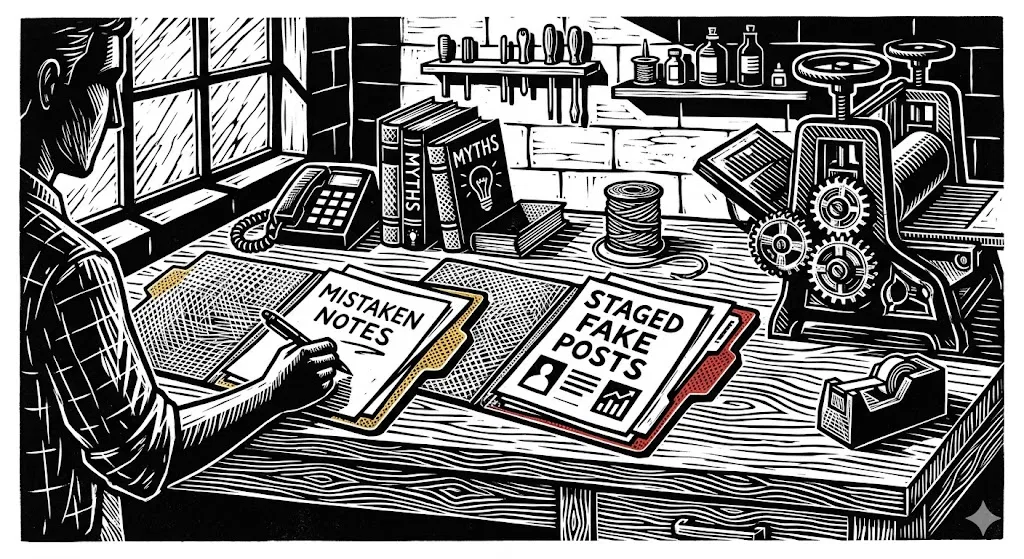
Misinformation often begins with ordinary human error. Someone misremembers a statistic, shares a dramatic image without checking its date, repeats a health rumour from a friend, or misunderstands a scientific finding. The information is false or inaccurate, but the sharer may believe they are helping. UNESCO defines misinformation as false information shared inadvertently, and the APA frames it as “getting the facts wrong” rather than setting out to mislead.[UNESCO]unesco.orgWhat is Misinformation? Meaning, Definition.Misinformation is false information that is shared inadvertently, without meaning to ca…
This is why misinformation is so common in myths and misconceptions. A person repeating a myth is not always lying. They may be relying on familiarity, trust, urgency or a simple story that seems to explain something complicated. During a crisis, for example, people often forward unverified claims because speed feels more important than accuracy. In a public health setting, that could mean sharing a false remedy; in a local safety incident, it could mean circulating the wrong name or identity of a suspect before official information is available.
The practical test is not simply “is this false?” but “why is this false claim moving?” In misinformation, the mechanism is often confusion, uncertainty, poor context, emotional salience or misplaced trust. A useful response therefore starts with repair: correct the claim, explain what went wrong, give a better source, and avoid shaming people who may have acted in good faith. Research on the continued influence effect shows why this matters: false information can continue shaping memory and reasoning even after a retraction, especially when the correction leaves a gap in the story.[PubMed]pubmed.ncbi.nlm.nih.govSource details in endnotes.
A correction works best when it does more than say “false”. It should provide a clear alternative explanation. If a rumour says a road closure was caused by a violent incident, a useful correction explains the actual cause, gives the source of that information, and updates the public as facts change. Without that replacement story, the original claim may remain mentally available because it still feels like the only complete explanation.
Deliberate deception
Disinformation is different because deception is part of the design. It may use false claims, edited images, fake accounts, impersonation, fabricated documents, misleading websites or coordinated amplification. First Draft’s information disorder framework describes disinformation as intentionally false content designed to cause harm, and highlights motives such as political influence, profit or deliberate disruption.[First Draft]firstdraftnews.orgFirst Draft Understanding Information disorderFirst Draft Understanding Information disorder
The same false claim can move between categories. A fabricated rumour may begin as disinformation when an actor invents it to mislead people. It may then become misinformation when ordinary users share it because they believe it. This is why judging intent at the level of every individual sharer is difficult. Governance responses usually need to look beyond a single post and examine patterns: who created the claim, whether accounts are coordinated, whether amplification is artificial, whether money is involved, and whether the claim is timed to exploit an election, emergency or social tension.
This mechanism is especially important online. Disinformation campaigns often do not need to persuade everyone. They may aim to confuse, polarise, exhaust attention, reduce trust in institutions, or make people feel that truth is unknowable. A campaign can succeed by flooding a discussion with competing falsehoods, not by getting the public to believe one single story. That is why the Council of Europe’s information disorder work warns against the vague term “fake news”: it can hide the wider system of manipulation, from misleading content to coordinated distribution.[Portal]coe.intPortal Information DisorderPortal Information Disorder
Disinformation also creates a harder evidence problem. Intent is rarely visible from one screenshot. A false claim may be deliberate, negligent or sincere. Labelling something “disinformation” therefore carries a burden: the strongest cases involve evidence of planning, coordination, impersonation, covert funding, repeated correction-resistant behaviour, or deliberate use of known falsehoods. Without that evidence, “misinformation” may be the safer descriptive term, even when the claim is harmful.
Why intent changes the response
The distinction between misinformation and disinformation is not just semantic. It is a governance choice. A system designed only for accidental error will be too weak against organised deception; a system designed only for hostile manipulation may overreach into ordinary mistakes, satire, disagreement or developing news.
For misinformation, the most useful responses are usually educational and corrective:
- Clear corrections: State what is wrong and what is true, without burying the answer.
- Replacement explanations: Fill the gap left by the false claim so the correction has somewhere to land.
- Source cues: Point people towards primary sources, professional fact-checks, official updates or reliable reporting.
- Friction before sharing: Prompts, labels and context can slow impulsive forwarding.
- Prebunking: Warnings about common manipulation techniques can help people recognise misleading content before they encounter it. Meta-analytic evidence suggests psychological inoculation can reduce perceived credibility of misinformation and improve assessment of real information, although effects vary by outcome.[PMC]pmc.ncbi.nlm.nih.govSource details in endnotes.
For disinformation, correction alone is often insufficient. If a network is deliberately manufacturing falsehoods, debunking one claim may leave the machinery untouched. Responses may need to target the infrastructure of deception: fake-account networks, advertising systems, opaque recommender algorithms, foreign influence operations, monetisation incentives or data access barriers that prevent researchers from detecting manipulation.
This is the logic behind many modern policy frameworks. The OECD argues for governance responses grounded in transparency, integrity, accountability and stakeholder participation, rather than treating disinformation as a problem solved by one ministry, one platform rule or one fact-check.[OECD]oecd.orggovernance responses to disinformation 6285c78agovernance responses to disinformation 6285c78a The EU’s Digital Services Act similarly focuses on systemic risk for very large platforms, including risks to fundamental rights, media freedom, public security, electoral processes and public health.[digital-strategy]digital-strategy.ec.europa.euSource details in endnotes.
The UK approach also shows why intent matters legally. Under the Online Safety Act framework, Ofcom evidence to Parliament described a false communications offence focused on messages the sender knows to be false and intends to cause non-trivial psychological or physical harm; misinformation, where that knowledge and intent are absent, is not captured in the same way.[UK Parliament Committees]committees.parliament.ukSource details in endnotes.
The grey zone between mistake and manipulation
Real cases rarely arrive neatly labelled. A rumour can begin with deliberate deception, be repeated by confused users, be boosted by engagement algorithms, be picked up by partisan influencers, and then be defended by people who feel accused when it is corrected. By the time the falsehood reaches a large audience, it may contain both disinformation and misinformation at once.
That grey zone is why intent should guide responses without becoming the only question. Three further questions usually matter:
What is false or misleading? A claim can be wrong, missing context, based on a real event but miscaptioned, or technically accurate while designed to create a false impression.
Who is responsible for the spread? An ordinary user, a public official, a media outlet, a platform, a state-linked network and a commercial scammer do not carry the same duties.
What harm is likely? False information about elections, health, violence, identity, disasters or financial fraud may require faster and more formal responses than a harmless misconception.
A useful public vocabulary therefore separates content, intent and impact. “False” describes the content. “Misleading” describes how it may be understood. “Misinformation” describes falsehood without proven intent to deceive. “Disinformation” describes deliberate deception. “Harmful” describes consequences, which can arise from either misinformation or disinformation.

A practical way to tell the difference
No quick checklist can prove intent, but the following signals help readers, journalists, moderators and public bodies avoid overclaiming.
QuestionMore like misinformationMore like disinformationHow did it start?A misunderstanding, outdated source, mistranslation or unverified rumourFabricated material, impersonation, forged evidence or a known falsehoodHow is it spreading?Organic sharing by people who seem to believe itCoordinated accounts, bots, paid amplification or repeated posting across networksWhat happens after correction? Sharers update, delete or qualify the claimActors keep repeating the claim, change tactics or attack the correction sourceWho benefits?No clear organiser or only social attentionPolitical, financial, strategic or reputational gainWhat evidence shows intent?Little beyond the claim being wrongPlanning, coordination, hidden sponsorship, fake identities or deliberate manipulation
The key caution is that being wrong is not the same as lying. A person can confidently share a falsehood without intending to deceive. Equally, a campaign can hide behind ordinary users, making deliberate deception look like grassroots confusion. Good governance has to hold both truths at once.
Why this distinction protects better debate
Public debate suffers when every error is treated as a plot. People become defensive, corrections feel like accusations, and institutions may appear to police opinion rather than accuracy. That can make myths more resilient, because communities interpret correction as hostility.
Public debate also suffers when deliberate deception is treated as just another viewpoint. Organised disinformation exploits the openness of democratic discussion while avoiding its norms: accountability, evidence, correction and good-faith disagreement. A fabricated claim does not deserve the same treatment as an honest mistake, especially when it is part of a coordinated effort to mislead voters, endanger public health or inflame violence.
The most defensible approach is proportionate. Correct misinformation with clarity, patience and evidence. Investigate disinformation through patterns, incentives and coordination. Regulate systems where platform design, monetisation or opaque amplification repeatedly rewards deception. Protect space for uncertainty, satire, developing news and honest disagreement. Intent matters not because it makes false information harmless, but because it tells us what kind of problem we are dealing with — and what kind of response is likely to work.
Amazon book picks
Further Reading
Books and field guides related to Misinformation or Disinformation: Why Intent Matters. Use these as the next step if you want deeper reading beyond the article.
Calling Bullshit
Bullshit isn’t what it used to be. Now, two science professors give us the tools to dismantle misinformation and think clearly in a world...
The Constitution of Knowledge
Arming Americans to defend the truth from today's war on facts In what could be the timeliest book of the year, Rauch aims to arm his rea...
![Cover for The Death of Truth [Hardcover] Michiko Kakutani](https://covers.openlibrary.org/b/id/9237737-M.jpg)
The Death of Truth [Hardcover] Michiko Kakutani
First published 2018. Subjects: United states, politics and government, 2017-2021, Political culture, Truth.
eBay marketplace picks
Marketplace Samples
Example marketplace items related to this page. Use the search link to explore similar finds on eBay.


Endnotes
1.
Source: unesco.org
Link:https://www.unesco.org/en/query-list/m/misinformation
Source snippet
What is Misinformation? Meaning, Definition.Misinformation is false information that is shared inadvertently, without meaning to ca...
2.
Source: apa.org
Link:https://www.apa.org/topics/journalism-facts/misinformation-disinformation
Source snippet
Misinformation and disinformationMisinformation is false or inaccurate information—getting the facts wrong. Disinformation is false in...
3.
Source: commonslibrary.parliament.uk
Title: House of Commons Library What is misinformation?
Link:https://commonslibrary.parliament.uk/research-briefings/cbp-10815/
Source snippet
The House of Commons Library5 May 2026 — Misinformation is information that is false or inaccurate. Disinformation usually refers to fals...
Published: May 2026
4.
Source: pmc.ncbi.nlm.nih.gov
Link:https://pmc.ncbi.nlm.nih.gov/articles/PMC10498317/
5.
Source: oecd.org
Title: governance responses to disinformation 6285c78a
Link:https://www.oecd.org/en/publications/2020/08/governance-responses-to-disinformation_6285c78a.html
6.
Source: oecd.org
Link:https://www.oecd.org/en/publications/good-practice-principles-for-public-communication-responses-to-mis-and-disinformation_6d141b44-en.html
7.
Source: committees.parliament.uk
Link:https://committees.parliament.uk/writtenevidence/140786/html/
8.
Source: unesco.org
Link:https://www.unesco.org/en/query-list/d/disinformation
9.
Source: committees.parliament.uk
Link:https://committees.parliament.uk/publications/51771/documents/287268/default/
10.
Source: oecd.org
Link:https://www.oecd.org/content/dam/oecd/en/publications/reports/2020/08/governance-responses-to-disinformation_6285c78a/d6237c85-en.pdf
11.
Source: oecd.org
Title: transparency of public information 60a963c4
Link:https://www.oecd.org/en/publications/2025/06/government-at-a-glance-2025_70e14c6c/full-report/transparency-of-public-information_60a963c4.html
12.
Source: pubmed.ncbi.nlm.nih.gov
Link:https://pubmed.ncbi.nlm.nih.gov/26173286/
13.
Source: firstdraftnews.org
Title: First Draft Understanding Information disorder
Link:https://firstdraftnews.org/long-form-article/understanding-information-disorder/
14.
Source: firstdraftnews.org
Title: info Disorder glossary
Link:https://firstdraftnews.org/wp-content/uploads/2018/07/infoDisorder_glossary.pdf
15.
Source: coe.int
Title: Portal Information Disorder
Link:https://www.coe.int/en/web/freedom-expression/information-disorder
16.
Source: digital-strategy.ec.europa.eu
Link:https://digital-strategy.ec.europa.eu/en/policies/digital-services-act
17.
Source: ofcom.org.uk
Title: misinformation and disinformation
Link:https://www.ofcom.org.uk/siteassets/resources/documents/about-ofcom/foi/2025/april/misinformation-and-disinformation.pdf?v=396219
18.
Source: digital-strategy.ec.europa.eu
Title: code practice disinformation
Link:https://digital-strategy.ec.europa.eu/en/policies/code-practice-disinformation
Additional References
19.
Source: youtube.com
Title: What is the difference between misinformation and disinformation?
Link:https://www.youtube.com/watch?v=bV47t7Q2h_U
Source snippet
Misinformation vs. Disinformation: What's the Difference?...
20.
Source: youtube.com
Title: Misinformation vs. Disinformation vs. Malinformation
Link:https://www.youtube.com/watch?v=A2Cg7lW5Y_M
Source snippet
What is the difference between misinformation and disinformation?...
21.
Source: youtube.com
Title: How to Spot Misinformation and Disinformation
Link:https://www.youtube.com/watch?v=4Yv7r5a-Wk4
Source snippet
The difference between misinformation, disinformation and malinformation...
22.
Source: youtube.com
Title: Misinformation vs. Disinformation: What’s the Difference?
Link:https://www.youtube.com/watch?v=S432rD7qg80
Source snippet
How to Spot Misinformation and Disinformation...
23.
Source: researchgate.net
Link:https://www.researchgate.net/publication/258180567_Misinformation_and_Its_Correction_Continued_Influence_and_Successful_Debiasing
24.
Source: boell.de
Link:https://www.boell.de/sites/default/files/2020-08/200825_E-Paper3_ENG.pdf
25.
Source: eu-digital-services-act.com
Link:https://www.eu-digital-services-act.com/
26.
Source: facebook.com
Link:https://www.facebook.com/EuropeanCommission/posts/online-platforms-have-always-held-all-the-cards-the-digital-services-act-is-chan/1318503833648076/
27.
Source: un.org
Link:https://www.un.org/sites/un2.un.org/files/notohate_fact_sheets_en.pdf
28.
Source: stratcomcoe.org
Link:https://stratcomcoe.org/publications/download/Inoculation-theory-and-Misinformation-FINAL-digital-ISBN-ebbe8.pdf
Topic Tree