Within Rumour Gaps
When We Do Not Know Yet Is Better
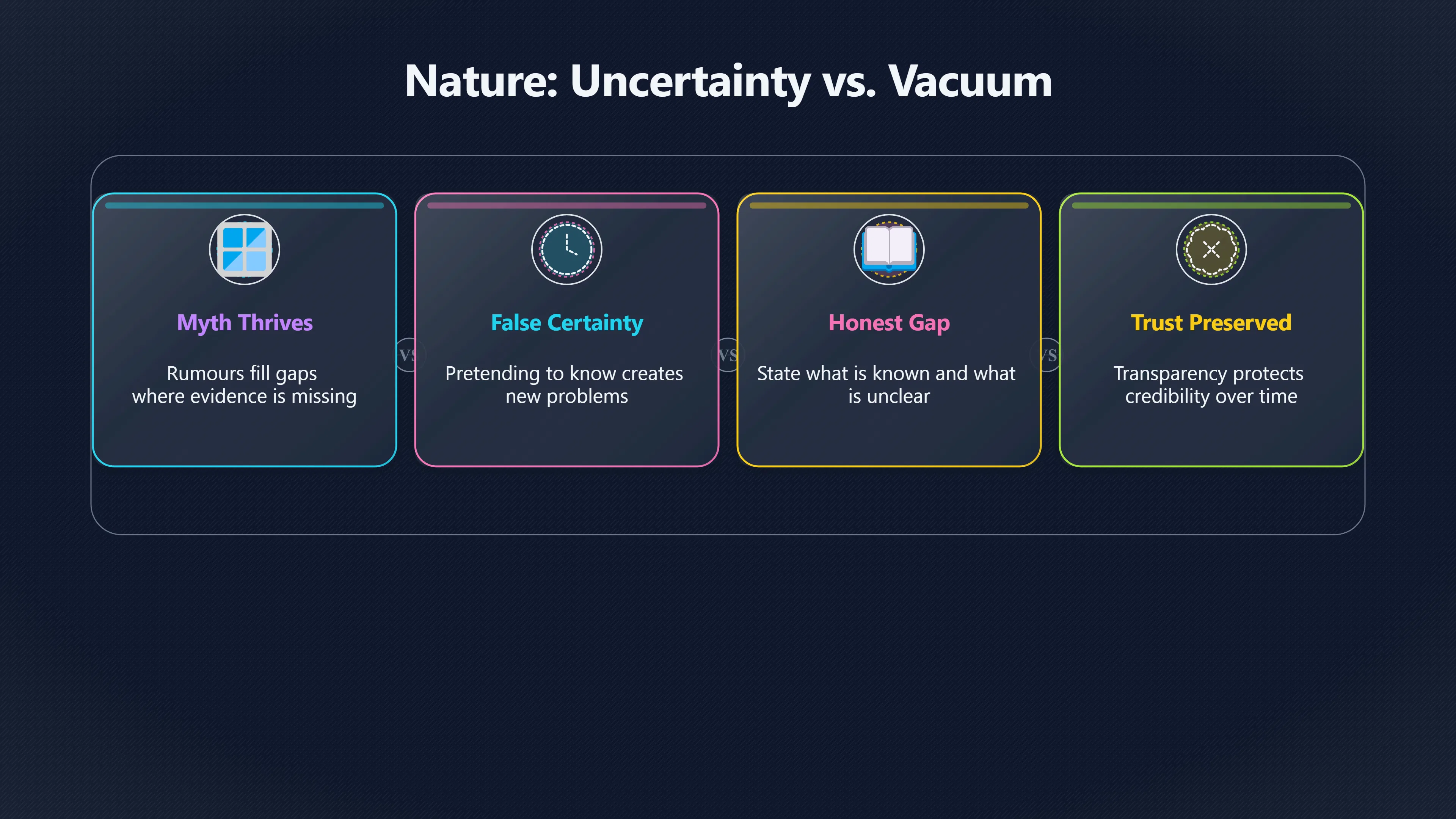
Saying what is known, unknown, and still being tested can replace false certainty without pretending the evidence is complete.
On this page
- Why uncertainty beats an information vacuum
- How to separate ruled out claims from open questions
- What evidence would close the gap
Page outline Jump by section
Introduction
Correcting a myth does not always mean replacing it with a complete answer. In many situations, the evidence is genuinely incomplete. Investigators may still be collecting data, scientists may not yet understand a mechanism, or key facts may remain unavailable. In these cases, a correction that pretends certainty exists can create new problems. A better replacement explanation may be an honest statement of uncertainty: what is known, what has been ruled out, what remains unclear, and what evidence could change the picture.
 This approach matters because myths and rumours often thrive in information vacuums. People prefer a story, even a flawed one, to no story at all. Yet research on misinformation shows that replacing false certainty with transparent uncertainty can be more effective than offering an unsupported alternative. When communicators explain why an answer is not yet available and what is being done to obtain it, they provide a framework for understanding events without filling gaps with speculation.[Nature]nature.comThe psychological drivers of misinformation belief and its…by UKH Ecker · 2022 · Cited by 1916 — In this Review, we describe the…[Skeptical Science]skepticalscience.comLewandowsky 2012 misinfoSkeptical ScienceMisinformation and its Correction: Continued Influence and…by S Lewandowsky · Cited by 4713 — To successfully replace…
Why Uncertainty Beats an Information Vacuum
A common misconception is that every correction must provide a fully developed alternative explanation. Sometimes no such explanation exists. The honest replacement is a structured account of uncertainty.
Research on the continued influence effect shows that misinformation often survives because it supplies a causal story. People continue to rely on it even after learning that it is false, especially if nothing else explains the situation. Effective corrections therefore need to address the explanatory gap. However, addressing the gap does not always require a definitive answer. It can mean explaining the limits of current knowledge and the reasons those limits exist.[Skeptical Science]skepticalscience.comLewandowsky 2012 misinfoSkeptical ScienceMisinformation and its Correction: Continued Influence and…by S Lewandowsky · Cited by 4713 — To successfully replace…[springer]link.springer.comfactors that mitigate the continued influence of…by IP Kan · 2021 · Cited by 27 — Across three studies, we evaluated the relative cont… Consider a developing public-health investigation. A rumour claims that a new illness was caused by a specific product. Authorities determine that the claim lacks evidence, but the true cause remains under investigation. A weak correction would simply deny the rumour. A stronger correction would state:
- The product has been examined and no evidence currently links it to the illness.
- Several other possibilities remain under investigation.
- Researchers are collecting laboratory and epidemiological data.
- Results are expected after further testing.
This does not leave people with an empty space. It replaces a false explanation with a truthful account of the current state of knowledge.
Importantly, uncertainty is not ignorance. It is information about the boundaries of what is known. That distinction helps prevent rumours from presenting themselves as the only available explanation.
How to Separate Ruled-Out Claims from Open Questions
One reason myths persist is that people often confuse two very different statements:
- “We know this claim is false.”
- “We know exactly what happened.”
The first may be supported by evidence even when the second is not.
Effective uncertainty statements clearly separate rejected explanations from unresolved questions. Research on misinformation correction consistently finds that people benefit when corrections explain not only that a claim is wrong but also why it is wrong and what remains uncertain.[University of Bristol]research-information.bris.ac.ukUniversity of Bristol Lewandowsky, S., Ecker, UKH, & Cook, J2017). BeyondToday — Second, corrections must explain why the misinformation was disseminated in the first place or they must provide an…[Skeptical Science]skepticalscience.comLewandowsky 2012 misinfoSkeptical ScienceMisinformation and its Correction: Continued Influence and…by S Lewandowsky · Cited by 4713 — To successfully replace…
A useful structure is:
- Known facts
-
Evidence-supported findings that can be stated confidently.
- Ruled-out explanations
-
Claims that have been tested and found inconsistent with available evidence.
- Open questions
-
Issues for which evidence remains incomplete or conflicting.
- Next steps
-
The investigations, measurements, or analyses that may resolve those questions.
This framework reduces a common risk in myth correction: replacing one form of overconfidence with another. If communicators present preliminary findings as final conclusions, later revisions can damage trust and create opportunities for new rumours.
The distinction became especially important during scientific and public-health debates in recent years. Scientific knowledge often changes as new evidence emerges. Communicating that process openly helps audiences understand that changing conclusions do not necessarily mean earlier statements were deceptive; they may reflect the normal accumulation of evidence.[Royal Society Publishing]royalsocietypublishing.orgRoyal Society PublishingCommunicating uncertainty about facts, numbers and scienceby AM van der Bles · 2019 · Cited by 558 — We review th…[PMC]pmc.ncbi.nlm.nih.govPMCThe role of discomfort in the continued influence effectby MW Susmann · 2021 · Cited by 90 — Research examining the continued influence effect (CIE) of misinformation has reliably found that…

What Evidence Would Close the Gap
An uncertainty statement becomes more useful when it identifies what evidence would resolve the uncertainty.
Without this step, “we do not know yet” can sound indefinite or evasive. With it, uncertainty becomes a testable condition.
For example:
- Instead of saying, “The cause is unknown,” explain that laboratory analysis is underway and that results will determine whether contamination occurred.
- Instead of saying, “Scientists disagree,” explain which measurements are missing and what future studies are expected to clarify.
- Instead of saying, “The evidence is inconclusive,” explain what additional observations would make one explanation more likely than another.
Research on uncertainty communication suggests that audiences respond better when uncertainty is accompanied by reasons and by information about how uncertainty may be reduced. People are generally capable of understanding incomplete knowledge when the process is explained clearly.[PsychArchives]psycharchives.orgThe third study examined…Read more…[Royal Society Publishing]royalsocietypublishing.orgRoyal Society PublishingCommunicating uncertainty about facts, numbers and scienceby AM van der Bles · 2019 · Cited by 558 — We review th…
This approach also helps distinguish scientific uncertainty from mere opinion. Scientific uncertainty is usually constrained by evidence. It is not an unlimited range of possibilities; it is a description of what the evidence currently permits and what future evidence might exclude.
The Risk of False Certainty
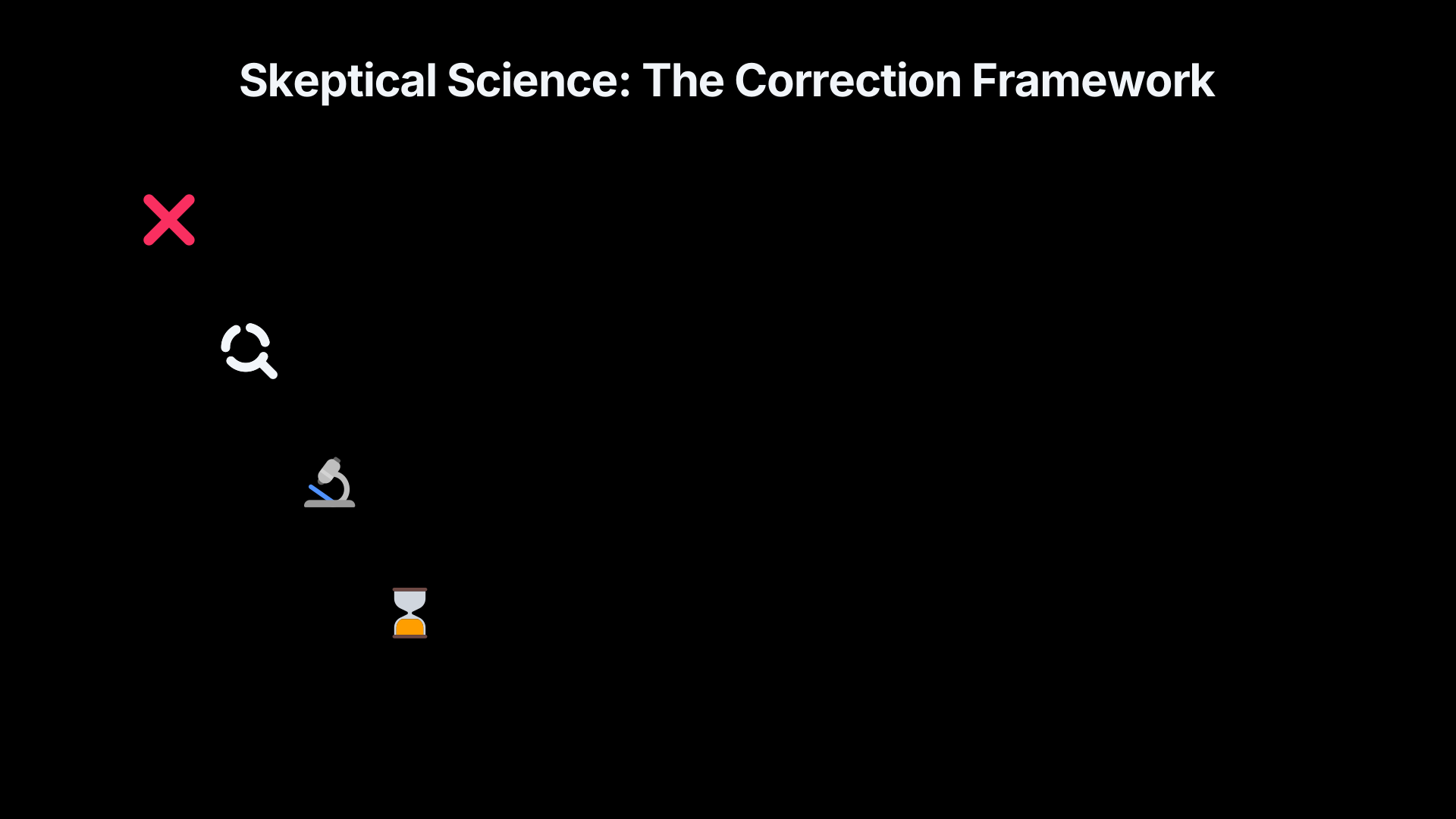
One temptation in myth correction is to provide a neat replacement story simply because audiences prefer closure. Yet false certainty can create long-term credibility problems.
Studies examining uncertainty communication have repeatedly found that openly acknowledging uncertainty often has only small negative effects on trust and, in many circumstances, can preserve trust when evidence later changes. Transparency about limitations may be less damaging than confident claims that require subsequent revision.[Cambridge University Repository]repository.cam.ac.ukis that communicating uncertainty will reduce public trust. However, a lack of systematic research makes it difficult to evaluate such cl…[PMC]pmc.ncbi.nlm.nih.govPMCUncertainty communication, trust and health promotionResearch is tentative, but that's okay: overcoming misconceptions about scientific…Read more…[Sage Journals]journals.sagepub.comSage JournalsCommunicating uncertainty protects against a loss of trust27 Feb 2024 — This study examines how communicating and explaining…
This matters because myths frequently emerge after official explanations appear incomplete or inconsistent. If communicators overstate confidence and later retreat from those claims, critics can portray the change as proof of incompetence or deception. A carefully framed uncertainty statement reduces that vulnerability by making clear from the outset that some questions remain open.
There are limits, however. Uncertainty can be exploited. Interest groups, conspiracy entrepreneurs, and motivated actors sometimes use genuine scientific uncertainty to imply that no knowledge exists at all. Effective communication therefore needs to balance openness with clarity about what is already established.[PubMed]pubmed.ncbi.nlm.nih.govscience communication can impact these trust… Keywords: disinformation; scientific uncertainty; systematic review; trust in science; u…[PMC]pmc.ncbi.nlm.nih.govThe effects of communicating uncertainty on public trust in…by AM van der Bles · 2020 · Cited by 385 — Results show that whereas pe…
When “We Do Not Know Yet” Is Better
The most effective replacement explanation is not always a competing causal story. Sometimes it is a transparent account of an unfinished investigation.
A good uncertainty statement does three things at once:
- Rejects claims that are unsupported or contradicted by evidence.
- Explains what remains unknown without exaggerating the mystery.
- Describes the evidence needed to resolve the remaining questions.
Within the broader problem of rumours and myths, this approach serves an important function. It prevents the information vacuum that rumours exploit while avoiding the temptation to manufacture certainty. Rather than replacing one misleading narrative with another, it offers a truthful map of current knowledge—showing both the ground that is firm and the territory that is still being explored. [Royal Society Publishing+3Center for Climate Change Communication+3Skeptical Science]
Amazon book picks
Further Reading
Books and field guides related to When We Do Not Know Yet Is Better. Use these as the next step if you want deeper reading beyond the article.
The Demon-Haunted World
Models scientific thinking that accepts uncertainty until evidence arrives.
Thinking, Fast and Slow
Explains why people prefer confident stories even when evidence is incomplete.
Factfulness
Encourages evidence-based reasoning and careful interpretation of incomplete information.

eBay marketplace picks
Marketplace Samples
Example marketplace items related to this page. Use the search link to explore similar finds on eBay.



Endnotes
1.
Source: nature.com
Link:https://www.nature.com/articles/s44159-021-00006-y
Source snippet
The psychological drivers of misinformation belief and its...by UKH Ecker · 2022 · Cited by 1916 — In this Review, we describe the...
2.
Source: link.springer.com
Link:https://link.springer.com/article/10.1186/s41235-021-00335-9
Source snippet
factors that mitigate the continued influence of...by IP Kan · 2021 · Cited by 27 — Across three studies, we evaluated the relative cont...
3.
Source: pmc.ncbi.nlm.nih.gov
Title: PMCThe role of discomfort in the continued influence effect
Link:https://pmc.ncbi.nlm.nih.gov/articles/PMC8447889/
Source snippet
by MW Susmann · 2021 · Cited by 90 — Research examining the continued influence effect (CIE) of misinformation has reliably found that...
4.
Source: pmc.ncbi.nlm.nih.gov
Title: PMCUncertainty communication, trust and health promotion
Link:https://pmc.ncbi.nlm.nih.gov/articles/PMC12652265/
Source snippet
Research is tentative, but that's okay: overcoming misconceptions about scientific...Read more...
5.
Source: psycharchives.org
Link:https://www.psycharchives.org/en/item/ce6655bb-bbf1-4ba4-8ab8-d5a5a2fbba50
Source snippet
The third study examined...Read more...
6.
Source: pmc.ncbi.nlm.nih.gov
Link:https://pmc.ncbi.nlm.nih.gov/articles/PMC7149229/
Source snippet
The effects of communicating uncertainty on public trust in...by AM van der Bles · 2020 · Cited by 385 — Results show that whereas pe...
7.
Source: pmc.ncbi.nlm.nih.gov
Title: PMCThe effect of uncertainty communication on public trust
Link:https://pmc.ncbi.nlm.nih.gov/articles/PMC11925018/
Source snippet
by C Dries · 2025 · Cited by 9 — Our results show that people's trust response to the communication of uncertainty depends on how cons...
8.
Source: skepticalscience.com
Title: Lewandowsky 2012 misinfo
Link:https://skepticalscience.com/docs/Lewandowsky_2012_misinfo.pdf
Source snippet
Skeptical ScienceMisinformation and its Correction: Continued Influence and...by S Lewandowsky · Cited by 4713 — To successfully replace...
9.
Source: research-information.bris.ac.uk
Title: University of Bristol Lewandowsky, S., Ecker, UKH, & Cook, J
Link:https://research-information.bris.ac.uk/ws/portalfiles/portal/152516154/Pages_from_JARMAC_2017_59_Revision_1_V1.pdf
Source snippet
(2017). BeyondToday — Second, corrections must explain why the misinformation was disseminated in the first place or they must provide an...
10.
Source: royalsocietypublishing.org
Link:https://royalsocietypublishing.org/rsos/article/6/5/181870/95102/Communicating-uncertainty-about-facts-numbers-and
Source snippet
Royal Society PublishingCommunicating uncertainty about facts, numbers and scienceby AM van der Bles · 2019 · Cited by 558 — We review th...
11.
Source: journals.sagepub.com
Link:https://journals.sagepub.com/doi/10.1177/09636625241228449
Source snippet
Sage JournalsCommunicating uncertainty protects against a loss of trust27 Feb 2024 — This study examines how communicating and explaining...
12.
Source: repository.cam.ac.uk
Link:https://www.repository.cam.ac.uk/items/2c8f4dc0-7fb4-4df6-8cd9-d654b9e9e399
Source snippet
is that communicating uncertainty will reduce public trust. However, a lack of systematic research makes it difficult to evaluate such cl...
13.
Source: pubmed.ncbi.nlm.nih.gov
Link:https://pubmed.ncbi.nlm.nih.gov/42014938/
Source snippet
science communication can impact these trust... Keywords: disinformation; scientific uncertainty; systematic review; trust in science; u...
Additional References
14.
Source: researchgate.net
Link:https://www.researchgate.net/publication/404058007_How_Communication_of_Scientific_Uncertainty_Affects_Trust_in_Science-A_Systematic_Review
Source snippet
disinformation on social media and the need to manage related societal consequences. This systematic review evaluates the available...Re...
15.
Source: researchgate.net
Link:https://www.researchgate.net/publication/404058007_How_Communication_of_Scientific_Uncertainty_Affects_Trust_in_Science-A_Systematic_Review?_fam=1
Source snippet
How Communication of Scientific Uncertainty Affects Trust...22 Apr 2026 — Our findings suggest that communicating scientific uncertainti...
16.
Source: nuffieldfoundation.org
Link:https://www.nuffieldfoundation.org/project/communicating-uncertainty-in-data-without-undermining-trust
Source snippet
Communicating uncertainty in data without undermining trustThis project aims to identify a range of methods to communicate uncertainty to...
17.
Source: merriam-webster.com
Link:https://www.merriam-webster.com/thesaurus/communicating
Source snippet
Synonyms of communicatingSynonyms for COMMUNICATING: connecting, connected, joined, attached, linked, united, closest, embracing; Antonym...
18.
Source: scispace.com
Link:https://scispace.com/pdf/the-continued-influence-of-misinformation-in-[memory
19.
Source: sciencearena.org
Link:https://www.sciencearena.org/en/news/communicating-scientific-uncertainties-can-weaken-support-for-public-policies-study-finds/
Source snippet
Communicating scientific uncertainties can weaken...Apr 1, 2026 — The impacts found are small—which does not mean they should be ignored...
20.
Source: misinforeview.hks.harvard.edu
Link:https://misinforeview.hks.harvard.edu/article/correcting-campaign-misinformation-experimental-evidence-from-a-two-wave-panel-study/
Source snippet
evidence from a two-wave panel studyby L Horvath · 2024 · Cited by 1 — In this study, we used a two-wave panel and a real-world intervent...
21.
Source: academic.oup.com
Link:https://academic.oup.com/pnasnexus/article/4/3/pgaf071/8052021
Source snippet
of uncertainty communication on public trust depends on...by C Dries · 2025 · Cited by 9 — Specifically, the study tests whether uncerta...
22.
Source: doc.health
Title: finding signal in the noise a trust crisis in medical science
Link:https://doc.health/finding-signal-in-the-noise-a-trust-crisis-in-medical-science/
Source snippet
Finding Signal in the Noise: A Trust Crisis in Medical ScienceSep 15, 2025 — At DOC 2024's Saturday morning session on misinformation, th...
23.
Source: researchgate.net
Link:https://www.researchgate.net/publication/258180567_Misinformation_and_Its_Correction_Continued_Influence_and_Successful_Debiasing
Source snippet
tions of misinformation are so ineffective in memory updating and why...Read more...
Topic Tree