Within Mythcraft
When Should a Myth Be Corrected?
Fast, clear correction can limit damage, but rushed debunking can also confuse people if evidence is still uncertain.
On this page
- Early correction advantages
- Risks of uncertainty
- Updating without losing trust
Page outline Jump by section
Introduction
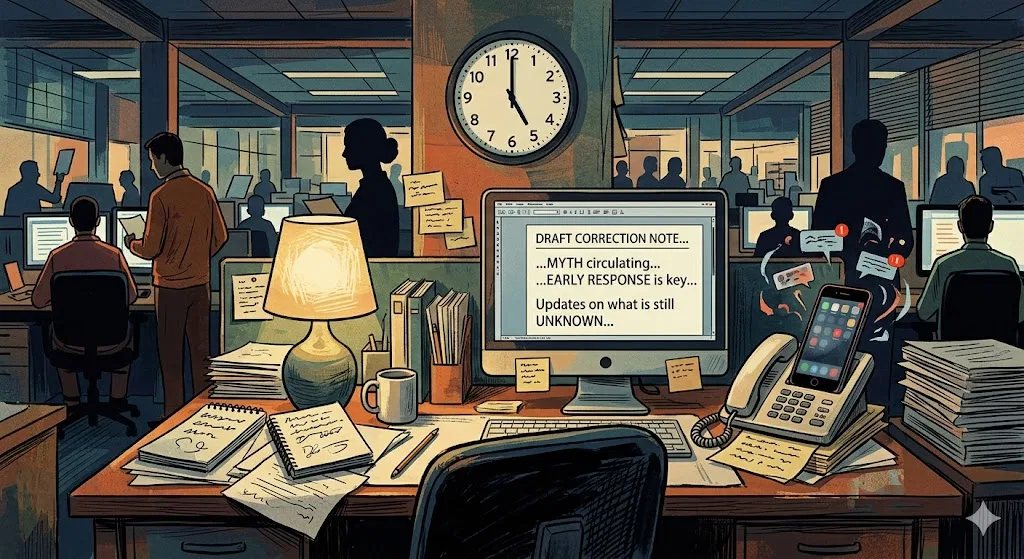
The best time to correct a viral myth is usually as early as possible, but not before the correction is accurate enough to stand up. Speed matters because false claims can gather familiarity, emotional force and social proof before a careful response appears. Yet speed alone is not the goal. A rushed debunk that overstates the evidence, mocks uncertainty or later has to be reversed can make the next correction harder to trust.
For communicators, the timing question is therefore not “instant correction or wait for certainty?” It is “what can be responsibly said now, what is still unknown, and when will this be updated?” In a fast-moving rumour, a good early response can be a holding correction: name the claim, state what is known, explain what is being checked, give people a safer action, and set expectations for updates. That approach is especially important in health, elections, disasters and public safety, where delayed correction can allow a false story to shape real-world behaviour.
Why early correction has an advantage
Viral myths do not spread like neutral facts waiting to be assessed. They often travel because they are novel, emotional, identity-reinforcing or useful to a group’s existing story. A large study of Twitter from 2006 to 2017 found that false news spread farther, faster and more broadly than true news, with false stories more likely to be retweeted; the researchers argued that novelty and emotional reaction helped explain the gap.[Science]science.orgThe spread of true and false news onlineby S Vosoughi · 2018 · Cited by 14051 — Although the terms fake news and misinformation al…
That speed changes the job of correction. Once a false claim has been seen repeatedly, people may remember the general story even if they later forget the correction. Research on the continued influence effect shows that misinformation can still shape reasoning after people have been told it is wrong, especially when the correction fails to replace the old story with a clear alternative explanation.[Springer Link]link.springer.comSource details in endnotes.
Early correction helps because it can interrupt three processes before they harden:
- Familiarity: repeated exposure can make a claim feel more plausible, even when people cannot remember where they heard it.
- Narrative completion: a myth often gives people a simple cause, villain or explanation; if no better explanation is offered, the myth keeps doing useful mental work.
- Social proof: when people see a claim shared by friends, influencers or community figures, it can begin to feel like common knowledge.
This does not mean every weak rumour deserves a full public rebuttal. Amplifying a tiny claim to a huge audience can spread it further than the original rumour did. The practical advantage lies in early proportionate correction: respond quickly when a myth is gaining traction, when the stakes are high, or when silence would leave the false claim as the only available explanation.
The first correction does not need to be the final word
A common mistake is to treat correction as a single event: myth appears, fact-check is published, problem solved. In practice, viral myths often require a sequence of messages. The first message may reduce harm; later messages add evidence, address mutations of the claim and correct misunderstandings created by the first wave of coverage.
Public health risk communication has long recognised this problem. The World Health Organization’s risk communication guidance says that effective communication should be timely, transparent, easy to understand and open about uncertainty.[NCBI]ncbi.nlm.nih.govOpen source on nih.gov. The CDC’s crisis and emergency risk communication model similarly uses the principle “be first, be right, be credible”, while warning communicators not to speculate and to monitor misinformation that needs correction.[ASSET]asset-scienceinsociety.euASSETCrisis and Emergency Risk CommunicationASSETCrisis and Emergency Risk Communication
For viral myths, this points to a useful distinction:
A holding correction says: “This claim is circulating. Here is what we know. Here is what we do not yet know. Here is the safest interpretation for now.”
A full debunk says: “This claim is false or misleading because of this evidence. Here is the more accurate explanation.”
The holding correction matters when waiting for a perfect answer would leave people exposed to a harmful falsehood. For example, during an outbreak, officials may not yet know every detail about transmission, but they can still correct a rumour that a vaccine team is spreading disease, that a harmless symptom proves poisoning, or that an invented cure is safe. A Reuters investigation into health rumours in the Democratic Republic of Congo reported that false claims about a supposed genital-atrophy illness contributed to violence and deaths, including attacks on health workers; the case illustrates how delay, mistrust and rumour can combine before authorities have regained control of the information environment.[Reuters]reuters.comFake rumors, real killings: Inside Congo's deadly health misinformation crisisSocial media, local media, and religious leaders, including megachurch pastor Jules Mulindwa and other pastors, played a key role in ampl…
The danger of being too fast
Speed becomes harmful when the correction outruns the evidence. A public statement that sounds final but later needs heavy revision can be read as incompetence, concealment or bad faith. That is especially risky when the subject is scientifically uncertain, politically charged or changing quickly.
The COVID-19 pandemic made this visible. Guidance on masks, transmission, treatments and origins evolved as evidence changed, but many people experienced those changes as contradiction rather than learning. Studies of COVID-19 communication found that changing guidance could reduce confidence in experts unless the possibility of revision was explained in advance.[Cambridge University Press & Assessment]cambridge.orgSource details in endnotes. Research on public reaction to mask guidance also shows how shifts in official recommendations became a focus for sentiment, confusion and politicisation.[JMIR]jmir.orgOpen source on jmir.org.
The lesson is not that officials should avoid correcting myths until certainty is complete. It is that they should avoid pretending to have certainty they do not have. WHO guidance on communicating uncertainty in emergencies stresses that uncertainty should be communicated because doing so helps maintain trust while advice develops.[World Health Organization]who.inttips for communicating uncertainty final engtips for communicating uncertainty final eng The most trustworthy early correction often contains plain uncertainty markers, such as “based on the evidence available today”, “we have not yet verified”, “this part is false”, and “this part is still under investigation”.
The timing decision therefore depends on the type of uncertainty:
- Uncertainty about details: correct the false central claim now, while saying which details may change.
- Uncertainty about classification: avoid a hard label such as “hoax” or “conspiracy theory” until the evidence supports it.
- Uncertainty about harm: issue a cautious warning if people may act dangerously while evidence is being gathered.
- Uncertainty about source intent: correct the content without claiming bad intent unless there is evidence of deliberate deception.
This distinction protects both accuracy and trust. It lets communicators act quickly without locking themselves into a brittle position.

When speed matters most
Not every myth needs the same response window. A false claim about a celebrity’s childhood may be irritating but low-risk. A false claim about contaminated drinking water, a vaccine team, a polling location or a bank failure can require immediate attention because people may act on it before a full investigation is complete.
A practical timing decision should weigh four questions.
Is the myth causing or likely to cause harm? Health, safety, finance and civic participation myths deserve faster intervention because even short delays can affect behaviour. The U.S. Surgeon General’s advisory on health misinformation described misinformation as a public health challenge because it can influence decisions and weaken trust in health systems.[HHS.gov]hhs.govConfronting Health MisinformationConfronting Health Misinformation
Is the claim accelerating? A myth shared by a few accounts may not need a public rebuttal, but one moving across platforms, languages or communities may need a visible correction before it becomes the default story.
Is there a clear accurate alternative? A correction works better when it replaces the myth with a usable explanation. Saying “that is false” is weaker than saying “that video is from a different year”, “that image is digitally altered”, or “the guidance changed because new evidence showed a different risk balance”.
Will correction amplify the myth? If the rumour is still obscure, a quiet response may be better: contact the platform, inform local leaders, prepare a statement, or correct within the affected community rather than broadcasting the false claim nationally.
The strongest case for rapid public correction is when the myth is both high-harm and high-spread. Low-harm and low-spread rumours are better monitored. High-harm but low-spread rumours may call for targeted intervention. High-spread but low-harm myths may be corrected through explainers, labels or routine fact-checking rather than emergency messaging.
Platform timing: labels help, but late labels miss the fastest spread
Modern correction is not only about what experts say. It is also about when platforms, fact-checkers and community systems attach context to a post. Warning labels, related-article panels and community notes can reduce belief in, engagement with or sharing of false content, but their effect depends heavily on timing.
A 2026 study of X’s Community Notes found that notes reduced the spread of misleading posts once they appeared and increased the odds that authors deleted misleading posts. However, the study also found that notes often arrived too late for the earliest and most viral stage of diffusion, limiting the system-wide reduction in engagement.[Nature]nature.comOpen source on nature.com.
That finding captures the central timing problem: a correction can be effective at the moment a user sees it, yet still fail to prevent much of the damage if it appears after the post has already peaked. This is why scalable systems matter. Human fact-checking is valuable, but viral myths can move faster than manual review. Automated detection, user reporting, trusted flagger systems and community annotation all try to shorten the gap between first spread and first correction.
Still, faster labelling brings its own risks. Automated or crowd-based systems can misread satire, emerging evidence, local context or legitimate disagreement. The implementation challenge is to speed up triage without pretending that every fast judgement is equally reliable. A sensible platform response can use stages: friction first, stronger labels after review, reduced recommendation for clearly harmful claims, and transparent correction when an earlier label was wrong.
Updating without losing trust
The hardest timing problem is not the first correction; it is the update. Viral myths thrive when changing information is framed as proof that “they lied”. Communicators can reduce that risk by making updates part of the original message rather than treating them as embarrassing reversals.
Good updating has three features.
It separates stable facts from moving evidence. A message might say: “There is no evidence that this video shows today’s event. We are still checking where it was filmed.” That makes clear which part is corrected and which part remains open.
It explains why the update happened. People are more likely to accept change when they can see the reason: a lab result arrived, a source document was released, the image was geolocated, or a previous witness account was contradicted.
It preserves a visible record. Silent deletion fuels suspicion. A dated correction note, update log or pinned follow-up lets readers see how the evidence changed.
This matters because corrections can decay. Research on correction durability has found that corrected beliefs may not remain stable over time, meaning a single debunk may need reinforcement, especially when the myth continues circulating.[ResearchGate]researchgate.netResearch Gate Correcting Misinformation in News Stories: An InvestigationResearch Gate Correcting Misinformation in News Stories: An Investigation The point is not to repeat the false claim endlessly, but to keep the accurate replacement explanation available where people are still encountering the myth.
A practical timing rule for viral myths
A useful rule is: move quickly on the risk, carefully on the claim, and openly on uncertainty.
In practice, that means the first response should not wait until every detail is known if people may be harmed. But it should avoid overclaiming. A strong early correction can say:
- what claim is circulating;
- whether the central claim is false, unverified, misleading or missing context;
- what evidence supports that judgement;
- what people should do now;
- what is still being checked;
- when and where updates will appear.
This approach fits the broader evidence on debunking. Corrections often work, and fears that they usually backfire are overstated, but corrections are rarely magic erasers.[PMC]pmc.ncbi.nlm.nih.govSource details in endnotes. Timing improves the odds: correct early enough to prevent the myth becoming the default explanation, but carefully enough that the correction itself does not become tomorrow’s misinformation.
Amazon book picks
Further Reading
Books and field guides related to When Should a Myth Be Corrected?. Use these as the next step if you want deeper reading beyond the article.
Calling Bullshit
Helps readers identify weak claims quickly and communicate why they are unreliable.
The misinformation age
Explains social transmission of false claims and why timing and networks affect correction.
Made to Stick
Explains why memorable claims spread and how clearer replacement messages can compete.
eBay marketplace picks
Marketplace Samples
Example marketplace items related to this page. Use the search link to explore similar finds on eBay.


Endnotes
1.
Source: link.springer.com
Link:https://link.springer.com/article/10.1186/s41235-020-00241-6
2.
Source: nature.com
Link:https://www.nature.com/articles/s44159-021-00006-y
3.
Source: ncbi.nlm.nih.gov
Link:https://www.ncbi.nlm.nih.gov/books/NBK540733/
4.
Source: asset-scienceinsociety.eu
Title: ASSETCrisis and Emergency Risk Communication
Link:https://www.asset-scienceinsociety.eu/sites/default/files/cdc_risk_communication_book.pdf
5.
Source: reuters.com
Title: Fake rumors, real killings: Inside Congo’s deadly health misinformation crisis
Link:https://www.reuters.com/business/media-telecom/fake-rumors-real-killings-inside-congos-deadly-health-misinformation-crisis-2026-05-07/
Source snippet
Social media, local media, and religious leaders, including megachurch pastor Jules Mulindwa and other pastors, played a key role in ampl...
6.
Source: cambridge.org
Link:https://www.cambridge.org/core/journals/judgment-and-decision-making/article/brief-forewarning-intervention-overcomes-negative-effects-of-salient-changes-in-covid19-guidance/2854EC51BEDB755B62EDDFBFC79C3039
7.
Source: jmir.org
Link:https://www.jmir.org/2023/1/e40706/
8.
Source: who.int
Title: tips for communicating uncertainty final eng
Link:https://www.who.int/docs/librariesprovider2/default-document-library/tips-for-communicating-uncertainty-final-eng.pdf?download=true&sfvrsn=6d9700d7_1
9.
Source: hhs.gov
Title: Confronting Health Misinformation
Link:https://www.hhs.gov/sites/default/files/surgeon-general-misinformation-advisory.pdf
10.
Source: ncbi.nlm.nih.gov
Title: NCBIConfronting Health Misinformation
Link:https://www.ncbi.nlm.nih.gov/books/NBK572169/
11.
Source: nature.com
Link:https://www.nature.com/articles/s41467-026-72597-0
12.
Source: researchgate.net
Title: Research Gate Correcting Misinformation in News Stories: An Investigation
Link:https://www.researchgate.net/publication/342577598_Correcting_Misinformation_in_News_Stories_An_Investigation_of_Correction_Timing_and_Correction_Durability
13.
Source: pmc.ncbi.nlm.nih.gov
Link:https://pmc.ncbi.nlm.nih.gov/articles/PMC9283209/
14.
Source: cdc.gov
Link:https://www.cdc.gov/cerc/media/pdfs/CERC_Introduction.pdf
15.
Source: nature.com
Link:https://www.nature.com/articles/s41598-026-42329-x
16.
Source: nature.com
Link:https://www.nature.com/articles/s41562-021-01278-3
17.
Source: infodemiology.jmir.org
Link:https://infodemiology.jmir.org/2025/1/e67464
18.
Source: researchgate.net
Link:https://www.researchgate.net/publication/343887042_Can_corrections_spread_misinformation_to_new_audiences_Testing_for_the_elusive_familiarity_backfire_effect
19.
Source: cambridge.org
Link:https://www.cambridge.org/core/books/social-media-and-democracy/misinformation-and-its-correction/61FA7FD743784A723BA234533012E810
20.
Source: assets.cambridge.org
Title: 9781009449038 excerpt
Link:https://assets.cambridge.org/97810094/49038/excerpt/9781009449038_excerpt.pdf
21.
Source: science.org
Link:https://www.science.org/doi/10.1126/science.aap9559
Source snippet
The spread of true and false news onlineby S Vosoughi · 2018 · Cited by 14051 — Although the terms [fake news]({{ 'fake-news/' | relative_url }}) and misinformation al...
22.
Source: sciencedirect.com
Link:https://www.sciencedirect.com/science/article/pii/S0167811626000261
23.
Source: sciencedirect.com
Link:https://www.sciencedirect.com/science/article/pii/S004727272500043X
24.
Source: sciencedirect.com
Link:https://www.sciencedirect.com/science/article/pii/S2468696420300458
25.
Source: sciencedirect.com
Link:https://www.sciencedirect.com/science/article/pii/S0277953625006033
26.
Source: ebm.bmj.com
Link:https://ebm.bmj.com/content/30/6/420
Additional References
27.
Source: news.mit.edu
Title: study twitter false news travels faster true stories 0308
Link:https://news.mit.edu/2018/study-twitter-false-news-travels-faster-true-stories-0308
Source snippet
MIT NewsStudy: On Twitter, false news travels faster than true stories8 Mar 2018 — Researchers from the Media Lab and Sloan found that hu...
28.
Source: whitehouse.gov
Link:https://www.whitehouse.gov/lab-leak-true-origins-of-covid-19/
29.
Source: govinfo.gov
Link:https://www.govinfo.gov/app/details/GOVPUB-HE20-PURL-gpo157762
30.
Source: youtube.com
Title: Misinformation: The “Truth Sandwich” and Other Techniques
Link:https://www.youtube.com/watch?v=o33y194O1O0
Source snippet
How to Talk to Someone Who Believes Conspiracy Theories...
31.
Source: youtube.com
Title: How to Talk to Someone Who Believes Conspiracy Theories
Link:https://www.youtube.com/watch?v=S216W98pZ_8
Source snippet
Debunking Misinformation: Strategies for Success...
32.
Source: ebolacommunicationnetwork.org
Link:https://ebolacommunicationnetwork.org/wp-content/uploads/2014/09/CrisisEmregencyRiskCommunication.pdf
33.
Source: asef.org
Link:https://asef.org/wp-content/uploads/2021/10/Presentation_Dr-Margaret-HARRIS.pdf
34.
Source: michsafetyconference.org
Link:https://michsafetyconference.org/wp-content/uploads/2022/04/WEd-1015-am-Emerg-Mgt-Crisis-and-Emergency-Risk-Communication.pdf
35.
Source: ualberta.ca
Link:https://www.ualberta.ca/en/law/media-library/faculty-research/hli/media/images/caulfield-debunking-works-vulnerable-caulfield.pdf
36.
Source: cepr.org
Link:https://cepr.org/voxeu/columns/fact-checking-reduces-circulation-misinformation-we-should-not-get-rid-it
Topic Tree