Within Concept Change
When Surprises Actually Change Thinking
Surprising evidence helps only when students compare predictions, evidence, and a stronger replacement explanation.
On this page
- Why discrepant events can fail
- Prediction, evidence, and explanation routines
- Turning conflict into a usable new model
Page outline Jump by section
Introduction
Classroom surprises are often treated as a shortcut to better science learning. A teacher drops two objects and they hit the ground together. A metal ball and ring behave differently when heated. A candle under a jar goes out sooner than students expect. These moments can be memorable, but research on conceptual change shows that surprise by itself rarely replaces a misconception. Students can watch a striking demonstration, enjoy it, and still leave with the same underlying explanation they had before.[ScienceDirect]sciencedirect.comOn the cognitive conflict as an instructional strategy for…by M Limón · 2001 · Cited by 1216 — One of the most common con…
 What matters is not simply creating cognitive conflict — the feeling that evidence clashes with an existing belief — but helping learners work through that conflict. The strongest results tend to appear when students first commit to a prediction, then compare that prediction with evidence, and finally construct a more powerful explanation that accounts for both the old intuition and the new observation. Cognitive conflict can open a door, but it does not tell students what to walk towards.[faculty.weber.edu]faculty.weber.eduToward a Theory of Conceptual Changeby GJ POSNER · Cited by 10769 — Accommodation of a Scientific Conception: Toward a Theory of Conceptu…[Sage Journals]journals.sagepub.comSage JournalsEffects of Cognitive Conflict Instructional Strategy on…by BC Madu · 2015 · Cited by 101 — Posner, Strike, Hewson, and Ge…
Why discrepant events can fail
The classic conceptual change literature gave cognitive conflict a central role. Posner, Strike, Hewson and Gertzog argued that learners are more likely to replace an existing conception when they become dissatisfied with it and encounter a new idea that seems intelligible, plausible and fruitful.[faculty.weber.edu]faculty.weber.eduToward a Theory of Conceptual Changeby GJ POSNER · Cited by 10769 — Accommodation of a Scientific Conception: Toward a Theory of Conceptu…[2eClass UOA]eclass.uoa.grAccommodation of a scientific conception: Toward a theory…by GJ POSNER · Cited by 10769 — Accommodation of a Scientific Conc…
Many science lessons tried to create this dissatisfaction through discrepant events: demonstrations whose outcomes contradict student expectations. The assumption was straightforward. If students see evidence that their idea cannot explain, they will abandon it and adopt a scientific alternative.
In practice, the process is far less reliable.
Research reviews have repeatedly found that cognitive conflict interventions produce mixed results. Some students change their thinking, while others reinterpret the evidence, ignore the contradiction, or treat the event as a special case. A surprising result may challenge the teacher’s understanding of the topic, yet fail to feel meaningful to the learner.[ScienceDirect]sciencedirect.comOn the cognitive conflict as an instructional strategy for…by M Limón · 2001 · Cited by 1216 — One of the most common con… ResearchGate Several recurring problems appear in classrooms:[researchgate.net]researchgate.netInconsistent or Discrepant Events in Science InstructionThese inconsistencies between students' observations and their expect…
- Students may not notice the conflict. If a learner’s prediction was never made explicit, they may not recognise that the result contradicts their own thinking.
- The evidence may seem untrustworthy. Students sometimes assume the equipment was faulty, the teacher manipulated the outcome, or unusual conditions produced an exception.
- The misconception may be deeply connected to everyday experience. A learner who believes continuous force is needed for motion sees countless objects stop moving when pushes stop. One classroom demonstration may not outweigh years of observation.
- Students may memorise the result without changing the model. They remember what happened but not why it happened.[ScienceDirect]sciencedirect.comOn the cognitive conflict as an instructional strategy for…by M Limón · 2001 · Cited by 1216 — One of the most common con… DigitalCommons This helps explain a common teaching frustration. A lesson can feel highly engaging[digitalcommons.unl.edu]digitalcommons.unl.eduIn this study, we defined and quantified the degree of cognitive conflict induced by a discrepant event from a cognitive perspective.Read…, with visible surprise and discussion, yet later assessments show that many students still hold the original misconception.
The danger of treating surprise as instruction
Discrepant events are sometimes used as attention-grabbing performances. Students laugh, react and become curious. Attention is valuable, but conceptual change requires more than attention.
Studies of cognitive conflict suggest that confusion can become productive only when learners actively try to resolve it. If the conflict remains unresolved, students may simply store the contradiction alongside their original belief. They end up with two competing explanations rather than a reorganised understanding.[ResearchGate]researchgate.netInconsistent or Discrepant Events in Science InstructionThese inconsistencies between students' observations and their expect…
This is one reason science education researchers increasingly distinguish between creating conflict and supporting knowledge reconstruction. The critical question is not whether students were surprised. It is whether they built a better explanatory model afterwards.[ScienceDirect]sciencedirect.comOn the cognitive conflict as an instructional strategy for…by M Limón · 2001 · Cited by 1216 — One of the most common con…
Prediction, evidence and explanation routines
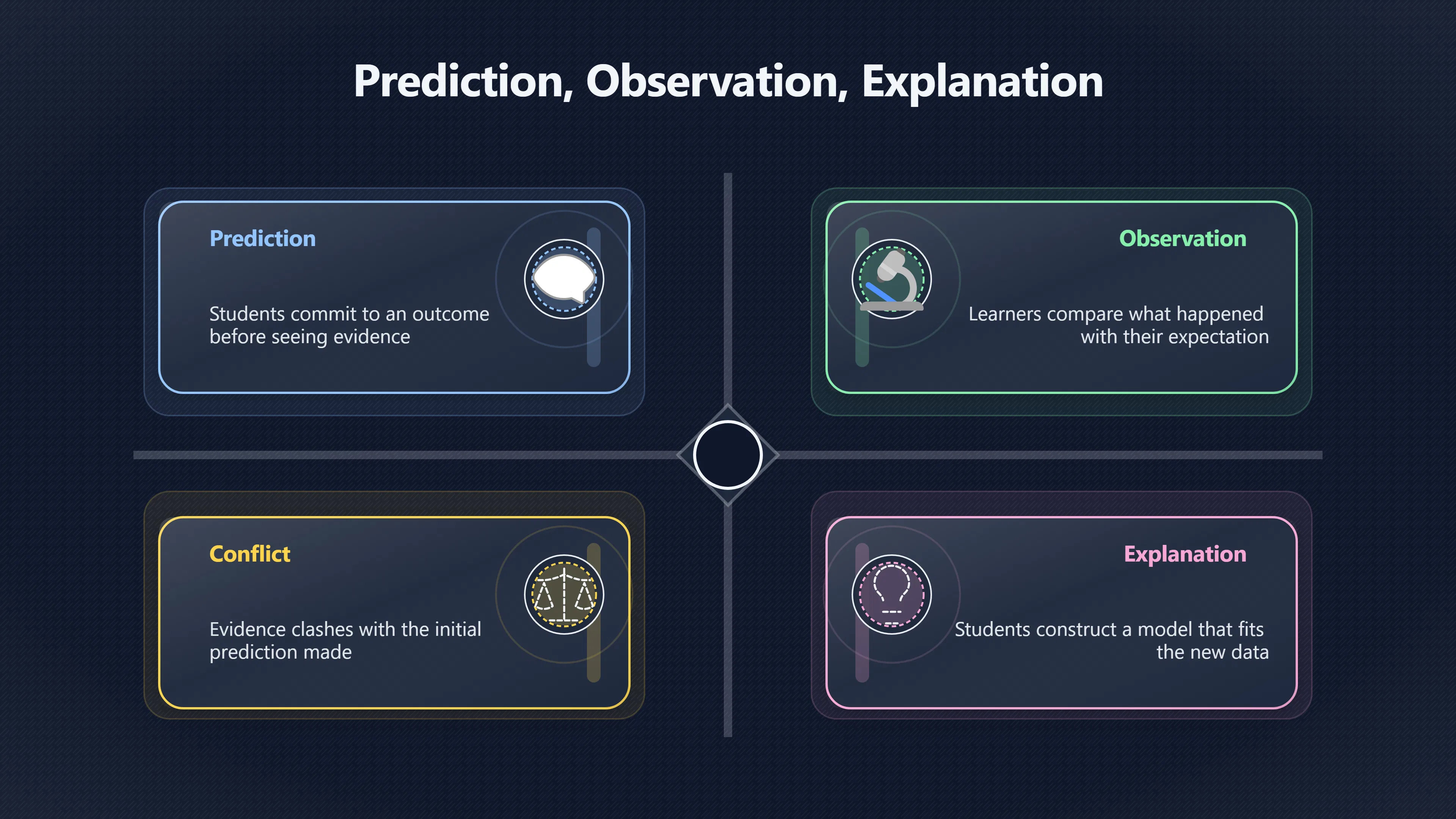
One of the most robust responses to the limits of pure cognitive conflict has been the use of structured routines that force students to connect expectations, observations and explanations.
A widely used approach is the Predict–Observe–Explain sequence.
Why prediction matters
Prediction changes a demonstration from passive viewing into a test of ideas.
When students must commit to an outcome before seeing evidence, their existing model becomes visible. They are no longer watching a teacher’s experiment. They are testing their own explanation of how the world works.
This matters because misconceptions are often tacit. Students may not realise what assumptions they are using until they are asked to make a concrete prediction. Research on discrepant events repeatedly highlights the importance of exposing learners’ prior conceptions before confronting them with contradictory evidence.[ResearchGate]researchgate.netInconsistent or Discrepant Events in Science InstructionThese inconsistencies between students' observations and their expect…
For example, before demonstrating that objects of different masses fall at the same rate in the absence of significant air resistance, a teacher might ask students to predict which object will land first and explain why. The explanation is often more informative than the prediction itself. It reveals whether students are reasoning about weight, force, speed, momentum or everyday experience.
Why observation alone is insufficient
Observation is commonly treated as the decisive step. Yet students do not simply record what they see.
Research on science learning has shown that observation is influenced by prior beliefs. Learners may focus on different aspects of an event, interpret the same evidence differently, or remember outcomes selectively.[ScienceDirect]sciencedirect.comOn the cognitive conflict as an instructional strategy for…by M Limón · 2001 · Cited by 1216 — One of the most common con…
Because of this, effective instruction often slows down the observation phase. Students compare what happened with what they expected. They discuss discrepancies. They revisit initial reasoning rather than moving immediately to the correct answer.
The conflict becomes an object of reflection rather than a fleeting surprise.
Explanation is where conceptual change happens
The most important stage is often the one teachers have the least time for.
After prediction and observation, students need opportunities to explain the mismatch. What assumption failed? What alternative explanation fits the evidence better? Why does the new model succeed where the old one struggled?
This step aligns closely with the conceptual change conditions proposed by Posner and colleagues. A replacement idea must not only expose weaknesses in the old conception. It must also provide a more satisfying account of the phenomenon.[faculty.weber.edu]faculty.weber.eduToward a Theory of Conceptual Changeby GJ POSNER · Cited by 10769 — Accommodation of a Scientific Conception: Toward a Theory of Conceptu…
Without this explanatory reconstruction, students may experience dissatisfaction without accommodation. They recognise that something is wrong but lack a workable replacement.
Turning conflict into a usable new model
The strongest conceptual change interventions do not stop at contradiction. They help students build a model that can be used repeatedly across contexts.
From anomaly to explanation
Consider a student who believes that seasons occur because Earth moves closer to the Sun during summer.
A discrepant event might involve evidence showing that Earth is actually slightly closer to the Sun during the Northern Hemisphere winter. The information creates tension, but it does not automatically generate understanding.
The instructional challenge is helping students replace the distance model with a tilt-and-sunlight-angle model. They need to see how axial tilt explains seasonal differences, why opposite hemispheres experience opposite seasons, and how day length changes across the year.
The replacement explanation succeeds because it explains more phenomena than the original one. It is not merely different. It is more powerful. This emphasis on explanatory fruitfulness appears throughout conceptual change research.[faculty.weber.edu]faculty.weber.eduToward a Theory of Conceptual Changeby GJ POSNER · Cited by 10769 — Accommodation of a Scientific Conception: Toward a Theory of Conceptu…
Revisiting the new model in multiple settings
A common reason misconceptions return is that the new explanation remains tied to a single classroom example.
Students may correctly answer a question immediately after instruction yet revert later because the scientific model has not become their default way of reasoning.
Research on long-term conceptual change therefore emphasises repeated application. Learners need chances to use the new model across different problems, examples and contexts. The goal is not simply recognising a correct answer but reorganising how phenomena are interpreted.[PMC]pmc.ncbi.nlm.nih.govPMCLong-Lasting Conceptual Change in Science EducationAccommodation of a scientific conception: Toward a theory of conceptual change. Science Education. 1982;66(2):211–…Read more…
In practical terms, this means returning to the same underlying idea in new forms:
- predicting new situations,
- explaining unfamiliar observations,
- comparing competing explanations,
- arguing from evidence,
- and revising earlier claims.
The model becomes useful rather than merely accepted.
When cognitive conflict backfires
The phrase “cognitive conflict” can suggest that stronger contradiction produces stronger learning. Evidence does not support such a simple relationship.
If the conflict is too weak, students may not notice it. If it is too strong, they may reject the evidence, disengage, or defend the original belief more vigorously. Researchers have argued that meaningful conflict depends on learners viewing the contradiction as relevant, understandable and solvable.[DigitalCommons]digitalcommons.unl.eduIn this study, we defined and quantified the degree of cognitive conflict induced by a discrepant event from a cognitive perspective.Read… ScienceDirect Motivation and beliefs about knowledge also matter. Students who see science as a collection of facts to memorise may respond differently fro[sciencedirect.com]sciencedirect.comOn the cognitive conflict as an instructional strategy for…by M Limón · 2001 · Cited by 1216 — One of the most common con… m students who view explanations as models that can be tested and revised. Reviews of conceptual change instruction increasingly stress that emotional, motivational and epistemological factors influence whether conflict leads to learning.[ScienceDirect]sciencedirect.comOn the cognitive conflict as an instructional strategy for…by M Limón · 2001 · Cited by 1216 — One of the most common con…
This helps explain why identical demonstrations can produce different outcomes in different classrooms. The effectiveness of cognitive conflict depends not only on the evidence presented but on how students interpret the task of learning itself.
The shift from exposing errors to supporting reconstruction
Modern conceptual change research has moved away from a simple “prove students wrong” approach. The most productive use of cognitive conflict is not humiliation, surprise or contradiction for its own sake.
Instead, conflict functions as a diagnostic and transitional tool. It reveals the limits of an existing explanation and creates a reason to search for a better one. The instructional work then shifts towards helping learners compare models, evaluate evidence and construct a more coherent account.
In that sense, the key lesson from decades of research is surprisingly modest. Misconceptions are rarely overturned by a dramatic demonstration alone. Durable change is more likely when students publicly predict, encounter evidence that challenges those predictions, and then receive sustained support in building an explanation that does more explanatory work than the one they started with. Wiley Online Library[ScienceDirect]sciencedirect.comOn the cognitive conflict as an instructional strategy for…by M Limón · 2001 · Cited by 1216 — One of the most common con…[ResearchGate]researchgate.netInconsistent or Discrepant Events in Science InstructionThese inconsistencies between students' observations and their expect…
Amazon book picks
Further Reading
Books and field guides related to When Surprises Actually Change Thinking. Use these as the next step if you want deeper reading beyond the article.

Making Sense of Secondary Science
First published 1993. Subjects: Study and teaching (Secondary), Teaching Methods & Materials, Curriculum planning, Science, Science & Tec...

How people learn
First published 1999. Subjects: Learning, Psychology of Learning, Research, Social aspects, Social aspects of Learning.
eBay marketplace picks
Marketplace Samples
Example marketplace items related to this page. Use the search link to explore similar finds on eBay.

Endnotes
1.
Source: sciencedirect.com
Link:https://www.sciencedirect.com/science/article/abs/pii/S0959475200000372
Source snippet
On the cognitive conflict as an instructional strategy for...by M Limón · 2001 · Cited by 1216 — One of the most common con...
2.
Source: faculty.weber.edu
Link:https://faculty.weber.edu/eamsel/Classes/Practicum/TA%20Practicum/papers/Posner%20et%20al.%20%281982%29.PDF
Source snippet
Toward a Theory of Conceptual Changeby GJ POSNER · Cited by 10769 — Accommodation of a Scientific Conception: Toward a Theory of Conceptu...
3.
Source: researchgate.net
Link:https://www.researchgate.net/publication/233135080_Inconsistent_or_Discrepant_Events_in_Science_Instruction
Source snippet
Inconsistent or Discrepant Events in Science InstructionThese inconsistencies between students' observations and their expect...
4.
Source: eclass.uoa.gr
Link:https://eclass.uoa.gr/modules/document/file.php/PHS122/%CE%91%CF%81%CE%B8%CF%81%CE%B1/Posner_Strike_Hewson_Gertzog.pdf
Source snippet
Accommodation of a scientific conception: Toward a theory...by GJ POSNER · Cited by 10769 — Accommodation of a Scientific Conc...
5.
Source: researchgate.net
Link:https://www.researchgate.net/publication/200772791_On_the_cognitive_conflict_as_an_instructional_strategy_for_conceptual_change_A_critical_appraisal
Source snippet
On the cognitive conflict as an instructional strategy for...One of the most common conceptual change instructional strategies implement...
6.
Source: acquire.cqu.edu.au
Title: Students learning in science lessons Responses to discrepant events
Link:https://acquire.cqu.edu.au/articles/thesis/Students_learning_in_science_lessons_Responses_to_discrepant_events/13424681
Source snippet
Students' learning in science lessons: Responses to...by K Appleton · 1993 · Cited by 5 — Discrepant events or counter-intuitive events...
7.
Source: onlinelibrary.wiley.com
Link:https://onlinelibrary.wiley.com/doi/10.1002/tea.21887
Source snippet
of conceptual change strategies in science...8 Jul 2023 — The primary instructional implication of the original CCM is creating a cognit...
8.
Source: pmc.ncbi.nlm.nih.gov
Title: PMCLong-Lasting Conceptual Change in Science Education
Link:https://pmc.ncbi.nlm.nih.gov/articles/PMC8593386/
Source snippet
Accommodation of a scientific conception: Toward a theory of conceptual change. Science Education. 1982;66(2):211–...Read more...
9.
Source: researchgate.net
Title: Conceptual Change in Science: A Process of Argumentation Posner, G
Link:https://www.researchgate.net/publication/228919537_Conceptual_Change_in_Science_A_Process_of_Argumentation
Source snippet
J., Strike, K. A., Hewson, P. W., & Gertzog, W. A.. (1982). Accommodation of a scientific conception: Toward a theory of conceptual chang...
10.
Source: digitalcommons.unl.edu
Link:https://digitalcommons.unl.edu/cgi/viewcontent.cgi?article=1412&context=teachlearnfacpub
Source snippet
In this study, we defined and quantified the degree of cognitive conflict induced by a discrepant event from a cognitive perspective.Read...
11.
Source: journals.sagepub.com
Link:https://journals.sagepub.com/doi/10.1177/2158244015594662
Source snippet
Sage JournalsEffects of Cognitive Conflict Instructional Strategy on...by BC Madu · 2015 · Cited by 101 — Posner, Strike, Hewson, and Ge...
12.
Source: tused.org
Link:https://www.tused.org/index.php/tused/article/view/917
Source snippet
The effect of cognitive Conflict-Based Learning (CCBL)...by F Mufit · 2023 · Cited by 57 — This study aims to find out the effectiveness...
Additional References
13.
Source: research.ncl.ac.uk
Link:https://research.ncl.ac.uk/fasmed/positionpapers/Cognitive%2Bconflict_Nottingham_ude_revised.pdf
Source snippet
Cognitive conflict is a term used to describe the psychological tension or perturbation that is created when an individual's expectations...
14.
Source: researchoutreach.org
Link:https://researchoutreach.org/wp-content/uploads/2022/04/Patrice-Potvin-1.pdf
Source snippet
Conceptual changeTHE COGNITIVE CONFLICT. PROCESS MODEL. From the many frameworks that appear in the literature, Potvin chose to frame his...
15.
Source: ejmste.com
Link:https://www.ejmste.com/article/fostering-conceptual-change-by-cognitive-conflict-based-instruction-on-students-understanding-of-4026
Source snippet
Fostering Conceptual Change by Cognitive Conflict Based...by M Başer · 2006 · Cited by 271 — The purpose of this study was to investigat...
16.
Source: dergipark.org.tr
Link:https://dergipark.org.tr/en/download/article-file/2349895
Source snippet
effective tools that can be used to develop students' content knowledge, avoid and eliminate misconceptions...Read mo...
17.
Source: per-central.org
Title: Toward a theory of conceptual change Journal Article Detail Page
Link:https://www.per-central.org/items/detail.cfm?ID=9832
Source snippet
Science Education. Accommodation of a scientific conception: Toward a theory of conceptual change. written by George J. Posner...Read...
18.
Source: eduhk.hk
Link:https://www.eduhk.hk/apfslt/v18_issue2/ates/page4.htm
Source snippet
d T9, the students have become interesting and different because they have never...Read more...
19.
Source: ejmste.com
Title: conceptual change in sciencea process of argumentation 4180
Link:https://www.ejmste.com/download/conceptual-change-in-sciencea-process-of-argumentation-4180.pdf
Source snippet
Accommodation of a scientific conception: Toward a theory of conceptual change. Science Education. 66(2), 211-227. Redish, E. F. & Stein...
20.
Source: scirp.org
Title: Posner, G., Strike, K., Hewson, P., & Gertzog, W
Link:https://www.scirp.org/reference/referencespapers?referenceid=1093694
Source snippet
(1982)....Posner, G., Strike, K., Hewson, P., & Gertzog, W. (1982). Accommodation of a scientific conception: Toward a theory of concept...
21.
Source: scribd.com
Link:https://www.scribd.com/document/131143653/Discrepant-Event
Source snippet
server. It is used in teaching to get students' attention...Read more...
22.
Source: static.nsta.org
Link:https://static.nsta.org/pdfs/201201BookBeatStaticElectricity.pdf
Source snippet
and Learning With Discrepant Eventsby T O’Brien · 2010 · Cited by 25 — The three activities use science education [analogies]({{ 'analogies/' | relative_url }}) to challenge...
Topic Tree