Within Tone
Mistaken Is Not Always Malicious
Treating every false claim as deliberate deception can make honest mistakes harder to repair and bad actors harder to identify.
On this page
- The difference between misinformation and disinformation
- Why ordinary trust networks spread sincere falsehoods
- When firmer correction is justified by harm or bad faith
Page outline Jump by section
Introduction
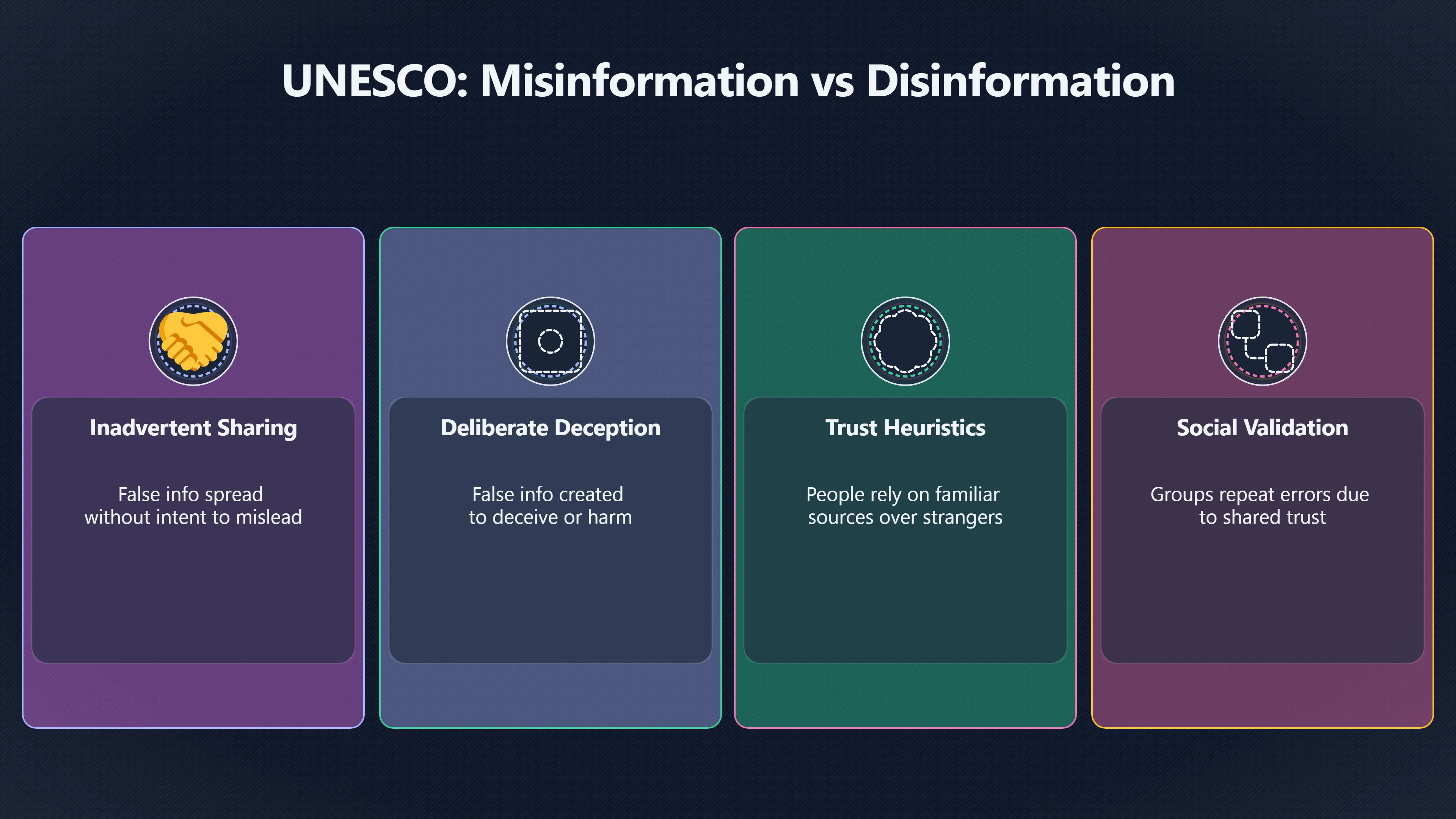
Correcting myths and misconceptions becomes harder when every false claim is treated as evidence of bad character. A common failure in misinformation responses is to assume that anyone repeating a falsehood must be deliberately deceptive. In reality, research and policy organisations consistently distinguish between misinformation—false information shared without intent to mislead—and disinformation, which is spread with the intention of deceiving or causing harm.[UNESCO]unesco.orgWhat is Misinformation? Meaning, Definition.Misinformation is false information that is shared inadvertently, without meaning to ca…[UNESCO]unesco.orghaving intention to deceive. Explore further with…Read more…
 This distinction matters for governance, public trust and effective correction. If sincere mistakes are treated as malicious acts, people become less willing to admit error, communities become more defensive, and resources meant for combating organised deception can be misdirected toward ordinary citizens who were simply mistaken. At the same time, assuming good faith in every case can leave harmful campaigns unchallenged. The challenge is not choosing between trust and scepticism; it is learning how to assess intent carefully enough to correct false claims without misidentifying the people involved.
The Difference Between Misinformation and Disinformation
The distinction between misinformation and disinformation is not merely academic. It shapes how institutions, platforms, journalists and citizens decide to respond.
UNESCO, parliamentary bodies, academic reviews and professional media-literacy frameworks all identify intent as the central dividing line. Misinformation refers to false information shared inadvertently or without an intention to mislead. Disinformation refers to false information deliberately created or spread to deceive.[PMC]pmc.ncbi.nlm.nih.govMisinformation, False information that is shared without the intention to mislead or to cause harm, Not to mislead…Read more…[UNESCO]unesco.orgUnit 2: The Misinformation and Disinformation Ecosystem11 Apr 2024 — Distinguish the different types of false and misleading conten…[UNESCO]unesdoc.unesco.orgdisinformation and misinformation. The spread of disinformation and misinformation is made possible largely through social networks and s…
This distinction is important because the same false claim may appear in very different contexts:
- A person shares an inaccurate health tip because a relative recommended it.
- A community group repeats a rumour that appears credible within its social network.
- A coordinated operation knowingly distributes fabricated material to influence public opinion.
The factual error may be identical, but the intent behind its spread differs substantially. Treating all three cases as equally malicious collapses a useful analytical distinction and can lead to ineffective responses. UNESCO[Carnegie Endowment]carnegieendowment.orgcountering disinformation effectively an evidence based policy guideCarnegie EndowmentCountering Disinformation Effectively: An Evidence-Based…31 Jan 2024 — A high-level, evidence-informed guide to some…
Research on misinformation repeatedly finds that belief in false information is often connected to limited information, cognitive shortcuts, source trust or lack of attention rather than deliberate dishonesty. Studies by Gordon Pennycook and colleagues, for example, challenge the assumption that people primarily share false content because of ideological commitment or conscious deception. Instead, many users simply fail to assess accuracy carefully before sharing.[ScienceDirect]sciencedirect.comPoor truth…Read more…
Why Ordinary Trust Networks Spread Sincere Falsehoods
One reason intent is frequently misread is that people often imagine false information moving through society as a deliberate campaign. In practice, many false claims spread through ordinary social relationships.
Trust Often Matters More Than Verification
People rarely investigate every claim they encounter. Daily life depends on trust in family members, friends, colleagues, community leaders and familiar media sources. When information arrives through a trusted relationship, it often receives less scrutiny than information from a stranger.
Research on misinformation highlights the importance of source heuristics, familiarity effects and social cues in shaping belief. People frequently rely on signals such as who shared the information or whether they have encountered it before, rather than conducting a detailed evaluation of the evidence. ScienceDirect[Nature As a result]nature.comThe psychological drivers of misinformation belief and its…by UKH Ecker · 2022 · Cited by 1919 — In this Review, we describe the cogni…, a person can become an enthusiastic promoter of a false claim while genuinely believing they are helping others. The behaviour may be harmful, but the motivation is often sincere.
Communities Can Amplify Errors Without Malice
False information does not require a central organiser to spread widely. Communities sometimes reinforce incorrect claims because members trust one another, share similar experiences or draw on the same information sources.
International and governmental reviews note that misinformation often spreads unintentionally and that trusted sources play a major role in determining whether information is accepted and shared. Repetition, emotional resonance and social validation can all increase circulation even when no participant intends deception.[Research Briefings]researchbriefings.files.parliament.ukResearch Briefings Disinformation: sources, spread and impactResearch BriefingsDisinformation: sources, spread and impactApril 26, 2024 — 25 Apr 2024 — People may intentionally share disinformation… ScienceDirect This creates a common correction mistake: interpreting confidence as evidence of bad faith. People may defend a false belief strongly because[sciencedirect.com]sciencedirect.comPoor truth…Read more… it comes from someone they trust, not because they know it is false.
What Happens When Corrections Misread Intent
Assuming malicious intent where none exists can undermine correction efforts in several ways.
First, it changes the social meaning of the correction. Instead of communicating, “This information is inaccurate,” the correction communicates, “You are dishonest.” The recipient is then responding not only to a factual challenge but also to a moral accusation.
Second, it makes updating beliefs more costly. A person who made an honest mistake can often acknowledge new evidence. A person accused of spreading lies may feel pressure to defend their reputation before they can evaluate the facts.
Third, it can reduce trust in institutions that conduct fact-checking or moderation. If people perceive corrective efforts as unfairly attributing malicious motives, they may reject the correction itself regardless of its accuracy. Research on misinformation correction consistently emphasises that social and psychological factors influence whether corrections are accepted. PMC[nature]nature.comThe psychological drivers of misinformation belief and its…by UKH Ecker · 2022 · Cited by 1919 — In this Review, we describe the cogni… There is also a governance cost. Over-attributing bad intent can blur the distinction between ordinary misinformation and coordinated disinformation campaigns. Analysts and policymakers may then spend less effort identifying genuinely organised actors because everyone spreading false information is treated as part of the same problem. Scholars studying disinformation have argued that understanding organised deception requires attention to strategy, coordination and intent rather than focusing solely on whether content is false.[arXiv]arxiv.orgDisambiguating Disinformation: Extending Beyond the Veracity of Online ContentJune 26, 2022…

Why Intent Is Difficult to Judge
Intent is one of the hardest elements of misinformation analysis because it is usually inferred rather than directly observed.
A person may continue sharing a false claim because:
- They have not seen corrective information.
- They distrust the correcting source.
- They misunderstood the correction.
- They are motivated by identity or group loyalty.
- They knowingly wish to mislead others.
The outward behaviour can appear similar in each case.
Recent research has explored ways of distinguishing intentional from unintentional spreaders, precisely because intent cannot simply be assumed from a single post or statement. Behaviour over time—especially how individuals react when confronted with reliable corrections—often provides stronger evidence than the original act of sharing alone.[arXiv]arxiv.orgDisambiguating Disinformation: Extending Beyond the Veracity of Online ContentJune 26, 2022…
This uncertainty is why many institutions use cautious terminology. The UK Parliament, for example, has stated that it prefers the term “misinformation” when purposeful intent cannot be clearly established and reserves “disinformation” for cases where intent to mislead is evident.[UK Parliament]publications.parliament.ukUK Parliament Chapter 2: Informed CitizensUK ParliamentChapter 2: Informed Citizens - Parliament UKIn our Report we use 'misinformation' where it is unclear if there was purposefu…
When Firmer Correction Is Justified by Harm or Bad Faith
Avoiding assumptions about intent does not mean treating every case gently or indefinitely extending the benefit of the doubt.
There are situations where stronger responses become justified.
Repeated Refusal After Reliable Corrections
When an individual or organisation repeatedly receives accurate corrective information yet continues to promote the same falsehood, the evidence for innocent error becomes weaker. Persistence alone does not prove malicious intent, but repeated behaviour after correction can provide a stronger basis for concern.[arXiv]arxiv.orgDisambiguating Disinformation: Extending Beyond the Veracity of Online ContentJune 26, 2022…
Evidence of Coordination or Strategic Deception
Disinformation campaigns often involve indicators that go beyond a single false claim. These can include coordinated messaging, fabricated evidence, networks of accounts acting together, or deliberate attempts to disguise the source of information. Researchers increasingly emphasise that organised deception is best identified through patterns of behaviour rather than isolated inaccuracies.[arXiv]arxiv.orgDisambiguating Disinformation: Extending Beyond the Veracity of Online ContentJune 26, 2022…
Significant Public Harm
In some circumstances, the potential consequences are severe enough that institutions must act even when intent remains uncertain. Public-health emergencies, election administration, disaster response and security incidents often require rapid intervention because delays can increase harm. In such cases, governance decisions frequently focus on the risk posed by the information rather than waiting for definitive proof of motive.[Carnegie Endowment]carnegieendowment.orgcountering disinformation effectively an evidence based policy guideCarnegie EndowmentCountering Disinformation Effectively: An Evidence-Based…31 Jan 2024 — A high-level, evidence-informed guide to some…[2communications.gov.uk]communications.gov.ukRESIST 2 Counter-disinformation toolkitIt explains the differences between misinformation, disinformation and malinformation and why thes…
Even then, separating the false claim from assumptions about the speaker’s motives remains valuable. A harmful statement can be corrected forcefully without claiming certainty about why it was made.
A More Accurate Approach to Correction
The most effective corrections often begin with a simple recognition: being wrong and being malicious are not the same thing.
A correction that distinguishes between misinformation and disinformation can acknowledge uncertainty about motives while remaining firm about facts. It can challenge the claim without automatically condemning the person. This approach preserves the ability to identify genuine bad actors while giving ordinary people room to revise their views.
For myths and misconceptions, that distinction is more than a matter of politeness. It is a practical tool for understanding how false beliefs spread, why corrections succeed or fail, and how institutions can respond proportionately. When intent is misread, both the mistaken individual and the deliberate deceiver may end up treated the same way. Effective correction depends on recognising that they are not.
Amazon book picks
Further Reading
Books and field guides related to Mistaken Is Not Always Malicious. Use these as the next step if you want deeper reading beyond the article.
Mistakes Were Made (but Not by Me) Third Edition
Explains why people defend errors without bad intent.

eBay marketplace picks
Marketplace Samples
Example marketplace items related to this page. Use the search link to explore similar finds on eBay.

Endnotes
1.
Source: unesco.org
Link:https://www.unesco.org/en/query-list/m/misinformation
Source snippet
What is Misinformation? Meaning, Definition.Misinformation is false information that is shared inadvertently, without meaning to ca...
2.
Source: unesco.org
Link:https://www.unesco.org/en/tags/disinformation-0
Source snippet
having intention to deceive. Explore further with...Read more...
3.
Source: publications.parliament.uk
Title: UK Parliament Chapter 2: Informed Citizens
Link:https://publications.parliament.uk/pa/ld5801/ldselect/lddemdigi/77/7706.htm
Source snippet
UK ParliamentChapter 2: Informed Citizens - Parliament UKIn our Report we use 'misinformation' where it is unclear if there was purposefu...
4.
Source: pmc.ncbi.nlm.nih.gov
Link:https://pmc.ncbi.nlm.nih.gov/articles/PMC9910783/
Source snippet
Misinformation, False information that is shared without the intention to mislead or to cause harm, Not to mislead...Read more...
5.
Source: unesco.org
Link:https://www.unesco.org/mil4teachers/en/module4/unit2
Source snippet
Unit 2: The Misinformation and Disinformation Ecosystem11 Apr 2024 — Distinguish the different types of false and misleading conten...
6.
Source: unesdoc.unesco.org
Link:https://unesdoc.unesco.org/ark%3A/48223/pf0000265552
Source snippet
disinformation and misinformation. The spread of disinformation and misinformation is made possible largely through social networks and s...
7.
Source: sciencedirect.com
Link:https://www.sciencedirect.com/science/article/pii/S1364661321000516
Source snippet
Poor truth...Read more...
8.
Source: nature.com
Link:https://www.nature.com/articles/s44159-021-00006-y
Source snippet
The psychological drivers of misinformation belief and its...by UKH Ecker · 2022 · Cited by 1919 — In this Review, we describe the cogni...
9.
Source: sciencedirect.com
Link:https://www.sciencedirect.com/science/article/pii/S2352250X23001847
Source snippet
The four stages are source selection, information selection, evaluation...Read more...
10.
Source: researchbriefings.files.parliament.uk
Title: Research Briefings Disinformation: sources, spread and impact
Link:https://researchbriefings.files.parliament.uk/documents/POST-PN-0719/POST-PN-0719.pdf
Source snippet
Research BriefingsDisinformation: sources, spread and impactApril 26, 2024 — 25 Apr 2024 — People may intentionally share disinformation...
Published: April 26, 2024
11.
Source: sciencedirect.com
Link:https://www.sciencedirect.com/org/science/article/pii/S2564189124000331
Source snippet
It is often spread by individuals who believe the information to be true...Read more...
12.
Source: pmc.ncbi.nlm.nih.gov
Link:https://pmc.ncbi.nlm.nih.gov/articles/PMC8979789/
Source snippet
Investigation of the determinants for misinformation correction...by Y Zhang · 2022 · Cited by 71 — This study explores determinants...
13.
Source: arxiv.org
Link:https://arxiv.org/abs/2206.12915
Source snippet
Disambiguating Disinformation: Extending Beyond the Veracity of Online ContentJune 26, 2022...
Published: June 26, 2022
14.
Source: arxiv.org
Link:https://arxiv.org/abs/2202.04752
Source snippet
February 9, 2022...
Published: February 9, 2022
15.
Source: arxiv.org
Link:https://arxiv.org/abs/2305.00957
16.
Source: communications.gov.uk
Link:https://www.communications.gov.uk/wp-content/uploads/2021/11/RESIST-2-counter-disinformation-toolkit.pdf
Source snippet
RESIST 2 Counter-disinformation toolkitIt explains the differences between misinformation, disinformation and malinformation and why thes...
17.
Source: unesco.org
Link:https://www.unesco.org/en/query-list/d/disinformation
Source snippet
having intention to deceive. Explore further with...Read more...
18.
Source: unesco.org
Title: deepfakes and crisis knowing
Link:https://www.unesco.org/en/articles/deepfakes-and-crisis-knowing
Source snippet
Deepfakes and the crisis of knowing27 Oct 2025 — The rise of AI-augmented disinformation and misinformation demands a fundamental shift i...
19.
Source: unesco.org
Title: What is Misinformation?
Link:https://www.unesco.org/en/tags/misinformation-0
Source snippet
Meaning, Definition.Misinformation is false information that is shared inadvertently, without meaning to cause harm. The terms misinforma...
20.
Source: moadoph.gov.au
Link:https://moadoph.gov.au/explore/democracy/what-is-the-difference-between-misinformation-and-disinformation
Source snippet
What is the difference between misinformation and...This glossary will help you navigate the lingo associated with misinformation, fake...
21.
Source: carnegieendowment.org
Title: countering disinformation effectively an evidence based policy guide
Link:https://carnegieendowment.org/russia-eurasia/research/2024/01/countering-disinformation-effectively-an-evidence-based-policy-guide
Source snippet
Carnegie EndowmentCountering Disinformation Effectively: An Evidence-Based...31 Jan 2024 — A high-level, evidence-informed guide to some...
22.
Source: facebook.com
Link:https://www.facebook.com/mgiep/posts/false-information-created-deliberately-to-misinform-and-mislead-others-with-the-/1140017351493368/
Source snippet
unesco mgiepThe key difference between misinformation and disinformation lies in the intent behind the spread of false information: Misin...
23.
Source: mediadefence.org
Link:https://www.mediadefence.org/resource-hub/false-news-misinformation-and-propaganda-europe/
Source snippet
'False News', Misinformation & Propaganda - EuropeWhile misinformation and disinformation are premised on the dissemination of [false info]({{ 'false-info/' | relative_url }})...
24.
Source: Wikipedia
Link:https://en.wikipedia.org/wiki/Misinformation
Source snippet
MisinformationWhereas misinformation can exist with or without specific malicious intent, disinformation is deliberately deceptive and...
Additional References
25.
Source: apa.org
Link:https://www.apa.org/topics/journalism-facts/misinformation-disinformation
Source snippet
Misinformation and disinformationMisinformation is false or inaccurate information—getting the facts wrong. Disinformation is false infor...
26.
Source: mediadefence.org
Link:https://www.mediadefence.org/ereader/publications/modules-on-litigating-freedom-of-expression-and-digital-rights-in-south-and-southeast-asia/module-8-false-news-misinformation-and-propaganda/misinformation-disinformation-and-mal-information/
Source snippet
Misinformation, Disinformation and Mal-informationMisinformation, Disinformation and Mal-information · Module 8: 'False news', misinforma...
27.
Source: mediadefence.org
Link:https://www.mediadefence.org/ereader/publications/modules-digital-rights-europe/module-5-disinformation-misinformation/false-news/
Source snippet
What is 'False News'? | eReaderLastly, misinformation entails false or misleading content shared inadvertently, lacking the malicious int...
28.
Source: pmc.ncbi.nlm.nih.gov
Title: PMC(Why) Is Misinformation a Problem?
Link:https://pmc.ncbi.nlm.nih.gov/articles/PMC10623619/
Source snippet
by Z Adams · 2023 · Cited by 146 — The overarching negative effect of misinformation comes from the argument that without an accuratel...
29.
Source: ofcom.org.uk
Title: misinformation and disinformation literature review
Link:https://www.ofcom.org.uk/siteassets/resources/documents/research-and-data/media-literacy-research/mis-and-disinformation/misinformation-and-disinformation-literature-review.pdf?v=397787
Source snippet
and Disinformation: Literature Review27 May 2025 — This briefing provides an overview of the available academic and grey literature on mi...
Published: May 2025
30.
Source: researchportal.port.ac.uk
Title: The review identified five themes. The theme of fabricated.Read more
Link:https://researchportal.port.ac.uk/files/63065979/Thesis.pdf
Source snippet
media misinformation and [fake news]({{ 'fake-news/' | relative_url }}): a consumer...by G Di Domenico · Cited by 4 — This paper represents the first systematic literature r...
31.
Source: unicef.org
Title: Misinformation and disinformation have
Link:https://www.unicef.org/innocenti/media/856/file/UNICEF-Global-Insight-Digital-Mis-Disinformation-and-Children-2021.pdf
Source snippet
Digital misinformation / disinformation and childrenby PN Howard · 2021 · Cited by 119 — Charges of 'fake news' to discredit legitimate b...
32.
Source: humanrights.ca
Link:https://humanrights.ca/resource-guide/misinformation-disinformation-and-malinformation
Source snippet
Misinformation, Disinformation and MalinformationMisinformation is false information that is shared, often inadvertently and without the...
33.
Source: digitallibrary.un.org
Title: ^EOSG 2023 8^ EOSG 2023 8 EN
Link:https://digitallibrary.un.org/record/4012857/files/%5EEOSG_2023_8%5E–EOSG_2023_8-EN.pdf
Source snippet
Integrity on Digital PlatformsMisinformation can be rooted in disinformation as delib- erate lies and misleading narratives are weaponize...
34.
Source: tandfonline.com
Title: Results show the field is mostly data-driven.Read more
Link:https://www.tandfonline.com/doi/full/10.1080/23808985.2024.2323736
Source snippet
Full article: Misinformation, disinformation, and fake newsby E Broda · 2024 · Cited by 348 — We have performed a systematic research rev...
Topic Tree