Within Tone
The Missing Piece in Many Corrections
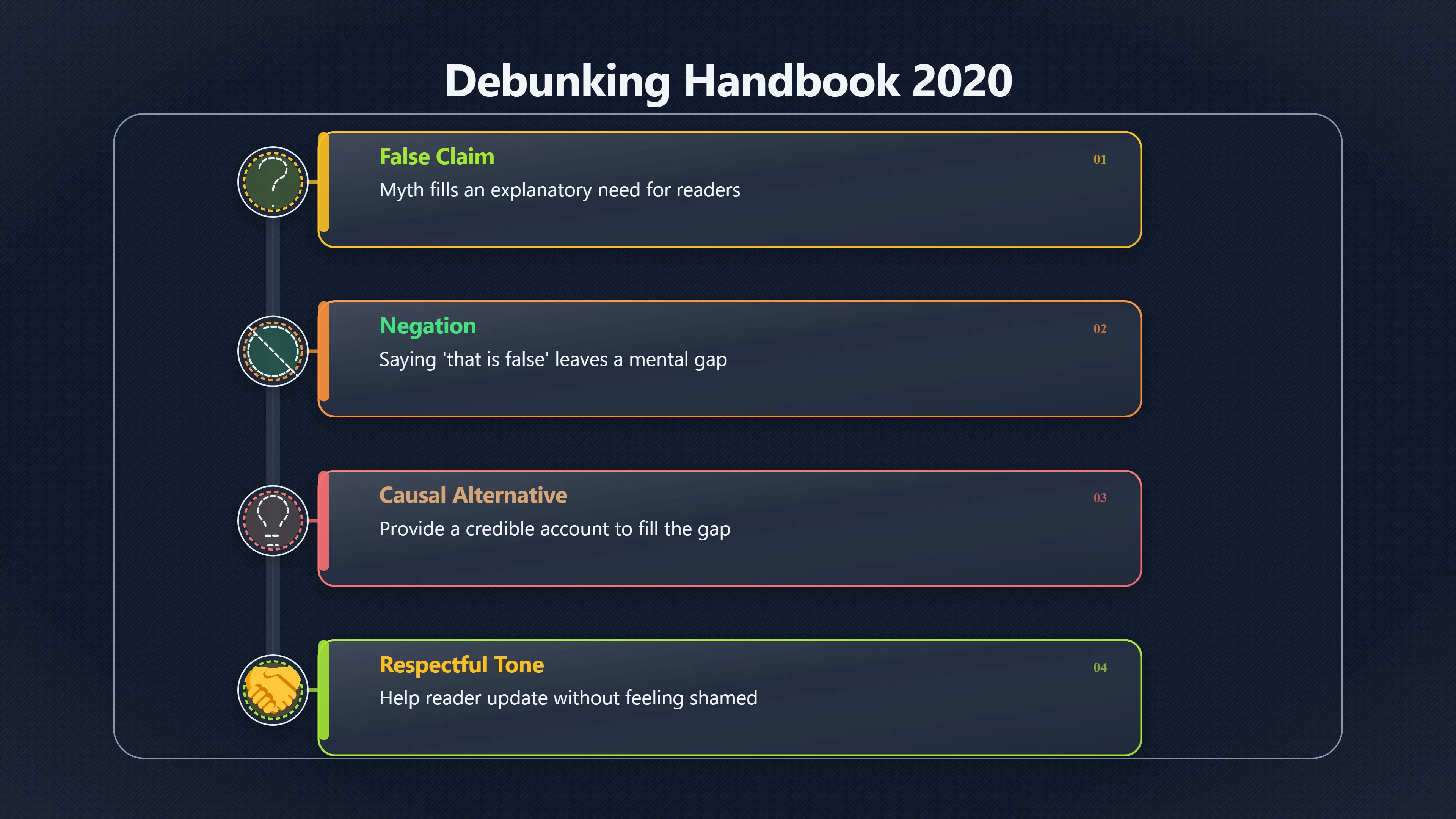
The strongest corrections do more than say a myth is wrong; they give readers a clearer explanation to use instead.
On this page
- Why simple negation leaves a mental gap
- How replacement facts make updating easier
- Before and after examples for myths, charts, and old images
Page outline Jump by section
Introduction
Many corrections fail for a simple reason: they remove a false claim but leave nothing useful in its place. When people hear that a familiar explanation is wrong, they are often left with an unanswered question. If a correction merely says “that’s false”, readers may continue relying on the myth because it still provides the only available explanation they can remember. Research on misinformation consistently finds that corrections work better when they replace the false account with a credible alternative explanation rather than simply negating it.[Brown Climate Social Science Network]cssn.orgDB2020paper 1Corrections are more effective if in addition to providing a simple retraction (“not true”), they propose a causal alternative, and gener…[Chapman University Digital Commons]digitalcommons.chapman.eduChapman University Digital CommonsA Meta-Analytic Examination of the Continued Influence of…by N Walter · 2019 · Cited by 642 — Rather…
 This matters especially when correcting myths without sounding condescending. A respectful correction does not just point out an error. It helps the reader understand what happened instead, why the misunderstanding arose, and what explanation best fits the evidence. The replacement explanation becomes an exit ramp: people can update their beliefs without feeling that they are being mocked, shamed, or left confused.[Center for Climate Change Communication]climatechangecommunication.orgCenter for Climate Change CommunicationDebunking HandbookOctober 11, 2020 — Corrections are most successful if people are suspicious, or…[Skeptical]skepticalscience.comSkeptical ScienceThe Debunking Handbook 2020: Debunk often and properly26 Oct 2020 — Provide a clear explanation of (1) why it is now cle…
The Missing Piece in Many Corrections
A myth often survives because it fills an explanatory need. It answers a question, links events together, or provides a simple cause for something people want to understand.
Psychologists studying the “continued influence effect” have repeatedly found that misinformation can continue shaping reasoning even after people learn that it is false. Simply retracting a claim does not always erase its influence because people have already incorporated it into their mental model of what happened. ScienceDirect[nature]nature.comThe psychological drivers of misinformation belief and its…by UKH Ecker · 2022 · Cited by 1916 — In this Review, we describe the… The practical implication is straightforward: if a correction removes a familiar explanation, it should offer another explanation that makes at least as much sense.
Researchers behind the Debunking Handbook describe this as “filling the gap”. When misinformation is removed, a gap appears in the reader’s understanding. Effective debunking fills that gap with an alternative account that explains the facts more accurately. Corrections that include a causal alternative are generally more successful than corrections that merely state that a claim is untrue.[Skeptical Science]skepticalscience.comSkeptical ScienceThe Debunking Handbook 2020: Debunk often and properly26 Oct 2020 — Provide a clear explanation of (1) why it is now cle…[Shaping]shapingtomorrowsworld.orgThe Debunking Handbook Part 5: Filling the gap with an…by S Lewandowsky — The most effective way to reduce the effect of misinformatio…
This approach is also less likely to sound patronising. “That’s wrong” can feel like a judgement. “Here’s what actually happened” feels more like assistance.
Why Simple Negation Leaves a Mental Gap
People rarely store isolated facts. They organise information into stories, causes, and relationships.
If someone believes that a disease outbreak was caused by a specific rumour, a correction that merely says “that rumour is false” leaves an unresolved question: what caused the outbreak? If no answer is supplied, the original claim retains some usefulness because it still explains the event.[ResearchGate]researchgate.netResearchGate(PDF) Misinformation and Its Correction Continued…We look at people's memory for misinformation and answer the questions o…
Research literature repeatedly notes that misinformation remains influential when corrections fail to preserve explanatory coherence. People prefer a complete, internally consistent account over a fragmented one. A replacement explanation helps maintain coherence while removing the inaccurate element. Brown Climate Social Science Network[Ecker Memory & Cognition Lab]emc-lab.orgEcker Memory & Cognition Lab HighlightsThe data suggest…Read more…
This is one reason respectful debunking often sounds more informative than argumentative. The goal is not to win a dispute. The goal is to help someone replace an outdated mental model with a better one.
Consider the difference:
- Negation only: “No, that chart does not prove crime increased.”
- Replacement explanation: “That chart starts during an unusually low year, which makes later numbers appear dramatic. Looking at the full decade shows crime remained within its normal range.”
The second response answers the reader’s likely follow-up question before it is asked.
How Replacement Facts Make Updating Easier
Replacement explanations work best when they do more than provide a competing fact. They should explain why the myth appeared convincing in the first place and what evidence points elsewhere.
Several recurring patterns appear in successful corrections:
A better cause.
If a myth claims Event A caused Event B, provide the actual cause or the strongest available evidence for it. People update more easily when one explanation is exchanged for another rather than removed entirely. Brown Climate Social Science Network[Laboratory of Tree-Ring Research]ltrr.arizona.eduDebunking Handbookby S Lewandowsky — The most effective way to reduce the effect of misinformation is to provide an alternative explanati…
A better interpretation.
Sometimes the facts are real but the interpretation is mistaken. A replacement explanation can show how the same evidence leads to a different conclusion.
A better source account.
In some cases the missing explanation concerns the misinformation itself. Explaining where a false claim originated, how a photo was miscaptioned, or why a graph was cropped can help readers understand both what is false and how the error emerged. Research suggests that drawing attention to the source or intent of misinformation can improve correction effectiveness.[Center for Climate Change Communication]climatechangecommunication.orgCenter for Climate Change CommunicationDebunking HandbookOctober 11, 2020 — Corrections are most successful if people are suspicious, or…[Shaping]shapingtomorrowsworld.orgThe Debunking Handbook Part 5: Filling the gap with an…by S Lewandowsky — The most effective way to reduce the effect of misinformatio…
A complete narrative.
The replacement should account for the key observations that made the myth attractive. If the myth seems to explain three visible facts, the correction should explain those facts too. Otherwise readers may feel that important questions remain unanswered.[Skeptical Science]skepticalscience.comSkeptical ScienceThe Debunking Handbook 2020: Debunk often and properly26 Oct 2020 — Provide a clear explanation of (1) why it is now cle…[Shaping]shapingtomorrowsworld.orgThe Debunking Handbook Part 5: Filling the gap with an…by S Lewandowsky — The most effective way to reduce the effect of misinformatio…
Before-and-After Examples for Myths, Charts, and Old Images
Myth correction
A common mistake is to focus entirely on the error.
Before
“That’s a myth. The claim is false.”
This establishes disagreement but does little to help the reader rebuild their understanding.
After
“That claim is false. The confusion comes from an early study that was later found to contain major methodological problems. Larger studies using better data found no such effect.”
The second version not only rejects the myth but explains why the myth existed and what evidence replaced it.
Misleading chart
Charts often become persuasive because they appear objective.
Before
[“This graph is misleading.”]bristol.ac.ukdebunking handbookOctober: Debunking Handbook | News and features14 Oct 2020 — "This handbook helps explain how best to combat misinformation, namely throu…
Readers may wonder how.
After
“This graph uses a truncated vertical axis, which exaggerates small changes. When the same data are displayed on a full scale, the trend becomes much less dramatic.”
The correction replaces suspicion with an understandable mechanism.
Old or miscaptioned image
Viral images frequently survive fact-checking because people remember the image more clearly than the correction.
Before
“This photo is not from the event being discussed.”
After
“This photo is genuine, but it was taken three years earlier during a different incident. The image was later reposted with a new caption that incorrectly linked it to the current event.”
The replacement explanation preserves the reality of the image while correcting the mistaken context.

What Makes a Good Replacement Explanation?
Not every alternative explanation improves a correction. Research and practitioner guidance suggest several qualities matter.[Center for Climate Change Communication]climatechangecommunication.orgCenter for Climate Change CommunicationDebunking HandbookOctober 11, 2020 — Corrections are most successful if people are suspicious, or…[Brown Climate Social Science Network]cssn.orgDB2020paper 1Corrections are more effective if in addition to providing a simple retraction (“not true”), they propose a causal alternative, and gener…
A useful replacement should be:
- Plausible, fitting the available evidence.
- Complete enough to answer the main question left by the myth.
- Simple enough to remember.
- Relevant to the original claim, rather than introducing unrelated facts.
- Respectful in tone, helping readers update rather than defend themselves.
Importantly, a replacement explanation is not the same as overwhelming someone with information. The Debunking Handbook and related research warn that excessive complexity can reduce effectiveness. A concise explanation that resolves the key confusion is usually more useful than a lengthy technical lecture. Center for Climate Change Communication[Digital Commons]digitalcommons.chapman.eduChapman University Digital CommonsA Meta-Analytic Examination of the Continued Influence of…by N Walter · 2019 · Cited by 642 — Rather…
Replacements Reduce the Need for Shame
Corrections become condescending when they focus on the person’s failure: how they should have known better, how gullible they were, or how obvious the truth supposedly was.
Replacement explanations shift attention away from the person’s mistake and towards the evidence. Instead of highlighting incompetence, they highlight understanding.
Compare these approaches:
- “Anyone who looked closely would see this is fake.”
- “The image looks convincing because the original context was removed. Here’s where it was actually taken.”
Both challenge the claim. Only one helps the reader understand the error without implying stupidity.
This distinction matters because belief revision is often easier when people can adopt a new explanation without feeling that they are surrendering social status or admitting personal inadequacy. Respectful debunking creates room for learning. Replacement explanations provide the substance that fills that room.[Nature]nature.comThe psychological drivers of misinformation belief and its…by UKH Ecker · 2022 · Cited by 1916 — In this Review, we describe the…[ScienceDirect]sciencedirect.comThe rational continued influence of misinformationby SAC Desai · 2020 · Cited by 71 — Studies on the 'Continued Influence Ef…
The Practical Takeaway
The strongest corrections do not stop at saying a myth is wrong. They answer the question that made the myth attractive in the first place.
A correction that only negates leaves a vacuum. A correction that supplies a clear alternative explanation gives people something better to remember, repeat, and rely on. Evidence from misinformation research repeatedly points in the same direction: when a false claim is replaced by a coherent and credible explanation, belief updating becomes easier and the correction is more likely to endure. [Laboratory of Tree-Ring Research+3Brown Climate Social Science Network+3Chapman University Digital Commons]

eBay marketplace picks
Marketplace Samples
Example marketplace items related to this page. Use the search link to explore similar finds on eBay.



Endnotes
1.
Source: digitalcommons.chapman.edu
Link:https://digitalcommons.chapman.edu/cgi/viewcontent.cgi?article=1061&context=comm_articles
Source snippet
Chapman University Digital CommonsA Meta-Analytic Examination of the Continued Influence of...by N Walter · 2019 · Cited by 642 — Rather...
2.
Source: nature.com
Link:https://www.nature.com/articles/s44159-021-00006-y
Source snippet
The psychological drivers of misinformation belief and its...by UKH Ecker · 2022 · Cited by 1916 — In this Review, we describe the...
3.
Source: sciencedirect.com
Link:https://www.sciencedirect.com/science/article/abs/pii/S0010027720302729
Source snippet
The rational continued influence of misinformationby SAC Desai · 2020 · Cited by 71 — Studies on the 'Continued Influence Ef...
4.
Source: researchgate.net
Link:https://www.researchgate.net/publication/258180567_Misinformation_and_Its_Correction_Continued_Influence_and_Successful_Debiasing
Source snippet
ResearchGate(PDF) Misinformation and Its Correction Continued...We look at people's [memory]({{ 'memory/' | relative_url }}) for misinformation and answer the questions o...
5.
Source: sciencedirect.com
Link:https://www.sciencedirect.com/science/article/pii/S004727272500043X
Source snippet
Debunking “[fake news]({{ 'fake-news/' | relative_url }})” on social media: Immediate and...by LM Berger · 2025 · Cited by 21 — We conduct a randomized survey experiment to...
6.
Source: cssn.org
Title: DB2020paper 1
Link:https://cssn.org/wp-content/uploads/2020/10/DB2020paper-1.pdf
Source snippet
Corrections are more effective if in addition to providing a simple retraction (“not true”), they propose a causal alternative, and gener...
7.
Source: climatechangecommunication.org
Link:https://www.climatechangecommunication.org/wp-content/uploads/2023/09/DebunkingHandbook2020.pdf
Source snippet
Center for Climate Change CommunicationDebunking HandbookOctober 11, 2020 — Corrections are most successful if people are suspicious, or...
Published: October 11, 2020
8.
Source: skepticalscience.com
Link:https://skepticalscience.com/print.php?n=4891
Source snippet
Skeptical ScienceThe Debunking Handbook 2020: Debunk often and properly26 Oct 2020 — Provide a clear explanation of (1) why it is now cle...
9.
Source: skepticalscience.com
Title: Debunking Handbook Part 5 Filling gap with alternative explanation
Link:https://skepticalscience.com/Debunking-Handbook-Part-5-Filling-gap-with-alternative-explanation.html
Source snippet
Skeptical ScienceThe Debunking Handbook Part 5: Filling the gap with an...25 Nov 2011 — The most effective way to reduce the effect of m...
10.
Source: shapingtomorrowsworld.org
Link:https://www.shapingtomorrowsworld.org/debunking-handbook-part-5-filling-gap-with-alternative-explanation.html
Source snippet
The Debunking Handbook Part 5: Filling the gap with an...by S Lewandowsky — The most effective way to reduce the effect of misinformatio...
11.
Source: emc-lab.org
Title: Ecker Memory & Cognition Lab Highlights
Link:https://www.emc-lab.org/uploads/1/1/3/6/113627673/ecker.2015.jml.pdf
Source snippet
The data suggest...Read more...
12.
Source: ltrr.arizona.edu
Link:https://www.ltrr.arizona.edu/~katie/kt/natsgc/Debunking_Handbook.pdf
Source snippet
Debunking Handbookby S Lewandowsky — The most effective way to reduce the effect of misinformation is to provide an alternative explanati...
13.
Source: climatecommunication.gmu.edu
Title: the debunking handbook 2020
Link:https://climatecommunication.gmu.edu/all/the-debunking-handbook-2020/
Source snippet
Center for Climate Change CommunicationThe Debunking Handbook 202013 Sept 2023 — The Debunking Handbook 2020 summarizes the current state...
14.
Source: digitalcommons.unl.edu
Link:https://digitalcommons.unl.edu/context/scholcom/article/1247/viewcontent/DebunkingHandbook2020.pdf
Source snippet
Digital CommonsThe Debunking Handbook 2020 - DigitalCommons@UNLby S Lewandowsky · Cited by 502 — Corrections are most successful if peopl...
15.
Source: shapingtomorrowsworld.org
Link:https://www.shapingtomorrowsworld.org/debunking-handbook-part-2-familiarity-[backfire
Source snippet
Shaping Tomorrows WorldThe Debunking Handbook Part 2: The Familiarity Backfire Effect18 Nov 2011 — Ideally, avoid mentioning the myth alt...
16.
Source: shapingtomorrowsworld.org
Link:https://www.shapingtomorrowsworld.org/debunking-handbook-part-1-first-myth-about-debunking.html
Source snippet
ive explanation that accounts for important qualities in the original misinformation.Read more...
17.
Source: etd.ohiolink.edu
Link:https://etd.ohiolink.edu/acprod/odb_etd/ws/send_file/send?accession=osu1638809124303347&disposition=inline
Source snippet
ohiolink.edu1 Mechanisms in Continued Influence of Misinformationby VL Westbrook · 2022 · Cited by 1 — Research on the CIE has shown that...
18.
Source: bristol.ac.uk
Title: debunking handbook
Link:https://www.bristol.ac.uk/news/2020/october/debunking-handbook-.html
Source snippet
October: Debunking Handbook | News and features14 Oct 2020 — "This handbook helps explain how best to combat misinformation, namely throu...
Additional References
19.
Source: communityengagementhub.org
Link:https://communityengagementhub.org/resource/the-debunking-handbook/
Source snippet
The debunking handbookA handbook on how to prevent and debunk misinformation. Available in multiple languages. Related Resources. Managin...
20.
Source: research-information.bris.ac.uk
Link:https://research-information.bris.ac.uk/files/298563464/Ecker_v4_TSshorten_UE_clean.pdf
21.
Source: youtube.com
Link:https://www.youtube.com/watch?v=iQRSZpBWoPE
Source snippet
These videos are relevant because they explore the psychological "continued influence effect" and the necessity of providing replacement...
22.
Source: education.umd.edu
Title: 10 14 20 debunking handbook 2020 countering misinformation
Link:https://education.umd.edu/news/10-14-20-debunking-handbook-2020-countering-misinformation
Source snippet
Handbook 2020: Countering Misinformation14 Oct 2020 — The Debunking Handbook 2020 aims to do just that by summarizing the current state o...
23.
Source: fondationdescartes.org
Title: how to effectively correct misinformation
Link:https://www.fondationdescartes.org/en/2020/07/how-to-effectively-correct-misinformation/
Source snippet
?Jun 30, 2020 — How can belief in misinformation be effectively corrected? Researchers in cognitive psychology investigate a series of so...
24.
Source: misinforeview.hks.harvard.edu
Link:https://misinforeview.hks.harvard.edu/article/correcting-campaign-misinformation-experimental-evidence-from-a-two-wave-panel-study/
Source snippet
evidence from a two-wave panel studyby L Horvath · 2024 · Cited by 1 — Correcting campaign misinformation: Experimental evidence from a t...
25.
Source: elias-tsakas.com
Title: Updating Misinformation
Link:https://www.elias-tsakas.com/Research/Papers/UpdatingMisinformation.pdf
Source snippet
(2010) study the influence of ex-ante warning subjects about misinformation. They consider a setting with a causal narrative and retract...
26.
Source: youtube.com
Title: Ep4: Stephan Lewandowsky: Sticky Lies And Engineered Beliefs
Link:https://www.youtube.com/watch?v=nHz3SXsJb_E
Source snippet
Breaking Down Misleading Arguments & Why Science Communication Fails with John Cook | TGS 212...
27.
Source: youtube.com
Title: Why Continued Influence Effect is THE Most Important Phenomenon to Recognize
Link:https://www.youtube.com/watch?v=2jmF5z_ZNFE
Source snippet
Ep4: Stephan Lewandowsky: Sticky Lies And Engineered Beliefs...
28.
Source: pmc.ncbi.nlm.nih.gov
Link:https://pmc.ncbi.nlm.nih.gov/articles/PMC8627545/
Source snippet
by IP Kan · 2021 · Cited by 27 — Our results contribute to our understanding of how fake news persists and how we may begin to mitigat...
Topic Tree