Within Familiarity
How to correct a myth without boosting it
Good corrections lead with the truth, identify the trap carefully, and give readers a clearer explanation to remember.
On this page
- Lead with the accurate claim
- Warn before naming the myth
- Replace the myth with a better explanation
Page outline Jump by section
Introduction
Correcting a myth is not simply a matter of stating that it is wrong. Research on misinformation shows that people often remember the general idea of a claim long after they forget where they heard it or whether it was later corrected. Because familiar statements can feel more believable, a poorly written correction can accidentally strengthen the memory of the myth it is trying to remove.[Nature]nature.comThe psychological drivers of misinformation belief and its…by UKH Ecker 2022 Cited by 1916 In this Review, we describe the…[Ecker Memory & Cognition Lab]emc-lab.orgEcker Memory & Cognition LabMisinformation and its Correctionby B Swire Cited by 139 Even after people receive clear and credible cor…
 Effective corrections work differently. They make the accurate information more memorable than the false claim. Instead of centring the myth, they lead with the truth, signal clearly that the false claim is incorrect, and replace it with a better explanation that readers can hold onto. This approach has become a core recommendation in misinformation research and practical fact-checking guidance.[ltrr.arizona.edu]ltrr.arizona.eduThe Debunking HandbookNovember 25, 2011 by S Lewandowsky To avoid these backfire effects, an effective debunking requires three maj…[Center for Climate Change Communication]climatechangecommunication.orgCenter for Climate Change CommunicationDebunking HandbookBecause a myth is necessarily repeated when it is debunked, the risk arises that…
Lead with the accurate claim
The first information readers encounter often becomes the anchor for everything that follows. If a correction opens by repeating a myth in a headline or first sentence, the myth receives the most attention. If it opens with the factual claim, the fact becomes the anchor instead.
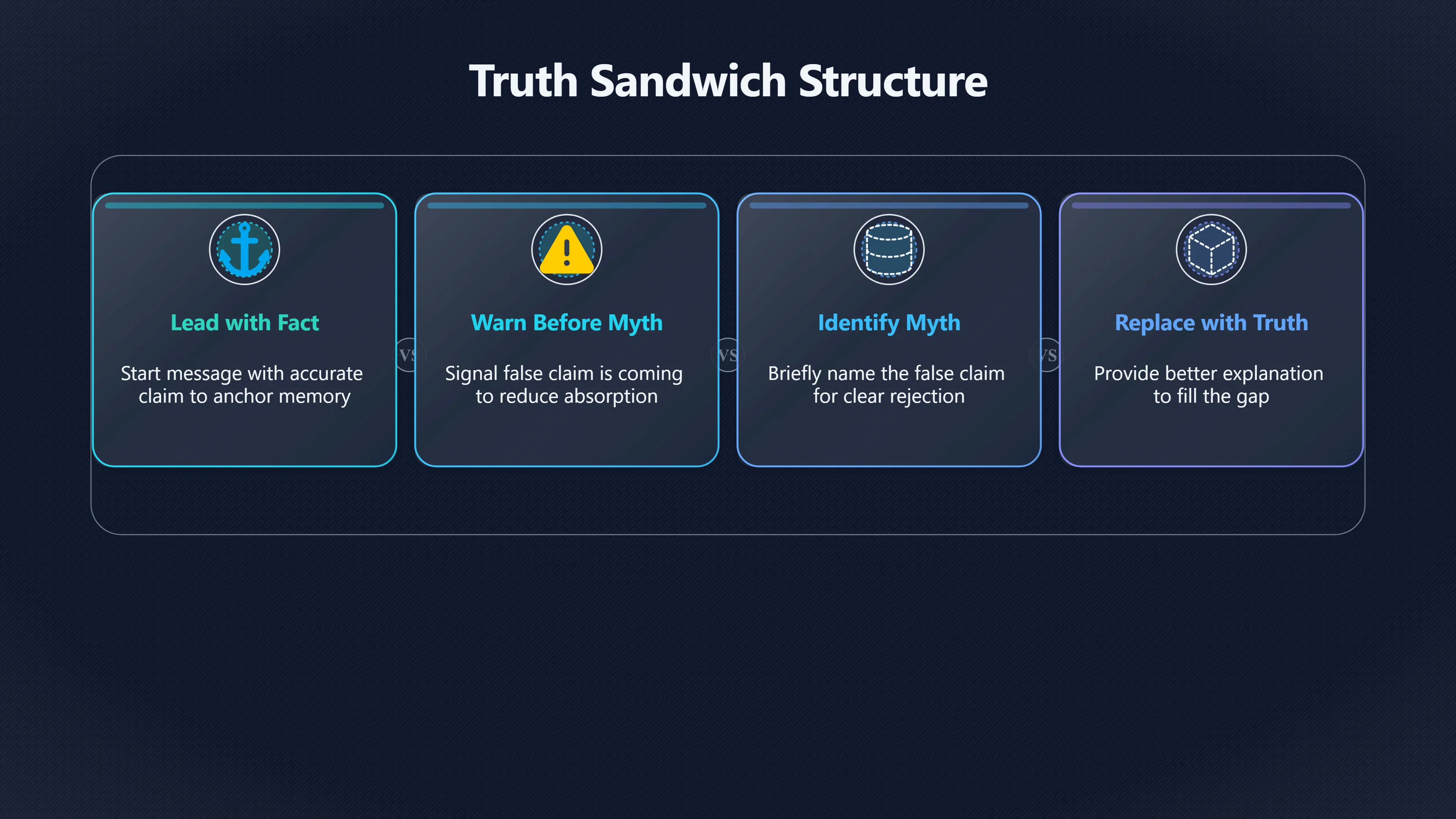
This is the logic behind the widely used “truth sandwich” approach. Rather than beginning with the falsehood, communicators start with what is known to be true, briefly address the misinformation, and then return to the factual explanation. The aim is not merely stylistic. It reflects evidence that repeated exposure can increase familiarity and perceived truthfulness, even when people later learn that the claim is false.[2ltrr.arizona.edu]ltrr.arizona.eduThe Debunking HandbookNovember 25, 2011 by S Lewandowsky To avoid these backfire effects, an effective debunking requires three maj…
Consider the difference:
- Weak correction: “No, vaccines do not alter your DNA.”
- Stronger correction: “Vaccines train the immune system to recognise disease. Claims that they alter DNA are incorrect.”
Both contain the same factual content, but the second version gives readers a true statement to remember before they encounter the myth.
This principle also applies to headlines, social posts and presentation slides. A headline such as “The Earth is warming because greenhouse gases trap heat” is generally safer than “No, climate change is not a hoax”. The factual frame appears first and remains the dominant message.[KSJ Handbook]ksjhandbook.orgKSJ Handbook Structuring Your ArgumentKSJ HandbookStructuring Your Argument - MisinformationThe fact-myth-fallacy structure when debunking a claim. This involves presenting…
Why leading with facts matters
People often retain the “gist” of information rather than its exact wording. Over time, they may remember that a topic was discussed without remembering whether the original claim was true or false.
That creates a risk for corrections built around myth repetition. A reader may later recall the familiar claim but forget the correction attached to it. Leading with the factual explanation increases the chance that the remembered gist is accurate.[Ecker Memory & Cognition Lab]emc-lab.orgEcker Memory & Cognition LabMisinformation and its Correctionby B Swire Cited by 139 Even after people receive clear and credible cor…
Researchers once worried that repeating a myth during correction could routinely produce a strong “familiarity backfire effect”. More recent reviews suggest that this effect is less robust than originally feared, and corrections usually help more than they harm. However, familiarity still matters, which is why communicators are encouraged to keep the factual information central rather than making the myth the star of the message. Brown Climate Social Science Network[PMC]pmc.ncbi.nlm.nih.govPMCCorrection format has a limited role when debunkingby B Swire-Thompson 2021 Cited by 79 This suggests that the standard format of leading with and then correcting a myth may be pr…
Warn before naming the myth
Sometimes a myth must be mentioned. Readers may not understand a correction if the false claim is never identified.
The key is to signal clearly that misinformation is coming before introducing it. A warning helps readers process the statement as something to reject rather than something to absorb.
A correction can use simple cues such as:
- “A common misconception is that…”
- “You may have seen the false claim that…”
- “The following statement is incorrect…”
- “Despite widespread rumours, there is no evidence that…”
These warnings act as mental labels. They help separate the myth from the factual explanation and reduce the chance that readers later remember the claim without remembering its status. This recommendation appears repeatedly in debunking guidance produced by misinformation researchers.[ltrr.arizona.edu]ltrr.arizona.eduThe Debunking HandbookNovember 25, 2011 by S Lewandowsky To avoid these backfire effects, an effective debunking requires three maj…
Avoid myth-first headlines
One of the most common mistakes in journalism and public communication is placing the myth in the headline and the correction in the article body.
Examples include:
- “Does drinking cold water cause illness?”
- “No, wind turbines do not cause cancer.”
- “The truth about the 10 per cent brain myth.”
These formats give the false claim prominent visibility before readers encounter the correction. Some readers may only see the headline, while others may remember the myth more clearly than the explanation.
Fact-checking specialists increasingly recommend making the factual point itself the headline.[KSJ Handbook]ksjhandbook.orgKSJ Handbook Structuring Your ArgumentKSJ HandbookStructuring Your Argument - MisinformationThe fact-myth-fallacy structure when debunking a claim. This involves presenting…
Replace the myth with a better explanation
One reason myths survive is that they often provide a simple story. Merely removing that story can leave a gap.
Research on misinformation correction has repeatedly found that effective debunking does more than deny a false claim. It provides an alternative account that explains the same event or observation.[Ecker Memory & Cognition Lab]emc-lab.orgEcker Memory & Cognition LabMisinformation and its Correctionby B Swire Cited by 139 Even after people receive clear and credible cor…[2ltrr.arizona.edu]ltrr.arizona.eduThe Debunking HandbookNovember 25, 2011 by S Lewandowsky To avoid these backfire effects, an effective debunking requires three maj…
For example:
- Weak correction: “Vaccines do not cause autism.”
- Better correction: “Large studies have found no link between vaccines and autism. Autism develops through complex developmental and genetic factors, not through vaccination.”
The second version gives readers somewhere to place their attention after the myth is removed.
This matters because people prefer coherent explanations. If a correction destroys a misconception without supplying a replacement, the original story may continue to influence reasoning even after it has been rejected intellectually. Psychologists describe this persistence as the continued influence effect.[Ecker Memory & Cognition Lab]emc-lab.orgEcker Memory & Cognition LabMisinformation and its Correctionby B Swire Cited by 139 Even after people receive clear and credible cor…

Explain the trap, not just the error
The strongest corrections often explain why the myth sounds convincing.
For example:
- “The claim feels plausible because children are often excited at parties where sweets are served. However, studies generally find that sugar itself is not responsible for the behaviour change.”
Or:
- “People may think we use only 10 per cent of the brain because different brain regions specialise in different tasks. Brain imaging shows, however, that far more than 10 per cent is active across normal daily life.”
Explaining the mechanism behind the misunderstanding gives readers a more durable mental model than a simple contradiction.
The Debunking Handbook refers to this as identifying the flaw in the misinformation and replacing it with a coherent alternative.[Center for Climate Change Communication]climatechangecommunication.orgCenter for Climate Change CommunicationDebunking HandbookBecause a myth is necessarily repeated when it is debunked, the risk arises that…
What recent research says about correction formats
The popularity of the truth sandwich has led researchers to test whether the order of information actually changes outcomes.
Recent studies suggest the picture is more nuanced than early guidance sometimes implied. Several experiments have found that corrections can be effective whether they begin with the truth or begin by identifying the misinformation, provided the correction is clear and detailed.[PMC]pmc.ncbi.nlm.nih.govPMCCorrection format has a limited role when debunkingby B Swire-Thompson 2021 Cited by 79 This suggests that the standard format of leading with and then correcting a myth may be pr…
A 2021 study found limited evidence that leading with factual information produced substantially stronger belief correction than more traditional formats. In some situations, corrections that first identified the myth performed similarly or even slightly better.[PMC]pmc.ncbi.nlm.nih.govPMCCorrection format has a limited role when debunkingby B Swire-Thompson 2021 Cited by 79 This suggests that the standard format of leading with and then correcting a myth may be pr…
A 2025 study likewise found that the truth sandwich format did not consistently outperform alternative correction structures in reducing belief in misinformation.[PMC]pmc.ncbi.nlm.nih.govPMCCorrection format has a limited role when debunkingby B Swire-Thompson 2021 Cited by 79 This suggests that the standard format of leading with and then correcting a myth may be pr…
These findings do not mean correction structure is irrelevant. Instead, they suggest that several elements matter simultaneously:
- The correction must be clear.
- The factual information must be memorable.
- The misinformation must be explicitly identified as false.
- The reader should receive a coherent alternative explanation.
- The source should appear trustworthy and knowledgeable.
In practice, the safest lesson is not “never mention the myth”. It is “do not let the myth dominate the message”.[Center for Climate Change Communication]climatechangecommunication.orgCenter for Climate Change CommunicationDebunking HandbookBecause a myth is necessarily repeated when it is debunked, the risk arises that…[Brown Climate Social Science Network]cssn.orgDB2020paper 1The familiarity backfire effectcorrections that repeat misinformation can ironically strengthen misconceptionsis not a robust phenomeno…

Common mistakes that make myths stick
Repeating the myth too many times
Every repetition increases familiarity. If a correction quotes the false claim in the headline, subheading, image caption and body text, readers may remember the repetition more than the correction itself.[Wikipedia]WikipediaTruth sandwichTruth sandwich
Using vague corrections
A statement such as “This is misleading” is often weaker than a correction that states what is actually true. Readers need replacement information, not only a warning.
Assuming facts speak for themselves
Data alone may not dislodge a misconception. Readers often need an explanation that links the evidence to a meaningful narrative.
Making the correction harder to process than the myth
Many myths succeed because they are short and simple. If the correction is full of jargon, caveats and technical language, readers may retain the easier message instead. Clear language improves the chances that accurate information will be remembered.[ScienceDirect]sciencedirect.comScienceDirect Familiarity backfire effects?Disentangling the competing…by IN Nibat 2026 This research finds no evidence of a familiarity backfire effect: in none of the stud…
A practical template for better corrections
A useful correction can often be built in four steps:
- State the accurate fact.
- Warn that a false claim exists.
- Briefly identify the myth.
- Explain why it is wrong and provide a better explanation.
For example:
Greenhouse gases trap heat and are driving long-term global warming. Some people claim recent warming is caused entirely by natural cycles, but that claim is not supported by the evidence. Measurements show that natural influences alone cannot explain the observed warming trend, whereas greenhouse gas increases can.
The factual explanation receives the most attention, the myth is clearly labelled as false, and readers leave with an alternative account that makes sense of the evidence.
That combination is what separates a correction that merely argues from a correction that helps replace a misconception with a more accurate understanding.[KSJ Handbook]ksjhandbook.orgKSJ Handbook Structuring Your ArgumentKSJ HandbookStructuring Your Argument - MisinformationThe fact-myth-fallacy structure when debunking a claim. This involves presenting…[2ltrr.arizona.edu]ltrr.arizona.eduThe Debunking HandbookNovember 25, 2011 by S Lewandowsky To avoid these backfire effects, an effective debunking requires three maj…
Amazon book picks
Further Reading
Books and field guides related to How to correct a myth without boosting it. Use these as the next step if you want deeper reading beyond the article.
The Elements of Style
First published 1920. Subjects: reference, Report writing, Rhetoric, Open Syllabus Project, Art d'écrire.
Don't Think of an Elephant!
First published 2004. Subjects: Politics and government, Communication in politics, Progressivism (United States politics), Politische Ko...
eBay marketplace picks
Marketplace Samples
Example marketplace items related to this page. Use the search link to explore similar finds on eBay.


Endnotes
1.
Source: nature.com
Link:https://www.nature.com/articles/s44159-021-00006-y
Source snippet
The psychological drivers of misinformation belief and its...by UKH Ecker 2022 Cited by 1916 In this Review, we describe the...
2.
Source: ltrr.arizona.edu
Link:https://www.ltrr.arizona.edu/~katie/kt/natsgc/Debunking_Handbook.pdf
Source snippet
The Debunking HandbookNovember 25, 2011 by S Lewandowsky To avoid these backfire effects, an effective debunking requires three maj...
Published: November 25, 2011
3.
Source: Wikipedia
Title: Truth sandwich
Link:https://en.wikipedia.org/wiki/Truth_sandwich
4.
Source: Wikipedia
Title: Illusory truth effect
Link:https://en.wikipedia.org/wiki/Illusory_truth_effect
5.
Source: pmc.ncbi.nlm.nih.gov
Link:https://pmc.ncbi.nlm.nih.gov/articles/PMC9283209/
Source snippet
backfire effect after correcting misinformation is strongly...by B Swire-Thompson 2022 Cited by 111 The backfire effect is when a...
6.
Source: sciencedirect.com
Title: ScienceDirect Familiarity backfire effects?
Link:https://www.sciencedirect.com/science/article/pii/S0167811626000261
Source snippet
Disentangling the competing...by IN Nibat 2026 This research finds no evidence of a familiarity backfire effect: in none of the stud...
7.
Source: sciencedirect.com
Link:https://www.sciencedirect.com/science/article/pii/S0950329325002794
Source snippet
Debunking meat myths using the truth sandwichby AE Seffen 2025 Cited by 2 First, a detailed refutation is advantageous...
8.
Source: pmc.ncbi.nlm.nih.gov
Title: PMCCorrection format has a limited role when debunking
Link:https://pmc.ncbi.nlm.nih.gov/articles/PMC8715407/
Source snippet
by B Swire-Thompson 2021 Cited by 79 This suggests that the standard format of leading with and then correcting a myth may be pr...
9.
Source: pmc.ncbi.nlm.nih.gov
Link:https://pmc.ncbi.nlm.nih.gov/articles/PMC12377696/
Source snippet
The truth sandwich format does not enhance the correction of...by B Swire-Thompson 2025 Cited by 2 The misinformation was then...
10.
Source: emc-lab.org
Link:https://www.emc-lab.org/uploads/1/1/3/6/113627673/chapter_swireecker_revised.pdf
Source snippet
Ecker Memory & Cognition LabMisinformation and its Correctionby B Swire Cited by 139 Even after people receive clear and credible cor...
11.
Source: climatechangecommunication.org
Link:https://www.climatechangecommunication.org/wp-content/uploads/2023/09/DebunkingHandbook2020.pdf
Source snippet
Center for Climate Change CommunicationDebunking HandbookBecause a myth is necessarily repeated when it is debunked, the risk arises that...
12.
Source: ksjhandbook.org
Title: KSJ Handbook Structuring Your Argument
Link:https://ksjhandbook.org/misinformation/structuring-your-argument/
Source snippet
KSJ HandbookStructuring Your Argument - MisinformationThe fact-myth-fallacy structure when debunking a claim. This involves presenting...
13.
Source: climatecommunication.gmu.edu
Title: the debunking handbook 2020
Link:https://climatecommunication.gmu.edu/all/the-debunking-handbook-2020/
Source snippet
Center for Climate Change CommunicationThe Debunking Handbook 2020Sep 13, 2023 The Debunking Handbook 2020 summarizes the current state...
14.
Source: cssn.org
Title: DB2020paper 1
Link:https://cssn.org/wp-content/uploads/2020/10/DB2020paper-1.pdf
Source snippet
The familiarity backfire effectcorrections that repeat misinformation can ironically strengthen misconceptionsis not a robust phenomeno...
Additional References
15.
Source: fullfact.org
Link:https://fullfact.org/training/misinformation-response-training/
Source snippet
Misinformation response trainingFor up to 90 minute sessions, we do short workshops on understanding misinformation. These provide an ove...
16.
Source: caad.info
Link:https://caad.info/wp-content/uploads/2022/10/Journalist-Field-Guide-3pager.pdf
Source snippet
NaviGatiNG Climate misiNFormatioNClimate Action Against Disinformation (CAAD), defines climate dis/misinformation as content which underm...
17.
Source: psychologytoday.com
Link:https://www.psychologytoday.com/us/basics/illusory-truth-effect
Source snippet
Illusory Truth EffectThe illusory truth effect is the tendency for any statement that is repeated frequentlywhether it is factually true...
18.
Source: facebook.com
Link:https://www.facebook.com/AmericanPsychologicalAssociation/posts/you-keep-seeing-the-same-claim-made-over-and-over-onlineso-it-must-be-true-right/1290086699819665/
19.
Source: fullfact.org
Link:https://fullfact.org/toolkit/
20.
Source: shapingtomorrowsworld.org
Title: Ideally, avoid mentioning the myth altogether while correcting it. When seeking
Link:https://www.shapingtomorrowsworld.org/debunking-handbook-part-2-familiarity-backfire-effect.html
Source snippet
The Debunking Handbook Part 2: The Familiarity Backfire Effect18 Nov 2011 How does one avoid causing the Familiarity Backfire Effect?...
21.
Source: archive.thinkprogress.org
Title: the debunking handbook part 1 the first myth about debunking 7f2eac1cb33f
Link:https://archive.thinkprogress.org/the-debunking-handbook-part-1-the-first-myth-about-debunking-7f2eac1cb33f/
Source snippet
Debunking Handbook Part 1: The First Myth About...26 Dec 2011 The evidence indicates that no matter how vigorously and repeatedly we c...
22.
Source: firstdraftnews.org
Title: a guide to prebunking a promising way to inoculate against misinformation
Link:https://firstdraftnews.org/articles/a-guide-to-prebunking-a-promising-way-to-inoculate-against-misinformation/
Source snippet
A guide to prebunking: a promising way to inoculate against...29 Jun 2021 Countering Misinformation and [Fake News]({{ 'fake-news/' | relative_url }}) Through Inoculation...
23.
Source: commonslibrary.org
Link:https://commonslibrary.org/from-elephants-to-sandwiches-countering-false-information/
Source snippet
Do you know how to counter misinformation? Here is a decision tree framework and templates...Read more...
24.
Source: pubmed.ncbi.nlm.nih.gov
Title: Pub Med How to debunk misinformation?
Link:https://pubmed.ncbi.nlm.nih.gov/37263771/
Source snippet
An experimental online...by J Kotz 2023 Cited by 26 How to debunk misinformation? An experimental online study investigating... I...
Topic Tree