Within Key Terms
Why Wrong Explanations Can Feel Right
A misconception often persists because it gives people a simple working explanation that fits what they think they see.
On this page
- How people build mistaken mental models
- Why everyday experience can mislead reasoning
- Why a correct fact may not replace a flawed explanation
Page outline Jump by section
Introduction
A misconception rarely feels absurd to the person holding it. In many cases, it feels sensible, practical and even supported by experience. That is why misconceptions are different from simple factual mistakes. They often function as working explanations that help people predict events, interpret what they see and connect separate observations into a coherent story.
 Research in education and cognitive science suggests that people frequently build what are called mental models: internal explanations of how something works. When those models are incomplete or flawed, they can still appear convincing because they successfully explain part of reality. The difficulty is not that people lack reasons for believing them. The difficulty is that the reasons seem to fit the evidence available from everyday life.[American Psychological Association]apa.orgAlternative conceptions (misconceptions) are not…Read more…[OUP]academic.oup.comOUP AcademicStudents' Misconceptions and Science Education30 Jul 2020 One of the first interpretations of misconceptions is that they a…
How People Build Mistaken Mental Models
People do not experience most of the world directly. They experience fragments of it and then construct explanations. A misconception often begins as an attempt to make those fragments fit together.
A child may notice that summer feels hotter and winter feels colder and conclude that Earth must be closer to the Sun in summer. The explanation seems reasonable because distance often affects temperature in ordinary life. Standing closer to a fire makes a person warmer. Moving away makes them cooler. The mistake comes from applying a familiar everyday pattern to a situation where different mechanisms are actually responsible. The reasoning is understandable even though the conclusion is wrong.[American Psychological Association]apa.orgAlternative conceptions (misconceptions) are not…Read more…
Researchers often describe such beliefs as intuitive theories or mental models rather than random errors. People connect observations into an organised framework that helps them explain and predict events. These frameworks can contain many correct pieces of information while still producing incorrect conclusions overall.[education.asu.edu-Star learning experiences]3starlearningexperiences.wordpress.com3-Star learning experiencesTackling Misconceptions Through Conceptual Change Part 210 Jul 2019 Similar to beliefs, a mental model can…
This explains why misconceptions can survive for years. They are not isolated wrong facts floating in memory. They are parts of a larger explanatory structure. Removing one belief may leave the rest of the structure intact, allowing the misconception to reappear in slightly different forms.[University at Buffalo]buffalo.eduUniversity at Buffalo Conceptual ChangeUniversity at BuffaloConceptual Change - TeachingMarch 5, 2024 Unfortunately, misconceptions tend to be difficult to change once they a…
Why Partial Success Makes a Model Feel True
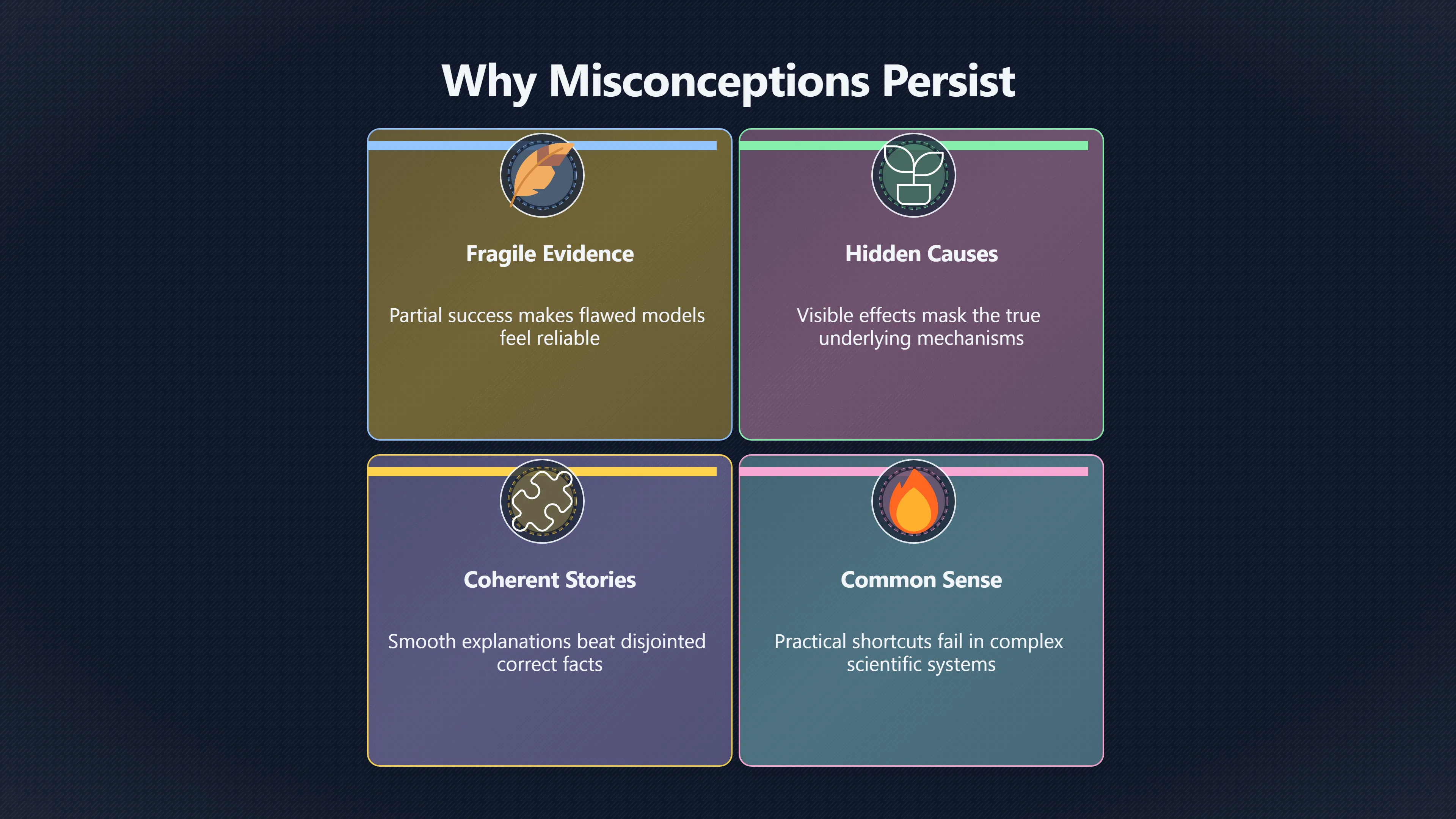
Many misconceptions survive because they work often enough to feel reliable.
For example, people commonly assume that heavier objects fall faster than lighter ones. In everyday life, a stone dropped beside a feather seems to confirm this idea. The observation is real. What is missing is an understanding of air resistance. The misconception persists because the visible evidence appears to support it.[arXiv]arxiv.orgAddressing misconceptions in university physics21 Mar 2025 Students often begin physics courses with misconceptions rooted in ever…
A flawed model does not need to explain everything. It only needs to explain enough experiences to seem useful. Once a model successfully predicts several familiar situations, people often treat it as trustworthy.
This creates a powerful illusion of understanding. The model feels logical because it has produced correct expectations in at least some circumstances, even if its underlying explanation is incomplete.
Why Everyday Experience Can Mislead Reasoning
Human reasoning evolved to deal with ordinary environments, not with abstract scientific systems. As a result, many intuitions that work well in daily life become misleading when applied to more complex phenomena.
Researchers studying scientific misconceptions have found that many arise from what are sometimes called intuitive knowledge domains: basic ways of understanding movement, living things and human behaviour that develop early in life. These intuitive systems help people navigate the world efficiently, but they can also encourage incorrect explanations when reality behaves differently from common experience.[Wikipedia]WikipediaScientific misconceptionsScientific misconceptions
Several recurring patterns appear:
- Visible effects seem more important than hidden causes. People naturally trust what they can observe directly.
- Simple explanations feel preferable to complex ones. A straightforward story is easier to remember and apply.
- Personal experience often outweighs abstract evidence. What someone has seen themselves can feel more convincing than statistics or expert explanations.
- Familiar analogies are extended too far. People use known situations to explain unfamiliar ones, sometimes beyond the analogy’s limits.
These habits are not signs of irrationality. They are practical shortcuts that usually help people make quick sense of everyday events. Problems arise when the shortcuts are applied to systems that operate according to rules that are not immediately visible.[Institute of Education Sciences]ies.ed.govInstitute of Education SciencesScientific Misconceptions: From Cognitive Underpinning to…In this project, the research team studied th…

The World Often Hides Its Real Mechanisms
Many correct explanations involve processes that cannot be observed directly.
People can see a plant grow, but they cannot directly watch cellular metabolism. They can feel heat, but they cannot see molecular motion. They can observe the movement of planets across the sky, but they cannot perceive the full geometry of orbital mechanics.
Because underlying mechanisms are hidden, people naturally create explanations based on appearances. Those explanations may seem entirely reasonable until more detailed evidence becomes available. The misconception is therefore often a product of limited access to information rather than carelessness or ignorance.[Boston University]bu.eduMagic Of MechanismBoston UniversityExplanation-Based Instruction on Counterintuitive…by D Kelemen 2019 Cited by 92 From early in development, huma…
Why Correct Facts Often Fail to Replace Wrong Explanations
One of the most important findings in conceptual-change research is that learning a correct fact does not automatically replace a flawed mental model.[education.asu.edu]education.asu.educhi concpetualchangechapter 0Three Types of Conceptual Change: Belief Revision, Mental…by MTH Chi Cited by 1386 The accumulation of multiple belief revisions c…
A person can memorise the correct answer while continuing to rely on the older explanation when reasoning independently. This happens because facts and explanations operate at different levels.
For example, a learner may correctly state that seasons are caused by Earth’s axial tilt. Yet when asked to explain why one hemisphere experiences summer while another experiences winter, the learner may unconsciously return to the older distance-from-the-Sun explanation. The fact has been learned, but the underlying model remains active.[education.asu.edu]education.asu.eduCommonsense Conceptions of Emergent ProcessesA domain-general perspective is potentially powerful in two ways: It can explain why a varie…
Researchers describe this as a problem of conceptual change rather than information transfer. The challenge is not merely adding new knowledge. It is reorganising an existing explanatory system.[PMC]pmc.ncbi.nlm.nih.govPMCMisconceptions Yesterday, Today, and TomorrowNIHby MJ Leonard 2014 Cited by 175 We define conceptual change (sensu Duit and Treagust, 2003) as learning that requires a fu…
Coherence Can Be More Persuasive Than Accuracy
A flawed explanation often survives because it feels internally coherent.
People generally prefer explanations that fit together smoothly. If a misconception connects multiple observations into a single story, it can feel more satisfying than a correct explanation that has not yet been fully understood.
This is why educators often find that directly correcting a statement is not enough. The learner must also acquire a replacement explanation capable of doing the same explanatory work. Without a replacement model, the old one remains attractive because it continues to answer questions.[ScienceDirect]sciencedirect.comEffectiveness of holistic mental model confrontation in…by S Gadgil 2012 Cited by 269 To achieve conceptual chang…[Tips for Teachers by Craig Barton]tipsforteachers.co.ukTips for Teachers by Craig BartonResearch: Three Types of Conceptual Change: Belief…Mental model transformation modifies a flawed ment…
Research on mental-model transformation suggests that successful correction often requires learners to recognise contradictions inside their existing framework and then rebuild the framework itself, not simply patch individual beliefs.[ScienceDirect]sciencedirect.comEffectiveness of holistic mental model confrontation in…by S Gadgil 2012 Cited by 269 To achieve conceptual chang…
When a Misconception Feels Like Common Sense
Perhaps the strongest reason misconceptions feel logical from the inside is that they are frequently built from common sense.
Common sense is not a formal theory. It is a collection of practical expectations derived from repeated experience. Most of the time, it works remarkably well. The problem is that scientific, historical and social realities sometimes operate in ways that conflict with everyday intuition.
A misconception therefore often represents an overextension of successful reasoning rather than a failure to reason at all. Someone is using a pattern that works in one context and applying it to another where it breaks down.[JSTOR]jstor.orgMisconceptions or P-Prims: How MayJune 1, 1996 by D Hammer 1996 Cited by 622 Other researchers have identified similar misco…
This perspective changes how misconceptions are understood. Instead of viewing them as simple ignorance, many researchers treat them as sincere efforts to explain the world using the evidence and mental tools available to the learner. The explanation is wrong, but the process that produced it can be entirely understandable.[American Psychological Association]apa.orgAlternative conceptions (misconceptions) are not…Read more…[OUP]academic.oup.comOUP AcademicStudents' Misconceptions and Science Education30 Jul 2020 One of the first interpretations of misconceptions is that they a…
That is why misconceptions often feel logical from the inside. They are not usually experienced as mistakes. They are experienced as explanations that seem to fit realityuntil stronger evidence, better models and deeper understanding reveal where the apparent logic went wrong.[Boston University]bu.eduMagic Of MechanismBoston UniversityExplanation-Based Instruction on Counterintuitive…by D Kelemen 2019 Cited by 92 From early in development, huma…
Amazon book picks
Further Reading
Books and field guides related to Why Wrong Explanations Can Feel Right. Use these as the next step if you want deeper reading beyond the article.
Thinking, Fast and Slow
Directly addresses intuitive reasoning, mental shortcuts, and persistent errors.
Mistakes Were Made (but Not by Me) Third Edition
Explores self-justification and why people cling to flawed beliefs.
eBay marketplace picks
Marketplace Samples
Example marketplace items related to this page. Use the search link to explore similar finds on eBay.




Endnotes
1.
Source: academic.oup.com
Link:https://academic.oup.com/edited-volume/61768/chapter/553571429?searchresult=1
Source snippet
OUP AcademicStudents' Misconceptions and Science Education30 Jul 2020 One of the first interpretations of misconceptions is that they a...
2.
Source: pmc.ncbi.nlm.nih.gov
Title: PMCMisconceptions Yesterday, Today, and Tomorrow
Link:https://pmc.ncbi.nlm.nih.gov/articles/PMC4041497/
Source snippet
NIHby MJ Leonard 2014 Cited by 175 We define conceptual change (sensu Duit and Treagust, 2003) as learning that requires a fu...
3.
Source: education.asu.edu
Title: chi concpetualchangechapter 0
Link:https://education.asu.edu/sites/g/files/litvpz656/files/lcl/chi_concpetualchangechapter_0.pdf
Source snippet
Three Types of Conceptual Change: Belief Revision, Mental...by MTH Chi Cited by 1386 The accumulation of multiple belief revisions c...
4.
Source: buffalo.edu
Title: University at Buffalo Conceptual Change
Link:https://www.buffalo.edu/catt/teach/develop/theory/conceptual-change.html
Source snippet
University at BuffaloConceptual Change - TeachingMarch 5, 2024 Unfortunately, misconceptions tend to be difficult to change once they a...
Published: March 5, 2024
5.
Source: arxiv.org
Link:https://arxiv.org/html/2405.20923v2
Source snippet
Addressing misconceptions in university physics21 Mar 2025 Students often begin physics courses with misconceptions rooted in ever...
6.
Source: Wikipedia
Title: Scientific misconceptions
Link:https://en.wikipedia.org/wiki/Scientific_misconceptions
7.
Source: education.asu.edu
Link:https://education.asu.edu/sites/g/files/litvpz656/files/lcl/emergjlspdf_3.pdf
Source snippet
Commonsense Conceptions of Emergent ProcessesA domain-general perspective is potentially powerful in two ways: It can explain why a varie...
8.
Source: Wikipedia
Title: Conceptual change
Link:https://en.wikipedia.org/wiki/Conceptual_change
9.
Source: sciencedirect.com
Link:https://www.sciencedirect.com/science/article/abs/pii/S0959475211000454
Source snippet
Effectiveness of holistic mental model confrontation in...by S Gadgil 2012 Cited by 269 To achieve conceptual chang...
10.
Source: jstor.org
Link:https://www.jstor.org/stable/1466772
Source snippet
Misconceptions or P-Prims: How MayJune 1, 1996 by D Hammer 1996 Cited by 622 Other researchers have identified similar misco...
Published: June 1, 1996
11.
Source: apa.org
Link:https://www.apa.org/education-career/k12/misconceptions
Source snippet
Alternative conceptions (misconceptions) are not...Read more...
12.
Source: bu.edu
Title: Magic Of Mechanism
Link:https://www.bu.edu/cdl/files/2019/05/MagicOfMechanism.pdf
Source snippet
Boston UniversityExplanation-Based Instruction on Counterintuitive...by D Kelemen 2019 Cited by 92 From early in development, huma...
13.
Source: ies.ed.gov
Link:https://ies.ed.gov/use-work/awards/scientific-misconceptions-cognitive-underpinning-educational-treatment
Source snippet
Institute of Education SciencesScientific Misconceptions: From Cognitive Underpinning to...In this project, the research team studied th...
14.
Source: tipsforteachers.co.uk
Link:https://tipsforteachers.co.uk/research-three-types-of-conceptual-change-belief-revision-mental-model-transformation-and-categorical-shift/
Source snippet
Tips for Teachers by Craig BartonResearch: Three Types of Conceptual Change: Belief...Mental model transformation modifies a flawed ment...
Additional References
15.
Source: takinglearningseriously.com
Link:https://takinglearningseriously.com/barriers-to-learning/misconceptions/
Source snippet
MisconceptionsChanging students' misconceptions involves revising their conceptual understanding, and not simply adding correct new infor...
16.
Source: my.chartered.college
Link:https://my.chartered.college/impact_article/minimising-misconceptions-through-the-design-of-explanatory-sequences/
Source snippet
misconceptions through the design...by A Stubbs We can design instruction to prevent misconceptions forming by managing the sequence o...
17.
Source: per-central.org
Link:https://www.per-central.org/items/perc/3451.pdf
Source snippet
g students' intuitive theory not only because it is located at the intersection of various disciplines...Read more...
18.
Source: theeducationhub.org.nz
Title: countering common misconceptions about cognitive perspectives of learning
Link:https://theeducationhub.org.nz/countering-common-misconceptions-about-cognitive-perspectives-of-learning/
Source snippet
Countering common misconceptions about cognitive...16 Feb 2021 This article explores some common misconceptions about cognitive perspe...
19.
Source: nordangliaeducation.com
Title: why science misconceptions matter and what they teach us about learning
Link:https://www.nordangliaeducation.com/bisc-south-loop/news/2026/02/12/why-science-misconceptions-matter-and-what-they-teach-us-about-learning
Source snippet
Why Science Misconceptions Matter and What They Teach...11 Feb 2026 A look at common science misconceptions and how challenging them h...
20.
Source: researchgate.net
Title: 352588191 Misconceptions or mental models
Link:https://www.researchgate.net/publication/352588191_Misconceptions_or_mental_models
Source snippet
(PDF) Misconceptions or mental models18 Jan 2026 It is argued that the mental-models perspective explains many aspects of the data and...
21.
Source: 3starlearningexperiences.wordpress.com
Link:https://3starlearningexperiences.wordpress.com/2019/07/10/tackling-misconceptions-through-conceptual-change-part-2/
Source snippet
3-Star learning experiencesTackling Misconceptions Through Conceptual Change Part 210 Jul 2019 Similar to beliefs, a mental model can...
22.
Source: carlhendrick.substack.com
Link:https://carlhendrick.substack.com/p/well-organised-misunderstanding-the
Source snippet
substack.comWell-Organised Misunderstanding": The Fine Art of Being...As she explains, "some false beliefs and flawed mental models are...
23.
Source: gettingsmart.com
Title: the persistence of misconceptions
Link:https://www.gettingsmart.com/2019/11/16/the-persistence-of-misconceptions/
Source snippet
16 Nov 2019 Preconceived notions are popular conceptions rooted in everyday experiences. Non-scientific beliefs include views learned b...
24.
Source: youtube.com
Link:https://www.youtube.com/watch?v=47OGAkP8Xhg
Source snippet
iew. It's odds with the accepted science and can be difficult to change...
Topic Tree