Within Mental Models
When Wrong Earth Models Make Sense
Children's Earth models show how wrong ideas can be creative attempts to reconcile teaching with everyday experience.
On this page
- Why flat ground conflicts with a round Earth
- Disc, hollow, and flattened sphere models
- What public myth correction can learn from classrooms
Page outline Jump by section
Introduction
Children’s ideas about the shape of the Earth provide one of the clearest demonstrations that misconceptions are often logical attempts to make sense of conflicting information. In a landmark series of studies, researchers found that many children did not simply choose between “the Earth is flat” and “the Earth is round”. Instead, they built imaginative intermediate models that combined classroom teaching with everyday experience. These models were wrong from a scientific standpoint, but they were internally coherent and often remarkably consistent.[ScienceDirect]sciencedirect.comMental models of the earth: A study of conceptual change…by S Vosniadou · 1992 · Cited by 3047 — Five alternative mental…
 The case matters because it reveals how myths and misconceptions can persist. People rarely abandon an existing mental model all at once. When new information clashes with what seems obvious from experience, they often create hybrid explanations that preserve as much coherence as possible. Children’s Earth models show this process in a particularly visible form.[ScienceDirect]sciencedirect.comMental models of the earth: A study of conceptual change…by S Vosniadou · 1992 · Cited by 3047 — Five alternative mental…
Why Flat Ground Conflicts with a Round Earth
For a young child, the idea that the Earth is a sphere creates an immediate problem. Everything in everyday experience appears to support the opposite conclusion. The ground looks flat. Buildings stand upright. People do not appear to be hanging upside down. Nothing suggests that the surface curves dramatically beneath one’s feet.[ScienceDirect]sciencedirect.comMental models of the earth: A study of conceptual change…by S Vosniadou · 1992 · Cited by 3047 — Five alternative mental…
Stella Vosniadou and William Brewer argued that children begin with certain deeply rooted assumptions derived from ordinary observation. Two are especially important:
- The ground people live on is flat.[www2.pd.infn.it]www2.pd.infn.itMental Models of the Earth Conceptual Changeby S VOSNIADOU · 1992 · Cited by 3046 — This paper presents the results of an experiment whic…
- Objects need support underneath them and cannot simply remain suspended in space.
These assumptions work well in everyday life, so children treat them as reliable facts about the world. The challenge arises when adults tell them that the Earth is round. Instead of immediately replacing their existing assumptions, many children try to integrate the new information into their old framework.[ScienceDirect]sciencedirect.comMental models of the earth: A study of conceptual change…by S Vosniadou · 1992 · Cited by 3047 — Five alternative mental…
This helps explain why misconceptions can be so stable. The problem is not ignorance. The child is actively reasoning. The misconception emerges because two seemingly trustworthy sources of information—direct experience and cultural instruction—point in different directions.[ScienceDirect]sciencedirect.comMental models of the earth: A study of conceptual change…by S Vosniadou · 1992 · Cited by 3047 — Five alternative mental…
Disc, Hollow, and Flattened Sphere Models
The most influential evidence comes from a 1992 study in which children were interviewed about the Earth’s shape, where people live, where the sky is located, and what would happen at the Earth’s edge. Rather than producing random answers, many children gave patterns of responses that fit identifiable mental models.[ScienceDirect]sciencedirect.comMental models of the earth: A study of conceptual change…by S Vosniadou · 1992 · Cited by 3047 — Five alternative mental…
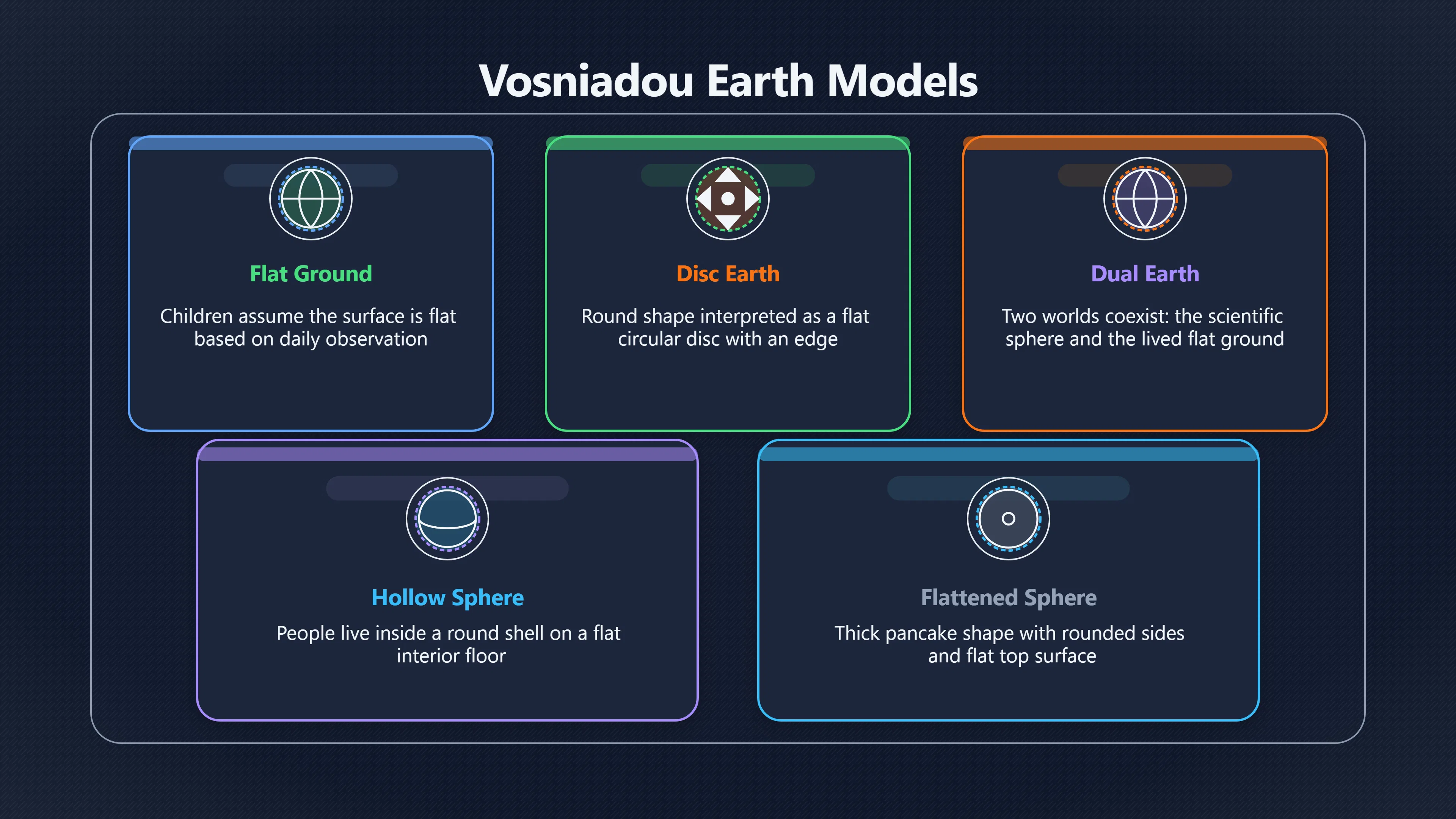
The Disc Earth
Some children imagined the Earth as a large flat disc. This model preserved the appearance of flat ground while acknowledging that the Earth might be round in the sense of being circular. In this view, one could potentially reach an edge and fall off.[ScienceDirect]sciencedirect.comMental models of the earth: A study of conceptual change…by S Vosniadou · 1992 · Cited by 3047 — Five alternative mental…
The model demonstrates a subtle point: the child is not rejecting the word “round”. Instead, “round” is interpreted as a flat circle rather than a globe. The misconception arises from a difference in meaning rather than a simple factual error.[ScienceDirect]sciencedirect.comMental models of the earth: A study of conceptual change…by S Vosniadou · 1992 · Cited by 3047 — Five alternative mental…
The Dual Earth
One of the most striking findings was the “dual Earth” model. Children using this model effectively maintained two Earths at once. There was a round Earth discussed by adults and shown in books, but there was also the flat ground where people actually lived. The scientific Earth and the experienced Earth coexisted without being fully integrated.[ScienceDirect]sciencedirect.comMental models of the earth: A study of conceptual change…by S Vosniadou · 1992 · Cited by 3047 — Five alternative mental…
This is a powerful example of how new information can be stored without fundamentally restructuring an older worldview. The child accepts the taught fact while preserving the original explanatory framework.[ScienceDirect]sciencedirect.comMental models of the earth: A study of conceptual change…by S Vosniadou · 1992 · Cited by 3047 — Five alternative mental…

The Hollow Sphere
Some children accepted that the Earth was spherical yet still believed people must stand on a flat surface. Their solution was to place people inside the sphere. In the hollow-sphere model, humans lived on a flat interior region, while the Earth itself remained round when viewed from outside.[ScienceDirect]sciencedirect.comMental models of the earth: A study of conceptual change…by S Vosniadou · 1992 · Cited by 3047 — Five alternative mental…
From an adult perspective this seems bizarre. From the child’s perspective it solves multiple problems simultaneously:
- The Earth can be spherical.
- People remain upright.
- Flat ground is preserved.[www2.pd.infn.it]www2.pd.infn.itMental Models of the Earth Conceptual Changeby S VOSNIADOU · 1992 · Cited by 3046 — This paper presents the results of an experiment whic…
- No one falls off the planet.
The model is creative because it reconciles conflicting constraints rather than choosing one side and ignoring the other.[ScienceDirect]sciencedirect.comMental models of the earth: A study of conceptual change…by S Vosniadou · 1992 · Cited by 3047 — Five alternative mental…
The Flattened Sphere
Another group imagined a thick, pancake-like Earth. It was rounded around the sides but flattened on the top and bottom where people lived. This model preserved the idea that the Earth is generally spherical while retaining a flat region suitable for human habitation.[ScienceDirect]sciencedirect.comMental models of the earth: A study of conceptual change…by S Vosniadou · 1992 · Cited by 3047 — Five alternative mental…[PsyBlog]spring.org.ukhow children learn earth isnt flatPsyBlogHow Children Learn the Earth Isn't Flat30 Apr 2008 — Hollow sphere: thought we live inside the Earth on a flat area (12/60). Flatt…
Again, the misconception is not random. It reflects an effort to minimise conflict between observation and instruction. The child modifies the scientific claim just enough to fit prior assumptions.[ScienceDirect]sciencedirect.comMental models of the earth: A study of conceptual change…by S Vosniadou · 1992 · Cited by 3047 — Five alternative mental…

What These Models Reveal About Conceptual Change
The Earth studies became influential because they shifted attention away from isolated wrong answers and toward underlying mental models. Researchers argued that conceptual change often involves restructuring a network of assumptions rather than replacing a single belief. ScienceDirect[academia]academia.eduConceptual Change and EducationAcademia(PDF) Conceptual Change and EducationReview of Educational Research, 57, 51–67. Vosniadou, S., & Brewer, W.F. (1992). Mental mode… A child cannot fully understand a spherical Earth simply by memorising the sentence“the Earth is round”. To make sense of the scientific model, the child must also revise ideas about gravity, up and down, support, space, and perspective. Until those related concepts change, hybrid models remain attractive.[ScienceDirect]sciencedirect.comMental models of the earth: A study of conceptual change…by S Vosniadou · 1992 · Cited by 3047 — Five alternative mental…
This insight helped shape broader theories of conceptual change in science education. Learning was increasingly seen as a process of reorganising existing knowledge structures rather than filling an empty container with facts. ERIC[Academia At the same time]academia.eduConceptual Change and EducationAcademia(PDF) Conceptual Change and EducationReview of Educational Research, 57, 51–67. Vosniadou, S., & Brewer, W.F. (1992). Mental mode…, later researchers questioned whether all of the identified Earth models were as coherent and widespread as originally proposed. Some studies suggested that interview methods and drawing tasks may have exaggerated the appearance of stable mental models. Children can misunderstand questions, switch between perspectives, or produce inconsistent answers. Nevertheless, even critics generally agree that children often struggle to integrate intuitive beliefs with scientific explanations and that hybrid understandings are common during learning.[PubMed]pubmed.ncbi.nlm.nih.govMental models and other misconceptions in children's…by G Panagiotaki · 2009 · Cited by 122 — This study investigated the claim…[ResearchGate]researchgate.netReframing the Classical Approach to Conceptual ChangeFrom a theoretical perspective, these difficulties can be explained through Vosniado…
What Public Myth Correction Can Learn from Classrooms
The Earth-model case has implications far beyond childhood astronomy. It illustrates why simply presenting a correct fact does not always eliminate a misconception.
When children hear that the Earth is spherical, they do not automatically discard beliefs that flat ground supports people. Instead, they create intermediary explanations that preserve both ideas. Adults often behave similarly when confronting corrections to political, health, economic, or scientific myths. New information is frequently grafted onto older assumptions rather than replacing them.[ScienceDirect]sciencedirect.comMental models of the earth: A study of conceptual change…by S Vosniadou · 1992 · Cited by 3047 — Five alternative mental…
Three lessons emerge:
- Misconceptions can be coherent. A wrong belief may fit into a larger explanatory system rather than existing as a standalone error.[ScienceDirect]sciencedirect.comMental models of the earth: A study of conceptual change…by S Vosniadou · 1992 · Cited by 3047 — Five alternative mental…
- Facts alone may not be enough. People often need a replacement explanation, not merely a contradiction.[Academia]academia.eduConceptual Change and EducationAcademia(PDF) Conceptual Change and EducationReview of Educational Research, 57, 51–67. Vosniadou, S., & Brewer, W.F. (1992). Mental mode…
- Hybrid models are normal. Transitional understandings are often signs of learning in progress rather than evidence of irrationality.[ScienceDirect]sciencedirect.comMental models of the earth: A study of conceptual change…by S Vosniadou · 1992 · Cited by 3047 — Five alternative mental…
Children’s Earth models remain a classic example because they expose a process that is usually hidden. They show the mind trying to preserve coherence while adapting to new evidence. The resulting models may be scientifically wrong, but they reveal an important truth about myths and misconceptions: people are often not failing to think. They are thinking with the best model they currently have.[ScienceDirect]sciencedirect.comMental models of the earth: A study of conceptual change…by S Vosniadou · 1992 · Cited by 3047 — Five alternative mental…
Amazon book picks
Further Reading
Books and field guides related to When Wrong Earth Models Make Sense. Use these as the next step if you want deeper reading beyond the article.
Thinking, Fast and Slow
Helps explain why intuitive observations can conflict with scientific models.

A short history of nearly everything
First published 2003. Subjects: Science, Popular works, Ciencia, Obras populares, Science, popular works.

The Magic of Reality
First published 2001. Subjects: Miscellanea, Science, Philosophy, Reality, Nature.

The Knowledge Illusion
First published 2017. Subjects: Cognitive psychology, Knowledge, theory of, Knowledge, sociology of, Thought and thinking, Intellect.
eBay marketplace picks
Marketplace Samples
Example marketplace items related to this page. Use the search link to explore similar finds on eBay.




Endnotes
1.
Source: sciencedirect.com
Link:https://www.sciencedirect.com/science/article/pii/001002859290018W
Source snippet
Mental models of the earth: A study of conceptual change...by S Vosniadou · 1992 · Cited by 3047 — Five alternative mental...
2.
Source: sciencedirect.com
Link:https://www.sciencedirect.com/science/article/abs/pii/S0022096508001513
Source snippet
Mental models and other misconceptions in children's...by G Panagiotaki · 2009 · Cited by 122 — Before any exposure to inst...
3.
Source: academia.edu
Title: Conceptual Change and Education
Link:https://www.academia.edu/48524586/Conceptual_Change_and_Education
Source snippet
Academia(PDF) Conceptual Change and EducationReview of Educational Research, 57, 51–67. Vosniadou, S., & Brewer, W.F. (1992). Mental mode...
4.
Source: researchgate.net
Link:https://www.researchgate.net/publication/278716843_Reframing_the_Classical_Approach_to_Conceptual_Change_Preconceptions_Misconceptions_and_Synthetic_Models
Source snippet
Reframing the Classical Approach to Conceptual ChangeFrom a theoretical perspective, these difficulties can be explained through Vosniado...
5.
Source: researchgate.net
Link:https://www.researchgate.net/publication/23682515_Mental_models_and_other_misconceptions_in_children%27s_understanding_of_the_earth
Source snippet
children have naïve, but coherent, mental models of the earth, such as the flat earth and the hollow sphere. Recent studies have challeng...
6.
Source: www2.pd.infn.it
Link:https://www2.pd.infn.it/~lacaprar/ProgettoScuola/Biblio/Vosniadou%20-%20Mental%20Models%20of%20the%20Earth%20Conceptual%20Change.pdf
Source snippet
Mental Models of the Earth Conceptual Changeby S VOSNIADOU · 1992 · Cited by 3046 — This paper presents the results of an experiment whic...
7.
Source: spring.org.uk
Title: how children learn earth isnt flat
Link:https://www.spring.org.uk/2008/04/how-children-learn-earth-isnt-flat.php
Source snippet
PsyBlogHow Children Learn the Earth Isn't Flat30 Apr 2008 — Hollow sphere: thought we live inside the Earth on a flat area (12/60). Flatt...
8.
Source: pubmed.ncbi.nlm.nih.gov
Link:https://pubmed.ncbi.nlm.nih.gov/19100995/
Source snippet
Mental models and other misconceptions in children's...by G Panagiotaki · 2009 · Cited by 122 — This study investigated the claim...
9.
Source: gral.ip.rm.cnr.it
Link:https://gral.ip.rm.cnr.it/borghi/vosniadou.pdf
Source snippet
Mental models of the earth: A study of conceptual change in childhood. Cognitive Psychology, 24, pp. 535-85. Vosniadou, S...Read more...
Additional References
10.
Source: link.springer.com
Link:https://link.springer.com/content/pdf/10.1007/978-3-642-77228
Source snippet
Fostering Conceptual Change: The Role of ComputerChildren with a hollow sphere model also interpret the rotation of the earth to...
11.
Source: carlhendrick.substack.com
Title: The Learning Dispatch“Well-Organised Misunderstanding”: The Fine Art of Being
Link:https://carlhendrick.substack.com/p/well-organised-misunderstanding-the
Source snippet
children don't picture the Earth as a sphere, but as a flattened disc or a hollow sphere. Their model is wrong but internally consistent...
12.
Source: scispace.com
Link:https://scispace.com/pdf/the-concept-of-the-earth-s-shape-a-study-of-conceptual-129cu3mjf0.pdf
Source snippet
school children's concept of the earth's shape and the related concept of...Read more...
13.
Source: files.eric.ed.gov
Title: ERICDOCUMENT RESUME Vosniadou, Stella Designing Curricula
Link:https://files.eric.ed.gov/fulltext/ED404098.pdf
Source snippet
Cognitive Psychology. Vosniadou, S., & Brewer, W. F. (in preparation). Elementary school...Read more...
14.
Source: nsuworks.nova.edu
Link:https://nsuworks.nova.edu/cgi/viewcontent.cgi?article=1128&context=edp
Source snippet
Models: How Children Learn the Earth Isnâ•Žt Flat25 Apr 2025 — The fourth category was the hollow sphere, which children thought humans l...
15.
Source: education.asu.edu
Title: chi concpetualchangechapter 0
Link:https://education.asu.edu/sites/g/files/litvpz656/files/lcl/chi_concpetualchangechapter_0.pdf
Source snippet
Three Types of Conceptual Change: Belief Revision, Mental...by MTH Chi · Cited by 1387 — Likewise, Vosniadou and Brewer (1992) have show...
16.
Source: youtube.com
Title: Mental Models and Scientific Understanding
Link:https://www.youtube.com/watch?v=0h9Vq1p8yYQ
Source snippet
These videos explore the cognitive processes involved in how learners, particularly children, construct mental models of scientific pheno...
17.
Source: pmc.ncbi.nlm.nih.gov
Link:https://pmc.ncbi.nlm.nih.gov/articles/PMC6713729/
Source snippet
by DP de la Hera · 2019 · Cited by 16 — Children's conceptual knowledge about the earth was quantified by mapping their verbal, drawn...
18.
Source: bpspsychub.onlinelibrary.wiley.com
Link:https://bpspsychub.onlinelibrary.wiley.com/doi/10.1348/026151005X39116
Source snippet
BPS Psych HubChildren's representations of the earth: A methodological...23 Dec 2010 — Hollow and dual mental models are 'synthetic' bec...
19.
Source: link.springer.com
Link:https://link.springer.com/article/10.1023/A%3A1008697908361
Source snippet
& Brewer, W.F.: 1992, 'Mental Models of the Earth: A Study of Conceptual Change in Childhood', Cognitive Psychology 24, 535-585. Google...
Topic Tree