Within Tone
How to Correct Without Cornering Someone
Face-saving corrections make it easier to accept better information without treating the original mistake as a personal failure.
On this page
- Why changing your mind can feel socially costly
- Wording that separates the claim from the person
- Examples that keep the correction clear and usable
Page outline Jump by section
Introduction
When people abandon a myth or misconception, they are not only updating a belief; they are often managing a social risk. Admitting “I was wrong” can feel like a loss of competence, status or credibility, especially in front of friends, colleagues or an online audience. Face-saving wording reduces that social cost without weakening the correction itself. The goal is not to avoid disagreement or soften facts beyond recognition. It is to make accepting better information feel compatible with being a reasonable person. Research on misinformation correction, autonomy-supportive communication and psychological reactance suggests that people are generally more receptive when corrections preserve their sense of agency and competence rather than threatening it.[Center for Climate Change Communication]climatechangecommunication.orgCenter for Climate Change CommunicationDebunking HandbookOctober 11, 2020 — Corrections have to point to the misinformation so they neces…[Self Determination Theory]positivepsychology.comand How It Explains Motivation21 Jun 2018 — Self-Determination Theory posits that autonomy, competence & relatedness are fundamental psyc…

Why changing your mind can feel socially costly
Many misconceptions survive because beliefs are tied to identity, reputation or group membership. If accepting a correction appears to require public humiliation, people may resist even strong evidence. The barrier is often social rather than informational.
This helps explain why the same factual correction can produce very different reactions depending on its wording. Compare:
- “That claim is outdated; newer evidence found something different.”
- “Anyone who looked at the evidence would know that’s wrong.”
Both reject the claim. Only the second attacks the person’s competence.
Research associated with Self-Determination Theory finds that people respond more positively when communication supports autonomy and competence rather than creating pressure, shame or control. Environments that support these psychological needs tend to reduce defensiveness and improve openness to learning and change.[Self Determination Theory]positivepsychology.comand How It Explains Motivation21 Jun 2018 — Self-Determination Theory posits that autonomy, competence & relatedness are fundamental psyc…[PMC]pmc.ncbi.nlm.nih.govPMCShould or could?Testing the use of autonomy-supportive…by MB Altendorf · 2019 · Cited by 31 — Theories of human motivation and reactance. Self-determi…
In practical terms, a correction becomes easier to accept when it allows the listener to preserve a reasonable self-image. Instead of forcing a choice between “keep my dignity” and “accept the facts”, face-saving language allows both.
Wording that separates the claim from the person
The most useful face-saving corrections create distance between the mistaken belief and the individual’s character.
A common pattern is to frame the error as understandable rather than foolish.
Instead of:
“You fell for a myth.”
Use:
“A lot of people have seen that claim because it gets repeated frequently.”
This shifts attention from personal failure to the information environment.
Another effective pattern is to emphasise new information.
Instead of:
“You were wrong.”
Use:
“The evidence has changed” or “More recent data shows something different.”
The person can update because circumstances or knowledge changed, not because they are inherently incompetent.
A third pattern is to acknowledge partial validity where appropriate.
Instead of:
“That’s completely nonsense.”
Use:
“I can see why that sounds plausible, but the evidence points elsewhere.”
This preserves respect while maintaining a clear correction.
These approaches align with broader findings that autonomy-supportive communication—communication that respects a person’s ability to evaluate information—tends to reduce resistance and encourage engagement. PMC[SAGE Knowledge]sk.sagepub.comSAGE Knowledge Encyclopedia of Social PsychologySAGE KnowledgeEncyclopedia of Social Psychology - Self-Determination TheoryStudies also show that when authority figures are autonomy sup…

The most useful face-saving phrases
Certain formulations repeatedly create an “exit ramp” for people who want to update their views.
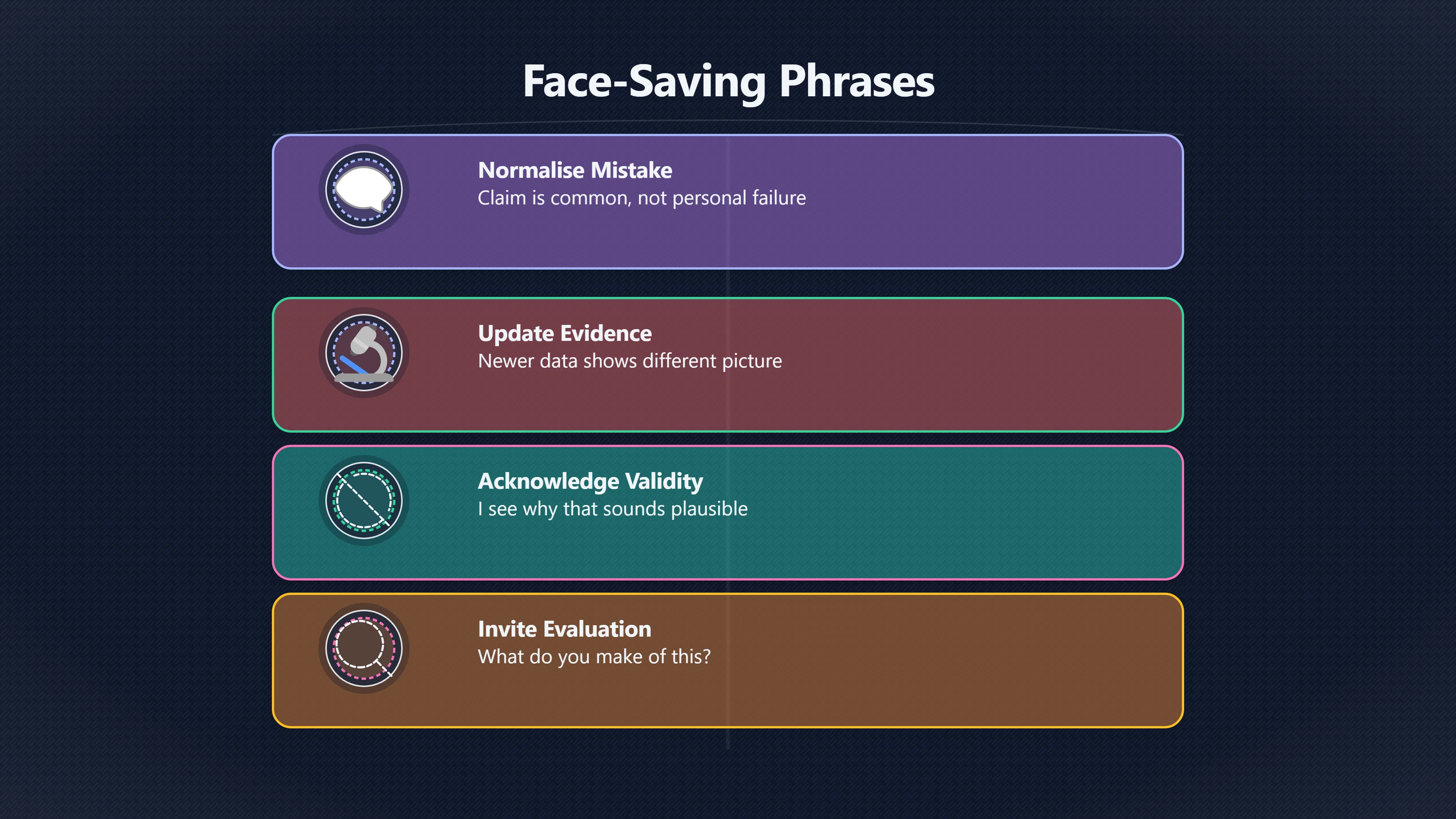
Normalising the mistake
- “A lot of people have heard that.”
- “That misunderstanding is very common.”
- “It’s easy to see why that idea spread.”
These phrases reduce the feeling of being singled out.
Emphasising information rather than blame
- “The current evidence suggests…”
- “Newer research found…”
- “The picture is a bit different than it first appears.”
The focus moves from personal error to factual clarification.
Creating room for revision
- “I used to think that as well.”
- “My understanding changed when I saw…”
- “It’s understandable to reach that conclusion from the older information.”
The correction becomes a shared learning process rather than a judgement.
Inviting evaluation
- “What do you make of this evidence?”
- “How does this fit with what you’ve seen?”
- “Would it help to compare the sources?”
Such wording preserves autonomy instead of demanding submission. Research on motivation and reactance consistently finds that people are less resistant when they feel they are choosing to reconsider rather than being forced to concede. PMC[Self Determination Theory]positivepsychology.comand How It Explains Motivation21 Jun 2018 — Self-Determination Theory posits that autonomy, competence & relatedness are fundamental psyc…
Examples that keep the correction clear and usable
Face-saving language is most effective when it remains specific. Vagueness can make corrections sound evasive. The correction still needs a clear factual replacement.
Health misconception
Less effective:
“You’ve been misled by bad science.”
More effective:
“That claim circulated widely for a while, but larger studies found different results. The current evidence suggests the treatment does not work as originally thought.”
The factual correction remains direct, but the listener is not portrayed as gullible.

Historical misconception
Less effective:
“That’s a myth people repeat because they don’t know history.”
More effective:
“That version of the story is very common, but historians now have records showing a more complicated picture.”
The correction targets the claim rather than the person’s intelligence.
Social media post
Less effective:
“Please stop spreading misinformation.”
More effective:
“This claim appears to come from an older source. More recent reporting and evidence point to a different conclusion.”
The person can revise or delete the post without feeling publicly shamed.
What face-saving is not
Face-saving corrections are sometimes mistaken for excessive politeness or unwillingness to state facts. That misses the point.
A face-saving correction can still be unequivocal:
“That claim is false. The evidence shows X.”
The difference lies in whether the wording turns the factual disagreement into a personal indictment.
Likewise, face-saving is not appropriate in every circumstance. Deliberate deception, repeated bad-faith behaviour or situations involving immediate harm may require more direct confrontation. However, many myths and misconceptions are shared by people acting in good faith. In those cases, reducing unnecessary status threats can make factual updates more likely, not less. Debunking research consistently finds that effective corrections work best when they provide a clear alternative explanation rather than simply attacking the mistaken belief or the person holding it.[Center for Climate Change Communication]climatechangecommunication.orgCenter for Climate Change CommunicationDebunking HandbookOctober 11, 2020 — Corrections have to point to the misinformation so they neces…[Brown Climate Social Science Network]cssn.orgDB2020paper 1Misinformation often continues to influence reasoning post-correction, and outdated information is not simply erased (the “continued infl…
The practical mechanism
Face-saving wording works because it changes the social meaning of being corrected. Instead of communicating, “You are the problem,” it communicates, “This information needs updating.” That distinction gives people a way to align themselves with better evidence without treating the original mistake as a personal failure.
For myths and misconceptions, that small shift can matter. People often update more readily when they can retain dignity while doing so. The correction remains clear, but accepting it no longer requires public self-demotion. In many everyday conversations, that difference is what turns a correction from a confrontation into a revision. PMC[Self Determination Theory]positivepsychology.comand How It Explains Motivation21 Jun 2018 — Self-Determination Theory posits that autonomy, competence & relatedness are fundamental psyc…
Amazon book picks
Further Reading
Books and field guides related to How to Correct Without Cornering Someone. Use these as the next step if you want deeper reading beyond the article.

Never Split the Difference
First published 2016. Subjects: Negotiation, Negotiation in business, Business communication, Business, Communication.

How to Have Impossible Conversations
First published 2019. Subjects: Interpersonal communication, Conversation.
eBay marketplace picks
Marketplace Samples
Example marketplace items related to this page. Use the search link to explore similar finds on eBay.



Endnotes
1.
Source: pmc.ncbi.nlm.nih.gov
Title: PMCShould or could?
Link:https://pmc.ncbi.nlm.nih.gov/articles/PMC6393822/
Source snippet
Testing the use of autonomy-supportive...by MB Altendorf · 2019 · Cited by 31 — Theories of human motivation and reactance. Self-determi...
2.
Source: pmc.ncbi.nlm.nih.gov
Title: PMCPutting Self‐Determination Theory Into Practice
Link:https://pmc.ncbi.nlm.nih.gov/articles/PMC12263349/
Source snippet
NIHby A Neufeld · 2025 · Cited by 10 — Supporting basic psychological needs in a deliberate and integrated way promotes engagement...
3.
Source: pmc.ncbi.nlm.nih.gov
Link:https://pmc.ncbi.nlm.nih.gov/articles/PMC3323356/
Source snippet
nih.govSelf-determination theory: its application to health behavior...by H Patrick · 2012 · Cited by 839 — As the science of behavior c...
4.
Source: face.com
Link:https://face.com/
5.
Source: climatechangecommunication.org
Link:https://www.climatechangecommunication.org/wp-content/uploads/2023/09/DebunkingHandbook2020.pdf
Source snippet
Center for Climate Change CommunicationDebunking HandbookOctober 11, 2020 — Corrections have to point to the misinformation so they neces...
Published: October 11, 2020
6.
Source: selfdeterminationtheory.org
Title: 1987 DeciRyan JPSP
Link:https://selfdeterminationtheory.org/SDT/documents/1987_DeciRyan_JPSP.pdf
Source snippet
Self Determination TheoryThe Support of Autonomy and the Control of Behaviorby EL Deci · 1987 · Cited by 6672 — Furthermore, it shows tha...
7.
Source: open.ncl.ac.uk
Link:https://open.ncl.ac.uk/theories/20/self-determination-theory/
Source snippet
Self-Determination Theory: A reviewSpecifically, they include autonomy, which refers to the ability to regulate one's actions in a self-d...
8.
Source: sk.sagepub.com
Title: SAGE Knowledge Encyclopedia of Social Psychology
Link:https://sk.sagepub.com/ency/edvol/socialpsychology/chpt/selfdetermination-theory
Source snippet
SAGE KnowledgeEncyclopedia of Social Psychology - Self-Determination TheoryStudies also show that when authority figures are autonomy sup...
9.
Source: ukcoaching.org
Link:https://www.ukcoaching.org/ukc-club/resources/self-determination-theory/
Source snippet
Self-Determination TheorySelf-Determination Theory emphasises that people are most motivated and fulfilled when their basic needs for aut...
10.
Source: cssn.org
Title: DB2020paper 1
Link:https://cssn.org/wp-content/uploads/2020/10/DB2020paper-1.pdf
Source snippet
Misinformation often continues to influence reasoning post-correction, and outdated information is not simply erased (the “continued infl...
11.
Source: selfdeterminationtheory.org
Link:https://selfdeterminationtheory.org/theory/
12.
Source: selfdeterminationtheory.org
Link:https://selfdeterminationtheory.org/research/autonomy-supportive-practices/
Source snippet
Autonomy-Supportive PracticesExploring the pathways through which teacher support predicts changes in students' academic coping across th...
13.
Source: simplypsychology.org
Link:https://www.simplypsychology.org/self-determination-theory.html
Source snippet
It is a theory that deals with two huge factors: people's inherent growth tendencies.Read m...
14.
Source: Wikipedia
Link:https://en.wikipedia.org/wiki/Face
Source snippet
FaceThe face is the front of the head in humans and many other animals that features most of the sense organs including the eyes, nose...
15.
Source: rccs.org.uk
Title: Self Determination Theory Explained
Link:https://www.rccs.org.uk/post/self-determination-theory
Source snippet
9 Jan 2026 — SDT highlights that intrinsic motivation thrives when autonomy, competence and relatedness are supported. Extrinsic Moti...
16.
Source: dictionary.cambridge.org
Link:https://dictionary.cambridge.org/dictionary/english/face
Source snippet
English meaning - Cambridge Dictionary7 days ago — FACE definition: 1. the front of the head, where the eyes, nose, and mouth are: 2. a...
17.
Source: researchgate.net
Link:https://www.researchgate.net/publication/51245607_Self-Determination_Theory_and_Diminished_Functioning_The_Role_of_Interpersonal_Control_and_Psychological_Need_Thwarting
Source snippet
Self-Determination Theory and Diminished Functioning...23 Jun 2011 — PDF | Drawing from self-determination theory, three studies explore...
18.
Source: book.all-means-all.education
Title: self determination
Link:https://book.all-means-all.education/ama-2025-en/chapter/self-determination/
Source snippet
It recognises the learner as an active participant in their own...Read more...
19.
Source: positivepsychology.com
Title: self determination theory
Link:https://positivepsychology.com/self-determination-theory/
Source snippet
and How It Explains Motivation21 Jun 2018 — Self-Determination Theory posits that autonomy, competence & relatedness are fundamental psyc...
20.
Source: structural-learning.com
Title: Learners need autonomy, competence, and relatedness to do well.Read more
Link:https://www.structural-learning.com/post/self-determination-theory
Source snippet
Self-Determination Theory: Autonomy, Competence, andNov 23, 2023 — Deci and Ryan (1985) showed that self-determination theory (SDT) matters...
Additional References
21.
Source: communityengagementhub.org
Link:https://communityengagementhub.org/resource/the-debunking-handbook/
Source snippet
The debunking handbookA handbook on how to prevent and debunk misinformation. Available in multiple languages. Related Resources. Managin...
22.
Source: facebook.com
Link:https://www.facebook.com/?locale=en_GB
Source snippet
log in or sign upCreate an account or log in to Facebook. Connect with friends, family and other people you know. Share photos...
23.
Source: ltrr.arizona.edu
Link:https://www.ltrr.arizona.edu/~katie/kt/natsgc/Debunking_Handbook.pdf
Source snippet
Unless great care is taken, any effort to debunk misinformation can inadvertently reinforce the very myths one seeks to correct.Read more...
24.
Source: verywellmind.com
Title: what is self determination theory 2795387
Link:https://www.verywellmind.com/what-is-self-determination-theory-2795387
Source snippet
How Self-Determination Theory Explains Motivation29 Oct 2025 — Self-determination theory suggests that fulfilling the core needs for auto...
25.
Source: skepticalscience.com
Title: debunking handbook 2020 references
Link:https://skepticalscience.com/debunking-handbook-2020-references.html
Source snippet
The Debunking Handbook 2020: References26 Oct 2020 — A meta-analytic examination of the continued influence of misinformation in the face...
26.
Source: research-information.bris.ac.uk
Title: debunking handbook 2020
Link:https://research-information.bris.ac.uk/en/datasets/debunking-handbook-2020/
Source snippet
Handbook 2020This handbook compiles expert data about debunking misinformation. You may download a PDF of the handbook in the "Highlights...
27.
Source: tandfonline.com
Link:https://www.tandfonline.com/doi/full/10.1080/15534510.2021.1908910
Source snippet
Full article: Autonomy supportive and reactance...by D Wilbur · 2021 · Cited by 9 — Self-determination theory holds that people who live...
28.
Source: bristol.ac.uk
Title: debunking handbook
Link:https://www.bristol.ac.uk/news/2020/october/debunking-handbook-.html
Source snippet
October: Debunking Handbook | News and features14 Oct 2020 — "This handbook helps explain how best to combat misinformation, namely throu...
29.
Source: pmc.ncbi.nlm.nih.gov
Link:https://pmc.ncbi.nlm.nih.gov/articles/PMC12256544/
Source snippet
emotional and motivational costs of poorly delivered...by DR Akolgo · 2025 · Cited by 5 — This study uses psychological reactance theory...
30.
Source: pmc.ncbi.nlm.nih.gov
Link:https://pmc.ncbi.nlm.nih.gov/articles/PMC12121785/
Source snippet
by L Ye · 2025 · Cited by 14 — This study examines how autonomy-supportive organizational environments contribute to the satisfaction...
Topic Tree