Within Neuromyths
How teacher training can preserve myths
Neuromyths spread when training templates and observation rubrics treat weak brain claims as professional standards.
On this page
- Where neuromyth language appears in training
- Why enthusiasm for neuroscience is not enough
- How evidence checks can improve professional judgement
Page outline Jump by section
Introduction
Teacher education does not usually spread neuromyths through dramatic claims about the brain. More often, myths survive because they are woven into ordinary professional routines: lesson-plan templates, observation forms, continuing professional development (CPD) materials and assessment rubrics. When trainee teachers are praised for identifying “visual learners”, criticised for not matching activities to learning styles, or encouraged to justify decisions with weak neuroscience language, the myth becomes part of professional judgement rather than a fringe belief.
 This matters because training systems do more than transmit information. They define what counts as good teaching. Research on neuromyths repeatedly finds that educators can possess substantial neuroscience knowledge while still endorsing misconceptions such as learning styles, hemispheric dominance or other “brain-based” classroom claims. The problem is therefore not simply ignorance. It is that institutional habits can reward the language of neuromyths even when evidence for the underlying practice is weak. PMC[PubMed]pubmed.ncbi.nlm.nih.govDispelling the Myth: Training in Education or Neuroscience…by K Macdonald · 2017 · Cited by 453 — These findings suggest that tr…
Where neuromyth language appears in training
Teacher-training programmes rarely contain a module titled “neuromyths”. Instead, problematic ideas often enter through broader themes such as differentiation, inclusion, personalisation or engagement.
A common example is the learning-styles framework. Researchers have repeatedly found that belief in learning styles remains widespread among educators despite longstanding criticism from cognitive psychology and educational research. Surveys in several countries have reported high levels of endorsement among both practising and prospective teachers. PMC[springer]link.springer.comlearning styles neuromyth: when the same term means…by M Papadatou-Pastou · 2021 · Cited by 134 — A study into neuromyths in education… The governance problem emerges when training rubrics transform those beliefs into assessment criteria. Examples include:
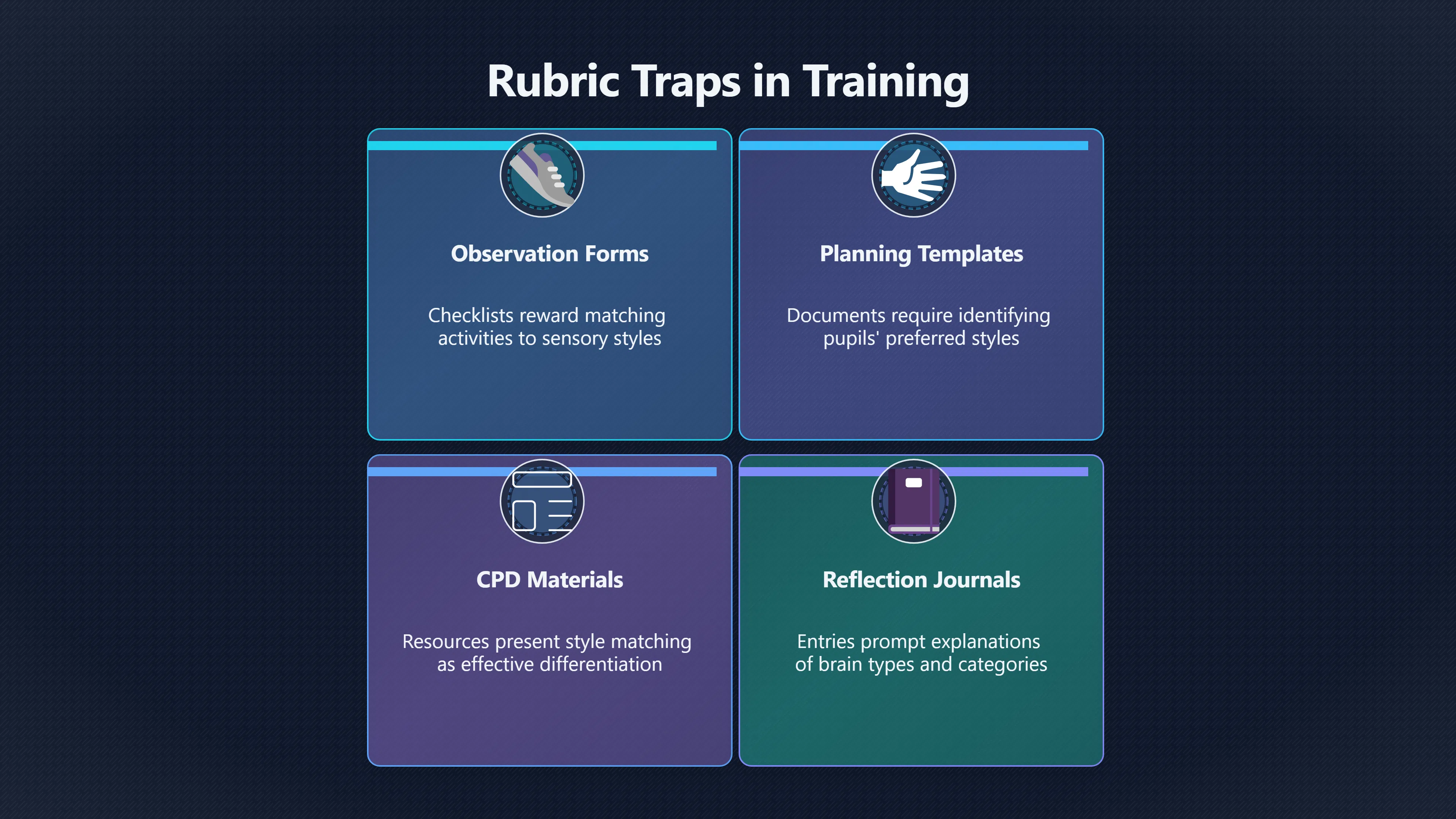
- Lesson observation forms asking trainees to demonstrate teaching for “visual, auditory and kinaesthetic learners”.
- Planning templates requiring teachers to identify pupils’ preferred learning styles.
- CPD materials presenting learning-style matching as evidence of effective differentiation.
- Reflection journals prompting trainees to explain how activities targeted different brain types or learner categories.
- Professional standards discussions that equate personalised learning with sensory-style matching.
In these situations, a trainee teacher may encounter conflicting messages. Research literature may question the effectiveness of learning-style matching, yet assessment systems may still reward its use. The result is a powerful incentive structure: teachers learn not only the myth itself but also its institutional value.
Higher education research has highlighted this problem. Analyses of educational literature have found that learning-styles concepts continue to appear positively in many educational publications and teacher-training resources even after major evidence reviews challenged their scientific basis.[PMC]pmc.ncbi.nlm.nih.govby S Dekker · 2012 · Cited by 1291 — Results showed that on average, teachers believed 49% of the neuromyths, particularly myths relat…
When observation frameworks mistake variety for validation
One reason neuromyths persist is that they attach themselves to practices that have genuine educational value.
A lesson containing diagrams, discussion, writing and practical activities may be highly effective. However, a rubric can incorrectly attribute that effectiveness to learning-style matching rather than to well-established principles such as retrieval practice, dual coding, elaboration, modelling or maintaining attention.
This creates a subtle but important confusion. Diverse teaching methods can support learning for many reasons. They do not automatically validate the claim that pupils possess fixed sensory learning styles requiring matched instruction.
Researchers studying the persistence of learning-styles beliefs note that teachers often observe engagement when using varied activities and then interpret that engagement through a learning-styles framework. The successful lesson reinforces the myth even though the mechanism behind the success may be entirely different.[Frontiers]frontiersin.orgVisual, Auditory, Converger) and that…[Frontiers]frontiersin.orgVisual, Auditory, Converger) and that…
Why enthusiasm for neuroscience is not enough
Many teacher educators are motivated by a legitimate goal: connecting classroom practice with modern science. The difficulty is that neuroscience findings do not translate directly into teaching methods.
Studies examining neuromyth beliefs have repeatedly found that educators with greater interest in neuroscience are not automatically protected from misconceptions. In some cases, exposure to brain-related information can coexist with strong endorsement of myths. Researchers have suggested that partial knowledge may even increase confidence in oversimplified claims when educators lack tools for evaluating evidence quality. PMC[PubMed]pubmed.ncbi.nlm.nih.govDispelling the Myth: Training in Education or Neuroscience…by K Macdonald · 2017 · Cited by 453 — These findings suggest that tr…
This helps explain why neuromyth language survives in professional training. Brain terminology carries authority. Terms such as:
- “left-brain versus right-brain learners”[my.chartered.college]my.chartered.collegeneuromyths about special educational needs what should teachers knowabout Special Educational Needs20 Sept 2022 — Some of the most common neuromyths include the beliefs that humans only use 10 per cent of… * “brain-compatible learning”[nature.com]nature.comEducational Neuroscience and Teacher PracticesNeuromyth: A widely held but unfounded belief about brain function and its application to t…
- “rewiring pathways”
- “critical learning windows”
- “kinaesthetic brain preference”
can make a training framework appear research-informed even when the educational recommendations are unsupported.
The attraction is understandable. Teacher educators face pressure to provide practical guidance, and neuroscience appears to offer objective answers to difficult classroom questions. Yet educational decisions usually require evidence from multiple fields, including cognitive psychology, classroom research and subject-specific pedagogy. A genuine brain finding does not automatically become a classroom strategy.[Dana Foundation]dana.orgDana FoundationWhen the Myth is the Message: Neuromyths and EducationWe investigate some of the most common neuromyths that pervade the e…[Frontiers]frontiersin.orgVisual, Auditory, Converger) and that…
The problem with rubric-friendly myths
Neuromyths are especially resilient when they can be converted into simple checklist items.
A rubric can easily record whether a trainee:
- identified learning styles;[link.springer.com]link.springer.comlearning styles neuromyth: when the same term means…by M Papadatou-Pastou · 2021 · Cited by 134 — A study into neuromyths in education…
- incorporated movement activities;
- used left-brain and right-brain tasks;[my.chartered.college]my.chartered.collegeneuromyths about special educational needs what should teachers knowabout Special Educational Needs20 Sept 2022 — Some of the most common neuromyths include the beliefs that humans only use 10 per cent of…
- provided brain-based differentiation.
By contrast, more evidence-informed questions are harder to score quickly. Assessing whether an explanation reduced cognitive load, whether retrieval opportunities were effective or whether misconceptions were successfully addressed often requires deeper professional judgement.
The governance challenge is therefore structural. Simplified myths can become attractive because they are easier to standardise and observe than complex evidence-based reasoning.
How training materials can accidentally normalise myths
Many training resources do not explicitly endorse neuromyths. Instead, they preserve them through ambiguity.
For example, a handbook might encourage teachers to “consider different learning styles” without explaining the distinction between learner preferences and evidence for matched instruction. A mentor may recommend visual, auditory and practical activities because varied representation can be useful, but trainees may interpret this as confirmation of learning-styles theory.
Research reviews have repeatedly identified this blurred boundary as a major reason neuromyths survive. Many myths contain a small element of truth surrounded by unsupported conclusions. People clearly differ from one another. The unsupported leap is the claim that identifying a preferred modality and matching instruction accordingly reliably improves learning outcomes.[Frontiers]frontiersin.orgVisual, Auditory, Converger) and that…[Frontiers]frontiersin.orgVisual, Auditory, Converger) and that…
The same pattern appears in other training contexts:
Legitimate educational concernNeuromyth versionLearners differ in prior knowledge and needsLearners belong to fixed learning-style categoriesMovement can support attention and wellbeingSpecific movement programmes integrate brain hemispheresBrain plasticity allows learning and developmentShort interventions can rapidly “rewire” learning capacitySome functions show hemispheric specialisationPeople are fundamentally left-brained or right-brained learners
When rubrics fail to distinguish between these ideas, myths can gain institutional legitimacy.

How evidence checks can improve professional judgement
Reducing neuromyths in teacher education does not require removing neuroscience from training. In fact, several researchers argue for better neuroscience education rather than less of it. The key difference is teaching future teachers how to evaluate claims instead of asking them to accept brain-based explanations at face value.[PubMed]pubmed.ncbi.nlm.nih.govDispelling the Myth: Training in Education or Neuroscience…by K Macdonald · 2017 · Cited by 453 — These findings suggest that tr…[Frontiers]frontiersin.orgVisual, Auditory, Converger) and that…
One practical change is shifting assessment language away from myth-based categories and towards evidence questions.
Instead of asking:
- “How did the lesson address visual, auditory and kinaesthetic learners?”
A rubric could ask:
- “How did the lesson support understanding through multiple representations?”
- “What evidence informed the choice of instructional approach?”
- “How were misconceptions identified and addressed?”
- “How was learning checked during and after instruction?”
These questions focus attention on observable learning processes rather than speculative brain claims.
Another useful safeguard is requiring evidence chains. Trainees can be encouraged to explain:
- The classroom problem they identified.
- The strategy they selected.
- The evidence supporting that strategy.
- The outcomes they observed.
- Alternative explanations for those outcomes.
This approach makes it harder for unsupported claims to survive on the strength of neuroscience vocabulary alone.
Teaching trainees to recognise red flags
Several recurring warning signs appear across neuromyth research and professional guidance:
- Claims that classify pupils into fixed brain types.
- Commercial programmes promising brain optimisation through simple exercises.
- Training materials that cite neuroscience without classroom evidence.
- Recommendations based primarily on brain scans rather than learning outcomes.
- Assessment rubrics that reward neuroscience terminology more than evidence of learning.
Reviews of neuromyth research consistently point to the need for stronger critical evaluation skills, better communication between researchers and educators, and higher-quality evidence literacy within teacher preparation programmes. PMC[Frontiers]frontiersin.orgVisual, Auditory, Converger) and that…
Professional standards shape what survives
The most influential feature of any training programme is not the lecture content but the assessment system. Teachers quickly learn which ideas affect observations, evaluations and career progression.
If professional standards reward evidence-informed reasoning, weak neuromyths gradually lose status. If observation forms and training rubrics continue to treat unsupported brain claims as markers of effective practice, those claims can persist for years even after the research community has moved on.
The persistence of learning-styles beliefs illustrates this dynamic. Despite decades of criticism and repeated reviews questioning the educational value of matching instruction to sensory preferences, the concept continues to appear in teacher beliefs, training materials and classroom discourse. Researchers studying neuromyths increasingly view this as a systems issue rather than merely an individual knowledge problem. The challenge is not only correcting teachers’ beliefs but ensuring that training structures, assessment language and professional development frameworks stop rewarding misconceptions as signs of expertise.[bps.org.uk]bps.org.uklearning styles myth still prevalent among educators and it shows no sign goingThe “learning styles” myth is still prevalent among educators4 Feb 2021 — The idea that people learn better when taught in a way that mat… 3PMC 3Frontiers(#endnote-9 “Snippet: Visual, Auditory, Converger)[frontiersin.org]frontiersin.orgVisual, Auditory, Converger) and that… and that”)
Amazon book picks
Further Reading
Books and field guides related to How teacher training can preserve myths. Use these as the next step if you want deeper reading beyond the article.
Visible Learning for Teachers
Encourages evaluation of what actually improves outcomes.
eBay marketplace picks
Marketplace Samples
Example marketplace items related to this page. Use the search link to explore similar finds on eBay.




Endnotes
1.
Source: pmc.ncbi.nlm.nih.gov
Link:https://pmc.ncbi.nlm.nih.gov/articles/PMC3475349/
Source snippet
by S Dekker · 2012 · Cited by 1291 — Results showed that on average, teachers believed 49% of the neuromyths, particularly myths relat...
2.
Source: pmc.ncbi.nlm.nih.gov
Link:https://pmc.ncbi.nlm.nih.gov/articles/PMC7835631/
Source snippet
The Persistence of Neuromyths in the Educational Settingsby M Torrijos-Muelas · 2021 · Cited by 259 — The findings present neuromyths...
3.
Source: link.springer.com
Link:https://link.springer.com/article/10.1007/s10212-020-00485-2
Source snippet
learning styles neuromyth: when the same term means...by M Papadatou-Pastou · 2021 · Cited by 134 — A study into neuromyths in education...
4.
Source: pmc.ncbi.nlm.nih.gov
Title: PMCThe Learning Styles Myth is Thriving in Higher Education
Link:https://pmc.ncbi.nlm.nih.gov/articles/PMC4678182/
Source snippet
by PM Newton · 2015 · Cited by 473 — The existence of 'Learning Styles' is a common 'neuromyth', and their use in all forms of educati...
5.
Source: dana.org
Link:https://dana.org/article/when-the-myth-is-the-message-neuromyths-and-education/
Source snippet
Dana FoundationWhen the Myth is the Message: Neuromyths and EducationWe investigate some of the most common neuromyths that pervade the e...
6.
Source: pmc.ncbi.nlm.nih.gov
Title: PMCIs it really a neuromyth?
Link:https://pmc.ncbi.nlm.nih.gov/articles/PMC11270031/
Source snippet
A meta-analysis of the learning styles...by V Clinton-Lisell · 2024 · Cited by 22 — The purpose of this study was to conduct a meta-anal...
7.
Source: bps.org.uk
Title: learning styles myth still prevalent among educators and it shows no sign going
Link:https://www.bps.org.uk/research-digest/learning-styles-myth-still-prevalent-among-educators-and-it-shows-no-sign-going
Source snippet
The “learning styles” myth is still prevalent among educators4 Feb 2021 — The idea that people learn better when taught in a way that mat...
8.
Source: pubmed.ncbi.nlm.nih.gov
Link:https://pubmed.ncbi.nlm.nih.gov/28848461/
Source snippet
Dispelling the Myth: Training in Education or Neuroscience...by K Macdonald · 2017 · Cited by 453 — These findings suggest that tr...
9.
Source: frontiersin.org
Link:https://www.frontiersin.org/journals/psychology/articles/10.3389/fpsyg.2017.00444/full
Source snippet
Visual, Auditory, Converger) and that...
10.
Source: frontiersin.org
Link:https://www.frontiersin.org/journals/education/articles/10.3389/feduc.2023.1147498/full
Source snippet
FrontiersThe persistence of matching teaching and learning stylesby SBRE Brown · 2023 · Cited by 35 — One such neuromyth claims that matc...
11.
Source: frontiersin.org
Link:https://www.frontiersin.org/journals/psychology/articles/10.3389/fpsyg.2024.1407518/full
Source snippet
There is no evidence to back up that some people are “auditory learners” or “visual learners” etc.Read more...
12.
Source: frontiersin.org
Link:https://www.frontiersin.org/journals/psychology/articles/10.3389/fpsyg.2017.01314/full
Source snippet
Dispelling the Myth: Training in Education or Neuroscience...by K Macdonald · 2017 · Cited by 455 — These findings suggest that training...
13.
Source: frontiersin.org
Link:https://www.frontiersin.org/journals/education/articles/10.3389/feduc.2021.665752/full
Source snippet
FrontiersReview on the Prevalence and Persistence of Neuromyths...by F Grospietsch · 2021 · Cited by 87 — This review article provides a...
14.
Source: frontiersin.org
Link:https://www.frontiersin.org/journals/psychology/articles/10.3389/fpsyg.2020.591923/full
Source snippet
The Persistence of Neuromyths in the Educational Settingsby M Torrijos-Muelas · 2021 · Cited by 273 — After two decades of publications o...
15.
Source: pubmed.ncbi.nlm.nih.gov
Link:https://pubmed.ncbi.nlm.nih.gov/34973019/
Source snippet
the Neuromyth of Learning Styleby A Yfanti · 2021 · Cited by 13 — In this study, neuromyths and the problems leading to education are ini...
16.
Source: frontiersin.org
Title: Is it really a neuromyth?
Link:https://www.frontiersin.org/journals/psychology/articles/10.3389/fpsyg.2024.1428732/full
Source snippet
A meta-analysis of the learning...by V Clinton-Lisell · 2024 · Cited by 27 — The purpose of this study was to conduct a meta-analysis of...
17.
Source: boldscience.org
Title: Neuromyths in education
Link:https://boldscience.org/neuromyths-in-education/
Source snippet
BOLD16 Oct 2017 — Surveys of neuromyths tell us about teacher beliefs, we are lacking information about how these have a real impact in t...
Additional References
18.
Source: my.chartered.college
Link:https://my.chartered.college/impact_article/teachers-understanding-of-neuromyths-a-role-for-educational-neuroscience-in-teacher-training/
Source snippet
role for educational neuroscience in teacher training.20 Sept 2022 — The current study aimed to understand the degree to which practising...
19.
Source: theguardian.com
Title: teachers neuromyth learning styles scientists neuroscience education
Link:https://www.theguardian.com/education/2017/mar/13/teachers-neuromyth-learning-styles-scientists-neuroscience-education
Source snippet
Teachers must ditch 'neuromyth' of learning styles, say...12 Mar 2017 — Teaching children according to their individual “learning style”...
20.
Source: my.chartered.college
Title: neuromyths about special educational needs what should teachers know
Link:https://my.chartered.college/impact_article/neuromyths-about-special-educational-needs-what-should-teachers-know/
Source snippet
about Special Educational Needs20 Sept 2022 — Some of the most common neuromyths include the beliefs that humans only use 10 per cent of...
21.
Source: educationalneuroscience.org.uk
Title: children have different learning styles
Link:https://www.educationalneuroscience.org.uk/resources/neuromyth-or-neurofact/children-have-different-learning-styles/
Source snippet
A survey from 2012 found that up to 93% of UK teachers believed in learning styles [v], and as recently as 2021, learning styles continue...
22.
Source: nature.com
Link:https://www.nature.com/nature-index/topics/l4/educational-neuroscience-and-teacher-practices
Source snippet
Educational Neuroscience and Teacher PracticesNeuromyth: A widely held but unfounded belief about brain function and its application to t...
23.
Source: cis.org.au
Title: knowledge is power what do teachers believe about learning
Link:https://www.cis.org.au/publication/knowledge-is-power-what-do-teachers-believe-about-learning/
Source snippet
Knowledge is power: What do teachers believe about...30 Oct 2025 — Specific studies on certain neuromyths such as learning styles and he...
24.
Source: discovery.ucl.ac.uk
Title: Tolmie Issue paper Chartered College of Teaching
Link:https://discovery.ucl.ac.uk/id/eprint/10156236/1/Tolmie_Issue%20paper-Chartered%20College%20of%20Teaching.pdf
Source snippet
UCL DiscoveryTeachers' understanding of neuromyths: A role for educational...by Y Arslan · 2022 · Cited by 8 — [Debunking]({{ 'debunking/' | relative_url }}) neuromyths thro...
25.
Source: nifdi.org
Link:https://www.nifdi.org/what-is-di/88-news/kerry-hempenstall/814-neuroscience-and-education-where-to.html
Source snippet
cline over the past decade. Potential adverse effects of...Read more...
26.
Source: niot.org.uk
Title: neuromyths in the classroom and the role of critical thinking
Link:https://niot.org.uk/insights/neuromyths-in-the-classroom-and-the-role-of-critical-thinking
Source snippet
3 Dec 2025 — Discover what our study of 570 teacher trainees revealed about widespread neuromyths in education...
27.
Source: bera.ac.uk
Link:https://www.bera.ac.uk/blog/neuromyths-in-schools
Source snippet
VAK learning styles (Dinham, 2016). It might lead...Read more...
Topic Tree