Within Slogans
Can myth busting accidentally spread myths?
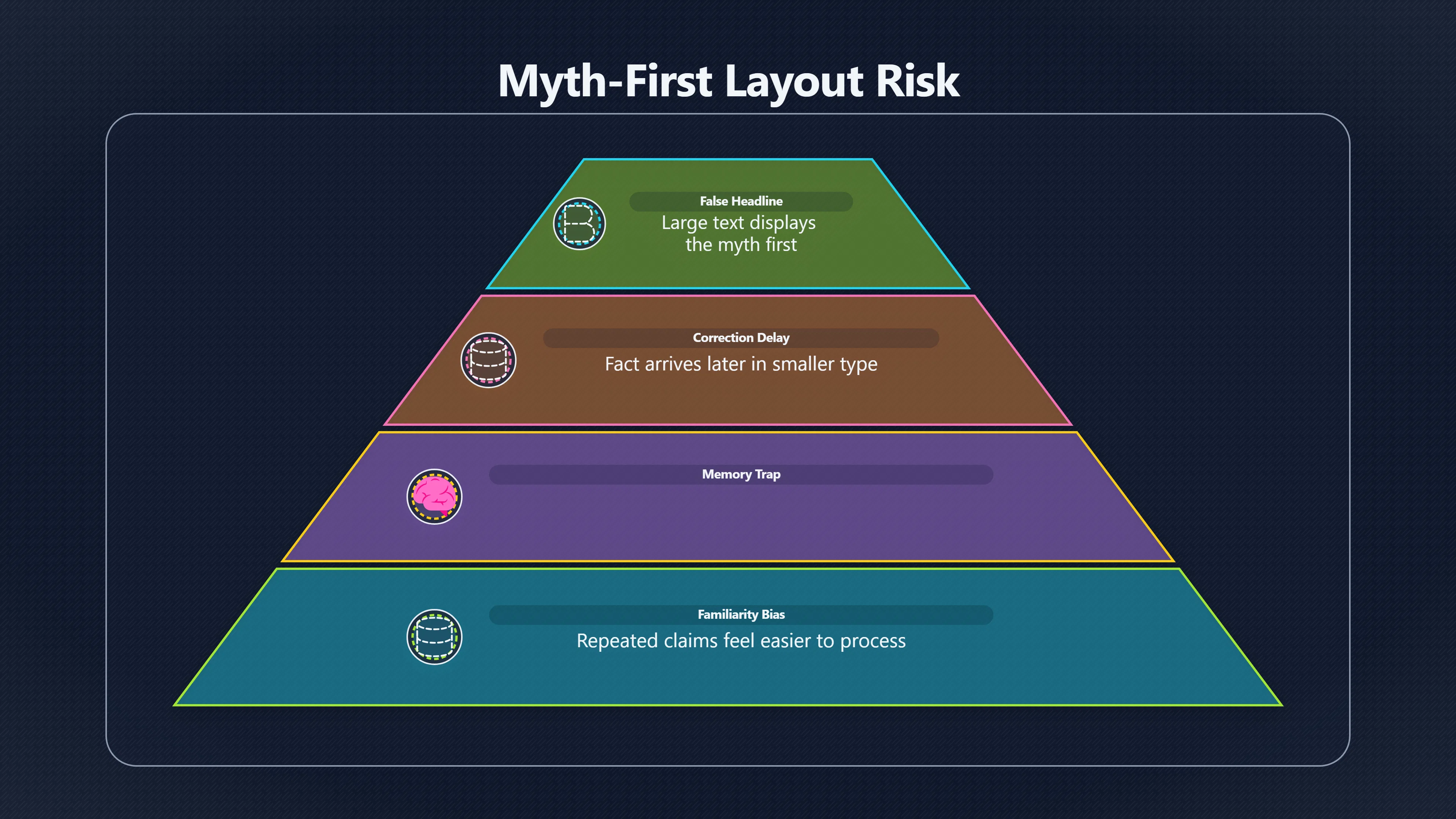
Putting the myth first can accidentally advertise it unless the correction leads with the fact and explains the misleading move.
On this page
- Why myth first layouts can strengthen memory of the claim
- The fact warning fallacy fact structure
- When naming the myth is necessary
Page outline Jump by section
Introduction
Can myth-busting accidentally spread myths? Sometimes, yes. The risk is not usually that corrections make people instantly believe false claims more strongly. Rather, the way a correction is presented can influence what people remember later. When a webpage, poster or social media graphic places the myth in a large headline and the correction underneath, readers may leave with a stronger memory of the myth itself than of the explanation. In a field concerned with myths and misconceptions, this is a governance and communication problem: the format of a correction can shape public understanding as much as the information it contains. Research on misinformation and debunking has therefore shifted attention from simply asking whether facts are provided to asking how they are structured, framed and recalled. Center for Climate Change Communication[2ltrr.arizona.edu]ltrr.arizona.eduThe Debunking Handbookby S Lewandowsky — Debunking myths is problematicUnless great care is taken, any effort to debunk misinformation can inadvertently reinforce the very myths one seeks to correct.Read more…
Why myth-first layouts can strengthen memory of the claim
Many traditional fact-check pages use a simple pattern:
- Myth: a false claim.[ksjhandbook.org]ksjhandbook.orgKSJ Handbook Structuring Your ArgumentKSJ HandbookStructuring Your Argument - MisinformationThe “fact-myth-fallacy” structure when debunking a claim. This involves presenting…
- Fact: the correction.
The format appears straightforward, but it can create an unintended emphasis. Readers encounter the false claim first, often in larger type, a memorable slogan or a striking headline. The correction arrives later and is usually longer and more complex.
Researchers have long worried that repeating misinformation increases familiarity. Familiar statements are often easier to process, and people can mistake that ease of processing for truth. This concern became known as the “familiarity backfire” hypothesis: repeating a myth while trying to correct it might make the myth more memorable. The concern influenced public-health campaigns, climate communication and fact-checking guidance for years. Center for Climate Change Communication[2ltrr.arizona.edu]ltrr.arizona.eduThe Debunking Handbookby S Lewandowsky — Debunking myths is problematicUnless great care is taken, any effort to debunk misinformation can inadvertently reinforce the very myths one seeks to correct.Read more…
However, newer evidence complicates the picture. Studies have found little support for a strong familiarity backfire effect in which corrections systematically increase belief in misinformation. Instead, corrections generally help. Yet the format still matters because myth-focused corrections can be less effective than fact-focused ones. Repeating the myth may not make people believe it more than before, but it can make the correction less memorable and less efficient than alternatives that foreground the factual explanation.[Ecker Memory & Cognition Lab]emc-lab.orgEcker Memory & Cognition LabThe role of familiarity in correcting inaccurate informationMarch 31, 2017 — by B Swire · Cited by 440 — Corr…[PMC]pmc.ncbi.nlm.nih.govThe backfire effect after correcting misinformation is strongly…by B Swire-Thompson · 2022 · Cited by 111 — The backfire effect is…
This distinction is important. The danger is not necessarily that a myth-busting page converts readers into believers. The danger is that it gives disproportionate attention to the myth and fails to make the factual account the most retrievable memory.
A practical example is a headline such as “MYTH: Scientists disagree about climate change.” Even when followed by a correction, the most prominent and memorable phrase may be the myth itself. Communication specialists increasingly recommend reversing that emphasis so that the first and most visible message is the accurate one.[KSJ Handbook]ksjhandbook.orgKSJ Handbook Structuring Your ArgumentKSJ HandbookStructuring Your Argument - MisinformationThe “fact-myth-fallacy” structure when debunking a claim. This involves presenting…
The fact-warning-fallacy-fact structure
To reduce the risk of inadvertently advertising misinformation, debunking researchers have developed alternative structures. One influential model is often described as fact-warning-fallacy-fact, sometimes called a “truth sandwich”.[KSJ Handbook]ksjhandbook.orgKSJ Handbook Structuring Your ArgumentKSJ HandbookStructuring Your Argument - MisinformationThe “fact-myth-fallacy” structure when debunking a claim. This involves presenting…[2arXiv]arxiv.orgGenerative Debunking of Climate Misinformation8 Jul 2024 — Psychological research recommends that debunkings should adopt the fact-m…
The sequence works as follows:
- Lead with the fact. State the accurate information first and make it the headline or opening message.
- Provide a warning. Tell readers that a false claim is about to be discussed.
- Explain the fallacy or misleading move. Show why the claim is incorrect, incomplete or logically flawed.
- Return to the fact. End with the accurate explanation so that it becomes the final takeaway.
This structure reflects a broader insight from misinformation research: corrections work best when they do more than negate a claim. People often need a replacement explanation. Simply saying “that is false” leaves a gap. Explaining the reasoning error, missing evidence or misleading inference gives readers a more coherent alternative account. Skeptical Science[2ltrr.arizona.edu]ltrr.arizona.eduThe Debunking Handbookby S Lewandowsky — Debunking myths is problematicUnless great care is taken, any effort to debunk misinformation can inadvertently reinforce the very myths one seeks to correct.Read more…
For governance bodies, public agencies and fact-checking organisations, this means designing corrections around the audience’s likely memory rather than around the myth itself. The goal is not merely to refute a claim but to ensure that the factual explanation becomes the dominant narrative readers carry away.

When naming the myth is necessary
Avoiding myths entirely is often impossible.
Public-health agencies may need to answer circulating rumours directly. Journalists may need to identify a false claim that has already become newsworthy. Fact-checkers cannot assess a statement without telling readers what is being checked.
Research therefore does not support a simple rule of “never repeat the myth”. Several studies have found that explicitly mentioning misinformation can be safe and sometimes useful when it is embedded within a strong correction. What matters is context, prominence and explanation.[University of Bristol]research-information.bris.ac.ukUniversity of Bristol Ecker, UK. H., Hogan, J. L., & Lewandowsky, S. (2017)….Today — recommendation to “myth debunkers” has been to avoid myth repetition in a corre… ResearchGate When naming a myth is necessary[researchgate.net]researchgate.netReminders and Repetition of Misinformation: Helping or…We found—contrary to the popular recommendation—that corrections we…, effective practice generally includes:
- Labelling it clearly as false before presenting it.
- Giving the factual explanation equal or greater prominence.
- Explaining the reasoning error rather than merely denying the claim.
- Returning attention to the factual account at the end.
- Avoiding headlines that effectively function as advertisements for the myth.[ltrr.arizona.edu]ltrr.arizona.eduThe Debunking Handbookby S Lewandowsky — Debunking myths is problematicUnless great care is taken, any effort to debunk misinformation can inadvertently reinforce the very myths one seeks to correct.Read more…[KSJ Handbook]ksjhandbook.orgKSJ Handbook Structuring Your ArgumentKSJ HandbookStructuring Your Argument - MisinformationThe “fact-myth-fallacy” structure when debunking a claim. This involves presenting…
This approach recognises that readers often encounter misinformation elsewhere first. In such cases, a correction must address the claim directly while preventing the correction page itself from becoming another vehicle for repetition.
Why this matters for public communication
The debate over myth-versus-fact pages illustrates a broader lesson about memorable slogans and accurate explanations. Communication is not only about transmitting information; it is also about shaping what remains in memory after details fade.
Early discussions of debunking often focused on dramatic “backfire effects”, where corrections would supposedly strengthen false beliefs. More recent reviews suggest that such effects are uncommon and that factual corrections usually improve accuracy. Yet this does not eliminate the design problem. The most effective corrections are those that make the truth more memorable than the myth, not merely those that place a factual sentence somewhere on the page. PMC[WIRED]wired.comFacebook has taken some measures to limit its reach, including applying fact-checks with notable hesitation. This hesitation stems partly… For organisations responsible for public information, the central question is therefore not whether to correct misinformation. It is how to structure the correction so that readers remember the fact, recognise the misleading move, and leave with a usable explanation rather than a recycled slogan.[Center for Climate Change Communication]climatechangecommunication.orgCenter for Climate Change CommunicationDebunking HandbookBecause a myth is necessarily repeated when it is debunked, the risk arises that…[Center for Climate Change Communication]climatechangecommunication.orgCenter for Climate Change CommunicationDebunking HandbookBecause a myth is necessarily repeated when it is debunked, the risk arises that…
Amazon book picks
Further Reading
Books and field guides related to Can myth busting accidentally spread myths?. Use these as the next step if you want deeper reading beyond the article.

The Righteous Mind
First published 2012. Subjects: Political psychology, Social psychology, Ethics, Religious Psychology, nyt:combined-print-and-e-book-nonf...

Foolproof: Why Misinformation Infects Our Minds and How to Bu...
Covers correction strategies and belief revision.
eBay marketplace picks
Marketplace Samples
Example marketplace items related to this page. Use the search link to explore similar finds on eBay.



Endnotes
1.
Source: climatechangecommunication.org
Link:https://www.climatechangecommunication.org/wp-content/uploads/2023/09/DebunkingHandbook2020.pdf
Source snippet
Center for Climate Change CommunicationDebunking HandbookBecause a myth is necessarily repeated when it is debunked, the risk arises that...
2.
Source: ltrr.arizona.edu
Title: The Debunking Handbookby S Lewandowsky — Debunking myths is problematic
Link:https://www.ltrr.arizona.edu/~katie/kt/natsgc/Debunking_Handbook.pdf
Source snippet
Unless great care is taken, any effort to debunk misinformation can inadvertently reinforce the very myths one seeks to correct.Read more...
3.
Source: pmc.ncbi.nlm.nih.gov
Link:https://pmc.ncbi.nlm.nih.gov/articles/PMC9283209/
Source snippet
The backfire effect after correcting misinformation is strongly...by B Swire-Thompson · 2022 · Cited by 111 — The backfire effect is...
4.
Source: arxiv.org
Link:https://arxiv.org/html/2407.05599v1
Source snippet
Generative Debunking of Climate Misinformation8 Jul 2024 — Psychological research recommends that debunkings should adopt the fact-m...
5.
Source: researchgate.net
Link:https://www.researchgate.net/publication/358083062_Reminders_and_repetition_of_misinformation_Helping_or_hindering_its_retraction
Source snippet
Reminders and Repetition of Misinformation: Helping or...We found—contrary to the popular recommendation—that corrections we...
6.
Source: wired.com
Link:https://www.wired.com/story/why-is-facebook-so-afraid-of-checking-facts
Source snippet
Facebook has taken some measures to limit its reach, including applying fact-checks with notable hesitation. This hesitation stems partly...
7.
Source: skepticalscience.com
Title: familiarity backfire
Link:https://skepticalscience.com/debunking-handbook-now-freely-available-download.html
Source snippet
The Debunking Handbook: now freely available for download27 Nov 2011 — The Handbook explores the surprising fact that debunking myths can...
8.
Source: climatecommunication.gmu.edu
Title: the debunking handbook 2020
Link:https://climatecommunication.gmu.edu/all/the-debunking-handbook-2020/
Source snippet
Center for Climate Change CommunicationThe Debunking Handbook 202013 Sept 2023 — The Debunking Handbook 2020 summarizes the current state...
9.
Source: emc-lab.org
Link:https://www.emc-lab.org/uploads/1/1/3/6/113627673/swire.2017.jeplmc.pdf
Source snippet
Ecker Memory & Cognition LabThe role of familiarity in correcting inaccurate informationMarch 31, 2017 — by B Swire · Cited by 440 — Corr...
Published: March 31, 2017
10.
Source: ksjhandbook.org
Title: KSJ Handbook Structuring Your Argument
Link:https://ksjhandbook.org/misinformation/structuring-your-argument/
Source snippet
KSJ HandbookStructuring Your Argument - MisinformationThe “fact-myth-fallacy” structure when debunking a claim. This involves presenting...
11.
Source: research-information.bris.ac.uk
Title: University of Bristol Ecker, U
Link:https://research-information.bris.ac.uk/ws/files/153248187/EckerHoganLewan_revTC.SL.pdf
Source snippet
K. H., Hogan, J. L., & Lewandowsky, S. (2017)....Today — recommendation to “myth debunkers” has been to avoid myth repetition in a corre...
Additional References
12.
Source: skepticalscience.com
Title: Debunking Handbook Part 5 Filling gap with alternative explanation
Link:https://skepticalscience.com/Debunking-Handbook-Part-5-Filling-gap-with-alternative-explanation.html
Source snippet
Skeptical ScienceThe Debunking Handbook Part 5: Filling the gap with an...25 Nov 2011 — The most effective way to reduce the effect of m...
13.
Source: firstdraftnews.org
Title: the psychology of misinformation why its so hard to correct
Link:https://firstdraftnews.org/articles/the-psychology-of-misinformation-why-its-so-hard-to-correct/
Source snippet
The psychology of misinformation: Why it's so hard to correct14 Jul 2020 — The familiarity backfire effect describes the fact that correc...
14.
Source: skepticalscience.com
Link:https://skepticalscience.com/print.php?n=1106
Source snippet
Skeptical ScienceThe Debunking Handbook Part 2: The Familiarity Backfire...18 Nov 2011 — Your debunking should begin with emphasis on th...
15.
Source: effectiviology.com
Link:https://effectiviology.com/familiarity-backfire-effect/
Source snippet
member misinformation better, and to remember it as being true.Read more...
16.
Source: richardberks.co.uk
Title: charities debunk myths effectively
Link:https://richardberks.co.uk/blog/charities-debunk-myths-effectively/
Source snippet
How can charities debunk myths effectively?9 Aug 2021 — How can charities debunk myths effectively? This blog looks at why [health myths]({{ 'health-myths/' | relative_url }}) p...
17.
Source: sciencedirect.com
Title: Familiarity backfire effects?
Link:https://www.sciencedirect.com/science/article/pii/S0167811626000261
Source snippet
Disentangling the competing...by IN Nibat · 2026 — Familiarity backfire effects? Disentangling the competing effects of repetition and f...
18.
Source: skepticalscience.com
Title: Debunking Handbook Part 2 Familiarity Backfire Effect
Link:https://skepticalscience.com/Debunking-Handbook-Part-2-Familiarity-Backfire-Effect.html
Source snippet
The driving force is the fact that familiarity increases the chances of accepting information as true...
19.
Source: academia.edu
Title: The Debunking Handbook 2020
Link:https://www.academia.edu/44938020/The_Debunking_Handbook_2020
Source snippet
(PDF) The Debunking Handbook 202030 Jan 2021 — The Debunking Handbook 2020 summarizes the insights from decades of research into counteri...
20.
Source: digitalcommons.unl.edu
Link:https://digitalcommons.unl.edu/context/scholcom/article/1247/viewcontent/DebunkingHandbook2020.pdf
Source snippet
Debunking Handbook 2020 - DigitalCommons@UNLby S Lewandowsky · Cited by 492 — Because a myth is necessarily repeated when it is debunked...
21.
Source: shapingtomorrowsworld.org
Link:https://www.shapingtomorrowsworld.org/debunking-handbook-part-1-first-myth-about-debunking.html
Source snippet
Shaping Tomorrows WorldThe Debunking Handbook Part 1: The first myth about...by S Lewandowsky · Cited by 1 — First, the refutation must...
Topic Tree