Within Mythcraft
When Personal Experience Becomes a Myth
Many misconceptions begin when a real experience is stretched into a rule that evidence does not support.
On this page
- Why anecdotes feel powerful
- The limits of one case
- Moving from story to evidence
Page outline Jump by section
Introduction
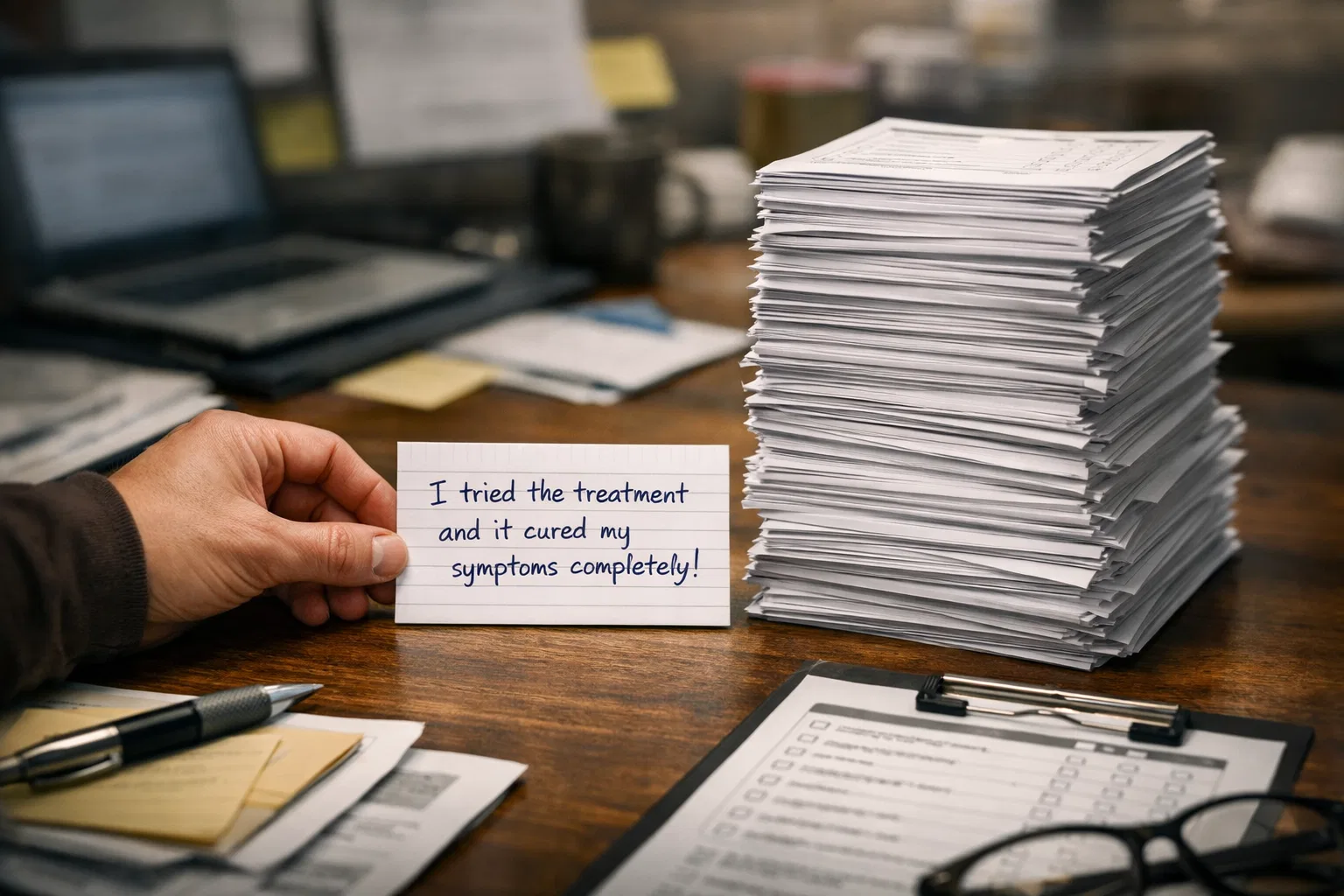
Overgeneralising from personal experience is one of the most common ways a misconception begins. A person has a real experience, remembers it vividly, and then stretches it into a rule: “that treatment worked for me, so it works”, “I had a bad encounter with one person from that group, so they are all like that”, or “I ignored the warning once and nothing happened, so the warning is exaggerated”. The problem is not that the experience is fake. Often it is perfectly sincere. The mistake is treating one case, or a small cluster of cases, as if it can carry the weight of broader evidence.
This matters because myths often grow from true fragments. Personal stories are memorable, emotionally persuasive and easy to share, while population-level evidence is slower, less vivid and harder to interpret. Research on judgement under uncertainty has long shown that people often lean on what comes easily to mind, what feels representative, or what fits an existing belief, even when the relevant evidence should include sample size, comparison groups and base rates.[PubMed]pubmed.ncbi.nlm.nih.govJudgment under Uncertainty: Heuristics and Biasesby A Tversky · 1974 · Cited by 58830 — This article described three heuristics tha…
Why anecdotes feel powerful
Anecdotes feel powerful because they arrive as stories, not spreadsheets. They usually contain a person, a sequence of events, a clear outcome and an implied lesson. That structure makes them easier to remember than abstract evidence. “My neighbour took this supplement and felt better” is more mentally available than a systematic review comparing many people under controlled conditions. The story has a face; the statistic has a denominator.
This is why personal experience can outrank better evidence in everyday reasoning. A 2020 meta-analysis of 61 papers on anecdotal versus statistical evidence found that anecdotal evidence can be especially persuasive when emotional engagement is high, such as in health issues, severe threats or personally relevant situations. In those contexts, statistics may be less influential than a vivid case, even when the statistics are more reliable for judging what usually happens.[IDEAS]ideas.repec.orgIDEAS/Re PEc When poignant stories outweigh cold hard facts: A metaIDEAS/RePEcWhen poignant stories outweigh cold hard facts: A meta…February 2, 2020 — by TH Freling · 2020 · Cited by 113 — The objecti…[RePEc]ideas.repec.orgIDEAS/Re PEc When poignant stories outweigh cold hard facts: A metaIDEAS/RePEcWhen poignant stories outweigh cold hard facts: A meta…February 2, 2020 — by TH Freling · 2020 · Cited by 113 — The objecti…
The same pattern appears in studies of flawed science and medical choices. Research on science-related decision-making found that anecdotal evidence can become a strong barrier to evidence-based reasoning. A 2024 study also found that reading anecdotes about medical treatments shifted participants’ beliefs about treatment efficacy, including when the anecdotes concerned artificial or real treatments.[PMC]pmc.ncbi.nlm.nih.govPMCWhen and why do people act on flawed science?Effects of…by AL Michal · 2021 · Cited by 39 — In particular, the presence of anecdotal evidence can serve as a powerful barrier for s…
The mechanism is simple but potent: a story supplies meaning before evidence has been weighed. Once a story feels like an explanation, later information is judged against it. If the story also fits someone’s existing worldview, group identity or fears, it becomes even harder to treat it as merely one data point.
The limits of one case
A single case can show that something happened. It usually cannot show how often it happens, why it happened, whether it would happen again, or whether the same explanation applies to other people. Those are different questions, and they require different evidence.
The central weakness is the missing comparison. Suppose someone drinks a herbal tea and their cold improves the next day. The improvement may be real, but colds often improve on their own. Without a comparison group, it is hard to separate the effect of the tea from time, placebo effects, regression to the mean, other treatments, changes in behaviour or ordinary variation. The personal story is evidence that the person got better after drinking the tea; it is not yet strong evidence that the tea caused the recovery.
This is why official safety-monitoring systems repeatedly warn against reading raw reports as proof of cause. The US Vaccine Adverse Event Reporting System, for example, accepts reports of adverse events after vaccination, but the CDC states that VAERS data alone cannot determine whether a vaccine caused the reported event. The system is designed to detect possible safety signals that need further investigation, not to turn every reported sequence into a confirmed causal claim.[CDC]cdc.govSource details in endnotes.
The same caution applies to drug adverse-event reports. The US Food and Drug Administration explains that the existence of a report does not establish causation, that report information may not be medically verified, and that such reports cannot be used to estimate occurrence rates. A report may reflect an observation worth investigating, but it is not the same as controlled evidence about risk.[U.S. Food and Drug Administration]fda.govSource details in endnotes.
That distinction is where many misconceptions begin. A real event is converted into a general rule before the basic evidential questions have been asked: How many cases are there? Compared with what? How were they selected? What else could explain the outcome? What happens when the claim is tested systematically?
How a real experience becomes a myth
Personal experience usually becomes a myth through a chain of small reasoning shortcuts rather than one dramatic error. The experience is noticed, remembered, repeated and simplified until it becomes a portable rule.
One common shortcut is the availability heuristic: people estimate frequency or likelihood partly by how easily examples come to mind. Tversky and Kahneman’s classic 1974 paper described availability as one of the heuristics people use when judging frequency and plausibility under uncertainty. This shortcut is useful in many ordinary situations, but it can mislead when memorable examples are not representative.[PubMed]pubmed.ncbi.nlm.nih.govJudgment under Uncertainty: Heuristics and Biasesby A Tversky · 1974 · Cited by 58830 — This article described three heuristics tha…
Another shortcut is the “law of small numbers”: the tendency to expect small samples to resemble the wider population more closely than they really do. Kahneman and Tversky argued that people often overestimate the stability and representativeness of small samples. In myth-making, this means a handful of striking cases can feel like a pattern even when they may be ordinary noise, coincidence or selection bias.[stats.org.uk]stats.org.ukBELIE F IN THE LAW OF SMALL NUMBERSBELIEF IN THE LAW OF SMALL NUMBERS - Statisticsby A TVERSKY · 1971 · Cited by 5219 — We pro- posed a representation hypothesis according…
A third shortcut is base-rate neglect. People may focus on the vivid detail of a case and underweight the background frequency of events. For example, if a health problem is common in a population, some people will develop it after eating a certain food, taking a medicine or receiving a vaccine purely by coincidence. Without the base rate, the timing can look more meaningful than it is. Research describes base-rate neglect as underweighting prior statistical information, with real-world consequences for judgement.[PMC]pmc.ncbi.nlm.nih.govOpen source on nih.gov.
The myth forms when these shortcuts combine:
- A memorable case is treated as typical. The more vivid the case, the more representative it feels.
- Timing is mistaken for cause. “After this” becomes “because of this”.
- Missing cases disappear. People remember the dramatic success, failure or harm, not the many times nothing unusual happened.
- The story is repeated in a simplified form. Each retelling trims uncertainty and strengthens the apparent lesson.
- The anecdote becomes identity-protective. Challenging the claim can start to feel like dismissing the person who lived through it.
This is why correcting anecdote-based myths can be delicate. The experience may be real, painful or meaningful. The correction is not “that did not happen”; it is “that happened, but it does not prove the wider rule being drawn from it”.
Personal experience is not useless
The opposite misconception is that anecdotes have no value at all. Personal experience can be an important starting point. It can flag overlooked harms, reveal lived consequences, generate research questions, expose blind spots in expert assumptions and make abstract problems humanly intelligible.
Medicine offers a useful distinction. Case reports and spontaneous safety reports are not usually enough to prove cause, but they can help detect signals. VAERS, for instance, is valuable because patterns in reports can prompt further investigation in stronger systems, even though individual reports do not establish causation.[Bloomberg School of Public Health]publichealth.jhu.eduwhat vaers is and isntwhat vaers is and isnt
Personal experience also matters in communication. Research on science and lived experience argues that weaving personal anecdotes into scientific research can make it more compelling and digestible, while dismissing lived experience too quickly can alienate people whose realities are being discussed.[PMC]pmc.ncbi.nlm.nih.govPMCCan we shift belief in the 'Law of Small Numbers'?PMCCan we shift belief in the 'Law of Small Numbers'?
The better rule is not “ignore anecdotes”. It is “put anecdotes in the right evidential role”. A story can suggest a possibility, illustrate a mechanism, identify a harm, or motivate a question. It becomes unreliable when it is asked to settle a claim about what is generally true.
Moving from story to evidence
The practical move is to keep the story, but change the question. Instead of asking “Did this happen to me or someone I know?”, ask “What would show whether this is common, causal and generalisable?”
A useful evidence shift looks like this:
- From sequence to cause: Did the outcome happen because of the suspected factor, or merely after it?
- From one case to a comparison: What happens to similar people who did not have the same exposure?
- From memorable cases to all cases: Are we counting quiet non-events as well as dramatic examples?
- From “people like me” to relevant subgroups: Does the evidence apply to people with the same age, condition, context or risk profile?
- From certainty to probability: Does the evidence show that something always works, sometimes helps, rarely harms, or has no clear effect?
This is why systematic evidence is so important for questions that affect health, safety, policy or public understanding. Cochrane describes its role as examining evidence behind questions that affect people’s lives so that decisions can be better informed. The point of evidence synthesis is not to erase individual stories, but to protect people from mistaking a selective set of stories for the whole picture.[Cochrane]cochrane.orgOpen source on cochrane.org.
In everyday life, the same logic applies outside medicine. A teacher may remember one student who thrived under a harsh method, but that does not prove the method helps most students. A manager may trust an interview “gut feeling” because one past hire worked out, but that does not show the judgement method is reliable. A traveller may visit a city once, encounter rude service, and form a sweeping view of the place. Each case may be real; the myth begins when the case is promoted into a rule.

The fairest way to challenge anecdote-based myths
The most effective response usually separates respect for the experience from acceptance of the conclusion. Saying “that is just anecdotal” can sound dismissive, especially when the person is describing pain, loss or hard-won practical knowledge. A better response acknowledges the story and then asks what kind of evidence would show whether it generalises.
For example: “I believe that happened to you. The question is whether it happens often enough, and for the reason we think, to make a general rule.” This keeps the person’s experience on the table while moving the claim into a testable form.
This approach also avoids a common trap in myth correction: replacing one overgeneralisation with another. Not every personal account is false. Not every official source is complete. Not every study applies to every individual. Evidence-based thinking means weighing the right kind of evidence for the question, not automatically choosing the most impersonal source.
The most reliable habit is to treat anecdotes as signals, not verdicts. A personal story can tell us where to look. It cannot, by itself, tell us what we will find when we look carefully.
Amazon book picks
Further Reading
Books and field guides related to When Personal Experience Becomes a Myth. Use these as the next step if you want deeper reading beyond the article.
Thinking, Fast and Slow
Explains cognitive biases behind overgeneralizing from experience.

Scout Mindset
First published 2021. Subjects: Economics, Psychology, Cognition, Skepticism, Critical thinking.
eBay marketplace picks
Marketplace Samples
Example marketplace items related to this page. Use the search link to explore similar finds on eBay.
Endnotes
1.
Source: stats.org.uk
Title: BELIE F IN THE LAW OF SMALL NUMBERS
Link:https://www.stats.org.uk/statistical-inference/TverskyKahneman1971.pdf
Source snippet
BELIEF IN THE LAW OF SMALL NUMBERS - Statisticsby A TVERSKY · 1971 · Cited by 5219 — We pro- posed a representation hypothesis according...
2.
Source: ideas.repec.org
Title: IDEAS/Re PEc When poignant stories outweigh cold hard facts: A meta
Link:https://ideas.repec.org/a/eee/jobhdp/v160y2020icp51-67.html
Source snippet
IDEAS/RePEcWhen poignant stories outweigh cold hard facts: A meta...February 2, 2020 — by TH Freling · 2020 · Cited by 113 — The objecti...
Published: February 2, 2020
3.
Source: pmc.ncbi.nlm.nih.gov
Title: PMCWhen and why do people act on flawed science?
Link:https://pmc.ncbi.nlm.nih.gov/articles/PMC8023527/
Source snippet
Effects of...by AL Michal · 2021 · Cited by 39 — In particular, the presence of anecdotal evidence can serve as a powerful barrier for s...
4.
Source: pmc.ncbi.nlm.nih.gov
Link:https://pmc.ncbi.nlm.nih.gov/articles/PMC11345347/
5.
Source: cdc.gov
Link:https://www.cdc.gov/vaccine-safety-systems/vaers/index.html
6.
Source: pmc.ncbi.nlm.nih.gov
Title: PMCCan we shift belief in the ‘Law of Small Numbers’?
Link:https://pmc.ncbi.nlm.nih.gov/articles/PMC8889191/
7.
Source: pmc.ncbi.nlm.nih.gov
Link:https://pmc.ncbi.nlm.nih.gov/articles/PMC9831339/
8.
Source: pmc.ncbi.nlm.nih.gov
Link:https://pmc.ncbi.nlm.nih.gov/articles/PMC7923648/
9.
Source: cochrane.org
Link:https://www.cochrane.org/
10.
Source: cochrane.org
Link:https://www.cochrane.org/about-us
11.
Source: cochrane.org
Link:https://www.cochrane.org/products-and-services/cochrane-library
12.
Source: cochrane.org
Link:https://www.cochrane.org/about-us/who-we-are/our-groups
13.
Source: pubmed.ncbi.nlm.nih.gov
Link:https://pubmed.ncbi.nlm.nih.gov/17835457/
Source snippet
Judgment under Uncertainty: Heuristics and Biasesby A Tversky · 1974 · Cited by 58830 — This article described three heuristics tha...
14.
Source: pubmed.ncbi.nlm.nih.gov
Link:https://pubmed.ncbi.nlm.nih.gov/26209838/
15.
Source: fda.gov
Link:https://www.fda.gov/drugs/fda-adverse-event-monitoring-system-aems/fda-adverse-event-monitoring-system-aems-public-dashboard
16.
Source: publichealth.jhu.edu
Title: what vaers is and isnt
Link:https://publichealth.jhu.edu/2022/what-vaers-is-and-isnt
17.
Source: fda.gov
Title: vaccine adverse event reporting system vaers questions and answers
Link:https://www.fda.gov/[vaccines
18.
Source: thedecisionlab.com
Title: Availability Heuristic
Link:https://thedecisionlab.com/biases/availability-heuristic
19.
Source: cochranelibrary.com
Link:https://www.cochranelibrary.com/
20.
Source: cochranelibrary.com
Link:https://www.cochranelibrary.com/advanced-search
21.
Source: Wikipedia
Title: Anecdotal evidence
Link:https://en.wikipedia.org/wiki/Anecdotal_evidence
22.
Source: Wikipedia
Title: Availability heuristic
Link:https://en.wikipedia.org/wiki/Availability_heuristic
23.
Source: Wikipedia
Title: Cochrane (organisation)
Link:https://en.wikipedia.org/wiki/Cochrane_%28organisation%29
24.
Source: youtube.com
Link:https://www.youtube.com/user/CochraneCollab
25.
Source: vaers.hhs.gov
Link:https://vaers.hhs.gov/data.html
26.
Source: uk.linkedin.com
Link:https://uk.linkedin.com/company/cochrane
Additional References
27.
Source: science.org
Title: antivaccine activists use government database side effects scare public
Link:https://www.science.org/content/article/antivaccine-activists-use-government-database-side-effects-scare-public
28.
Source: youtube.com
Title: The Danger of Small Sample Sizes and Personal Experience
Link:https://www.youtube.com/watch?v=gT-824_v1Xg
Source snippet
How Cognitive Biases Distort Our Reality...
29.
Source: researchgate.net
Link:https://www.researchgate.net/publication/226764072_Anecdotal_Statistical_and_Causal_Evidence_Their_Perceived_and_Actual_Persuasiveness
30.
Source: researchgate.net
Link:https://www.researchgate.net/publication/380077387_Base_Rate_Neglect_Bias_Can_it_be_Observed_in_HRM_Decisions_and_Can_it_be_Decreased_by_Visually_Presenting_the_Base_Rates_in_HRM_Decisions
31.
Source: researchgate.net
Link:https://www.researchgate.net/publication/353730747_The_influence_of_design_on_flower_personality_the_moderating_role_of_human_personality
32.
Source: researchgate.net
Link:https://www.researchgate.net/publication/369977297_Revisiting_the_Belief_in_the_law_of_small_numbers_Conceptual_replication_and_extensions_Registered_Report_of_problems_reviewed_in_Tversky_and_Kahneman_1971
33.
Source: apa.org
Link:https://www.apa.org/pubs/databases/psycbooks/psycbooks-sample-counseling-titles-toc.pdf
34.
Source: facebook.com
Link:https://www.facebook.com/unbiasedscipod/posts/anecdotal-evidence-is-data-collected-in-a-non-scientific-manner-to-assert-specif/403464464775223/
35.
Source: simplypsychology.org
Link:https://www.simplypsychology.org/base-rate-fallacy.html
36.
Source: researchgate.net
Link:https://www.researchgate.net/publication/321222805_The_business_of_blogging_Effective_approaches_of_women_food_bloggers
Topic Tree