Within Identity
How corrections avoid sounding like attacks
Corrections work better when they protect the listener's dignity while separating a trusted person from a false claim.
On this page
- Why blunt debunking can trigger defensiveness
- Using in group trust without spreading new myths
- Guardrails for respectful myth correction
Page outline Jump by section
Introduction
Correcting a myth is not only a factual task. It is often a social one. People can accept new information more easily when the correction does not force them to choose between accuracy and belonging. A myth tied to family traditions, political identity, religious community, professional pride or personal intelligence can become difficult to challenge because rejecting the claim may feel like rejecting the people associated with it.
 Research on misinformation and identity-protective reasoning suggests that corrections work best when they reduce threat rather than increase it. Trusted messengers can play a crucial role because they are often seen as part of the listener’s group rather than an external critic. The most effective interventions tend to separate respect for the person from rejection of the false claim, allowing people to update beliefs without public humiliation or loss of status.[SSRN]papers.ssrn.comMisconceptions, Misinformation, and the Logic of Identity-…by DM Kahan · 2017 · Cited by 582 — Identity protective cognition refer…[Informal Science]informalscience.orgIdentity | Dan KahanDan Kahan's identity-related work has focused on “identity protective cognition”, which refers to the tendency of ind…
Why blunt debunking can trigger defensiveness
Many failed corrections share a common problem: they sound like judgments about the believer rather than evaluations of the information.
A direct statement such as “that’s nonsense” or “only uninformed people believe that” may communicate more than disagreement. It can imply that the listener is gullible, irresponsible or disloyal. Once a correction is interpreted as an identity threat, people often shift from evaluating evidence to defending themselves or their group. Research on misinformation correction notes that perceived attacks on identity can trigger emotional responses that interfere with belief revision and encourage people to dismiss the source of the correction.[Ecker Memory & Cognition Lab]emc-lab.orgecker.2022.nrp preprintEcker Memory & Cognition Lab1 The Psychological Drivers of Misinformation Belief and its…by UKH Ecker · Cited by 1916 — Such correctio…
This helps explain why highly educated people can still resist corrections. The barrier is not necessarily a lack of intelligence. It is often a concern about social consequences. If accepting a correction feels like admitting that one’s family, political allies, religious community or trusted leaders were wrong, the psychological cost becomes much higher.
Importantly, recent reviews of misinformation research suggest that fears of dramatic “backfire effects” have often been overstated. Corrections frequently help rather than harm. However, effectiveness still depends on how the correction is delivered and whether it generates unnecessary defensiveness.[PMC]pmc.ncbi.nlm.nih.govby AK Shen · 2021 · Cited by 46 — Vaccine hesitancy is a major health threat that can undermine communities' ability to attain herd im…
The dignity principle
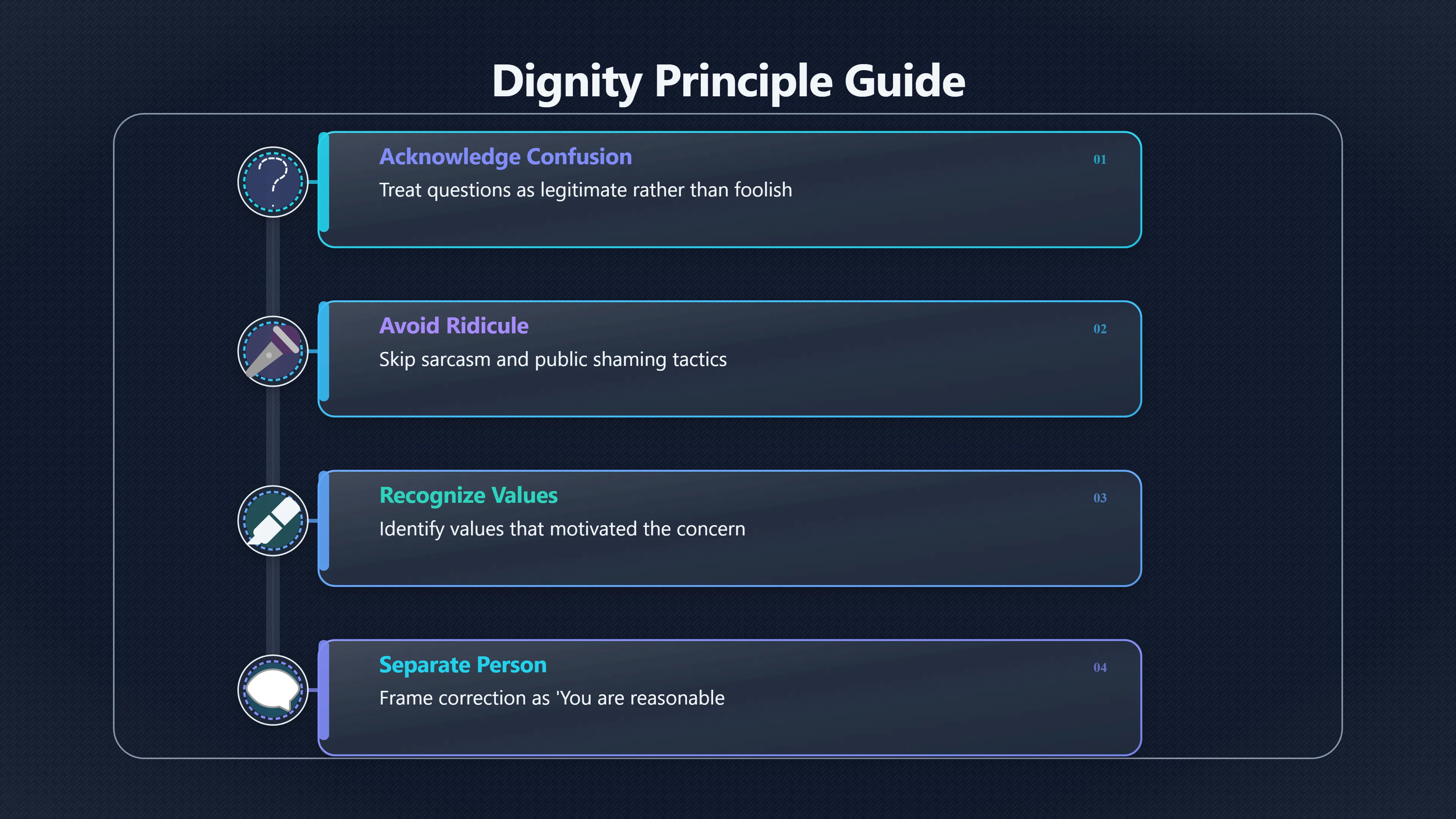
One of the most practical lessons from communication research is that people become more receptive when their dignity remains intact.
This means:
- Acknowledging that confusion is understandable.
- Treating questions as legitimate rather than foolish.
- Avoiding ridicule, sarcasm and public shaming.
- Recognising values that motivated the concern in the first place.
The World Health Organization’s guidance on vaccine conversations emphasises listening with empathy, acknowledging concerns and creating space for discussion before presenting corrective information.[World Health Organization]who.inthow to talk about vaccinesDon't dismiss them; instead, acknowledge how they're feeling and create space…Read more…
The correction then becomes: “You are a reasonable person who received inaccurate information,” rather than: “You are the problem.”
Why trusted messengers change the equation
People rarely evaluate claims in isolation. They ask whether the source understands their world, shares their concerns and has earned credibility over time.
A correction from an outsider may be factually stronger yet socially weaker than a correction from someone inside the listener’s community. Trusted messengers reduce perceived hostility because they already possess relationship capital. The listener is less likely to assume malicious motives.
Studies of misinformation correction on messaging platforms have found that people are more willing to engage with and share debunking material when it comes through strong social ties or trusted in-group connections. Research on WhatsApp misinformation, for example, found that close relationships can increase willingness to redistribute corrective information.[DSpace]dspace.mit.eduSocial Debunking of Misinformation on WhatsAppby I Pasquetto · 2022 · Cited by 87 — Our research design enables us to examine wheth…
This does not mean any familiar person automatically becomes persuasive. Trust generally combines several elements:
- Shared identity or lived experience.
- A history of honesty.
- Demonstrated competence in the topic.
- Evidence that the messenger respects the audience.
A local pharmacist, community organiser, sports coach, religious leader or neighbourhood volunteer may sometimes outperform a distant institution because they are seen as understanding local concerns rather than issuing instructions from above.[PMC]pmc.ncbi.nlm.nih.govby AK Shen · 2021 · Cited by 46 — Vaccine hesitancy is a major health threat that can undermine communities' ability to attain herd im…[Local]local.gov.ukleeds importance messenger not just messageernment AssociationThe importance of the messenger, not just the message10 Mar 2022 — Local insight, taken before the first wave…
When the messenger shares the listener’s values
One powerful strategy is value alignment.
Instead of framing a correction as a battle between informed and uninformed people, trusted messengers can frame it as consistent with the group’s existing values.
For example:
- A religious leader may connect medical guidance to teachings about protecting community health.
- A military veteran may explain a scientific issue through values of responsibility and preparedness.
- A conservative community figure may frame environmental risk information around stewardship, resilience or local economic stability.
- A parent may discuss childhood health in terms of care and responsibility rather than compliance.
The factual content may remain unchanged, but the social meaning shifts. The correction no longer signals group betrayal.
Research on identity-protective cognition helps explain why this matters. People often evaluate evidence through the lens of group commitments. Information becomes easier to accept when acceptance does not threaten those commitments.[SSRN]papers.ssrn.comMisconceptions, Misinformation, and the Logic of Identity-…by DM Kahan · 2017 · Cited by 582 — Identity protective cognition refer…
Using in-group trust without spreading new myths
Trusted messengers can be highly effective, but there is a risk. The same trust that helps corrections spread can also spread inaccuracies if messengers improvise, exaggerate or repeat myths carelessly.
The goal is not simply to recruit popular voices. It is to connect trusted voices with reliable information.
Separate the person from the myth
One useful technique is to avoid portraying previous believers as villains.
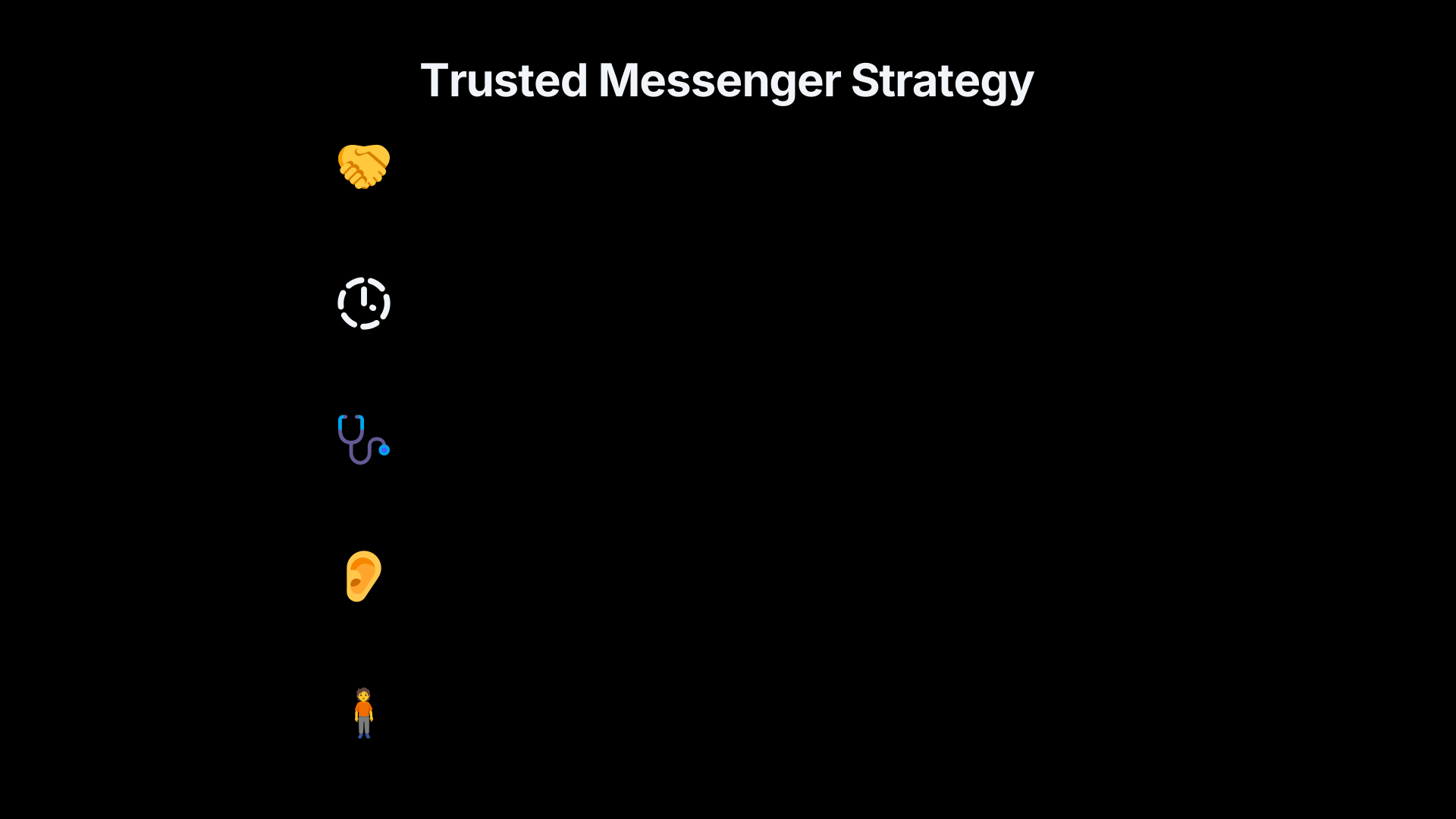
A trusted messenger might say:
- “A lot of people heard that claim because it circulated widely.”
- “I wondered about that too before checking the evidence.”
- “Many of us were given incomplete information.”
This framing creates distance between the listener and the myth. The myth becomes a mistaken claim that affected many people, not proof that the listener was foolish.
Use the “truth first” approach
Many misinformation researchers recommend leading with accurate information before discussing the false claim.
Instead of repeatedly restating a myth, communicators can:
- Present the correct information.
- Explain why it is supported.
- Briefly address the inaccurate claim.
- Return to the accurate explanation.
This reduces the risk of increasing familiarity with the myth itself while still correcting it. Research on debunking strategies and misinformation correction has repeatedly examined the benefits of emphasising the factual explanation rather than centring the falsehood.[ResearchGate]researchgate.netSocial Debunking of Misinformation on WhatsAppA cross-cultural study in the US, Singapore, and Turkey revealed that users who have greate…
Share a journey rather than a verdict
People often respond better to narratives of learning than declarations of superiority.
A trusted messenger who says, “I used to think that too, then I found out…” offers a socially safer path for belief revision than someone who says, “Everyone knows that’s false.”
The first message provides a model for changing one’s mind without losing status. The second can make belief change feel humiliating.
What successful community corrections look like
Large public-health campaigns provide some of the clearest examples of this approach in practice.
During vaccine communication efforts, many organisations found that official statements alone were often insufficient in communities with low institutional trust. Local partnerships with faith leaders, neighbourhood groups, healthcare workers and community advocates became important channels for addressing rumours and fears.[World Health Organization]who.inthow to talk about vaccinesDon't dismiss them; instead, acknowledge how they're feeling and create space…Read more…[PMC]pmc.ncbi.nlm.nih.govby AK Shen · 2021 · Cited by 46 — Vaccine hesitancy is a major health threat that can undermine communities' ability to attain herd im…
In Leeds, local authorities reported that understanding community concerns and working through trusted local partners helped address misinformation and mistrust around vaccination. The emphasis was not merely on distributing facts but on identifying messengers who already possessed credibility within specific communities.[Local Government Association]local.gov.ukleeds importance messenger not just messageernment AssociationThe importance of the messenger, not just the message10 Mar 2022 — Local insight, taken before the first wave…
Similar patterns appeared in community-based outreach efforts described by journalists and public-health organisations. Campaigns often relied on familiar local figures, multilingual communication and testimonials from recognised community members rather than purely institutional messaging.[The New Yorker]newyorker.comThe New Yorker The Fight Against Vaccine MisinformationVaccine hesitancy, partly fueled by misinformation, poses a significant challenge to achieving herd immunity. Fact-checking organizations…
These examples illustrate an important distinction: trust cannot be manufactured at the moment of crisis. Effective messengers are usually people whose credibility existed before the correction became necessary.
Guardrails for respectful myth correction
Trusted messengers can reduce backlash, but certain practices consistently increase risk.

Avoid public humiliation
People are more likely to become defensive when corrected in front of an audience.
Private conversations, small-group discussions or respectful one-to-one exchanges often create more room for reconsideration than highly visible confrontations designed to score points.
Do not treat uncertainty as weakness
A communicator who admits limits can appear more trustworthy than one who projects certainty on every issue.
Overconfidence creates vulnerability. If a small part of the correction later proves inaccurate, audiences may reject the entire message.
Focus on shared goals
Corrections become less threatening when both sides are reminded that they want similar outcomes.
Examples include:
- Keeping children healthy.
- Protecting community safety.
- Making informed decisions.
- Avoiding unnecessary harm.
Shared goals reduce the sense that the conversation is a contest between opposing camps.
Avoid turning myths into identity badges
Sometimes campaigns accidentally strengthen myths by portraying believers as a distinct social group under attack.
When people feel targeted, they may embrace the belief more strongly as a sign of loyalty. Communication efforts that focus on evidence while preserving respect are less likely to create this reaction.[Ecker Memory & Cognition Lab]emc-lab.orgecker.2022.nrp preprintEcker Memory & Cognition Lab1 The Psychological Drivers of Misinformation Belief and its…by UKH Ecker · Cited by 1916 — Such correctio…
Build trust before a correction is needed
The strongest corrections often succeed because trust already exists.
Healthcare workers, teachers, local leaders and community organisations that maintain credibility over time have a reservoir of goodwill during moments of confusion or misinformation. Public-health research increasingly emphasises community engagement and relationship-building as foundations for effective responses to false claims rather than relying exclusively on reactive fact-checking after myths spread. ScienceDirect[PMC]pmc.ncbi.nlm.nih.govby AK Shen · 2021 · Cited by 46 — Vaccine hesitancy is a major health threat that can undermine communities' ability to attain herd im…[PMC]pmc.ncbi.nlm.nih.govby AK Shen · 2021 · Cited by 46 — Vaccine hesitancy is a major health threat that can undermine communities' ability to attain herd im…
The central lesson
Trusted messengers are effective not because they possess magical persuasive powers, but because they lower the social cost of changing one’s mind.
A correction is more likely to succeed when it allows people to keep their dignity, preserve valued relationships and remain part of their community while accepting new information. Facts remain essential, but the route those facts travel often determines whether they are heard. When trusted voices separate respect for people from criticism of a claim, myths can be challenged without making listeners feel personally attacked.
Amazon book picks
Further Reading
Books and field guides related to How corrections avoid sounding like attacks. Use these as the next step if you want deeper reading beyond the article.
Mistakes Were Made (but Not by Me) Third Edition
Explains defensiveness, self-justification and belief protection.


Mistakes Were Made (But Not by Me)
First published 2007. Subjects: Fouten, Vergissingen, Cognitive dissonance, Self-deception, Rechtvaardiging.
eBay marketplace picks
Marketplace Samples
Example marketplace items related to this page. Use the search link to explore similar finds on eBay.



Endnotes
1.
Source: papers.ssrn.com
Link:https://papers.ssrn.com/sol3/papers.cfm?abstract_id=2973067
Source snippet
Misconceptions, Misinformation, and the Logic of Identity-...by DM Kahan · 2017 · Cited by 582 — Identity protective cognition refer...
2.
Source: pmc.ncbi.nlm.nih.gov
Link:https://pmc.ncbi.nlm.nih.gov/articles/PMC9283209/
Source snippet
The backfire effect after correcting misinformation is strongly...by B Swire-Thompson · 2022 · Cited by 111 — The backfire effect is...
3.
Source: who.int
Title: how to talk about [vaccines]({{ ‘vaccines/’ | relative_url }})
Link:https://www.who.int/news-room/feature-stories/detail/how-to-talk-about-vaccines
Source snippet
Don't dismiss them; instead, acknowledge how they're feeling and create space...Read more...
4.
Source: who.int
Link:https://www.who.int/teams/regulation-prequalification/regulation-and-safety/pharmacovigilance/guidance/operations/communication
Source snippet
Vaccine safety communicationVaccine safety is a concern that continues to drive hesitancy and refusal in populations in low-and-middle in...
5.
Source: researchgate.net
Link:https://www.researchgate.net/publication/359807700_Social_Debunking_of_Misinformation_on_WhatsApp_The_Case_for_Strong_and_In-group_Ties
Source snippet
Social Debunking of Misinformation on WhatsAppA cross-cultural study in the US, Singapore, and Turkey revealed that users who have greate...
6.
Source: pmc.ncbi.nlm.nih.gov
Link:https://pmc.ncbi.nlm.nih.gov/articles/PMC8522433/
Source snippet
by AK Shen · 2021 · Cited by 46 — Vaccine hesitancy is a major health threat that can undermine communities' ability to attain herd im...
7.
Source: who.int
Link:https://www.who.int/europe/news/item/09-12-2024-trusted-messengers–community-anchors-and-agents-of-change–engaging-health-and-care-workers-in-times-of-crisis
Source snippet
World Health OrganizationTrusted messengers, community anchors and agents of...9 Dec 2024 — The COVID-19 pandemic underscored the necess...
8.
Source: researchgate.net
Link:https://www.researchgate.net/publication/317603082_Misinformation_and_its_Correction_Cognitive_Mechanisms_and_Recommendations_for_Mass_Communication
Source snippet
Misinformation and its Correction: Cognitive Mechanisms...December 31, 2018 — Based on this notion, one recommendation to “m...
Published: December 31, 2018
9.
Source: pmc.ncbi.nlm.nih.gov
Link:https://pmc.ncbi.nlm.nih.gov/articles/PMC12184151/
Source snippet
Building trust and equity in vaccine communication through...by T Sommers · 2025 · Cited by 22 — Community engagement (CE) strategies...
10.
Source: pmc.ncbi.nlm.nih.gov
Title: Tackling disinformation and misinformation.Read more
Link:https://pmc.ncbi.nlm.nih.gov/articles/PMC12872406/
Source snippet
Effective communication and public engagement strategies to...by S Cruickshank · 2025 — The 5 Cs to tackle declining vaccine uptake...
11.
Source: sciencedirect.com
Link:https://www.sciencedirect.com/science/article/pii/S0264410X25007716
Source snippet
3.3.5. Challenge: bandwidth and...Read more...
12.
Source: who.int
Title: policy brief covid 19 rcce
Link:https://www.who.int/docs/default-source/coronaviruse/policy-briefs/policy-brief_covid-19_rcce.pdf?download=true&sfvrsn=ada67c54_4
Source snippet
Building trust through risk communication and community...WHO Policy Brief: Building trust through risk communication and community enga...
13.
Source: sciencedirect.com
Link:https://www.sciencedirect.com/science/article/pii/S0268401224000288
Source snippet
Social media trust: Fighting misinformation in the time of crisisby M Shahbazi · 2024 · Cited by 198 — This research looks at the utilisa...
14.
Source: informalscience.org
Link:https://informalscience.org/identity/dan-kahan/
Source snippet
Identity | Dan KahanDan Kahan's identity-related work has focused on “identity protective cognition”, which refers to the tendency of ind...
15.
Source: emc-lab.org
Title: ecker.2022.nrp preprint
Link:https://www.emc-lab.org/uploads/1/1/3/6/113627673/ecker.2022.nrp_preprint.pdf
Source snippet
Ecker [Memory]({{ 'memory/' | relative_url }}) & Cognition Lab1 The Psychological Drivers of Misinformation Belief and its...by UKH Ecker · Cited by 1916 — Such correctio...
16.
Source: dspace.mit.edu
Link:https://dspace.mit.edu/bitstream/handle/1721.1/146161/3512964.pdf
Source snippet
Social Debunking of Misinformation on WhatsAppby I Pasquetto · 2022 · Cited by 87 — Our research design enables us to examine wheth...
17.
Source: local.gov.uk
Title: leeds importance messenger not just message
Link:https://www.local.gov.uk/case-studies/leeds-importance-messenger-not-just-message
Source snippet
ernment AssociationThe importance of the messenger, not just the message10 Mar 2022 — Local insight, taken before the first wave...
18.
Source: newyorker.com
Title: The New Yorker The Fight Against Vaccine Misinformation
Link:https://www.newyorker.com/news/letter-from-the-uk/the-fight-against-vaccine-misinformation
Source snippet
Vaccine hesitancy, partly fueled by misinformation, poses a significant challenge to achieving herd immunity. Fact-checking organizations...
Additional References
19.
Source: asc.upenn.edu
Link:https://www.asc.upenn.edu/news-events/news/research-identifies-factors-make-correcting-misinformation-about-science-more-successful
Source snippet
Identifies Factors That Make Correcting...20 Jun 2023 — A new study from PIK Professor Dolores Albarracín and Research Associate Man-pui...
20.
Source: eprints.icstudies.org.uk
Link:https://eprints.icstudies.org.uk/269/5/VACCINE%20HESITANCY%20V5a%20amended%20title.pdf
Source snippet
'community engagement remains an underutilised approach' in the context of vaccine hesitancy and consequently...Read more...
21.
Source: pmc.ncbi.nlm.nih.gov
Link:https://pmc.ncbi.nlm.nih.gov/articles/PMC9829031/
Source snippet
by HS Whitehead · 2023 · Cited by 154 — This review identifies some promising communication strategies for addressing vaccine misinfor...
22.
Source: cidob.org
Link:https://www.cidob.org/sites/default/files/2025-10/REGROUP%20focus%20paper%20no.%208.pdf
Source snippet
ly a cognitive processing problem but is deeply tied to emotional manipulation, social identity...Read more...
23.
Source: carnegieendowment.org
Title: countering disinformation effectively an evidence based policy guide
Link:https://carnegieendowment.org/russia-eurasia/research/2024/01/countering-disinformation-effectively-an-evidence-based-policy-guide
Source snippet
Countering Disinformation Effectively: An Evidence-Based...31 Jan 2024 — A high-level, evidence-informed guide to some of the major prop...
24.
Source: frontiersin.org
Link:https://www.frontiersin.org/journals/psychology/articles/10.3389/fpsyg.2020.01755/full
Source snippet
Human Cognition Through the Lens of Social Engineering...by R Montañez · 2020 · Cited by 188 — In this paper, we review human cognition...
25.
Source: scispace.com
Link:https://scispace.com/pdf/misconceptions-misinformation-and-the-logic-of-identity-mpc3ka7t6o.pdf
Source snippet
individuals to selectively credit and dismiss evi- dence in patterns that reflect the...Read more...
26.
Source: Tech Policy Press
Title: why people believe misinformation and resist correction
Link:https://techpolicy.press/why-people-believe-misinformation-and-resist-correction
Source snippet
14 Jan 2022 — The authors suggest broader interventions to strengthen trust may yield results in the fight against misinformation.Read more...
27.
Source: cochrane.org
Title: role trusted evidence fighting vaccine disinformation
Link:https://www.cochrane.org/about-us/news/role-trusted-evidence-fighting-vaccine-disinformation
Source snippet
The role of trusted evidence in fighting vaccine disinformation16 Oct 2025 — The speakers highlighted how disinformation deliberately sow...
28.
Source: youtube.com
Link:https://www.youtube.com/watch?v=E4Rkf_JWbG4
Source snippet
Do Autistic People Feel Empathy? Debunking Research Myths with Critical Thinking Tools...
Topic Tree