Within Mythcraft
Are People Really Left Brain or Right Brain?
Left-brain and right-brain learner labels oversimplify brain function and can distract from better teaching choices.
On this page
- What the label claims
- What the simplification misses
- Why learner labels can mislead
Page outline Jump by section
Introduction
The claim that people are “left-brain learners” or “right-brain learners” is a memorable myth built from a real fact: some brain functions are somewhat lateralised, meaning one hemisphere may be more involved than the other. The leap from that fact to classroom labels is where the evidence fails. Large-scale brain imaging has not supported the idea that people have a global left-brain or right-brain dominance that explains personality, talent or learning style. In practice, learning usually depends on networks across both hemispheres, plus attention, prior knowledge, motivation, feedback and practice.[PLOS]journals.plos.orgOpen source on plos.org.
This matters because the label can sound scientific while encouraging weak teaching choices. A pupil described as “right-brained” may be steered towards creative tasks and away from structured reasoning; a “left-brained” pupil may be treated as analytical but not imaginative. The better conclusion is simpler and more useful: learners differ, but their differences are not reliably explained by a two-column brain label.
What the label claims
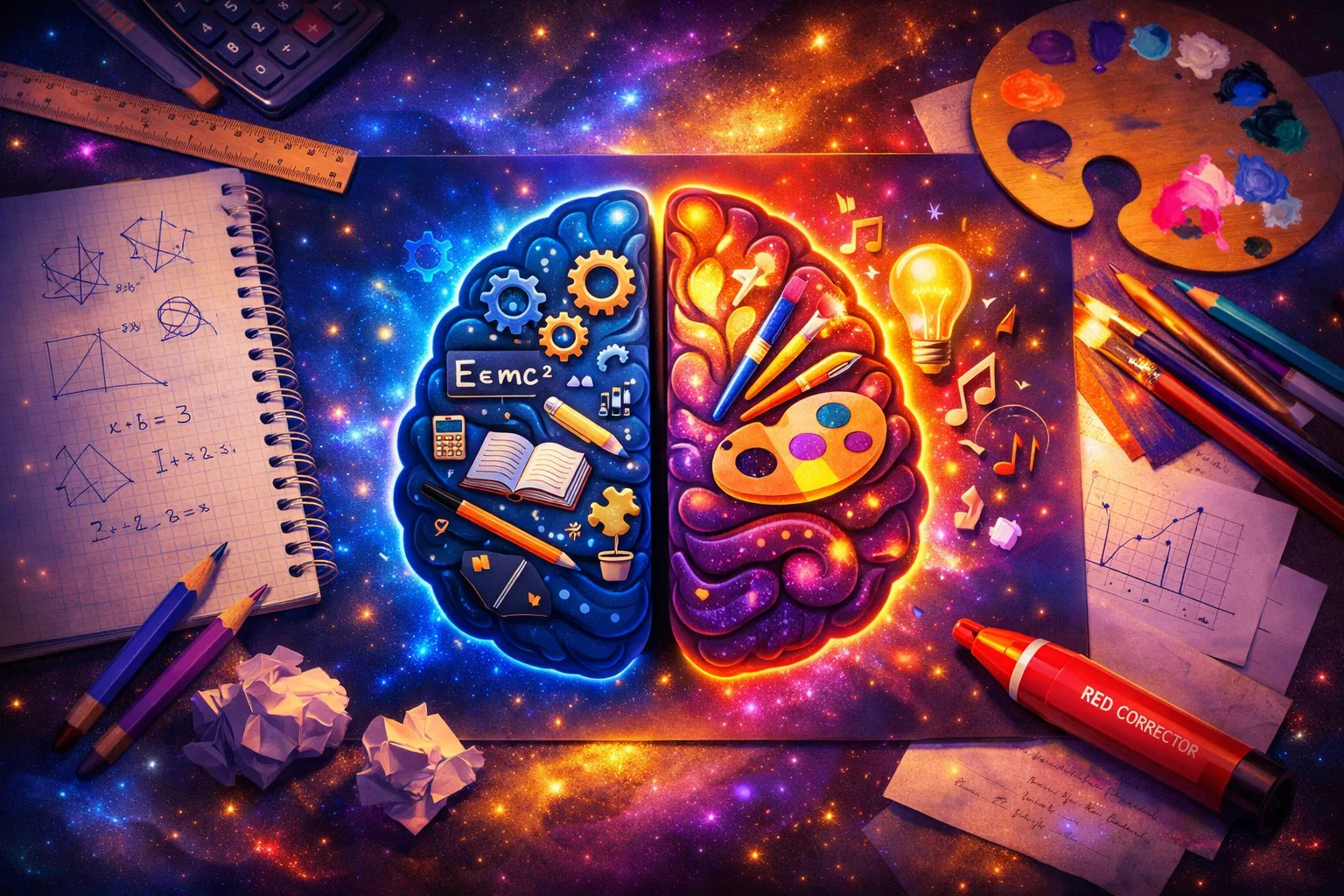
The popular version divides people into two types. “Left-brain” learners are said to be logical, verbal, analytical, mathematical and sequential. “Right-brain” learners are said to be visual, intuitive, creative, emotional and holistic. The educational version then adds a teaching prescription: match instruction to the supposed dominant hemisphere, or use special activities to “activate” the underused side.
That story has survived because it borrows from genuine neuroscience. Language is often more left-lateralised, and some attention and spatial processes are more right-lateralised. In a 2013 resting-state functional magnetic resonance imaging study of 1,011 people aged 7 to 29, researchers did find left- and right-lateralised hubs, including left-lateralised language regions and right-lateralised attention-control regions. But the same study found that lateralisation was local, not a whole-person trait: the data were “not consistent” with a global phenotype of stronger left-brained or right-brained network strength across individuals.[PLOS]journals.plos.orgOpen source on plos.org.
That distinction is the heart of the myth. A brain can show specialised regions without making the person a specialised hemisphere type. Hemispheric dominance, used accurately, means one hemisphere is more involved in a specific process. The neuromyth turns that narrow idea into a broad identity claim about how a learner thinks, learns and should be taught.[Frontiers]frontiersin.orgSource details in endnotes.

What the simplification misses
The left-brain/right-brain learner story treats the hemispheres as if they were separate personalities. Normal cognition is not organised that way. The hemispheres are linked by the corpus callosum, and information is exchanged between them during ordinary activity. Reviews of neuromyths in education stress that functions are lateralised only to a degree, while memory and learning depend on distributed neural networks rather than a single hemisphere acting alone.[Frontiers]frontiersin.orgSource details in endnotes.
Creativity is a useful example because it is so often assigned to the “right brain”. The evidence does not support that tidy assignment. A critique of right-brain teaching notes that creative acts involve activation and integration across both hemispheres, and that educational products promising to selectively stimulate the right hemisphere for creativity are scientifically weak.[MPG.PuRe]pure.mpg.deSource details in endnotes.
The same caution applies to “learning styles” more broadly. The influential review by Harold Pashler and colleagues explains that learning-style claims require a specific kind of evidence: students would need to be assessed by style, randomly assigned to different teaching methods, and then show that each style learns best from a matching method. Their review found that the evidence needed to justify learning-style-based instruction was not available, despite the popularity of the approach.[Sage Journals]journals.sagepub.comSage Journals Learning StylesSage Journals Learning Styles
So the problem is not that all learners are identical. They are not. The problem is that hemisphere labels do not give teachers a reliable map of those differences. More defensible explanations point to prior knowledge, vocabulary, working memory demands, interest, attention, practice history, feedback quality and task design. These are less catchy than “left-brain” or “right-brain”, but they are closer to what teachers can actually observe and improve.[Frontiers]frontiersin.orgSource details in endnotes.
Why the myth feels plausible
The myth has a grain of truth, a simple visual metaphor and a flattering identity hook. Two hemispheres are easy to picture. “Logical left” and “creative right” are easy to remember. A learner who dislikes algebra but loves drawing may recognise themselves in the story, even if the explanation is wrong.
It also benefits from the authority of brain language. Educational neuroscience researchers describe neuromyths as misunderstandings or overextensions of brain research, especially when valid findings are converted into classroom programmes without adequate evidence. The left-brain/right-brain claim is a classic case: it starts with lateralisation, then stretches it into a personality test, then stretches it again into a teaching prescription.[Educational Neuroscience]educationalneuroscience.org.ukHoward Jones Neuromyth nature14Howard Jones Neuromyth nature14
Surveys show that such myths remain common among educators. A 2012 study of teachers interested in neuroscience found that teachers believed, on average, 49% of listed neuromyths, with especially strong belief in myths linked to commercialised educational programmes. More recent evidence from early childhood educators in Australia found that only 15% correctly identified “students are either left or right brained” as false, and only 7% correctly identified the learning-styles claim as false.[PMC]pmc.ncbi.nlm.nih.govSource details in endnotes.
That persistence does not mean teachers are careless. It shows how easily attractive brain claims spread when they sound practical, hopeful and learner-centred. The left-brain/right-brain label gives a quick explanation for classroom differences; evidence-based teaching often asks for slower diagnosis of the task, the learner’s knowledge, and the instruction itself.
Why learner labels can mislead
A learner label becomes harmful when it changes expectations. A child who is called “right-brained” may receive praise for imagination but less encouragement to develop calculation, writing structure or step-by-step reasoning. A child called “left-brained” may be praised for accuracy but not pushed to explore design, music, storytelling or open-ended problem solving. The label can turn a current preference into a predicted limit.
It can also distract from better teaching decisions. If a pupil struggles with fractions, the useful question is not whether they are a left-brain or right-brain learner. Better questions include: Do they understand ratio? Can they connect the symbol to a visual model? Are they overloading working memory? Have they had enough guided practice and feedback? The answer may involve diagrams, spoken explanation, worked examples, retrieval practice and discussion — not because the pupil belongs to a hemisphere type, but because the content benefits from multiple representations.
The same applies to creative subjects. A pupil learning composition, drawing or creative writing still needs structure, critique, modelling, vocabulary, memory and revision. Treating creativity as a right-brain trait can underplay the disciplined, teachable parts of creative work. Conversely, treating analysis as a left-brain trait can underplay the imagination involved in mathematics, science and argument.
A better replacement idea
The useful replacement is not “everyone learns the same way”. It is “learning is task-specific and whole-brain”. Some tasks benefit from visual models, some from verbal explanation, some from physical demonstration, some from repeated retrieval, and many from a combination. The match should be between the teaching method and the material to be learned, not between the method and a supposed hemisphere identity.
A better classroom rule is:
- Use visuals when the structure of the idea is spatial, relational or hard to hold in words.
- Use spoken and written explanation when precise concepts, vocabulary or sequences matter.
- Use practice and feedback when learners need fluency, accuracy or transfer.
- Use varied examples when learners need to recognise the same idea in different contexts.
- Use discussion and elaboration when learners need to connect new knowledge to what they already know.
This approach still respects learner differences, but it avoids turning them into fixed types. A pupil may prefer drawing, talking, reading or building; those preferences can help with engagement. They should not be mistaken for evidence that the pupil can only learn well through one channel, one style or one hemisphere.

The tested claim in one sentence
People do have lateralised brain functions, but the tested educational claim — that learners can be usefully divided into left-brain and right-brain types and taught accordingly — is not supported by the evidence. The myth survives because it is simple, personal and brain-flavoured; better teaching starts from the learning goal, the evidence about how people learn, and the specific barriers a learner is facing.
Amazon book picks
Further Reading
Books and field guides related to Are People Really Left Brain or Right Brain?. Use these as the next step if you want deeper reading beyond the article.
Behave
First published 2017. Subjects: Neurophysiology, Neurobiology, Animal behavior, nyt:paperback-nonfiction=2018-05-20, New York Times bests...

The Tale of the Dueling Neurosurgeons
First published 2014. Subjects: Neurosciences, Physicians, Popular Works, Neurologic Manifestations, Brain Diseases.

50 Great Myths of Popular Psychology
First published 2009. Subjects: Nonfiction, Psychology, Human behavior, Popular works, Volksopvattingen.
eBay marketplace picks
Marketplace Samples
Example marketplace items related to this page. Use the search link to explore similar finds on eBay.
Endnotes
1.
Source: journals.plos.org
Link:https://journals.plos.org/plosone/article?id=10.1371%2Fjournal.pone.0071275
2.
Source: pure.mpg.de
Link:https://pure.mpg.de/rest/items/item_2495945_3/component/file_2496040/content
3.
Source: pmc.ncbi.nlm.nih.gov
Link:https://pmc.ncbi.nlm.nih.gov/articles/PMC3475349/
4.
Source: journals.plos.org
Link:https://journals.plos.org/plosone/article/citation?id=10.1371%2Fjournal.pone.0071275
5.
Source: journals.plos.org
Link:https://journals.plos.org/plosone/article/figures?id=10.1371%2Fjournal.pone.0071275
6.
Source: frontiersin.org
Link:https://www.frontiersin.org/journals/education/articles/10.3389/feduc.2021.665752/full
7.
Source: journals.sagepub.com
Title: Sage Journals Learning Styles
Link:https://journals.sagepub.com/doi/abs/10.1111/j.1539-6053.2009.01038.x
8.
Source: educationalneuroscience.org.uk
Title: Howard Jones Neuromyth nature14
Link:https://www.educationalneuroscience.org.uk/wordpress/wp-content/uploads/2016/01/Howard-Jones-Neuromyth-nature14.pdf
9.
Source: educationalneuroscience.org.uk
Link:https://educationalneuroscience.org.uk/wordpress/resources/neuromyth-or-neurofact/left-brain-versus-right-brain-thinkers/
10.
Source: edcan.ca
Title: neuromyths in education
Link:https://www.edcan.ca/articles/neuromyths-in-education/
Additional References
11.
Source: youtube.com
Link:https://www.youtube.com/watch?v=855Now8h5pI
Source snippet
These videos are relevant because they provide scientific evidence [debunking]({{ 'debunking/' | relative_url }}) the "left-brain vs. right-brain" personality and learning st...
12.
Source: youtube.com
Title: The Left Brain / Right Brain Myth with Dr. Richie Davidson and Dr. Cortland Dahl
Link:https://www.youtube.com/watch?v=hvpkLMBGmd0
Source snippet
No, You're Not Left-Brained or Right-Brained...
13.
Source: oecd.org
Link:https://www.oecd.org/content/dam/oecd/en/publications/reports/2007/06/understanding-the-brain-the-birth-of-a-learning-science_g1gh76fd/9789264029132-en.pdf
14.
Source: oecd.org
Link:https://www.oecd.org/en/publications/2007/06/understanding-the-brain-the-birth-of-a-learning-science_g1gh76fd.html
15.
Source: youtube.com
Title: The Biggest Myth In Education (Veritasium)
Link:https://www.youtube.com/watch?v=p4w_L93L3B8
Source snippet
Learning styles & the importance of critical self-reflection | Tesia Marshik | TEDxUWLaCrosse...
16.
Source: researchgate.net
Link:https://www.researchgate.net/publication/233600402_Learning_Styles_Concepts_and_Evidence
17.
Source: researchgate.net
Link:https://www.researchgate.net/publication/266945518_Neuroscience_and_education_Myths_and_messages
18.
Source: researchgate.net
Link:https://www.researchgate.net/publication/337731017_The_Myth_of_Left-vs_Right-Brain_Learning
19.
Source: pavpub.com
Link:https://www.pavpub.com/app/uploads/2019/08/Plenary-1_Fact-or-myth_Using-the-brain-in-ELT-practice_CLethaby.pdf?srsltid=AfmBOorNFlJlGfDByvMXGUq6AyUujm0KeAIRhHPPMtLnkePhfaeBKBwC
20.
Source: semanticscholar.org
Link:https://www.semanticscholar.org/paper/An-Evaluation-of-the-Left-Brain-vs.-Right-Brain-Nielsen-Zielinski/c6611664a0bcece52ca2fd4d8080632d054fda7c
Topic Tree