Within Concept Change
Why Wrong Science Ideas Feel Sensible
Students often keep wrong science ideas because the models still make everyday experiences feel explainable.
On this page
- Everyday rules that work until they do not
- Why old models survive correct answers
- Classroom signs that students are still using the old model
Page outline Jump by section
Introduction
Students often keep scientifically incorrect ideas because those ideas genuinely help them make sense of everyday experience. A child who believes that heavier objects fall faster, that moving things need a constant push, or that summer happens because Earth is closer to the Sun is not usually guessing at random. They are applying patterns that seem to work in ordinary life. The misconception survives because it explains enough visible events to feel useful.
 This is one of the central problems in conceptual change in science learning. Scientific explanations do not arrive in an empty mind. Learners already have working models built from observation, language, analogy and common experience. When school science presents a different explanation, students may memorise the new answer while continuing to reason with the older model underneath. Research on conceptual change repeatedly shows that prior ideas are not simply replaced by facts; they compete with, reshape and sometimes resist new learning.[ScienceDirect]sciencedirect.comScienceDirect Conceptual Change TheoryConceptual Change Theory - an overviewDue to robust misconceptions developed by students during their earlier learning histo…[California State University, Northridge]csun.eduHow People Learnpdfby JD Bransford · 2004 · Cited by 33022 — How people learn: brain, mind, experience, and school / John D…. science of learning to…
Everyday Rules That Work Until They Do Not
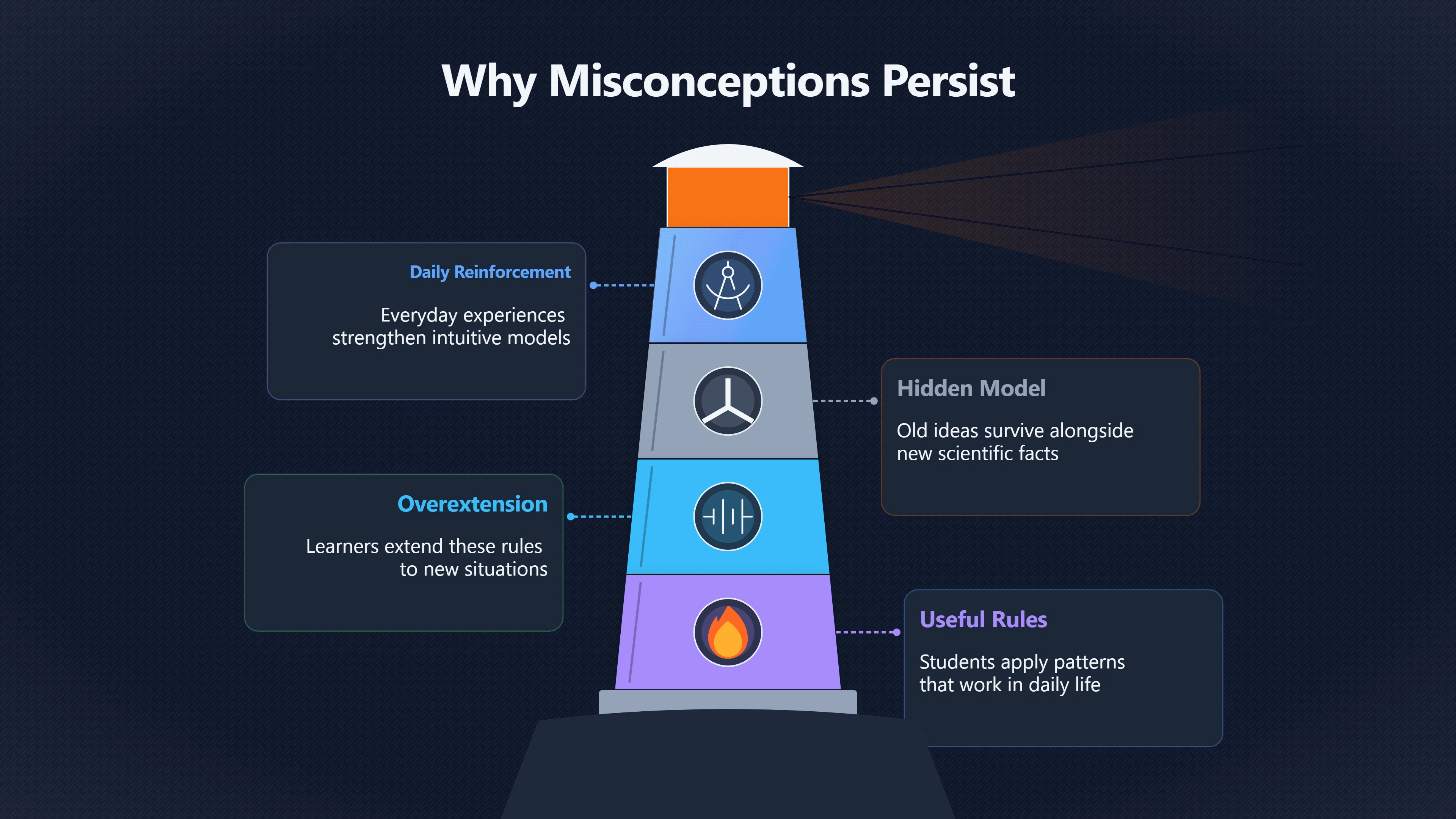
Many misconceptions begin as successful everyday rules.
From early childhood, people learn that pushing harder makes things move faster, that objects eventually stop moving, and that standing closer to a fire feels warmer. These observations are real. The problem appears when learners extend them into situations where different scientific principles apply.
Consider a few common examples:
- Motion: Everyday objects slow down because of friction and air resistance. Students therefore often conclude that continuous motion requires continuous force.
- Seasons: Getting closer to a heat source usually increases warmth. Students therefore infer that summer must happen when Earth is nearer the Sun.
- Electric circuits: Batteries seem to “run out”, so students may imagine electric current being gradually used up as it travels around a circuit.
- Evolution: Organisms appear well suited to their environments, encouraging the idea that animals deliberately develop traits because they need them.
In each case, the learner is using a rule that works in many ordinary situations. The misconception is not irrational. It is an overextension of a pattern that has been useful before. Researchers have long argued that students construct explanations from their experiences rather than merely collecting facts, which is why misconceptions can be coherent and persistent.[Roehampton University]roehampton.ac.ukRoehampton UniversityStudents' conceptions and the learning of science23 Feb 2007 — 1987, The process of conceptual change in science: A…[OUP Academic]oxfordre.comOUP AcademicStudents' Misconceptions and Science Education30 Jul 2020 — Influenced by Piagetian and Vygotskian research, science educator…
Astronomy provides especially clear examples. Studies of student understanding of seasons, gravity and lunar phases have repeatedly found that learners build explanations from everyday observations and intuitive reasoning. Even after formal instruction, many continue to rely on those experience-based interpretations because they remain psychologically convincing.[Eurasia Journal]ejmste.comEurasia Journalalternative-conceptions-of-astronomy-how-irish-secondaryMarch 18, 2021 — by A Cardinot · 2021 · Cited by 20 — Furthermore, learners attempt to create a scientific argument by using daily experi…
Why the Old Model Feels More Useful
A scientific explanation is not automatically attractive simply because it is correct.
For a learner, an explanation has to do practical cognitive work. It needs to help predict events, organise observations and answer questions. If an everyday model already performs those functions reasonably well, there is little pressure to abandon it.
Conceptual change researchers have argued that learners compare new explanations against existing ones. The older model survives when it still feels understandable, reliable and useful in familiar situations. A new scientific explanation must seem not only correct but also more satisfying than the previous account.[Wiley Online Library]onlinelibrary.wiley.com1982) introduced the conceptual change model (CCM) into science education literature…Read more…[ScienceDirect]sciencedirect.comScienceDirect Conceptual Change TheoryConceptual Change Theory - an overviewDue to robust misconceptions developed by students during their earlier learning histo…
This creates an important classroom problem. A student may learn the scientific definition of force yet continue to think about motion using the everyday push-keeps-it-going model. The scientific idea becomes a school answer, while the everyday idea remains the reasoning tool used outside tests.
The National Research Council’s work on learning highlighted this pattern directly: students can learn information for assessment purposes yet return to their original explanations when interpreting real-world situations.[San Diego County Office of Education]sdcoe.netSan Diego County Office of EducationKey Findings from How People LearnA fundamental insight about learning is that new understandings are…
Why Correct Answers Do Not Automatically Replace Old Ideas
One of the most common misunderstandings about science learning is the assumption that a wrong idea disappears once a student hears the right answer.
In practice, learners often keep both.
A student may correctly state that Earth’s axial tilt causes the seasons while simultaneously imagining Earth moving much closer to the Sun in summer. The scientific statement exists alongside the older intuitive explanation rather than replacing it.
The famous educational documentary A Private Universe made this problem visible. Interviews with high-achieving students and graduates revealed that many could recall scientific vocabulary yet still relied on private explanatory systems when asked to reason through astronomical phenomena. The striking finding was not ignorance but the durability of intuitive models after years of instruction.[Annenberg Learner]learner.orgAnnenberg LearnerA Private UniverseThis video brings into sharp focus the dilemma facing all educators: Why don't even the brightest stud…[SIU School of Medicine]siumed.eduSIU School of MedicineA Private UniverseEven the brightest students in the class have false ideas based on enduring misconceptions that t…
Several mechanisms help old models survive:
They are used more often.
Students encounter everyday experiences constantly but encounter formal scientific reasoning only during limited periods of instruction. Daily reinforcement strengthens the intuitive model.
They are easier to visualise.
Many scientific explanations involve invisible processes such as forces, particles, fields or evolutionary timescales. Everyday explanations often rely on directly observable events.
They connect to existing beliefs.
Prior knowledge forms networks. A misconception is often linked to other assumptions, meanings and experiences. Replacing it may require changing several connected ideas at once.[PMC]pmc.ncbi.nlm.nih.govPMCLong-Lasting Conceptual Change in Science Educationby X Li · 2021 · Cited by 50 — Misconceptions have been considered as “theory-like naïve assumptions held by medieval scientists” (Chi…[ScienceDirect]sciencedirect.comScienceDirect How does prior knowledge affect learning?A review of 16…by M Schneider · 2025 · Cited by 29 — We give an integrative review of 16 learning processes mediating the effects of p…
Language keeps reviving it.
Ordinary speech frequently reinforces intuitive models. People say batteries “store power”, plants “eat” nutrients, or species “adapt because they need to”. These phrases can quietly support non-scientific interpretations.
The Difference Between Memorising and Reorganising
A major insight from conceptual change research is that science learning is not mainly about adding information. It often requires reorganising how information is interpreted.
When students first encounter a scientific idea, they commonly assimilate it into their existing framework. Instead of changing the framework itself, they adjust the new information to fit what they already believe. This can create hybrid explanations that combine scientific terms with everyday reasoning.[Wikipedia]WikipediaConceptual changeConceptual change
For example, a learner might say:
The Earth tilts towards the Sun, so it gets closer and therefore becomes warmer.
The student has incorporated the scientific idea of tilt but has interpreted it through the older distance-based model.
This is why conceptual change is often slow. The challenge is not remembering a fact. The challenge is learning when an old explanatory rule no longer works and adopting a new way of organising experience.
Research reviews describe misconceptions as robust because they emerge from earlier learning histories and continue shaping how new information is interpreted. New knowledge is filtered through existing knowledge rather than simply replacing it.[ScienceDirect]sciencedirect.comScienceDirect Conceptual Change TheoryConceptual Change Theory - an overviewDue to robust misconceptions developed by students during their earlier learning histo…[ScienceDirect]sciencedirect.comScienceDirect Conceptual Change TheoryConceptual Change Theory - an overviewDue to robust misconceptions developed by students during their earlier learning histo…
Classroom Signs That Students Are Still Using the Old Model
Students do not always reveal their underlying thinking through multiple-choice answers or memorised definitions. Their older model often becomes visible only when they must explain, predict or apply ideas in unfamiliar situations.
Common warning signs include:
Correct vocabulary with incorrect reasoning.
Students use scientific terms accurately but connect them through everyday logic.
Answers that change across contexts.
A learner gives the scientific answer in class yet reverts to an intuitive explanation when discussing a real-world example.
Confidence in explanations that conflict with evidence.
The model feels obvious because it has worked in many previous situations.
Difficulty transferring knowledge.
Students solve textbook problems but struggle when the same concept appears in a different setting.
Mixed explanations.
Scientific and everyday ideas appear together in the same account.
Educational researchers have often found that misconceptions remain hidden when assessment focuses only on recall. Interviews, prediction tasks and requests for explanations reveal much more about the model students are actually using. A Private Universe became influential largely because it exposed these hidden reasoning patterns rather than simply measuring right and wrong answers.[Annenberg Learner]learner.orgAnnenberg LearnerA Private UniverseThis video brings into sharp focus the dilemma facing all educators: Why don't even the brightest stud…[2scienceinschool.org]scienceinschool.orgA Private Universe online resources, By Matthew H…7 Dec 2010 — The A Private Universe project in science is a collection of nine works…

Why These Models Matter for Learning
Treating misconceptions as simple mistakes misses their most important feature: they are attempts to explain the world.
Students keep everyday science models because those models have explanatory power within ordinary experience. They help organise observations, support predictions and provide coherent stories about how things work. Their strength is precisely what makes them difficult to replace.
For science education, this means that conceptual change is not a battle against ignorance. It is a process of helping learners recognise where an intuitive model succeeds, where it fails, and why a scientific model can explain a wider range of phenomena. Until students experience those limits for themselves, the everyday model often remains the explanation that feels most sensible. OUP Academic 3Wiley Online Library[San Diego County Office of Education]sdcoe.netSan Diego County Office of EducationKey Findings from How People LearnA fundamental insight about learning is that new understandings are…
eBay marketplace picks
Marketplace Samples
Example marketplace items related to this page. Use the search link to explore similar finds on eBay.

Endnotes
1.
Source: sciencedirect.com
Title: ScienceDirect Conceptual Change Theory
Link:https://www.sciencedirect.com/topics/psychology/conceptual-change-theory
Source snippet
Conceptual Change Theory - an overviewDue to robust misconceptions developed by students during their earlier learning histo...
2.
Source: onlinelibrary.wiley.com
Link:https://onlinelibrary.wiley.com/doi/full/10.1002/tea.21887
Source snippet
(1982) introduced the conceptual change model (CCM) into science education literature...Read more...
3.
Source: learner.org
Link:https://www.learner.org/series/a-private-universe/1-a-private-universe/
Source snippet
Annenberg LearnerA Private UniverseThis video brings into sharp focus the dilemma facing all educators: Why don't even the brightest stud...
4.
Source: pmc.ncbi.nlm.nih.gov
Title: PMCLong-Lasting Conceptual Change in Science Education
Link:https://pmc.ncbi.nlm.nih.gov/articles/PMC8593386/
Source snippet
by X Li · 2021 · Cited by 50 — Misconceptions have been considered as “theory-like naïve assumptions held by medieval scientists” (Chi...
5.
Source: Wikipedia
Title: Conceptual change
Link:https://en.wikipedia.org/wiki/Conceptual_change
6.
Source: sciencedirect.com
Title: ScienceDirect How does prior knowledge affect learning?
Link:https://www.sciencedirect.com/science/article/pii/S1041608025001207
Source snippet
A review of 16...by M Schneider · 2025 · Cited by 29 — We give an integrative review of 16 learning processes mediating the effects of p...
7.
Source: scienceinschool.org
Link:https://scienceinschool.org/article/2010/privateuniverse/
Source snippet
A Private Universe online resources, By Matthew H...7 Dec 2010 — The A Private Universe project in science is a collection of nine works...
8.
Source: csun.edu
Title: How People Learn
Link:https://www.csun.edu/~SB4310/How%20People%20Learn.pdf
Source snippet
pdfby JD Bransford · 2004 · Cited by 33022 — How people learn: brain, mind, experience, and school / John D.... science of learning to...
9.
Source: sdcoe.net
Link:https://www.sdcoe.net/ngss/evidence-based-practices/key-findings-from-how-people-learn
Source snippet
San Diego County Office of EducationKey Findings from How People LearnA fundamental insight about learning is that new understandings are...
10.
Source: roehampton.ac.uk
Link:https://www.roehampton.ac.uk/globalassets/documents/education/pgce-welcome-subject-specific-reading/science-essential-reading-1-driver.pdf
Source snippet
Roehampton UniversityStudents' conceptions and the learning of science23 Feb 2007 — 1987, The process of conceptual change in science: A...
11.
Source: oxfordre.com
Link:https://oxfordre.com/education/display/10.1093/acrefore/9780190264093.001.0001/acrefore-9780190264093-e-965?d=%2F10.1093%2Facrefore%2F9780190264093.001.0001%2Facrefore-9780190264093-e-965&p=emailAon3Ef8P3hGVA
Source snippet
OUP AcademicStudents' Misconceptions and Science Education30 Jul 2020 — Influenced by Piagetian and Vygotskian research, science educator...
12.
Source: ejmste.com
Title: Eurasia Journalalternative-conceptions-of-astronomy-how-irish-secondary
Link:https://www.ejmste.com/download/alternative-conceptions-of-astronomy-how-irish-secondary-students-understand-gravity-seasons-and-the-10780.pdf
Source snippet
March 18, 2021 — by A Cardinot · 2021 · Cited by 20 — Furthermore, learners attempt to create a scientific argument by using daily experi...
Published: March 18, 2021
13.
Source: ejmste.com
Title: In other.Read more
Link:https://www.ejmste.com/download/an-overview-of-conceptual-changetheories-4082.pdf
Source snippet
Eurasia JournalAn Overview of Conceptual Change Theoriesby G Özdemir · 2007 · Cited by 549 — Misconceptions are therefore not only inaccu...
14.
Source: siumed.edu
Link:https://www.siumed.edu/academy/private-universe.html
Source snippet
SIU School of MedicineA Private UniverseEven the brightest students in the class have false ideas based on enduring misconceptions that t...
Additional References
15.
Source: lweb.cfa.harvard.edu
Link:https://lweb.cfa.harvard.edu/education/k12.html
Source snippet
student misconceptions to physics, chemistry, and life science. Built around longer clips of science classroom activities and student...
16.
Source: researchgate.net
Link:https://www.researchgate.net/publication/234662855_Why_We_Have_Seasons_and_Other_Common_Misconceptions
Source snippet
Why We Have Seasons and Other Common MisconceptionsThere is a substantial body of discipline-based education research demonstrating the d...
17.
Source: nationalacademies.org
Link:https://www.nationalacademies.org/read/5287/chapter/5
Source snippet
Descriptions and examples of some common misconceptions in science. Methods to identify misconceptions.Read more...
18.
Source: researchgate.net
Link:https://www.researchgate.net/publication/314134259_Introduction_Misconceptions_in_Science_Education_An_Overview
Source snippet
Misconceptions in Science Education: An OverviewStudent misconceptions must be addressed in a way that does not discredit a student's ini...
19.
Source: openlearning.mit.edu
Title: cognitive science teaching and learning how people learn
Link:https://openlearning.mit.edu/news/cognitive-science-teaching-and-learning-how-people-learn
Source snippet
Cognitive Science of Teaching and Learning15 Oct 2018 — Apparently, a controlled study suggests that while learning a new method or infor...
20.
Source: cambridge.org
Link:https://www.cambridge.org/core/books/cambridge-handbook-of-the-learning-sciences/history-of-conceptual-change-research/D3902E2ACAA0764A9F3C92342B0E1499
Source snippet
ng as “critical barriers.” Others used different terms for the same idea...Read more...
21.
Source: blogs.ubc.ca
Title: student misconceptions as their private universe
Link:https://blogs.ubc.ca/etec533brendathomas/2023/01/17/student-misconceptions-as-their-private-universe/
Source snippet
UBC BlogsStudent Misconceptions as Their Private Universe17 Jan 2023 — In A Private Universe, Heather, a 9 th grade student, is formulati...
22.
Source: nsta.org
Link:https://www.nsta.org/science-scope/science-scope-january-2003/science-sampler-why-we-have-seasons-and-other-common?srsltid=AfmBOoqiKIk5DgxDR9tLlPnRaFLA4-fa3JY6gRYEobxuN7NHFwXM7q-b
Source snippet
eptions. This video is effective in capturing preservice teachers'...
23.
Source: edutopia.org
Link:https://www.edutopia.org/blog/how-people-learn-evidence-based-paul-bruno
Source snippet
them into their long-term [memory]({{ 'memory/' | relative_url }}). Read more...
24.
Source: learningscientists.org
Link:https://www.learningscientists.org/blog/2022/9/13-1
Source snippet
Prior Knowledge and Learning New Information: The Rich...15 Sept 2022 — Every student comes into class with some type of prior knowledge...
Topic Tree