Within Neuromyths
Why left brain labels mislead teachers
Left-brain and right-brain labels turn real hemispheric differences into misleading learner types that can narrow expectations.
On this page
- The real science behind brain lateralisation
- How personality labels enter classroom language
- Why complex learning cannot be sorted by hemisphere
Page outline Jump by section
Introduction
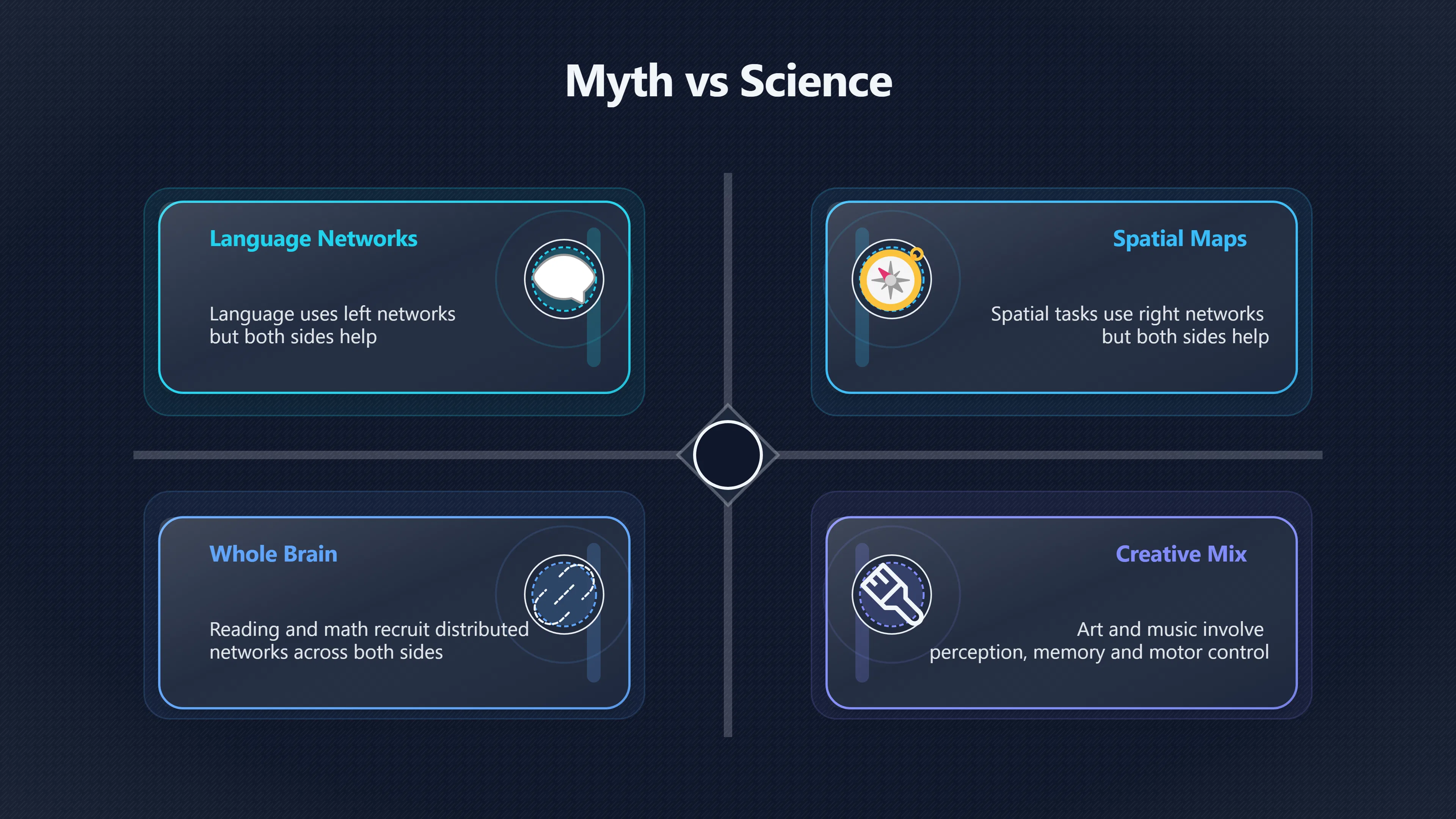
The idea that some pupils are “left-brained” and others are “right-brained” is one of the most durable neuromyths in education. It survives because it begins with a real scientific observation: the two hemispheres of the brain do show some functional specialisation. Language is usually more strongly associated with networks in the left hemisphere, while some aspects of spatial processing show stronger right-hemisphere involvement. The mistake comes when those findings are turned into personality categories and classroom labels. Research does not support the claim that pupils can be divided into stable “logical left-brain learners” and “creative right-brain learners”, nor that teaching should be tailored around such categories. PMC[Frontiers]frontiersin.orgmore…
 In classrooms, the risk is not only scientific inaccuracy. Once a pupil is described as a “right-brain child” or a “left-brain thinker”, expectations can narrow. Teachers may unintentionally steer pupils towards some activities and away from others, turning a simplistic brain story into a self-fulfilling educational label.
The real science behind brain lateralisation
The myth persists because brain lateralisation is real. The two hemispheres are not identical, and neuroscientists have documented differences in how some functions are organised. Language processing, for example, is usually more strongly lateralised to the left hemisphere, although both hemispheres contribute to understanding and communication.[PMC]pmc.ncbi.nlm.nih.govPMCLeft Brain, Right Brain: Facts and FantasiesNIHby MC Corballis · 2014 · Cited by 517 — Michael Corballis discusses in this essay how the asymmetry of the brain raises question…
However, lateralisation is not the same thing as a learner type. A brain can show stronger involvement of one hemisphere for a particular task without that person becoming a globally “left-brained” or “right-brained” individual. Modern neuroscience describes cognition as the product of distributed networks that span both hemispheres and communicate continuously through extensive neural connections. ScienceDirect[PNAS]pnas.orgthe right cerebral hemisphere.Read more…
This distinction matters. Educational versions of the myth often imply:
- Left-brained pupils are logical, analytical and mathematical.
- Right-brained pupils are creative, intuitive and artistic.
- Teaching should match a pupil’s dominant hemisphere.
The evidence supports none of these claims. Researchers studying neuromyths repeatedly note that hemispheric dominance refers to the relative involvement of a hemisphere in a specific process, not to a person’s overall intelligence, personality or learning capacity.[Frontiers]frontiersin.orgmore…
Even activities popularly associated with one hemisphere typically involve large-scale cooperation across the brain. Reading, problem-solving, music, creativity and mathematical reasoning all recruit multiple networks distributed across both sides.[Taylor & Francis Online]tandfonline.comTaylor & Francis OnlineBeyond left and right: Learning is a whole-brain processby DD Shin · 2022 · Cited by 12 — The argument of left- an…[PMC]pmc.ncbi.nlm.nih.govChoosing words: left hemisphere, right hemisphere, or both…by SK Ries · 2016 · Cited by 190 — Language is considered to be one of t…
How personality labels enter classroom language
The educational version of the myth often spreads through a subtle shift in language. Scientific findings about hemispheric specialisation become personality descriptions.
A statement such as “language functions are often more left-lateralised” becomes “left-brain people are verbal”. A finding that some spatial processes involve stronger right-hemisphere activity becomes “right-brain people are creative”. From there, teachers, parents and pupils can begin using brain language as an identity label.[Harvard Health]health.harvard.eduright brainleft brain right 2017082512222Harvard HealthRight brain/left brain, right?24 Mar 2022 — According to conventional wisdom, people tend to have a personality, thinking s…[PMC]pmc.ncbi.nlm.nih.govBrain Knowledge and the Prevalence of Neuromyths among…by M Papadatou-Pastou · 2017 · Cited by 191 — The myth of right-brain and le…
This translation is attractive because it offers a simple explanation for complex differences between learners. A pupil who struggles with writing but enjoys drawing can appear to fit the “right-brained” description. A pupil who enjoys structured tasks may seem “left-brained”. The label creates an apparently scientific story that feels intuitive even when the underlying evidence is weak.
Surveys of teachers in multiple countries show that left-brain/right-brain beliefs remain common despite decades of criticism from researchers. Neuromyth studies repeatedly identify hemisphere-based learner categories among the most widely accepted misconceptions in education.[PMC]pmc.ncbi.nlm.nih.govDispelling the Myth: Training in Education or Neuroscience…by K Macdonald · 2017 · Cited by 455 — Two of the most pervasive myths a…[PMC]pmc.ncbi.nlm.nih.govby S Dekker · 2012 · Cited by 1254 — Results showed that on average, teachers believed 49% of the neuromyths, particularly myths relat…
The popularity of the myth reflects a broader pattern seen across educational neuromyths. A genuine finding from neuroscience becomes detached from its original limits and repackaged as a practical classroom typology.[Learning Difficulties Australia Inc.]ldaustralia.orge and predictors of neuromyths among teachers in selected regions in the United Kingdom and the Netherlands.Read more…[ScienceDirect]sciencedirect.comCross-hemispheric communication: Insights on lateralized…by S Ocklenburg · 2024 · Cited by 63 — Cross-hemispheric communi…
Why labels can change teacher expectations
The most important educational concern is not whether a pupil casually describes themselves as left-brained. The concern is what happens when labels influence expectations.
Educational psychology has long shown that teacher expectations can affect opportunities offered to pupils. When a teacher believes a learner belongs to a particular category, they may unconsciously interpret behaviour through that lens. Hemisphere labels provide a ready-made framework for doing exactly that.
For example:
- A pupil labelled “right-brained” may be praised for imagination but not pushed towards analytical work.
- A pupil labelled “left-brained” may be encouraged in mathematics while receiving fewer opportunities to develop creative confidence.
- Difficulties in one area may be explained as a fixed brain characteristic rather than a skill that can improve with practice.
The myth therefore risks transforming temporary strengths, interests or experiences into apparently biological limits.
This is especially significant because many classroom abilities develop unevenly. A child may show strong verbal performance at one age and later excel in art, music, engineering or science. Development is dynamic. Hemisphere labels encourage a static view of potential that neuroscience itself does not support. Taylor & Francis Online[Educational Neuroscience]educationalneuroscience.org.ukLeft brain versus right brain thinkersThe implication of the left brain/right brain myth is that some people are better than others, or m…
The language of “brain dominance” can also make expectations seem objective. A teacher who would hesitate to say “this child is not a maths person” may feel more comfortable saying “this child is right-brained”. The second statement sounds scientific, but it can have a similar limiting effect.

Why complex learning cannot be sorted by hemisphere
One reason the myth fails scientifically is that school learning is rarely reducible to a single cognitive process.
Consider creative writing. Popular accounts often classify creativity as a right-brain function. Yet writing also relies on vocabulary, grammar, memory, planning, self-monitoring and language production, all involving extensive activity across both hemispheres.[PMC]pmc.ncbi.nlm.nih.govPMCLeft Brain, Right Brain: Facts and FantasiesNIHby MC Corballis · 2014 · Cited by 517 — Michael Corballis discusses in this essay how the asymmetry of the brain raises question…
The same problem appears in mathematics. Arithmetic and symbolic reasoning are often described as left-brain activities, but mathematical thinking also involves visualisation, pattern recognition, estimation and spatial reasoning. These processes draw on networks distributed across the brain rather than a single hemisphere.[ScienceDirect]sciencedirect.comCross-hemispheric communication: Insights on lateralized…by S Ocklenburg · 2024 · Cited by 63 — Cross-hemispheric communi…
Even artistic activities undermine the stereotype. Music, painting and design involve perception, memory, attention, sequencing, motor control and evaluation. None can be neatly assigned to one side of the brain.
Modern neuroscience increasingly describes learning as the coordinated activity of multiple specialised systems working together. The question is not which hemisphere a learner uses, but how networks communicate and adapt during learning.[ScienceDirect]sciencedirect.comCross-hemispheric communication: Insights on lateralized…by S Ocklenburg · 2024 · Cited by 63 — Cross-hemispheric communi…
This is one reason researchers argue that the popular left-brain/right-brain distinction oversimplifies a far more interconnected reality.[Taylor & Francis Online]tandfonline.comTaylor & Francis OnlineBeyond left and right: Learning is a whole-brain processby DD Shin · 2022 · Cited by 12 — The argument of left- an…
The classroom appeal of brain labels
Despite criticism, hemisphere labels continue to appear in teacher training materials, educational products and popular discussions of learning. Several features make them especially attractive.
First, they offer an easy route to personalisation. If pupils can be categorised into brain types, teaching appears simpler: identify the type and adapt instruction accordingly.
Second, the labels sound positive. Unlike older deficit-oriented classifications, “left-brained” and “right-brained” descriptions often present every learner as having a special strength. This can make the framework feel inclusive and supportive.
Third, the labels fit wider cultural ideas about personality. Popular books, websites and workplace training programmes have spent decades promoting the notion that people naturally belong to analytical or creative camps. Educational settings inherit those assumptions.[Harvard Health]health.harvard.eduright brainleft brain right 2017082512222Harvard HealthRight brain/left brain, right?24 Mar 2022 — According to conventional wisdom, people tend to have a personality, thinking s…
The problem is that a flattering label can still become a restrictive one. A pupil repeatedly told they are a creative right-brain learner may begin to avoid tasks associated with analysis. Another told they are naturally left-brained may become reluctant to take risks in artistic or imaginative work.
A better way to talk about differences between pupils
Rejecting the left-brain/right-brain myth does not mean pretending all learners are identical.
Pupils genuinely differ in interests, prior knowledge, motivation, confidence, attention, learning strategies and opportunities. Some may currently show stronger verbal skills; others may show stronger spatial reasoning or artistic strengths. These differences are real and educationally important.[Frontiers]frontiersin.orgmore…
The key difference is that evidence-based approaches describe observable strengths and needs rather than assigning pupils to neurological personality types.
Instead of saying:
- “She is right-brained.”[health.harvard.edu]health.harvard.eduright brainleft brain right 2017082512222Harvard HealthRight brain/left brain, right?24 Mar 2022 — According to conventional wisdom, people tend to have a personality, thinking s…
A teacher can say:
- “She currently shows strong visual-spatial skills and enjoys open-ended creative tasks.”
Instead of saying:
- “He is left-brained.”[health.harvard.edu]health.harvard.eduright brainleft brain right 2017082512222Harvard HealthRight brain/left brain, right?24 Mar 2022 — According to conventional wisdom, people tend to have a personality, thinking s…
A teacher can say:
- “He currently prefers structured problem-solving and has developed strong analytical skills.”
The second approach remains flexible. Skills can grow, interests can change and pupils are not trapped inside a biological category.
That flexibility aligns more closely with what neuroscience actually suggests: learning emerges from highly connected, adaptable brain systems rather than from a competition between two separate learner types.[Taylor & Francis Online]tandfonline.comTaylor & Francis OnlineBeyond left and right: Learning is a whole-brain processby DD Shin · 2022 · Cited by 12 — The argument of left- an…[ScienceDirect]sciencedirect.comEducational neuromyths and instructional practicesby P Tsang · 2024 · Cited by 14 — As OECD warned, at the heart of these myths is a misi…

Amazon book picks
Further Reading
Books and field guides related to Why left brain labels mislead teachers. Use these as the next step if you want deeper reading beyond the article.
Why Don't Students Like School?
Helps teachers avoid oversimplified cognitive classifications.

The Tale of the Dueling Neurosurgeons
First published 2014. Subjects: Neurosciences, Physicians, Popular Works, Neurologic Manifestations, Brain Diseases.

Livewired
First published 2020. Subjects: Physiology, Internal medicine, Brain, Neuroplasticity, Learning.
The learning brain
First published 2005. Subjects: Education, Neuropsychology, Learning, Brain, Physiology.
eBay marketplace picks
Marketplace Samples
Example marketplace items related to this page. Use the search link to explore similar finds on eBay.

Endnotes
1.
Source: pmc.ncbi.nlm.nih.gov
Title: PMCLeft Brain, Right Brain: Facts and Fantasies
Link:https://pmc.ncbi.nlm.nih.gov/articles/PMC3897366/
Source snippet
NIHby MC Corballis · 2014 · Cited by 517 — Michael Corballis discusses in this essay how the asymmetry of the brain raises question...
2.
Source: pmc.ncbi.nlm.nih.gov
Link:https://pmc.ncbi.nlm.nih.gov/articles/PMC4874870/
Source snippet
Choosing words: left hemisphere, right hemisphere, or both...by SK Ries · 2016 · Cited by 190 — Language is considered to be one of t...
3.
Source: sciencedirect.com
Link:https://www.sciencedirect.com/science/article/pii/S089662732400120X
Source snippet
Cross-hemispheric communication: Insights on lateralized...by S Ocklenburg · 2024 · Cited by 63 — Cross-hemispheric communi...
4.
Source: pnas.org
Link:https://www.pnas.org/doi/10.1073/pnas.1302581110
Source snippet
the right cerebral hemisphere.Read more...
5.
Source: pmc.ncbi.nlm.nih.gov
Link:https://pmc.ncbi.nlm.nih.gov/articles/PMC5447089/
Source snippet
Brain Knowledge and the Prevalence of Neuromyths among...by M Papadatou-Pastou · 2017 · Cited by 191 — The myth of right-brain and le...
6.
Source: health.harvard.edu
Title: right brainleft brain right 2017082512222
Link:https://www.health.harvard.edu/blog/right-brainleft-brain-right-2017082512222
Source snippet
Harvard HealthRight brain/[left brain]({{ 'left-brain/' | relative_url }}), right?24 Mar 2022 — According to conventional wisdom, people tend to have a personality, thinking s...
7.
Source: pmc.ncbi.nlm.nih.gov
Link:https://pmc.ncbi.nlm.nih.gov/articles/PMC5554523/
Source snippet
Dispelling the Myth: Training in Education or Neuroscience...by K Macdonald · 2017 · Cited by 455 — Two of the most pervasive myths a...
8.
Source: pmc.ncbi.nlm.nih.gov
Link:https://pmc.ncbi.nlm.nih.gov/articles/PMC3475349/
Source snippet
by S Dekker · 2012 · Cited by 1254 — Results showed that on average, teachers believed 49% of the neuromyths, particularly myths relat...
9.
Source: sciencedirect.com
Link:https://www.sciencedirect.com/science/article/pii/S2211949324000024
Source snippet
Educational neuromyths and instructional practicesby P Tsang · 2024 · Cited by 14 — As OECD warned, at the heart of these myths is a misi...
10.
Source: sciencedirect.com
Link:https://www.sciencedirect.com/science/article/pii/S2211949323000224
Source snippet
Neuromyths: Misconceptions about neurodevelopment by...by E Bei · 2024 · Cited by 41 — Three examples of common neuromyths include: “Stu...
11.
Source: sciencedirect.com
Link:https://www.sciencedirect.com/science/article/abs/pii/S0742051X2600020X
Source snippet
Neuromyths in education: Comparing perceptions between...by E Wauthia · 2026 — In this study, participants were presented with pedagogic...
12.
Source: sciencedirect.com
Link:https://www.sciencedirect.com/science/article/abs/pii/S2211949325000183
Source snippet
Belief in neuromyths among primary school teachersby OC Adiguzel · 2025 · Cited by 2 — Neuromyths greatly impact teachers' instructional...
13.
Source: frontiersin.org
Link:https://www.frontiersin.org/journals/education/articles/10.3389/feduc.2021.665752/full
Source snippet
more...
14.
Source: educationalneuroscience.org.uk
Link:https://educationalneuroscience.org.uk/wordpress/resources/neuromyth-or-neurofact/left-brain-versus-right-brain-thinkers/
Source snippet
Left brain versus right brain thinkersThe implication of the left brain/right brain myth is that some people are better than others, or m...
15.
Source: tandfonline.com
Link:https://www.tandfonline.com/doi/abs/10.1080/00405841.2022.2096386
Source snippet
Taylor & Francis OnlineBeyond left and right: Learning is a whole-brain processby DD Shin · 2022 · Cited by 12 — The argument of left- an...
16.
Source: ldaustralia.org
Link:https://ldaustralia.org/research-papers/neuromyths-in-education-prevalence-and-predictors-of-misconceptions-among-teachers/
Source snippet
e and predictors of neuromyths among teachers in selected regions in the United Kingdom and the Netherlands.Read more...
17.
Source: educationalneuroscience.org.uk
Link:https://www.educationalneuroscience.org.uk/resources/neuromyth-or-neurofact/children-have-different-learning-styles/
Source snippet
It refers to two related ideas: firstly that students have different preferences...Read more...
18.
Source: frontiersin.org
Link:https://www.frontiersin.org/journals/psychology/articles/10.3389/fpsyg.2017.01314/full
Source snippet
Dispelling the Myth: Training in Education or Neuroscience...by K Macdonald · 2017 · Cited by 440 — These findings suggest that training...
19.
Source: blogs.ucl.ac.uk
Title: ucl.ac.uk Neuromyths in Education
Link:https://blogs.ucl.ac.uk/cdld/2021/12/10/neuromyths-in-education/
Source snippet
in Education - UCL Blogs10 Dec 2021 — General Neuromyth Questionnaire: 15 statements to test general knowledge about the brain: 9 correct...
Additional References
20.
Source: oecd.org
Link:https://www.oecd.org/en/publications/2007/06/understanding-the-brain-the-birth-of-a-learning-science_g1gh76fd.html
Source snippet
Understanding the Brain: The Birth of a Learning ScienceThis book provides new insights about learning by synthesising existing and emerg...
21.
Source: oecd.org
Link:https://www.oecd.org/en/publications/understanding-the-brain-the-birth-of-a-learning-science_9789264029132-en.html
Source snippet
Understanding the Brain: The Birth of a Learning ScienceThis book provides new insights about learning by synthesising existing and emerg...
22.
Source: strath.ac.uk
Link:https://www.strath.ac.uk/humanities/education/blog/creativeneuroscience/
Source snippet
University of StrathclydeCreative Neuroscienceby W Strathclyde — The neuromyth which I will focus on here is the idea that one side of yo...
23.
Source: quizlet.com
Link:https://quizlet.com/gb/723499913/hemispheric-lateralisation-flash-cards/
24.
Source: educationhq.com
Link:https://educationhq.com/news/significant-proportion-of-aussie-teachers-back-discredited-neuromyths-study-201077/
Source snippet
teachers back the debunked 'learning styles' neuromyth, and half believe the widely discredited 'left-brain versus right-brain learners'...
25.
Source: lthechat.com
Title: 186 [debunking]({{ ‘debunking/’ | relative_url }}) neuromyths in education what psychology really tells us
Link:https://lthechat.com/2020/10/11/lthechat186-debunking-neuromyths-in-education-what-psychology-really-tells-us/
Source snippet
#LTHEchat185: Debunking Neuromyths in Education...11 Oct 2020 — Recent research has suggested that among college-level staff, 97% and 77...
26.
Source: innovationdistrict.childrensnational.org
Title: children use both brain hemispheres to understand language unlike adults
Link:https://innovationdistrict.childrensnational.org/children-use-both-brain-hemispheres-to-understand-language-unlike-adults/
Source snippet
use both brain hemispheres to understand language11 Sept 2020 — New research finds young children process language in both hemispheres of...
27.
Source: onlinelibrary.wiley.com
Title: This study used an online survey to examine aspiring teachers’
Link:https://onlinelibrary.wiley.com/doi/full/10.1111/mbe.12426
Source snippet
for Cognition, Neuromyths, and Knowledge about the...by E Boyle · 2024 · Cited by 4 — Neuromyths are widely held false beliefs about the...
28.
Source: tutor2u.net
Title: biopsychology hemispheric lateralisation split brain research
Link:https://www.tutor2u.net/psychology/reference/biopsychology-hemispheric-lateralisation-split-brain-research?srsltid=AfmBOooatOM_qSeyb4JQxMtlji5FDsIGERD15UylXUFxCBlQpZ3uFKJy
Source snippet
Hemispheric Lateralisation & Split Brain Research10 Apr 2017 — Lateralisation is the idea that the two halves of the brain are functional...
29.
Source: landmark.edu
Title: neuromyths are misconceptions about the brain dangerous
Link:https://www.landmark.edu/research-and-training/blog/neuromyths-are-misconceptions-about-the-brain-dangerous
Source snippet
Neuromyths: are misconceptions about the brain dangerous?31 Jan 2020 — Much of the research assumes the answer is “yes” and posits a stro...
Topic Tree