Within Health Claims
Why Urgent Health Warnings Spread So Fast
Urgent health warnings can feel like protection, but speed often beats verification when fear and care are mixed together.
On this page
- How fear turns sharing into a duty
- Why urgency weakens source checking
- How to slow down without sounding dismissive
Page outline Jump by section
Introduction
Urgent health warnings spread quickly because they trigger a powerful social instinct: protect people first, verify later. When a message claims that a food causes cancer, a vaccine is harming children, a medicine has been secretly recalled or a new disease is spreading, many people feel a responsibility to warn friends and family immediately. In that moment, sharing can feel less like passing on information and more like preventing harm.
 This is one reason false health claims often travel through caring social networks rather than through obvious bad actors alone. Fear, uncertainty and concern for others create a sense that delay is risky. Verification takes time, while forwarding a warning takes seconds. As a result, emotional urgency can outrun evidence, especially during outbreaks, medical scares and periods of intense public anxiety. Research on health misinformation repeatedly finds that strong emotions, social pressure and information overload all weaken careful evaluation and increase the spread of misleading claims.[PMC]pmc.ncbi.nlm.nih.govby S Munusamy · 2024 · Cited by 42 — Cognitive biases, emotional appeals, and social identity motivations are believed to play a cruci…[American Psychological Association]apa.orgAmerican Psychological AssociationUsing psychological science to understand and fight health…This report describes the best available…
How Fear Turns Sharing Into a Duty
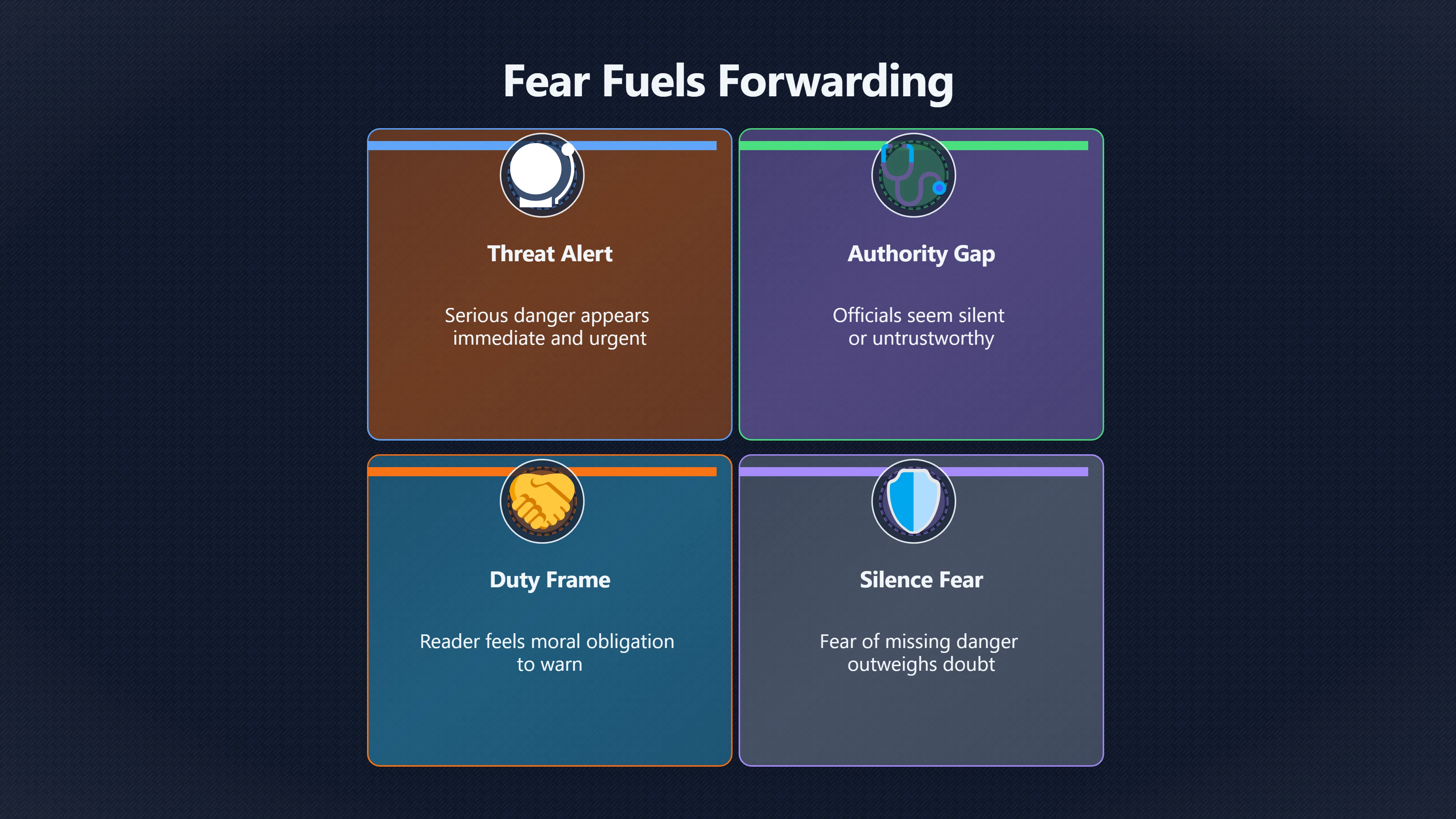
Many urgent health rumours are framed as warnings rather than arguments. They do not ask people to weigh evidence. They ask people to act.
A typical message follows a familiar pattern:
- A serious threat is presented.
- The threat appears immediate.
- Authorities are portrayed as slow, silent or untrustworthy.
- The reader is urged to alert others.
This structure changes the psychology of sharing. Instead of asking, “Is this true?”, people start asking, “What if it is true and I stay silent?”
The fear of missing a genuine danger can feel stronger than the fear of spreading incorrect information. A parent who forwards an alarming claim about a child’s health risk may believe that being wrong is less damaging than failing to warn another parent. The emotional calculation becomes precautionary rather than evidential.
Researchers studying misinformation have found that emotional responses increase willingness to share content, particularly when messages provoke fear, anger or anxiety. During health crises, emotional reactions can make people perceive claims as more credible and more worthy of distribution, even before careful scrutiny occurs.[Misinformation Review]misinforeview.hks.harvard.eduMisinformation Review Anger contributes to the spread of COVID-19 misinformationMisinformation ReviewAnger contributes to the spread of COVID-19 misinformationSeptember 17, 2020 — by J Han · 2020 · Cited by 108 — A su… ResearchGate The language used in many viral warnings deliberately reinforces this feeling of duty:[researchgate.net]researchgate.netThe application of emotions, sharing motivations, and…This study uses appraisal theory to analyze the impact of such rumor…
- “Share before it gets deleted.”
- “Please warn everyone you know.”
- “Doctors won’t tell you this.”
- “Even if there’s a small chance it’s true, people need to know.”
These phrases create a moral frame. Passing the message on becomes a sign of care. Not sharing can feel irresponsible.
Why Urgency Weakens Source Checking
Source checking is a slow process. Urgent warnings are designed to feel fast.
Verifying a health claim often requires comparing multiple sources, checking dates, looking for expert consensus and understanding scientific uncertainty. Most people do not do that in everyday conversation, especially when a message arrives from someone they trust.
Instead, urgency pushes people towards shortcuts.
One shortcut is trusting the sender. If a warning comes from a friend, relative, local community group or parent network, people may treat the relationship itself as evidence. The question becomes “Would they send this if it wasn’t important?” rather than “Where did this information originate?”
Another shortcut is treating repetition as credibility. During major health events, people may encounter the same warning across multiple platforms. Seeing a claim repeatedly can create familiarity, and familiarity is often mistaken for truth. WHO’s work on infodemics highlights how information overload makes it harder for people to identify trustworthy guidance during health emergencies.[World Health Organization]who.intWorld Health OrganizationInfodemicAn infodemic is too much information including false or misleading information in digital and physical…[World Health Organization]who.intWorld Health OrganizationInfodemicAn infodemic is too much information including false or misleading information in digital and physical…
Urgency also discourages waiting. A message that says “Act now” or “Share immediately” frames verification itself as a potential danger. Checking sources can start to feel like wasting valuable time.
This effect became highly visible during the COVID-19 pandemic. Researchers and public-health organisations documented how rapidly changing information, uncertainty and constant social media updates created an environment where rumours, speculation and unverified claims travelled alongside legitimate guidance. The speed of communication often exceeded the speed of verification.[PMC]pmc.ncbi.nlm.nih.govby S Munusamy · 2024 · Cited by 42 — Cognitive biases, emotional appeals, and social identity motivations are believed to play a cruci…[The Lancet]thelancet.comHow to fight an infodemicby J Zarocostas · 2020 · Cited by 3513 — a global epidemic of misinformation—spreading rapidly through social me…
Why Caring People Can Become Reliable Spreaders of False Claims
A common misconception is that misinformation spreads mainly because people are careless or deceptive. In reality, some of the most effective distributors of false health warnings are conscientious people who genuinely want to help.
Several factors make these individuals influential:
- They already have social trust.
- Their concern appears authentic.
- They are motivated to protect others.
- Their warning feels personal rather than promotional.
A message from an unknown account can be ignored. The same message from a trusted neighbour or family member may be taken seriously.
This is why false health warnings often move through close social networks. The credibility comes from the relationship, not the evidence. Researchers examining health misinformation have repeatedly identified social influence, emotional engagement and identity-based trust as major drivers of sharing behaviour.[PMC]pmc.ncbi.nlm.nih.govby S Munusamy · 2024 · Cited by 42 — Cognitive biases, emotional appeals, and social identity motivations are believed to play a cruci…[American Psychological Association]apa.orgAmerican Psychological AssociationUsing psychological science to understand and fight health…This report describes the best available…
In some cases, people share without fully believing the claim themselves. They may be uncertain but decide that forwarding it is the safer option. The logic resembles: “I’m not sure if this is true, but just in case.”
That mindset can be enough to keep a rumour circulating long after fact-checkers have addressed it.

When Information Overload Makes Verification Harder
People often imagine misinformation spreading because information is scarce. Modern health scares frequently involve the opposite problem: too much information.
WHO describes an infodemic as an overabundance of information, including false and misleading material, during a health event. In these conditions, people must process a constant stream of updates, corrections, expert disagreements, news reports and social media posts.[World Health Organization]who.intWorld Health OrganizationInfodemicAn infodemic is too much information including false or misleading information in digital and physical…
When information volume becomes overwhelming, many people rely on mental shortcuts:
- Trusting familiar sources.
- Following recommendations from friends.
- Reacting to emotionally striking stories.
- Sharing content that appears actionable.
A dramatic warning can therefore outperform a careful explanation. Scientific communication often includes uncertainty, limitations and evolving evidence. Viral warnings tend to offer certainty and immediate instructions.
That difference in style matters. A post saying “Researchers are still studying the evidence” competes against one saying “Stop using this immediately before it’s too late.” The second message creates a stronger sense of urgency, even when the evidence is weak or false.

What Happens When Warnings Outrun Evidence
The consequences extend beyond individual mistakes.
False health warnings can lead people to avoid useful treatments, distrust public-health advice, panic-buy products, overwhelm healthcare services or direct attention towards imaginary threats while real risks are ignored. WHO and public-health researchers have repeatedly warned that infodemics can alter behaviour in ways that directly affect health outcomes.[World Health Organization]who.intWorld Health OrganizationInfodemicAn infodemic is too much information including false or misleading information in digital and physical…[World Health Organization]who.intWorld Health OrganizationInfodemicAn infodemic is too much information including false or misleading information in digital and physical…
In extreme situations, rumours can produce real-world harm. Recent reporting from the Democratic Republic of Congo described how false health rumours spread through social media and community networks, contributing to panic and violence against health workers. The episode demonstrated how warnings presented as protective messages can escalate when fear spreads faster than verification.[Reuters]reuters.comFake rumors, real killings: Inside Congo's deadly health misinformation crisisThe panic led to violence, including the killing of four health workers conducting vaccination surveys. The WHO and Africa Infodemic Resp…
Most false health warnings do not end in violence, but many still have consequences. Delayed medical care, unnecessary anxiety, strained relationships and reduced trust in health institutions can all emerge from claims that began with someone’s attempt to help.
How to Slow Down Without Sounding Dismissive
Because urgent warnings are often shared with good intentions, aggressive corrections can backfire. If people feel accused of being gullible or irresponsible, they may become defensive and cling more tightly to the claim.
A more effective response is often to slow the process rather than attack the person.
Useful approaches include:
- Asking where the information came from.
- Looking for the original source rather than screenshots or reposts.
- Checking whether reputable health organisations have addressed the claim.
- Looking for publication dates, since old warnings are often recirculated as new.
- Asking whether the message provides evidence or only urgency.
The U.S. Surgeon General’s advisory on health misinformation encourages people to verify information with trustworthy sources and avoid sharing material when they are uncertain about its accuracy.[HHS.gov]hhs.govConfronting Health MisinformationJuly 2, 2021 — 14 Jul 2021 — Verify accuracy of information by checking with trustworthy and credible so…
One practical habit is replacing immediate forwarding with a brief pause. Even a few minutes spent checking a claim can interrupt the emotional momentum that many viral warnings depend on.
The key insight is that urgency itself is not evidence. A message may feel important precisely because it is designed to trigger concern. Treating urgency as a signal to verify, rather than a signal to share, is one of the simplest ways to reduce the spread of false health warnings.[cma.ca]cma.cahow simple fact‑checking steps can help you avoid spreading misleading or…[2mayoclinic.org]mayoclinic.orgart 20587692Can you spot a fake health article?16 Aug 2025 — If you see a post that stirs fear without solid evidence, it's worth checking a trusted…
Amazon book picks
Further Reading
Books and field guides related to Why Urgent Health Warnings Spread So Fast. Use these as the next step if you want deeper reading beyond the article.
Foolproof: Why We Fall for Misinformation and How to Build Im...
Explains how emotionally charged misinformation spreads rapidly.
Thinking, Fast and Slow
Helps explain rapid intuitive reactions that drive sharing behavior.

eBay marketplace picks
Marketplace Samples
Example marketplace items related to this page. Use the search link to explore similar finds on eBay.


Endnotes
1.
Source: pmc.ncbi.nlm.nih.gov
Link:https://pmc.ncbi.nlm.nih.gov/articles/PMC9421549/
Source snippet
Infodemics and health misinformation: a systematic review of...by IJB do Nascimento · 2022 · Cited by 695 — This phenomenon, called a...
2.
Source: pmc.ncbi.nlm.nih.gov
Link:https://pmc.ncbi.nlm.nih.gov/articles/PMC11575416/
Source snippet
by S Munusamy · 2024 · Cited by 42 — Cognitive biases, emotional appeals, and social identity motivations are believed to play a cruci...
3.
Source: researchgate.net
Link:https://www.researchgate.net/publication/360117527_The_application_of_emotions_sharing_motivations_and_psychological_distance_in_examining_the_intention_to_share_COVID-19-related_fake_news
Source snippet
The application of emotions, sharing motivations, and...This study uses appraisal theory to analyze the impact of such rumor...
4.
Source: who.int
Link:https://www.who.int/health-topics/infodemic
Source snippet
World Health OrganizationInfodemicAn infodemic is too much information including false or misleading information in digital and physical...
5.
Source: who.int
Link:https://www.who.int/health-topics/infodemic/understanding-the-infodemic-and-misinformation-in-the-fight-against-covid-19
Source snippet
World Health OrganizationUnderstanding the infodemic and misinformation...Conducting visual network analyses to better understand the ec...
6.
Source: pmc.ncbi.nlm.nih.gov
Link:https://pmc.ncbi.nlm.nih.gov/articles/PMC8088318/
Source snippet
misinformation infodemic during public health...by N Chowdhury · 2021 · Cited by 130 — This rapid integrative review will draw on knowle...
7.
Source: pmc.ncbi.nlm.nih.gov
Link:https://pmc.ncbi.nlm.nih.gov/articles/PMC9217148/
Source snippet
Understanding How and by Whom COVID-19 Misinformation...by Y Zhao · 2022 · Cited by 29 — We propose an elaboration likelihood model–b...
8.
Source: who.int
Link:https://www.who.int/health-topics/infodemic/the-covid-19-infodemic
Source snippet
World Health OrganizationThe COVID-19 infodemicAn infodemic is too much information including false or misleading information in digital...
9.
Source: who.int
Link:https://www.who.int/europe/news/item/01-09-2022-infodemics-and-misinformation-negatively-affect-people-s-health-behaviours–new-who-review-finds
Source snippet
World Health OrganizationInfodemics and misinformation negatively affect people's...1 Sept 2022 — The systematic review of published stu...
10.
Source: reuters.com
Title: Fake rumors, real killings: Inside Congo’s deadly health misinformation crisis
Link:https://www.reuters.com/business/media-telecom/fake-rumors-real-killings-inside-congos-deadly-health-misinformation-crisis-2026-05-07/
Source snippet
The panic led to violence, including the killing of four health workers conducting vaccination surveys. The WHO and Africa Infodemic Resp...
11.
Source: hhs.gov
Link:https://www.hhs.gov/sites/default/files/surgeon-general-misinformation-advisory.pdf
Source snippet
Confronting Health MisinformationJuly 2, 2021 — 14 Jul 2021 — Verify accuracy of information by checking with trustworthy and credible so...
Published: July 2, 2021
12.
Source: cma.ca
Link:https://www.cma.ca/healthcare-for-real/why-health-misinformation-social-media-dangerous
Source snippet
how simple fact‑checking steps can help you avoid spreading misleading or...
13.
Source: mayoclinic.org
Title: art 20587692
Link:https://www.mayoclinic.org/healthy-lifestyle/consumer-health/in-depth/spot-fake-health-articles-misinformation/art-20587692
Source snippet
Can you spot a fake health article?16 Aug 2025 — If you see a post that stirs fear without solid evidence, it's worth checking a trusted...
14.
Source: who.int
Link:https://www.who.int/
15.
Source: who.int
Title: disinformation and public health
Link:https://www.who.int/news-room/questions-and-answers/item/disinformation-and-public-health
Source snippet
6 Feb 2024 — This WHO questions and answers page looks at how health-related disinformation has emerged as a threat to public health and...
16.
Source: who.int
Link:https://www.who.int/news-room/spotlight/let-s-flatten-the-infodemic-curve
17.
Source: who.int
Link:https://www.who.int/teams/digital-health-and-innovation/digital-channels/combatting-misinformation-online
Source snippet
Combatting misinformation onlineWHO and partners recognize that misinformation online has the potential to travel further, faster and som...
18.
Source: apa.org
Link:https://www.apa.org/pubs/reports/health-misinformation
19.
Source: misinforeview.hks.harvard.edu
Title: Misinformation Review Anger contributes to the spread of COVID-19 misinformation
Link:https://misinforeview.hks.harvard.edu/article/anger-contributes-to-the-spread-of-covid-19-misinformation/
Source snippet
Misinformation ReviewAnger contributes to the spread of COVID-19 misinformationSeptember 17, 2020 — by J Han · 2020 · Cited by 108 — A su...
Published: September 17, 2020
20.
Source: thelancet.com
Link:https://www.thelancet.com/journals/lancet/article/PIIS0140-6736%2820%2930461-X/fulltext
Source snippet
How to fight an infodemicby J Zarocostas · 2020 · Cited by 3513 — a global epidemic of misinformation—spreading rapidly through social me...
21.
Source: reutersinstitute.[politics]({{ ‘politics/’ | relative_url }}). ox.ac.uk
Link:https://reutersinstitute.politics.ox.ac.uk/infodemic-how-people-six-countries-access-and-rate-news-and-information-about-coronavirus
Source snippet
the 'infodemic': how people in six countries access...15 Apr 2020 — It is clear that both information and various kinds of misinformatio...
Additional References
22.
Source: youtube.com
Title: Growing Concerns Over Impact Of Medical Misinformation On Public Health
Link:http://www.youtube.com/watch?v=ckCbmbLb0VY
Source snippet
Why we share health misinformation urgency Steven Bartlett sharing harmful health misinformation in Diary of CEO podcast | BBC News BBC News...
23.
Source: centerforhealthsecurity.org
Title: Addressing Misleading and Purposefully Manipulated
Link:https://centerforhealthsecurity.org/our-work/research-projects/addressing-misleading-and-purposefully-manipulated-health-related-information
Source snippet
COVID-19 Pandemic · National Priorities to Combat Misinformation and Disinformation for COVID-19 and Future Public Health Threats: A Call...
24.
Source: apa.org
Title: misinformation mental health
Link:https://www.apa.org/topics/journalism-facts/misinformation-mental-health
Source snippet
Addressing misinformation about mental health with patients6 Nov 2024 — Mental health misinformation on social media often spreads inaccu...
25.
Source: youtube.com
Link:https://www.youtube.com/watch?v=fTgJB6Bg97I
Source snippet
social media, with a new study finding more than half of...
26.
Source: youtube.com
Title: Steven Bartlett sharing harmful health misinformation in Diary of CEO podcast
Link:http://www.youtube.com/watch?v=XV_B96fAzKs
Source snippet
What to know about the rise of mental health misinformation on social media...
27.
Source: piftick.org.uk
Title: False health information – the warning signs
Link:https://piftick.org.uk/guide/false-health-information-the-warning-signs/
Source snippet
Scroll down for translated guides and audio. Health information helps us to stay well.Read more...
28.
Source: youtube.com
Title: What to know about the rise of mental health misinformation on social media
Link:http://www.youtube.com/watch?v=QdI2kEivaRk
Source snippet
Growing Concerns Over Impact Of Medical Misinformation On Public Health...
29.
Source: news.cancerresearchuk.org
Title: sorting fact from fiction a guide to spotting health misinformation
Link:https://news.cancerresearchuk.org/2024/02/16/sorting-fact-from-fiction-a-guide-to-spotting-health-misinformation/
Source snippet
Here are 5 ways to help you spot health misinformation...
30.
Source: pmc.ncbi.nlm.nih.gov
Link:https://pmc.ncbi.nlm.nih.gov/articles/PMC10546230/
Source snippet
structured literature review of the health infodemic on social...by C Hove · 2023 · Cited by 11 — This strategic review described the ro...
31.
Source: ncbi.nlm.nih.gov
Link:https://www.ncbi.nlm.nih.gov/books/NBK585504/
Source snippet
WHO defines an infodemic as “too much information, including false or misleading information, in digital and physical environments du...
Topic Tree