Within Platform Design
Can a Pause Stop a False Claim?
A small pause before reposting can reduce myth spread by shifting users from impulse to attention at the moment a claim travels.
On this page
- Why myths benefit from one click sharing
- What read before sharing prompts change
- Where protective friction becomes overreach
Page outline Jump by section
Introduction
A surprisingly small design change can interrupt the spread of myths and misconceptions: asking people to pause before they repost. Read-before-sharing prompts are one of the simplest forms of platform friction. Instead of blocking content or judging whether a claim is true, they insert a brief moment of reflection between seeing a post and amplifying it.
 The idea is based on a practical observation. Many false or misleading claims travel because sharing is nearly effortless. Users often repost headlines, screenshots or snippets without reading the underlying material, checking the source, or considering accuracy. By slowing that process at the exact moment a claim could reach a larger audience, platforms can reduce impulsive reposting and improve the quality of information that circulates. Research and platform experiments suggest that even lightweight prompts can meaningfully change behaviour without removing users ability to share.[TechCrunch]techcrunch.comTwitter plans to bring prompts to 'read before you retweet…September 24, 2020 24 Sept 2020 Twitter says the prompts work…
Why myths benefit from one-click sharing
False claims often spread through speed rather than persuasion. A dramatic headline, emotional reaction or identity-affirming message can be shared in seconds. The user does not need to investigate the claim for it to travel.
Research into online misinformation repeatedly finds a gap between what people believe and what they share. Many users are not deliberately spreading falsehoods. Instead, social media environments encourage attention to humour, outrage, social approval and group identity, leaving accuracy in the background. When sharing becomes frictionless, that attention gap can help myths move faster than careful corrections.[ScienceDirect]sciencedirect.comReview The Psychology of Fake Newsby G Pennycook 2021 Cited by 1962 Concern about fake news was redoubled in 2020 in t…
Evidence suggests this is not a rare behaviour. A large study of news links shared on Facebook found that more than three-quarters of shared links were circulated without users clicking through to read the content first. In such conditions, headlines and social cues can matter more than the underlying article.[Penn State]psu.edusocial media users probably wont read beyond headline researchers sayPenn StateSocial media users probably won't read beyond this…Nov 19, 2024 A study led by Penn State researchers revealed that more t…
This is why the sharing moment attracts so much interest from researchers and platform designers. Once a claim has already spread widely, corrections face an uphill battle. A pause before reposting targets the earlier stage when amplification is still optional.
What read-before-sharing prompts change
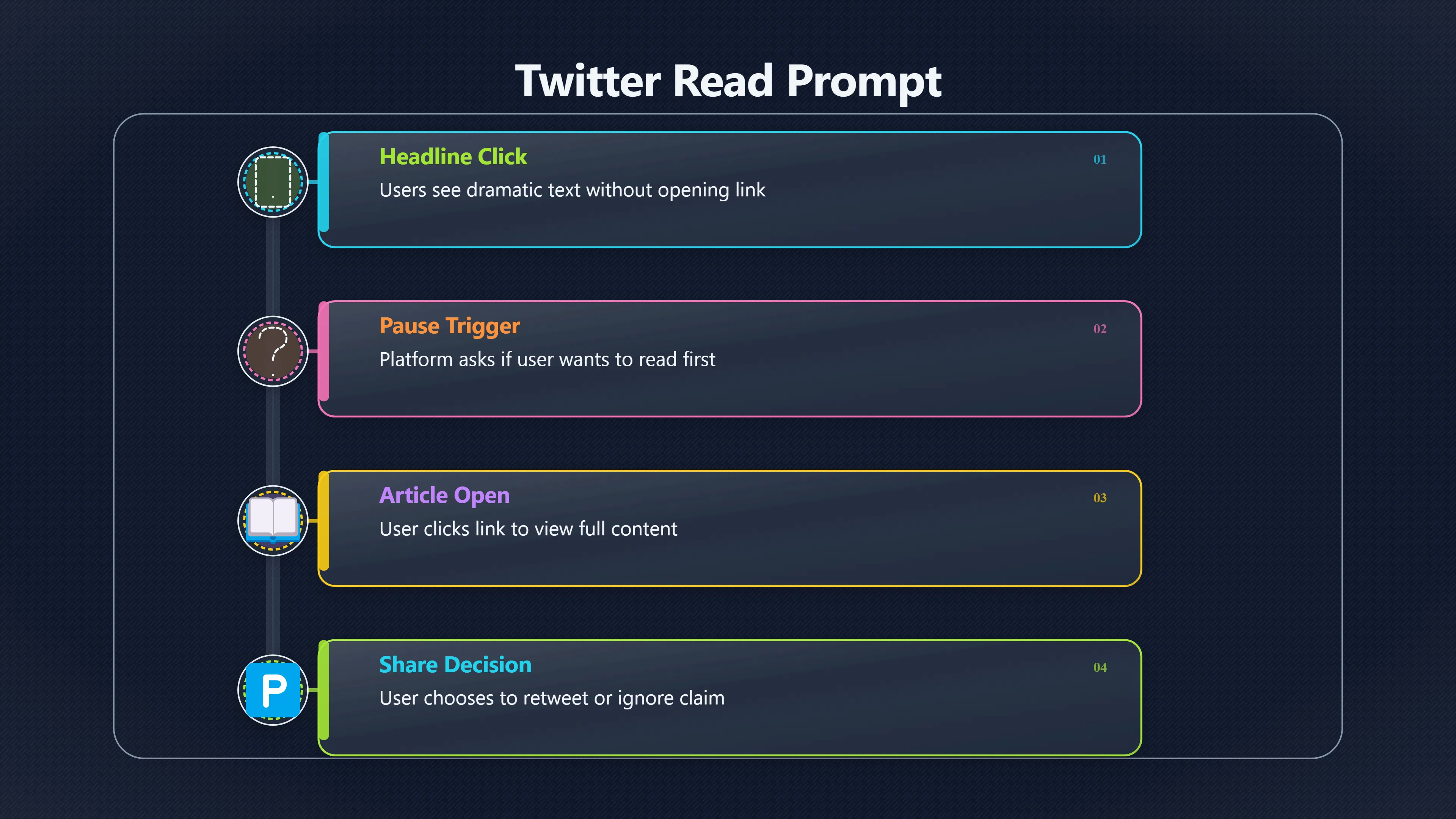
The most widely known example came from Twitter’s read before you retweet experiment. Users attempting to repost an article they had not opened received a prompt asking whether they wanted to read it first. After testing the feature, Twitter reported that users opened articles 40% more often after seeing the prompt, and article-opening before retweeting increased by 33%. Some users chose not to repost after reading, which was considered a desirable outcome rather than a failure. TechCrunch[Nieman Lab]niemanlab.orgNieman LabFollowing successful experiments, Twitter will prompt all…25 Sept 2020 According to Twitter Communications, people opened…
The significance of this intervention is not that it determined truth. The prompt did not label content as misinformation or remove posts. Instead, it altered the sequence of actions. Reading became slightly easier to choose than immediate amplification.
Researchers often describe this approach as a form of friction: a deliberate interruption of automatic behaviour. Studies examining misinformation sharing have found that asking people to pause and consider accuracy, explain why a headline might be true or false, or reflect briefly before sharing can reduce willingness to share false content while leaving sharing of accurate information largely unchanged. Misinformation Review[DOAJ]doaj.orgtrue or false indicated that they were less likely to share false information…
Attention rather than censorship
One common misconception is that these prompts work because they force users to accept a platform’s judgement. In reality, many successful interventions operate by redirecting attention rather than imposing a verdict.
A series of studies led by Gordon Pennycook and colleagues found that simple accuracy nudges improved the quality of information people said they would share. Even asking users to evaluate the accuracy of a single, unrelated headline could increase attention to accuracy in later sharing decisions. The proposed mechanism is straightforward: people often care about truthfulness but are distracted by other motivations when using social media.[Nature]nature.comShifting attention to accuracy can reduce misinformation…by G Pennycook 2021 Cited by 1492 The sharing of misinformation o…[Nature]nature.comA perspective on friction interventions to curb the spread of…by L Jahn 2025 Cited by 1 Adding as little friction as havin…
From an implementation perspective, this matters because attention-based prompts can be deployed without requiring platforms to identify every false claim in advance. The intervention targets behaviour rather than content classification.
Why timing matters
The effectiveness of these prompts depends heavily on timing. A warning shown after a post has already gone viral may do little to prevent further spread. A prompt delivered at the exact moment of sharing influences a decision that has not yet been made.
Researchers studying online misinformation increasingly describe engagement as a sequence of choices: what to view, what to trust and what to share. Read-before-sharing prompts intervene at the final stage, where a user is deciding whether to amplify information to others. By targeting this decision point, platforms can affect diffusion without substantially altering what users are allowed to see.[ScienceDirect]sciencedirect.comReview The Psychology of Fake Newsby G Pennycook 2021 Cited by 1962 Concern about fake news was redoubled in 2020 in t…

Where protective friction becomes overreach
Although read-before-sharing prompts are generally considered one of the less intrusive interventions, they are not free of trade-offs.
A first concern is user fatigue. If prompts appear too frequently, people may learn to dismiss them automatically. The intervention then becomes background noise rather than a meaningful pause. Behavioural research on digital friction consistently suggests that effectiveness depends on careful targeting rather than constant interruption.[Nature]nature.commisinformation on social media: Experimental evidence for a scalable accuracy nudge intervention…. fake news sharing on Twitter. Am…
A second concern is unequal burden. If prompts are applied selectively, users may perceive them as politically biased or ideologically motivated. Trust can erode if people believe the platform is steering behaviour in opaque ways rather than applying rules consistently.
There is also a practical limit to what friction alone can achieve. Some studies and modelling work suggest that simply making sharing harder may reduce overall posting activity without necessarily improving information quality. More promising results emerge when friction is combined with cues that help users recognise quality or accuracy. In other words, a pause works best when it encourages reflection rather than merely creating inconvenience.[arXiv]arxiv.orgFriction Interventions to Curb the Spread of Misinformation…by L Jahn 2023 Cited by 12 Adding as little friction as having users…
Can a pause stop a false claim?
A pause cannot eliminate myths and misconceptions, and read-before-sharing prompts are not a substitute for media literacy, fact-checking or broader platform governance. Determined users can still repost misleading content, and some false claims spread through channels where prompts are absent.
However, the evidence suggests that many instances of misinformation sharing are surprisingly sensitive to small design changes. When platforms insert a brief moment for reading, reflection or accuracy consideration, users often behave differently. They open articles more frequently, pay greater attention to accuracy and become less likely to share questionable information impulsively. Nature 3TechCrunch[Nieman Lab]niemanlab.orgNieman LabFollowing successful experiments, Twitter will prompt all…25 Sept 2020 According to Twitter Communications, people opened…
For platform designers seeking to reduce the spread of false beliefs, this is the key lesson: myths often benefit from speed. A well-placed pause does not decide what people must think, but it can change how quickly a doubtful claim travels.[Nature]nature.comFollowing news on social media boosts knowledge, belief…by S Altay 2025 Cited by 15 These trends may exacerbate polarization, ra…
Amazon book picks
Further Reading
Books and field guides related to Can a Pause Stop a False Claim?. Use these as the next step if you want deeper reading beyond the article.
The Psychology of Fake News
Directly connects to why people share content without careful evaluation.
eBay marketplace picks
Marketplace Samples
Example marketplace items related to this page. Use the search link to explore similar finds on eBay.



Endnotes
1.
Source: techcrunch.com
Link:https://techcrunch.com/2020/09/24/twitter-read-before-retweet/
Source snippet
Twitter plans to bring prompts to 'read before you retweet...September 24, 2020 24 Sept 2020 Twitter says the prompts work...
Published: September 24, 2020
2.
Source: nature.com
Link:https://www.nature.com/articles/s41586-021-03344-2
Source snippet
Shifting attention to accuracy can reduce misinformation...by G Pennycook 2021 Cited by 1492 The sharing of misinformation o...
3.
Source: sciencedirect.com
Link:https://www.sciencedirect.com/science/article/pii/S1364661321000516
Source snippet
Review The Psychology of Fake Newsby G Pennycook 2021 Cited by 1962 Concern about [fake news]({{ 'fake-news/' | relative_url }}) was redoubled in 2020 in t...
4.
Source: doaj.org
Link:https://doaj.org/article/c0637e7db45844599250ba7feabc88d1
Source snippet
true or false indicated that they were less likely to share false information...
5.
Source: nature.com
Link:https://www.nature.com/articles/s44260-025-00051-1
Source snippet
A perspective on friction interventions to curb the spread of...by L Jahn 2025 Cited by 1 Adding as little friction as havin...
6.
Source: nature.com
Link:https://www.nature.com/articles/s41467-022-30073-5
Source snippet
misinformation on social media: Experimental evidence for a scalable accuracy nudge intervention.... fake news sharing on Twitter. Am...
7.
Source: sciencedirect.com
Link:https://www.sciencedirect.com/science/article/pii/S2352250X23001847
Source snippet
The Online Misinformation Engagement Frameworkby M Geers 2024 Cited by 40 Similarly, introducing friction (e.g., askin...
8.
Source: arxiv.org
Link:https://arxiv.org/pdf/2307.11498
Source snippet
Friction Interventions to Curb the Spread of Misinformation...by L Jahn 2023 Cited by 12 Adding as little friction as having users...
9.
Source: arxiv.org
Link:https://arxiv.org/abs/2307.11498
Source snippet
Friction Interventions to Curb the Spread of Misinformation on Social MediaJuly 21, 2023...
Published: July 21, 2023
10.
Source: nature.com
Link:https://www.nature.com/articles/s41562-025-02205-6
Source snippet
Following news on social media boosts knowledge, belief...by S Altay 2025 Cited by 15 These trends may exacerbate polarization, ra...
11.
Source: facebook.com
Link:https://www.facebook.com/SearchEngineJournal/posts/twitter-is-testing-a-prompt-to-encourage-you-to-read-an-article-before-sharing-t/10157636757543721/
Source snippet
ead the article before sharing it, one report shows. Now a...Read more...
12.
Source: techcrunch.com
Title: twitter retweet prompt android
Link:https://techcrunch.com/2020/06/10/twitter-retweet-prompt-android/
Source snippet
The company describes the...
13.
Source: techcrunch.com
Link:https://techcrunch.com/2021/07/01/twitter-considers-new-features-for-tweeting-only-to-friends-under-different-personas-and-more/
Source snippet
retweet, it found that users opened articles before sharing them 40% more often. But in the case of someone determined to troll, it may n...
14.
Source: techcrunch.com
Title: twitter relaunches test that asks users to revise harmful replies
Link:https://techcrunch.com/2021/02/23/twitter-relaunches-test-that-asks-users-to-revise-harmful-replies/
Source snippet
tweet before retweeting it, the company found that users would open the articles 40% more often than without the nudge. Twitter has also...
15.
Source: psu.edu
Title: social media users probably wont read beyond headline researchers say
Link:https://www.psu.edu/news/research/story/social-media-users-probably-wont-read-beyond-headline-researchers-say
Source snippet
Penn StateSocial media users probably won't read beyond this...Nov 19, 2024 A study led by Penn State researchers revealed that more t...
16.
Source: niemanlab.org
Link:https://www.niemanlab.org/2020/09/following-successful-experiments-twitter-will-prompt-all-users-to-read-the-articles-theyre-about-to-retweet/
Source snippet
Nieman LabFollowing successful experiments, Twitter will prompt all...25 Sept 2020 According to Twitter Communications, people opened...
17.
Source: science.org
Link:https://www.science.org/doi/10.1126/sciadv.abo6169
Source snippet
more...
Additional References
18.
Source: researchgate.net
Link:https://www.researchgate.net/publication/372547505_Friction_Interventions_to_Curb_the_Spread_of_Misinformation_on_Social_Media
Source snippet
Friction Interventions to Curb the Spread of Misinformation...Jul 21, 2023 We propose a friction intervention with a learning componen...
19.
Source: misinforeview.hks.harvard.edu
Title: developing an accuracy prompt toolkit to reduce covid 19 misinformation online
Link:https://misinforeview.hks.harvard.edu/article/developing-an-accuracy-prompt-toolkit-to-reduce-covid-19-misinformation-online/
Source snippet
an accuracy-prompt toolkit to reduce COVID...by Z Epstein 2021 Cited by 133 We focused on COVID-19 misinformation, and began by re...
20.
Source: socialmediatoday.com
Title: twitter shares insights into the effectiveness of its new prompts to get us
Link:https://www.socialmediatoday.com/news/twitter-shares-insights-into-the-effectiveness-of-its-new-prompts-to-get-us/585860/
Source snippet
Twitter Shares Insights Into the Effectiveness of its New...24 Sept 2020 According to Twitter: People open articles 40% more often aft...
21.
Source: pmc.ncbi.nlm.nih.gov
Title: PMCThe case against efficiency: friction in social media
Link:https://pmc.ncbi.nlm.nih.gov/articles/PMC12827046/
Source snippet
case against efficiency: friction in social media - PMCby J Garland 2026 Cited by 2 One notable example of cognitive friction is th...
22.
Source: chicagopolicyreview.org
Title: try [accuracy prompts]({{ ‘accuracy-prompts/’ | relative_url }}) to reduce the spread of misinformation online
Link:https://chicagopolicyreview.org/2022/01/04/try-accuracy-prompts-to-reduce-the-spread-of-misinformation-online/
Source snippet
Try Accuracy Prompts to Reduce the Spread of...Jan 4, 2022 These accuracy prompts were modest interventions that encouraged participan...
23.
Source: news.ku.dk
Title: small digital frictions can slow the spread of misinformation
Link:https://news.ku.dk/all_news/2025/11/small-digital-frictions-can-slow-the-spread-of-misinformation/
Source snippet
digital frictions can slow the spread of misinformationNov 11, 2025 Our idea is to introduce a small pause in the sharing process to m...
24.
Source: news.cornell.edu
Title: accuracy nudges decrease misinformation sharing left right
Link:https://news.cornell.edu/stories/2024/04/accuracy-nudges-decrease-misinformation-sharing-left-right
Source snippet
'nudges' decrease misinformation-sharing on left, right4 Apr 2024 They found that nudges regarding the importance of accuracy reduced...
25.
Source: adweek.com
Title: twitter says its read before you retweet prompt is working
Link:https://www.adweek.com/programmatic/twitter-says-its-read-before-you-retweet-prompt-is-working/
Source snippet
Twitter Says Its 'Read Before You Retweet' Prompt Is Working24 Sept 2020 Twitter said Thursday that people opened articles 40% more oft...
26.
Source: pmc.ncbi.nlm.nih.gov
Title: PMCNudging Social Media toward Accuracy
Link:https://pmc.ncbi.nlm.nih.gov/articles/PMC9082967/
Source snippet
fake news sharing on Twitter).... Fighting COVID-19 misinformation on social media: Experimental evidence for a scalable accuracy nudge...
27.
Source: crestresearch.ac.uk
Title: psychological interventions to combat misinformation
Link:https://crestresearch.ac.uk/comment/psychological-interventions-to-combat-misinformation/
Source snippet
Oct 10, 2023 Behaviour nudges include accuracy prompts that remind the consumer to consider information veracity, the introduction of f...
Topic Tree