Within Key Terms
Is It a Myth or a Misconception?
A practical test asks whether a belief mainly spreads through repetition or mainly rests on a mistaken explanation.
On this page
- The repetition test for myths
- The explanation test for misconceptions
- When one belief fits both labels
Page outline Jump by section
Introduction
A quick way to tell a myth from a misconception is to ask a simple question: does the belief survive mainly because people keep repeating it, or because it seems to explain how something works?
 A myth is usually a socially shared story, claim or piece of conventional wisdom that gains credibility through familiarity. A misconception is usually a mistaken explanation that feels sensible to the person holding it. In practice, many false beliefs contain elements of both, but the distinction matters because different kinds of errors require different responses. Repetition can make a claim feel true even when evidence is weak, while a flawed mental model can survive even after someone hears the correct facts. Research on the “illusory truth effect” shows that repeated statements often become more believable through familiarity alone, while studies of conceptual change show that misconceptions often persist because they are embedded in people’s explanations of the world.[PubMed]pubmed.ncbi.nlm.nih.govThe illusory truth effect: A review of how repetition…by J Udry · 2024 · Cited by 103 — Repetition increases belief in informati…[PMC]pmc.ncbi.nlm.nih.govThis finding is known as the illusory truth effect, and it is…
The Repetition Test for Myths
When trying to classify a false belief, first look at how it spreads.
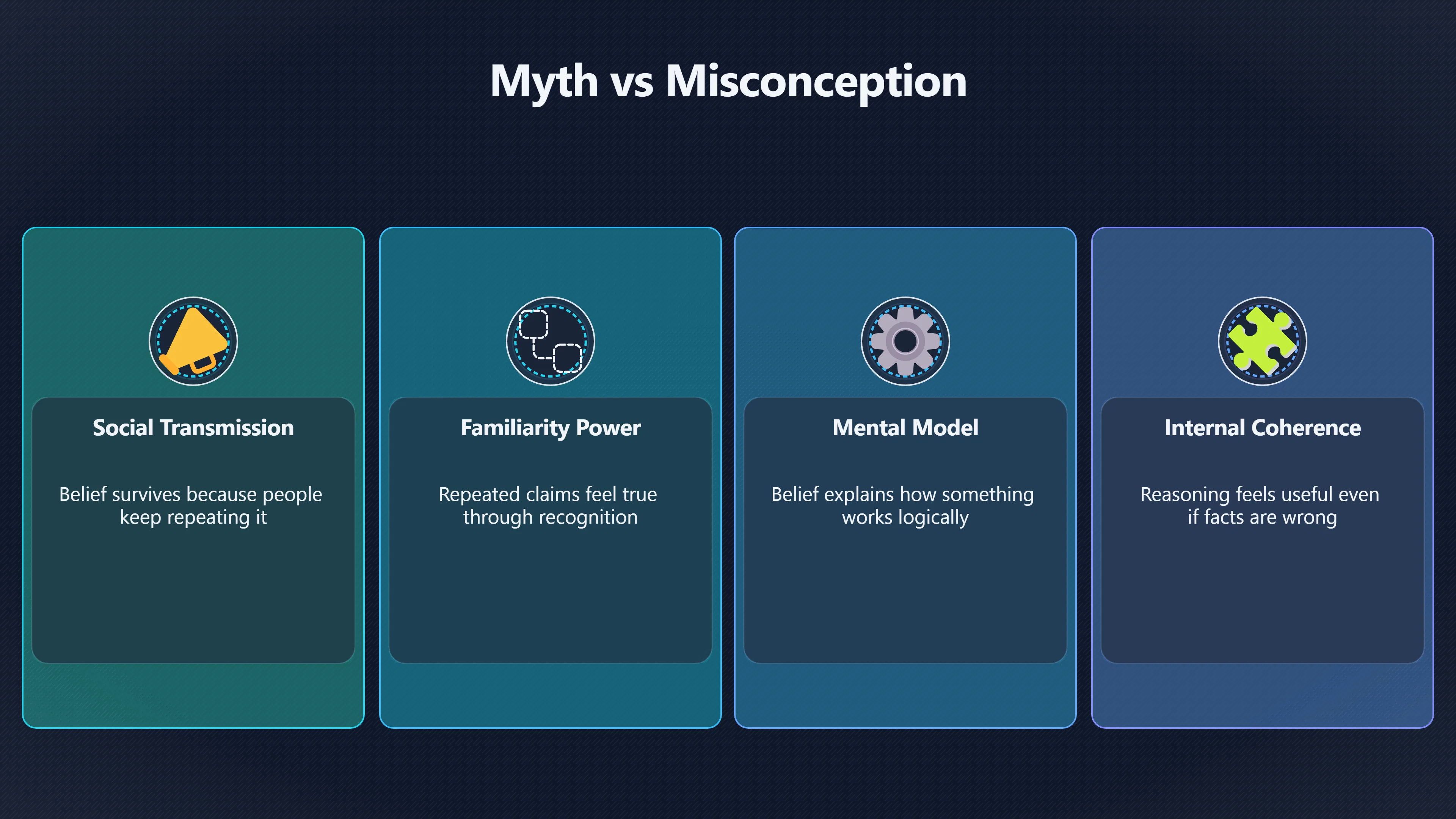
A belief is functioning as a myth when its strength comes largely from circulation. People hear it from friends, media, advertising, schools, family members or social networks. The claim becomes familiar long before anyone checks whether it is accurate.
Consider a statement such as “people only use 10 per cent of their brains”. Many people cannot explain where the idea came from or why it would be true. They know it because they have encountered it repeatedly. The belief’s power comes from recognition rather than understanding.
This pattern matches what psychologists call the illusory truth effect: repeated claims are often judged as more credible simply because they feel familiar. Studies have found that repetition can increase perceived truthfulness even when statements are implausible or conflict with prior knowledge.[PubMed]pubmed.ncbi.nlm.nih.govThe illusory truth effect: A review of how repetition…by J Udry · 2024 · Cited by 103 — Repetition increases belief in informati…[PMC]pmc.ncbi.nlm.nih.govThe backfire effect after correcting misinformation is strongly…by B Swire-Thompson · 2022 · Cited by 111 — The illusory truth effe…
Several signs suggest that a belief is operating mainly as a myth:
- People repeat the claim but struggle to explain the mechanism behind it.
- The belief appears in slogans, sayings, headlines or common “facts”.
- Familiarity seems more important than evidence.
- Many versions of the same claim circulate across different settings.
- People often defend it by saying they have “always heard” it.
In these cases, the central problem is social transmission. The belief survives because it remains culturally available.
The Explanation Test for Misconceptions
A different diagnostic question is: what explanation is the belief providing?
Misconceptions are usually not held because they are famous. They are held because they seem to make sense.
A person who thinks heavier objects fall faster than lighter ones is not merely repeating a slogan. They are often drawing a conclusion from everyday observation. A person who believes the seasons occur because Earth moves closer to the Sun is using an intuitive model to explain changing weather. The explanation is flawed, but it performs useful mental work.
Research in science education has repeatedly found that learners build internal models to organise experience. These models can be incomplete or inaccurate while still feeling coherent and predictive. Because the misconception is tied to an explanatory framework, simply hearing the correct answer may not replace it. Taylor & Francis Online[University at Buffalo]buffalo.eduUniversity at Buffalo Conceptual ChangeUniversity at BuffaloConceptual Change - TeachingMisconceptions pose a challenge to learning because they are often robust and prevent st…
Several clues point towards a misconception:
- The person can explain why they believe it.
- The belief is connected to a broader mental model.
- The reasoning appears internally logical.
- The error survives because the explanation still feels useful.
- Correct facts are accepted verbally but not fully integrated into understanding.
Educational research on conceptual change emphasises that misconceptions are often robust because they are woven into existing ways of thinking. Correcting them requires revising the underlying model, not just supplying missing information.[ScienceDirect]sciencedirect.comThe influence of prior exposure on judgments of truth – sometimes referred to as the illusory…Read more…[Mary Lou Fulton College]education.asu.educhi concpetualchangechapter 0Mary Lou Fulton CollegeThree Types of Conceptual Change: Belief Revision, Mental…by MTH Chi · Cited by 1379 — Learning of complex mate…

A Practical Comparison
The distinction becomes clearer when the same belief is examined from two different angles.
Imagine someone believes that cracking knuckles causes arthritis.
If the person says, “Everybody knows that,” the belief is functioning primarily as a myth. Its force comes from repetition and social familiarity.
If the person says, “The cracking sound must damage the joints over time,” the belief is functioning as a misconception. The person is relying on an explanatory model, even if that model is incorrect.
The factual claim is the same, but the mechanism keeping it alive differs.
This distinction helps explain why some corrections fail. A fact-check may weaken a myth by interrupting repetition and replacing it with more accurate information. A misconception often requires something more demanding: showing why the old explanation fails and why a better explanation works.
When One Belief Fits Both Labels
Many real-world beliefs do not fit neatly into a single category.
A misconception can become a myth when it spreads widely through culture. A myth can also encourage the formation of misconceptions by supplying people with ready-made explanations.
For example, a mistaken scientific idea may begin as an individual’s flawed understanding. If teachers, media outlets or popular culture repeat it for years, it can become a cultural myth as well. At that point, the belief survives through both familiarity and explanation.
This overlap is one reason why public debates about misinformation can become confusing. People sometimes assume that all false beliefs spread in the same way. In reality, some beliefs persist because they are socially repeated, while others persist because they fit an existing mental model. Many combine both forces.
Research on misinformation increasingly points to familiarity and explanatory coherence as separate influences on belief. Repetition can make claims feel true, while intuitive mental models can make them feel reasonable. A belief supported by both mechanisms is often especially difficult to change.[PubMed]pubmed.ncbi.nlm.nih.govThe illusory truth effect: A review of how repetition…by J Udry · 2024 · Cited by 103 — Repetition increases belief in informati…[ScienceDirect]sciencedirect.comThe influence of prior exposure on judgments of truth – sometimes referred to as the illusory…Read more…
Why the Difference Matters
The labels are useful because they suggest different responses.
If a belief behaves mainly as a myth, the priority is often reducing the power of repetition. Clear fact-checking, accurate repetition of corrections and improved information environments can help counter familiar false claims. Psychologists studying misinformation frequently emphasise the role of repeated exposure in shaping perceived truth.[American Psychological Association]apa.orgAmerican Psychological AssociationRecommendations for countering misinformation29 Nov 2023 — The repetition of false claims increases bel…[American Psychological Association]apa.orgAmerican Psychological AssociationRecommendations for countering misinformation29 Nov 2023 — The repetition of false claims increases bel…
If a belief behaves mainly as a misconception, the challenge is different. The goal is not only to provide facts but to help people reconstruct their understanding. Educational approaches often focus on revealing contradictions, comparing competing explanations and encouraging conceptual change rather than simple memorisation. ScienceDirect[2thescienceteacher.co.uk]thescienceteacher.co.ukshow students that the same mass of plasticine will sink and float depending…Read more…
A practical rule is therefore:
- If the belief survives because people keep hearing it, treat it as a myth.
- If the belief survives because it keeps explaining things, treat it as a misconception.
- If both conditions apply, recognise that the belief may require both myth-correction and misconception-correction strategies.
That distinction does not solve every case, but it provides a useful test for understanding why false beliefs persist and what kind of response is most likely to work.
Amazon book picks
Further Reading
Books and field guides related to Is It a Myth or a Misconception?. Use these as the next step if you want deeper reading beyond the article.
Thinking, Fast and Slow
Covers both repetition-driven judgments and flawed explanatory thinking.
Factfulness
Illustrates the difference between accepted myths and evidence-based understanding.
The Skeptics' Guide to the Universe
Teaches readers how to distinguish unsupported claims from sound explanations.
Calling Bullshit
Useful for separating repeated myths from evidence-backed conclusions.
eBay marketplace picks
Marketplace Samples
Example marketplace items related to this page. Use the search link to explore similar finds on eBay.



Endnotes
1.
Source: pmc.ncbi.nlm.nih.gov
Link:https://pmc.ncbi.nlm.nih.gov/articles/PMC8116821/
Source snippet
This finding is known as the illusory truth effect, and it is...
2.
Source: sciencedirect.com
Link:https://www.sciencedirect.com/science/article/pii/S1364661321000516
Source snippet
The influence of prior exposure on judgments of truth – sometimes referred to as the illusory...Read more...
3.
Source: buffalo.edu
Title: University at Buffalo Conceptual Change
Link:https://www.buffalo.edu/catt/teach/develop/theory/conceptual-change.html
Source snippet
University at BuffaloConceptual Change - TeachingMisconceptions pose a challenge to learning because they are often robust and prevent st...
4.
Source: sciencedirect.com
Title: ScienceDirect Conceptual Change Theory
Link:https://www.sciencedirect.com/topics/psychology/conceptual-change-theory
Source snippet
Conceptual Change Theory - an overviewConceptual change theory refers to frameworks that guide the design of educational int...
5.
Source: sciencedirect.com
Link:https://www.sciencedirect.com/science/article/abs/pii/S0959475211000454
Source snippet
Effectiveness of holistic mental model confrontation in...by S Gadgil · 2012 · Cited by 267 — Prior research on conceptual change has id...
6.
Source: sciencedirect.com
Link:https://www.sciencedirect.com/science/article/pii/S0010027724000775
Source snippet
This truth effect has been widely researched and is relevant for topics...Read more...
7.
Source: pmc.ncbi.nlm.nih.gov
Link:https://pmc.ncbi.nlm.nih.gov/articles/PMC9283209/
Source snippet
The [backfire]({{ 'backfire/' | relative_url }}) effect after correcting misinformation is strongly...by B Swire-Thompson · 2022 · Cited by 111 — The illusory truth effe...
8.
Source: thescienceteacher.co.uk
Link:https://thescienceteacher.co.uk/misconceptions-in-science-education/
Source snippet
show students that the same mass of plasticine will sink and float depending...Read more...
9.
Source: sciencedirect.com
Link:https://www.sciencedirect.com/science/article/pii/S0193397399000465
Source snippet
Science Education as Conceptual Changeby S Carey · 2000 · Cited by 650 — This paper shows that, for the average student, the conceptual c...
10.
Source: sciencedirect.com
Link:https://www.sciencedirect.com/science/article/abs/pii/S0010027719302276
Source snippet
An initial accuracy focus prevents illusory truthby NM Brashier · 2020 · Cited by 184 — Repeated statements feel easier to process, and t...
11.
Source: pubmed.ncbi.nlm.nih.gov
Link:https://pubmed.ncbi.nlm.nih.gov/38113667/
Source snippet
The illusory truth effect: A review of how repetition...by J Udry · 2024 · Cited by 103 — Repetition increases belief in informati...
12.
Source: apa.org
Link:https://www.apa.org/topics/journalism-facts/misinformation-recommendations
Source snippet
American Psychological AssociationRecommendations for countering misinformation29 Nov 2023 — The repetition of false claims increases bel...
13.
Source: education.asu.edu
Title: chi concpetualchangechapter 0
Link:https://education.asu.edu/sites/g/files/litvpz656/files/lcl/chi_concpetualchangechapter_0.pdf
Source snippet
Mary Lou Fulton CollegeThree Types of Conceptual Change: Belief Revision, Mental...by MTH Chi · Cited by 1379 — Learning of complex mate...
14.
Source: apa.org
Title: trends taking aim misinformation
Link:https://www.apa.org/monitor/2023/01/trends-taking-aim-misinformation
Source snippet
American Psychological AssociationPsychologists are taking aim at misinformation with these...1 Jan 2023 — Why people trust falsehoods ·...
15.
Source: pubmed.ncbi.nlm.nih.gov
Link:https://pubmed.ncbi.nlm.nih.gov/19100995/
Source snippet
models and other misconceptions in children's...by G Panagiotaki · 2009 · Cited by 120 — It tested the proposal that children appear to...
16.
Source: dictionary.cambridge.org
Link:https://dictionary.cambridge.org/dictionary/english-chinese-traditional/conceptual
Source snippet
in Traditional Chinese - Cambridge DictionaryMay 13, 2026 — based on ideas or principles 觀念上的;構思的;概念上的 The main weakness of the proposal...
Published: May 13, 2026
17.
Source: thedecisionlab.com
Title: Illusory truth effect
Link:https://thedecisionlab.com/biases/illusory-truth-effect
Source snippet
The Decision...The illusory truth effect, also known as the illusion of truth, describes how when we hear the same false information rep...
18.
Source: facebook.com
Link:https://www.facebook.com/AmericanPsychologicalAssociation/posts/you-keep-seeing-the-same-claim-made-over-and-over-onlineso-it-must-be-true-right/1290086699819665/
Source snippet
American Psychological AssociationThe illusory truth effect is the tendency for any statement that is repeated frequently - whether it is...
19.
Source: Wikipedia
Title: Illusory truth effect
Link:https://en.wikipedia.org/wiki/Illusory_truth_effect
Source snippet
Illusory truth effectThe illusory truth effect, also known as the illusion of truth effect, validity effect, truth effect, or the reit...
20.
Source: ebsco.com
Link:https://www.ebsco.com/research-starters/psychology/illusory-truth-effect
Source snippet
Illusory truth effect | Psychology | Research Starters“Why Do We Believe Misinformation More Easily when It's Repeated Many Times?” The D...
Additional References
21.
Source: researchoutreach.org
Link:https://researchoutreach.org/wp-content/uploads/2022/04/Patrice-Potvin-1.pdf
Source snippet
Conceptual changeOften referred to as misconceptions, these representations are personal models or theories borrowed or developed by lear...
22.
Source: psychologytoday.com
Link:https://www.psychologytoday.com/us/basics/illusory-truth-effect
Source snippet
Illusory Truth EffectThe illusory truth effect is the tendency for any statement that is repeated frequently—whether it is factually true...
23.
Source: jes.ejournal.unri.ac.id
Link:https://jes.ejournal.unri.ac.id/index.php/JES/article/view/34
Source snippet
Models and Conceptual Change in Chemistryby Z Alqadri · Cited by 6 — This study aims to analyze students' mental models in chemistry, ide...
24.
Source: leadalchemists.com
Link:https://www.leadalchemists.com/marketing-psychology/illusory-truth-effect/
25.
Source: researchgate.net
Link:https://www.researchgate.net/publication/351563163_The_effects_of_repetition_frequency_on_the_illusory_truth_effect
Source snippet
This illusory truth effect occurs with many different types of statements (e.g., trivia facts, news headlines...Read more...
26.
Source: per-central.org
Link:https://www.per-central.org/items/perc/3451.pdf
Source snippet
r terms (alternative conceptions, mental models, and [memory]({{ 'memory/' | relative_url }})), which are used for representing students'...Read more...
27.
Source: ovid.com
Title: xge0000098~knowledge does not protect against illusory truth
Link:https://www.ovid.com/journals/jepge/fulltext/10.1037/xge0000098~knowledge-does-not-protect-against-illusory-truth
Source snippet
Knowledge Does Not Protect Against Illusory Truthby LK Fazio · 2015 · Cited by 933 — One key factor appears to be repetition: Repeated st...
28.
Source: royalsocietypublishing.org
Title: Illusory implications incidental exposure to ideas
Link:https://royalsocietypublishing.org/rsos/article/12/1/240716/92711/Illusory-implications-incidental-exposure-to-ideas
Source snippet
Illusory implications: incidental exposure to ideas can induce...22 Jan 2025 — The illusory truth effect suggests that incidental exposu...
29.
Source: reddit.com
Link:https://www.reddit.com/r/science/comments/1fryhzw/repeating_a_claim_can_make_it_seem_more/
Source snippet
ory truth effect”. A new study found that repetition boosts...Read more...
30.
Source: tipsforteachers.substack.com
Title: research bite 52 three types of conceptual
Link:https://tipsforteachers.substack.com/p/research-bite-52-three-types-of-conceptual
Source snippet
Bite #52: Three Types of Conceptual Change: Belief...The provided text explores three distinct types of conceptual change in learning, p...
Topic Tree