Within 10 Brain
Why Small Brain Injuries Can Matter
Injury and disease show that even small brain areas can matter for language, movement, memory, emotion, and perception.
On this page
- What clinical neurology reveals about function
- Why lost abilities challenge the 90 percent idea
- The difference between unknown function and no function
Page outline Jump by section
Introduction
One of the strongest arguments against the idea that humans use only 10 per cent of their brains comes from clinical neurology. If large portions of the brain were genuinely inactive or unnecessary, damage to those regions should have little effect. Instead, doctors repeatedly observe the opposite. Small strokes, tiny tumours, localised injuries and early-stage neurodegenerative diseases can cause striking losses of language, memory, movement, vision, emotional regulation or personality. These effects reveal that brain tissue is not sitting idle waiting to be unlocked. Even areas whose functions are not fully understood often contribute to complex networks that support everyday behaviour. Clinical evidence does not suggest that 90 per cent of the brain is unused. It suggests that much of the brain is doing something important, even when that role is not immediately obvious.[Wikipedia]WikipediaTen-percent-of-the-brain mythTen-percent-of-the-brain myth[PMC]pmc.ncbi.nlm.nih.govPMCMapping human brain lesions and their functionalNIHby HO Karnath 2017 Cited by 229 Neuroscience has a long history of inferring brain function by examining the relationship…
What Clinical Neurology Reveals About Function
For more than a century, neurologists have learned about brain function by studying what happens when specific areas are damaged. This approach, known as lesion analysis, remains one of the foundations of neuroscience. Researchers compare the location of an injury with the abilities that were lost, helping map the functions of different brain systems.[PMC]pmc.ncbi.nlm.nih.govPMCLesion studies in contemporary neuroscienceNIHby AR Vaidya 2019 Cited by 260 Studies on the effects of permanent lesions provide vital data about brain function that ar…[PMC]pmc.ncbi.nlm.nih.govfunctional localization of language regions in the brainby JJ Lee 2023 Cited by 8 The brain's language network can be localized jus…
The pattern is remarkably consistent. Damage to particular regions produces particular deficits:
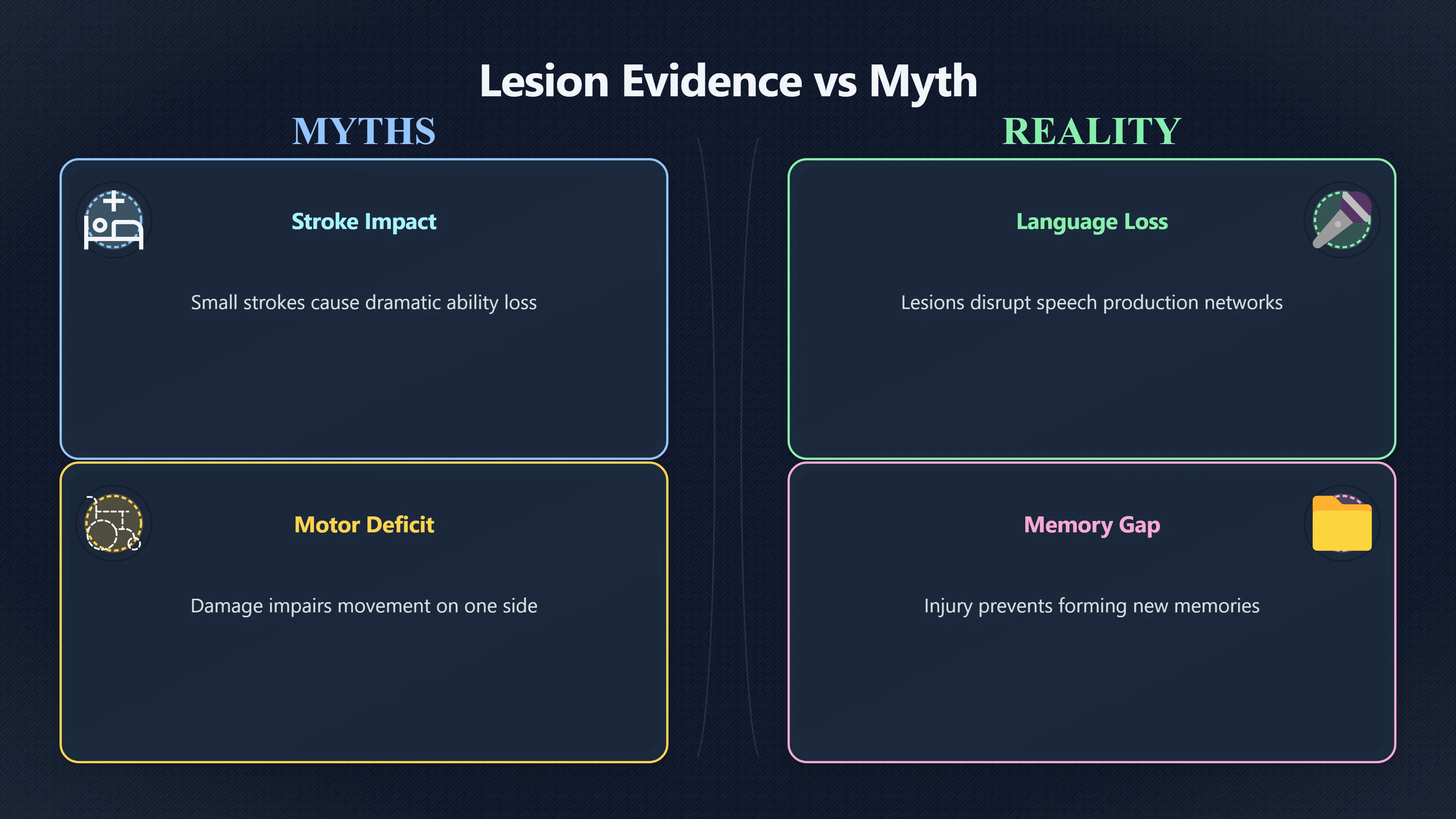
- Injury to language networks can cause aphasia, making speech production or comprehension difficult.
- Damage to motor regions can impair movement on one side of the body.
- Injury to memory-related structures can prevent the formation of new memories.
- Damage affecting visual pathways can remove part of a person’s visual field even when the eyes remain healthy.
- Lesions involving emotional and social processing networks can alter judgement, impulse control or personality.[Open Encyclopedia of Cognitive Science]oecs.mit.eduOpen Encyclopedia of Cognitive ScienceNeuroscience of Languageby G Hartwigsen 2024 Cited by 1 Brain lesions such as stroke can seve…[PMC]pmc.ncbi.nlm.nih.govPMCMapping human brain lesions and their functionalNIHby HO Karnath 2017 Cited by 229 Neuroscience has a long history of inferring brain function by examining the relationship…
These observations are difficult to reconcile with the idea that most of the brain is unused. If large areas were functionless, neurologists would regularly encounter patients whose injuries produced no meaningful changes. Instead, clinical medicine shows that seemingly modest injuries can have life-altering consequences.[Wikipedia]WikipediaTen-percent-of-the-brain mythTen-percent-of-the-brain myth
Modern lesion-mapping studies have strengthened this conclusion. Researchers can now compare thousands of brain scans and behavioural outcomes, linking specific patterns of damage to specific impairments with far greater precision than was possible in earlier decades. The continued success of this approach depends on a simple fact: different parts of the brain contribute to different functions, and damaging them changes behaviour.[PMC]pmc.ncbi.nlm.nih.govPMCLesion studies in contemporary neuroscienceNIHby AR Vaidya 2019 Cited by 260 Studies on the effects of permanent lesions provide vital data about brain function that ar…
Why Lost Abilities Challenge the 90 Per Cent Idea
The 10 per cent myth often assumes that unused brain regions exist as dormant reserves. Clinical cases argue strongly against that assumption.
Consider stroke medicine. A stroke may affect a relatively small region of brain tissue, yet the resulting impairments can be dramatic. A person may suddenly lose the ability to speak fluently, recognise faces, coordinate movements or form new memories. The deficit reflects the loss of a specialised system rather than the destruction of a redundant area.[Open Encyclopedia of Cognitive Science]oecs.mit.eduOpen Encyclopedia of Cognitive ScienceNeuroscience of Languageby G Hartwigsen 2024 Cited by 1 Brain lesions such as stroke can seve…
Neuroscientist Barry Beyerstein highlighted this point in one of the best-known critiques of the 10 per cent myth. If only a small fraction of the brain were actually used, damage to the remaining tissue should produce little or no impairment. In reality, there is almost no brain region that can be injured without some measurable consequence.[Wikipedia]WikipediaTen-percent-of-the-brain mythTen-percent-of-the-brain myth
This argument becomes even stronger when considering subtle deficits. Not all brain damage produces obvious paralysis or loss of speech. Some injuries affect attention, emotional regulation, social judgement or sensory integration. These changes may be less visible but still reveal that the damaged tissue had an active role. Historically, some regions were incorrectly assumed to be unimportant simply because their functions were difficult to detect with older clinical methods. As assessment tools improved, previously overlooked deficits became easier to identify.[Wikipedia]WikipediaTen-percent-of-the-brain mythTen-percent-of-the-brain myth
The lesson is that absence of obvious symptoms is not evidence of absence of function. The brain contains many systems whose contributions are distributed, specialised or difficult to measure. Discovering a function later is not the same as proving that the tissue was unused all along.[PMC]pmc.ncbi.nlm.nih.govfunctional localization of language regions in the brainby JJ Lee 2023 Cited by 8 The brain's language network can be localized jus…
Small Injuries Often Have Outsized Effects
One reason the myth persists is that people imagine brain function as evenly distributed across a large mass of tissue. Clinical reality is more complicated.
Many brain functions depend on highly connected networks. Damage to a small but strategically important hub can disrupt communication across larger systems. This is similar to how the failure of a key railway junction can affect transport far beyond the immediate location of the problem.
Language offers a useful example. Relatively small lesions in critical language regions can produce major communication difficulties. The amount of tissue damaged may be limited, but its position within the network makes it essential. Neuroscience research continues to use lesion studies precisely because these disruptions reveal how specialised systems are organised.[Open Encyclopedia of Cognitive Science]oecs.mit.eduOpen Encyclopedia of Cognitive ScienceNeuroscience of Languageby G Hartwigsen 2024 Cited by 1 Brain lesions such as stroke can seve…[PMC]nih.govPMC5834348This includes claims of how many cells compose the human brain.Read more
The same principle appears in movement disorders, memory disorders and sensory impairments. A lesion does not need to destroy a large percentage of the brain to produce a major effect. It only needs to affect the wrong place.[OUP Academic]academic.oup.comOUP Academicreturn of the lesion for localization and therapy | Brainby J Joutsa 2023 Cited by 35 Lesions have recently begun to ma…
This is one reason neurosurgeons carefully map critical brain regions before operations. The goal is not simply to avoid removing large amounts of tissue. It is to avoid disrupting areas that support essential functions. If vast regions were genuinely unused, such detailed mapping would be far less important.[OUP Academic]academic.oup.comOUP Academicreturn of the lesion for localization and therapy | Brainby J Joutsa 2023 Cited by 35 Lesions have recently begun to ma…
The Difference Between Unknown Function and No Function
Confusion between “unknown” and “unused” has helped sustain the myth for decades.
At various points in scientific history, researchers lacked clear explanations for what certain brain regions did. Early neurologists sometimes encountered areas whose functions were difficult to identify because the resulting impairments were subtle or because available methods were limited. Some people later interpreted these uncertainties as evidence that the regions had no purpose.[Wikipedia]WikipediaTen-percent-of-the-brain mythTen-percent-of-the-brain myth
Modern neuroscience rejects that conclusion. The brain remains full of unanswered questions, but uncertainty about a mechanism is not evidence of inactivity. Researchers are still investigating how consciousness emerges, how memories are stored and how large networks coordinate complex behaviour. These open questions reflect the brain’s complexity, not the existence of vast unused territories.[Scientific American]scientificamerican.comdo people only use 10 percent of their brainsScientific AmericanDo People Only Use 10 Percent of Their Brains?7 Feb 2008 Another mystery hidden within our crinkled cortices is that…
The distinction matters because scientific knowledge often develops in stages. A region may first be recognised as important because damage causes a deficit. Only later do researchers understand precisely how that region contributes to behaviour. Lesion studies frequently provide the first clue that a function exists.[PMC]nih.govPMC5834348This includes claims of how many cells compose the human brain.Read more
Why Brain Damage Remains One of the Clearest Tests
Brain imaging shows that activity is distributed across the brain during both demanding tasks and ordinary rest. Yet lesion evidence offers something imaging alone cannot: a test of necessity. A brain scan can show that an area becomes active during a task, but damage can reveal whether that area is actually required for the function.[Encyclopedia Britannica]britannica.comEncyclopedia BritannicaDo We Really Use Only 10 Percent of Our Brain?The data clearly shows that large areas of the brainfar more than 1…[Scientific American]scientificamerican.comdo people only use 10 percent of their brainsScientific AmericanDo People Only Use 10 Percent of Their Brains?7 Feb 2008 Another mystery hidden within our crinkled cortices is that…
This is why neurologists continue to regard lesion studies as so informative. When injury consistently removes a specific ability, it demonstrates that the affected tissue was contributing something meaningful. The accumulated record from stroke units, neurosurgery, traumatic brain injury treatment and neurodegenerative disease research points in the same direction. Brain tissue is not largely dormant. It is organised into specialised and interconnected systems whose importance becomes obvious when they fail.[Cleveland Clinic]my.clevelandclinic.orgCleveland ClinicBrain Lesions: What They Are, Causes, Symptoms &…16 Nov 2022 Brain lesions are areas of brain tissue that show damag…[PMC]nih.govPMC5834348This includes claims of how many cells compose the human brain.Read more[OUP Academic]academic.oup.comOUP Academicreturn of the lesion for localization and therapy | Brainby J Joutsa 2023 Cited by 35 Lesions have recently begun to ma…
In that sense, brain damage provides a real-world experiment that directly challenges the 10 per cent myth. If 90 per cent of the brain were truly unused, medicine would routinely encounter injuries with no consequences. Instead, clinical neurology repeatedly shows that even small areas can matter enormously.[Wikipedia]WikipediaTen-percent-of-the-brain mythTen-percent-of-the-brain myth[2mcgovern.mit.edu]mcgovern.mit.edudo we use only 10 percent of our brainDo we only use 10 percent of our brain?26 Jan 2024 The idea that we use 10 percent of our brain is 100 percent a myth. In fact, scienti…
Amazon book picks
Further Reading
Books and field guides related to Why Small Brain Injuries Can Matter. Use these as the next step if you want deeper reading beyond the article.

The Man Who Mistook His Wife for a Hat
First published 1980. Subjects: Neurology -, Anecdotes, Neurology, Nervous system, Mental Disorders.

Phantoms in the brain : probing the mysteries of the human mind
First published 1999. Subjects: Neurosciences, Brain, Neurology, Popular works, Mind and body.
eBay marketplace picks
Marketplace Samples
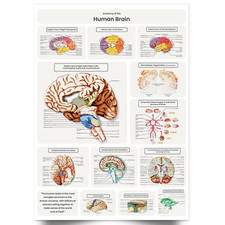
Example marketplace items related to this page. Use the search link to explore similar finds on eBay.


Endnotes
1.
Source: Wikipedia
Title: Ten-percent-of-the-brain myth
Link:https://en.wikipedia.org/wiki/Ten-percent-of-the-brain_myth
2.
Source: pmc.ncbi.nlm.nih.gov
Title: PMCMapping human brain lesions and their functional
Link:https://pmc.ncbi.nlm.nih.gov/articles/PMC5777219/
Source snippet
NIHby HO Karnath 2017 Cited by 229 Neuroscience has a long history of inferring brain function by examining the relationship...
3.
Source: pmc.ncbi.nlm.nih.gov
Title: PMCLesion studies in contemporary neuroscience
Link:https://pmc.ncbi.nlm.nih.gov/articles/PMC6712987/
Source snippet
NIHby AR Vaidya 2019 Cited by 260 Studies on the effects of permanent lesions provide vital data about brain function that ar...
4.
Source: academic.oup.com
Link:https://academic.oup.com/brain/article/146/8/3146/7114971
Source snippet
OUP Academicreturn of the lesion for localization and therapy | Brainby J Joutsa 2023 Cited by 35 Lesions have recently begun to ma...
5.
Source: oecs.mit.edu
Link:https://oecs.mit.edu/pub/3bgjh908
Source snippet
Open Encyclopedia of Cognitive ScienceNeuroscience of Languageby G Hartwigsen 2024 Cited by 1 Brain lesions such as stroke can seve...
6.
Source: pmc.ncbi.nlm.nih.gov
Link:https://pmc.ncbi.nlm.nih.gov/articles/PMC10999251/
Source snippet
functional localization of language regions in the brainby JJ Lee 2023 Cited by 8 The brain's language network can be localized jus...
7.
Source: britannica.com
Link:https://www.britannica.com/story/do-we-really-use-only-10-percent-of-our-brain
Source snippet
Encyclopedia BritannicaDo We Really Use Only 10 Percent of Our Brain?The data clearly shows that large areas of the brainfar more than 1...
8.
Source: mcgovern.mit.edu
Title: do we use only 10 percent of our brain
Link:https://mcgovern.mit.edu/2024/01/26/do-we-use-only-10-percent-of-our-brain/
Source snippet
Do we only use 10 percent of our brain?26 Jan 2024 The idea that we use 10 percent of our brain is 100 percent a myth. In fact, scienti...
9.
Source: frontiersin.org
Link:https://www.frontiersin.org/journals/human-neuroscience/articles/10.3389/fnhum.2010.00174/full
Source snippet
The Lesioned Brain: Still a Small-World?by L Douw 2010 Cited by 32 The intra-arterial amobarbital procedure (IAP or Wada test) is u...
10.
Source: scientificamerican.com
Title: do people only use 10 percent of their brains
Link:https://www.scientificamerican.com/article/do-people-only-use-10-percent-of-their-brains/
Source snippet
Scientific AmericanDo People Only Use 10 Percent of Their Brains?7 Feb 2008 Another mystery hidden within our crinkled cortices is that...
11.
Source: scientificamerican.com
Link:https://www.scientificamerican.com/article/you-use-only-10andpercnt-of-your-br/
Source snippet
You use only 10% of your brainBrain scans show that at times some areas are more active than others, but no region in a healthy brain is...
12.
Source: my.clevelandclinic.org
Link:https://my.clevelandclinic.org/health/symptoms/17839-brain-lesions
Source snippet
Cleveland ClinicBrain Lesions: What They Are, Causes, Symptoms &...16 Nov 2022 Brain lesions are areas of brain tissue that show damag...
13.
Source: scientificamerican.com
Title: do we really use only 10
Link:https://www.scientificamerican.com/article/do-we-really-use-only-10/
Source snippet
percent of our brains?8 Mar 2004 The 10-percent myth has undoubtedly motivated many people to strive for greater creativity and product...
14.
Source: scientificamerican.com
Title: 5 common myths about the brain
Link:https://www.scientificamerican.com/article/5-common-myths-about-the-brain/
Source snippet
1 Jan 2015 MYTH HUMANS USE ONLY 10 PERCENT OF THEIR BRAIN FACT The 10 percent... use both hemispheres of the brain for all cognitive f...
15.
Source: facebook.com
Title: Do we only use 10 percent of our brain?
Link:https://www.facebook.com/carletonuniversity/posts/do-we-only-use-10-percent-of-our-brain-neuroscience-expert-professor-kim-hellema/1042717867889471/
Source snippet
of Americans believe they're only using 10% of their brain capacity based on a myth that neuroimaging disproved...
Additional References
16.
Source: nm.org
Link:https://www.nm.org/healthbeat/healthy-tips/ten-surprising-facts-about-your-brain
Source snippet
10 Surprising Facts About Your BrainMyth No. 1: You only use 10 percent of your brain. The truth is Neurologists agree that the brain is...
17.
Source: fondazione-mariani.org
Link:https://www.fondazione-mariani.org/pubblicazione/brain-lesion-localization-and-developmental-functions/
Source snippet
Brain lesion localization and developmental functionsThis volume discusses the consequences of early brain injury to many parts of the br...
18.
Source: news-medical.net
Link:https://www.news-medical.net/news/20181029/Study-investigates-how-brain-lesion-affects-childs-language-localization-and-abilities.aspx
Source snippet
Study investigates how brain lesion affects child's...29 Oct 2018 Children with brain injuries are able to reorganize their language r...
19.
Source: apertureneuro.org
Link:https://apertureneuro.org/article/128149-consensus-recommendations-for-clinical-functional-mri-applied-to-language-mapping
Source snippet
Consensus recommendations for clinical functional MRI...by NL Voets 2025 Cited by 8 Ample reports highlight fMRI's added value to...
20.
Source: educationalneuroscience.org.uk
Link:https://www.educationalneuroscience.org.uk/resources/neuromyth-or-neurofact/we-only-use-10-of-our-brains/
Source snippet
In a recent survey, 43-59% of teachers from around the world reported that they thought this...
21.
Source: youtube.com
Link:https://www.youtube.com/watch?v=VwrdPEdJv9g
Source snippet
The Ten Percent Brain MythHave you heard that we only use 10% of our brains? It's a myth! We use 100% of our brains, and they're active e...
22.
Source: medicalnewstoday.com
Link:https://www.medicalnewstoday.com/articles/321060
Source snippet
fMRI scans show that even simple activities require almost all of the brain to be active...Read more...
23.
Source: educationalneuroscience.org.uk
Link:https://educationalneuroscience.org.uk/wordpress/resources/neuromyth-or-neurofact/we-only-use-10-of-our-brains/
Source snippet
The advent of functional magnetic...Read more...
24.
Source: quizlet.com
Link:https://quizlet.com/gb/687959749/we-only-use-10-of-our-brains-myth-flash-cards/
Source snippet
this would kill us life expectancy with this is only 9 months.Read more...
25.
Source: bps.org.uk
Title: great myths brain we only use 10 cent
Link:https://www.bps.org.uk/psychologist/great-myths-brain-we-only-use-10-cent
Source snippet
Great myths of the brain: We only use 10 per cent1 Dec 2014 Other evidence that refutes the 10 percent myth comes from studies of brain...
Topic Tree