Within Timing
Why do repeated myths start feeling true?
Familiarity can make a myth feel credible even when people no longer remember where it came from.
On this page
- How repetition changes perceived plausibility
- Why source memory fades faster than the claim
- How early correction can interrupt familiarity
Page outline Jump by section
Introduction
A myth does not have to become more convincing because new evidence appears. Often, it becomes more convincing because people encounter it repeatedly. Psychologists call this the illusory truth effect: repeated exposure makes a statement feel more familiar, and that familiarity can be mistaken for accuracy. As a result, even claims that are false, implausible, or previously recognised as incorrect can begin to seem true simply because they are encountered again and again.[Wikipedia]WikipediaIllusory truth effectIllusory truth effect PubMed This mechanism is especially important when thinking about the timing of myth correction. Viral misinformation gains an advantage every time[pubmed.ncbi.nlm.nih.gov]pubmed.ncbi.nlm.nih.govThe illusory truth effect: A review of how repetition…by J Udry · 2024 · Cited by 131 — Repetition even increases belief in clai… it is shared, quoted, reposted, or repeated in conversation. By the time a correction arrives, the false claim may already feel familiar and therefore more plausible than it did when people first encountered it. Understanding why this happens helps explain why early, effective correction matters.
How repetition changes perceived plausibility
The key mechanism is not that people consciously decide a repeated statement must be true. Instead, repetition makes information easier for the brain to process. Psychologists refer to this as processing fluency. When a statement feels easy to recognise and understand, people often use that feeling as a shortcut when judging whether it is accurate.[Journal of Cognition]journalofcognition.orgJournal of CognitionA Longitudinal Study of the Illusory Truth Effectby EL Henderson · 2021 · Cited by 85 — When judging truth or accurac… ScienceDirect This shortcut usually works reasonably well in everyday life. True information is often encountered multiple times[sciencedirect.com]sciencedirect.comThe illusory truth effect requires semantic coherence…by J Udry · 2023 · Cited by 14 — Repeated exposure to information increases its'…, so familiarity can be a useful signal. The problem is that false information can exploit the same mental process. Repetition increases familiarity regardless of whether the claim is correct.
Research has repeatedly found that:[pmc.ncbi.nlm.nih.gov]pmc.ncbi.nlm.nih.govPMCThe role of discomfort in the continued influence effectby MW Susmann · 2021 · Cited by 90 — Research examining the continued influence effect (CIE) of misinformation has reliably found that…
- Repeated statements are judged as more truthful than new statements.
- The effect appears across different kinds of information, including trivia, news headlines, and misinformation.
- Repetition can increase belief even when a claim conflicts with prior knowledge.
- The effect is often strongest when people are uncertain about the topic and lack a firm factual reference point.[PubMed]pubmed.ncbi.nlm.nih.govThe illusory truth effect: A review of how repetition…by J Udry · 2024 · Cited by 131 — Repetition even increases belief in clai… 3Springer 3PubMed(#endnote-16 “Snippet: PubMedThe illusory truth[Wikipedia]WikipediaIllusory truth effectIllusory truth effect effect: A review of how repetition…by J Udry · 2024 · Cited by 131 — Repetition even increases belief in clai”)
The result is a subtle shift in perceived plausibility. A person may not fully believe a myth, but repeated exposure can move it from “obviously false” to “possibly true” or from “unlikely” to “worth considering”. That shift can be enough to influence discussion, voting, health decisions, or online sharing behaviour.[ScienceDirect]sciencedirect.comThe illusory truth effect requires semantic coherence…by J Udry · 2023 · Cited by 14 — Repeated exposure to information increases its'…
Familiarity is often mistaken for evidence
One reason repetition is powerful is that people rarely experience familiarity as a separate feeling. Instead, the feeling is often attributed to the claim itself.
When someone thinks, “I have heard this before,” the brain may unconsciously translate that sensation into “there must be something to it.” Research on the illusory truth effect shows that repeated claims gain what one review described as an illusion of evidential weight, despite the fact that repetition provides no new evidence at all.[Journal of Cognition]journalofcognition.orgJournal of CognitionA Longitudinal Study of the Illusory Truth Effectby EL Henderson · 2021 · Cited by 85 — When judging truth or accurac…
This helps explain why myths can persist even after they have been publicly challenged. Every repetition strengthens familiarity, while the underlying evidence remains unchanged.
Why source memory fades faster than the claim
A second reason repeated myths feel true is that people often remember the claim longer than they remember where it came from.
Human memory does not store every piece of information together with a durable record of its source. Over time, details about context, attribution, and credibility can fade, while the central statement remains accessible. Psychologists sometimes describe this as a source-monitoring problem: people remember the content but lose track of how they learned it.[PMC]pmc.ncbi.nlm.nih.govThis finding is known as the illusory truth effect.Read more…
This creates a particularly favourable environment for misinformation. A person may initially encounter a false claim in a dubious social media post and recognise it as questionable. Weeks later, they may remember the claim itself but forget that it came from an unreliable source.
Research on misinformation correction has found that people can continue relying on false information even after learning that it has been retracted. This persistence is known as the continued influence effect. Once misinformation becomes integrated into memory or helps explain an event, it can continue shaping reasoning despite correction.[PMC]pmc.ncbi.nlm.nih.govPMCMisinformation and the Sins of Memory: False-Beliefby EJ Newman · 2022 · Cited by 23 — The Continued Influence of Misinformation and Implications for Corrections. Once people have forme…[PMC]pmc.ncbi.nlm.nih.govPMCThe role of discomfort in the continued influence effectby MW Susmann · 2021 · Cited by 90 — Research examining the continued influence effect (CIE) of misinformation has reliably found that…
Recent work has also shown that belief can drift back towards the original misinformation over time when memory for the correction weakens. In other words, people often forget the correction before they forget the claim.[PMC]pmc.ncbi.nlm.nih.govPMCCan you believe it?An investigation into the impact of… - PMCby UKH Ecker · 2021 · Cited by 211 — The continued influence effect refers to the finding th…

Why viral environments make the problem worse
Online platforms frequently expose users to the same idea through multiple routes:
- Original posts.
- Reposts and shares.
- Screenshots.
- Commentary and reactions.
- Debunks that repeat the original claim.
Each encounter increases familiarity. Later, people may remember seeing the claim many times without remembering which encounters endorsed it, criticised it, or disproved it.
This helps explain why widespread circulation alone can increase the apparent credibility of a myth. Familiarity accumulates even when agreement does not.
How early correction can interrupt familiarity
Because familiarity grows through exposure, timing matters. A correction delivered before a myth becomes widely familiar has a different task from a correction delivered after millions of exposures.
Early correction can interrupt the familiarity-building process in several ways:
- It prevents the false claim from becoming the only explanation people encounter.
- It gives audiences an alternative interpretation before the myth becomes entrenched.
- It allows accurate information to gain familiarity alongside, or instead of, the false claim.
- It reduces the chance that people will later remember only the myth and forget the correction.[PubMed]pubmed.ncbi.nlm.nih.govThe illusory truth effect: A review of how repetition…by J Udry · 2024 · Cited by 131 — Repetition even increases belief in clai…[Sage Journals]journals.sagepub.comSage JournalsMisinformation and Its Correction: Continued Influence and…by S Lewandowsky · 2012 · Cited by 4713 — Sources of the conti…
Research on misinformation correction increasingly suggests that communicators should focus on making accurate information memorable and repeatable, rather than merely repeating the myth while attempting to refute it. Studies of repetition effects show that familiarity benefits whichever message is encountered most often.[ScienceDirect]sciencedirect.comThe illusory truth effect requires semantic coherence…by J Udry · 2023 · Cited by 14 — Repeated exposure to information increases its'…
A useful implication is that myth correction is not simply about producing a fact-check once. It is also about ensuring that the accurate explanation is repeated enough to become familiar in its own right.
A simple way to think about the mechanism
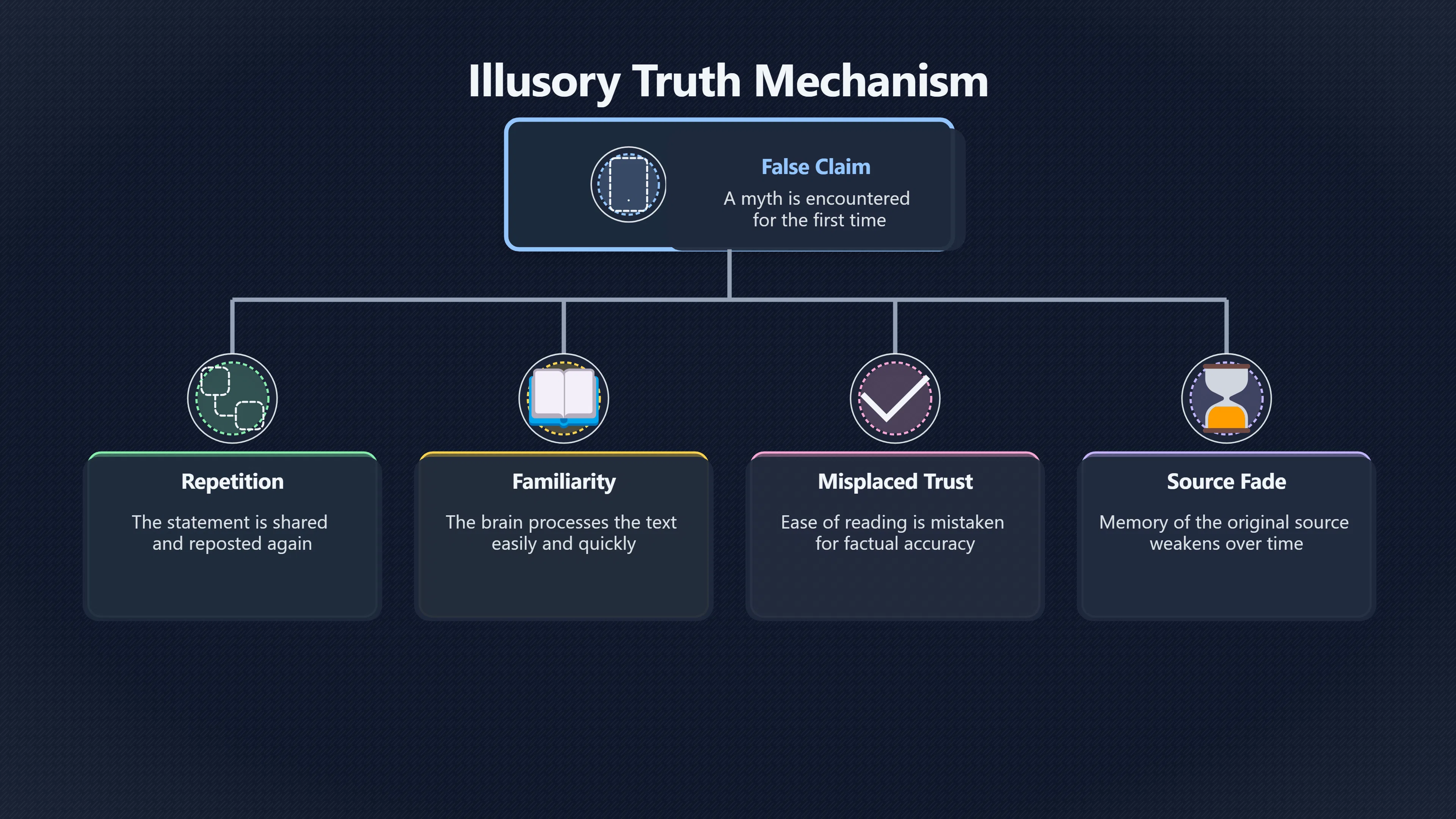
The power of repeated myths comes from a sequence that is deceptively simple:
- A false claim is encountered.
- Repetition increases familiarity.[sciencedirect.com]sciencedirect.comThe illusory truth effect: A review of how repetition…by J Udry · 2024 · Cited by 103 — Repetition increases belief in in…
- Familiarity makes the claim easier to process.
- Ease of processing is unconsciously interpreted as plausibility.
- Memory for the source weakens over time.
- The claim remains familiar even after its origins are forgotten.
This chain helps explain why many persistent misconceptions survive long after their evidence has been discredited. Familiarity is not proof, but the human mind often treats it as a clue. In fast-moving information environments, that tendency gives repeated myths an advantage unless accurate information arrives early and is repeated often enough to compete. PMC[Wikipedia]WikipediaIllusory truth effectIllusory truth effect[PubMed]pubmed.ncbi.nlm.nih.govThe illusory truth effect: A review of how repetition…by J Udry · 2024 · Cited by 131 — Repetition even increases belief in clai…
Amazon book picks
Further Reading
Books and field guides related to Why do repeated myths start feeling true?. Use these as the next step if you want deeper reading beyond the article.
The Psychology of Fake News
Directly relevant to repetition, familiarity and belief formation.
Thinking, Fast and Slow
Provides foundational insight into cognitive shortcuts behind illusory truth effects.

eBay marketplace picks
Marketplace Samples
Example marketplace items related to this page. Use the search link to explore similar finds on eBay.



Endnotes
1.
Source: Wikipedia
Title: Illusory truth effect
Link:https://en.wikipedia.org/wiki/Illusory_truth_effect
2.
Source: pmc.ncbi.nlm.nih.gov
Link:https://pmc.ncbi.nlm.nih.gov/articles/PMC8116821/
Source snippet
This finding is known as the illusory truth effect.Read more...
3.
Source: sciencedirect.com
Link:https://www.sciencedirect.com/science/article/abs/pii/S001002772300241X
Source snippet
The illusory truth effect requires semantic coherence...by J Udry · 2023 · Cited by 14 — Repeated exposure to information increases its'...
4.
Source: sciencedirect.com
Link:https://www.sciencedirect.com/science/article/abs/pii/S2352250X23001811
Source snippet
The illusory truth effect: A review of how repetition...by J Udry · 2024 · Cited by 103 — Repetition increases belief in in...
5.
Source: link.springer.com
Link:https://link.springer.com/article/10.3758/s13423-019-01651-4
Source snippet
The observed illusory truth effect is largest for ambiguous items.Read more...
6.
Source: sciencedirect.com
Link:https://www.sciencedirect.com/science/article/pii/S0010027723000550
Source snippet
The illusory truth effect leads to the spread of misinformationby V Vellani · 2023 · Cited by 116 — Repetition of misinforma...
7.
Source: pmc.ncbi.nlm.nih.gov
Title: PMCMisinformation and the Sins of Memory: False-Belief
Link:https://pmc.ncbi.nlm.nih.gov/articles/PMC10284569/
Source snippet
by EJ Newman · 2022 · Cited by 23 — The Continued Influence of Misinformation and Implications for [Corrections]({{ 'corrections/' | relative_url }}). Once people have forme...
8.
Source: pmc.ncbi.nlm.nih.gov
Title: PMCThe role of discomfort in the continued influence effect
Link:https://pmc.ncbi.nlm.nih.gov/articles/PMC8447889/
Source snippet
by MW Susmann · 2021 · Cited by 90 — Research examining the continued influence effect (CIE) of misinformation has reliably found that...
9.
Source: pmc.ncbi.nlm.nih.gov
Title: PMCCan you believe it?
Link:https://pmc.ncbi.nlm.nih.gov/articles/PMC7810102/
Source snippet
An investigation into the impact of... - PMCby UKH Ecker · 2021 · Cited by 211 — The continued influence effect refers to the finding th...
10.
Source: pmc.ncbi.nlm.nih.gov
Link:https://pmc.ncbi.nlm.nih.gov/articles/PMC10710738/
Source snippet
Memory failure predicts belief regression after the correction of...by B Swire-Thompson · 2022 · Cited by 54 — The current study aime...
11.
Source: sciencedirect.com
Title: ScienceDirect Familiarity backfire effects?
Link:https://www.sciencedirect.com/science/article/pii/S0167811626000261
Source snippet
Disentangling the competing...by IN Nibat · 2026 — Repetition reliably increases belief in misinformation (illusory truth effect), while...
12.
Source: sciencedirect.com
Link:https://www.sciencedirect.com/science/article/pii/S0010027724002865
Source snippet
Relative source credibility affects the continued influence...by CV Hey · 2025 · Cited by 6 — Only when post-event misinformation came f...
13.
Source: sciencedirect.com
Link:https://www.sciencedirect.com/science/article/pii/S0010027724000775
Source snippet
This truth effect has been widely researched and is relevant for topics...R...
14.
Source: link.springer.com
Link:https://link.springer.com/article/10.1186/s41235-021-00335-9
Source snippet
factors that mitigate the continued influence of...by IP Kan · 2021 · Cited by 27 — Researchers have found that individuals' beliefs, pe...
15.
Source: link.springer.com
Link:https://link.springer.com/article/10.1186/s41235-021-00301-5
Source snippet
effects of repetition frequency on the illusory truth effectby A Hassan · 2021 · Cited by 375 — This finding is known as the illusory tru...
16.
Source: pubmed.ncbi.nlm.nih.gov
Link:https://pubmed.ncbi.nlm.nih.gov/38113667/
Source snippet
The illusory truth effect: A review of how repetition...by J Udry · 2024 · Cited by 131 — Repetition even increases belief in clai...
17.
Source: journalofcognition.org
Link:https://journalofcognition.org/articles/10.5334/joc.161
Source snippet
Journal of CognitionA Longitudinal Study of the Illusory Truth Effectby EL Henderson · 2021 · Cited by 85 — When judging truth or accurac...
18.
Source: pubmed.ncbi.nlm.nih.gov
Link:https://pubmed.ncbi.nlm.nih.gov/31420808/
Source snippet
The observed illusory truth effect is largest for ambiguous items.Read more...
19.
Source: pubmed.ncbi.nlm.nih.gov
Link:https://pubmed.ncbi.nlm.nih.gov/26173286/
Source snippet
Misinformation and Its Correction: Continued Influence and...by S Lewandowsky · 2012 · Cited by 4713 — We first examine the mechan...
20.
Source: journals.sagepub.com
Link:https://journals.sagepub.com/doi/abs/10.1177/1529100612451018
Source snippet
Sage JournalsMisinformation and Its Correction: Continued Influence and...by S Lewandowsky · 2012 · Cited by 4713 — Sources of the conti...
21.
Source: dictionary.cambridge.org
Link:https://dictionary.cambridge.org/dictionary/english-chinese-traditional/illusory
Source snippet
of illusory – English–Traditional Chinese dictionaryILLUSORY translate: 虛假的,幻覺的,不實際的. Learn more in the Cambridge English-Chinese traditi...
22.
Source: pmc.ncbi.nlm.nih.gov
Link:https://pmc.ncbi.nlm.nih.gov/articles/PMC8715407/
Source snippet
by B Swire-Thompson · 2021 · Cited by 79 — The current paper investigated how altering the format of corrections influences people's s...
23.
Source: pmc.ncbi.nlm.nih.gov
Link:https://pmc.ncbi.nlm.nih.gov/articles/PMC11549669/
Source snippet
by G Chen · 2024 · Cited by 2 — The continued influence effect (CIE) of misinformation refers to the persistence of misinformation's i...
24.
Source: pmc.ncbi.nlm.nih.gov
Link:https://pmc.ncbi.nlm.nih.gov/articles/PMC11750381/
Source snippet
implications: incidental exposure to ideas can induce...by J Mikell · 2025 · Cited by 1 — Under many accounts of the illusory truth effe...
25.
Source: pmc.ncbi.nlm.nih.gov
Link:https://pmc.ncbi.nlm.nih.gov/articles/PMC10204694/
Source snippet
could increase the perceived truth of conspiracy...by J Béna · 2023 · Cited by 31 — We found that repetition increased truth judgments o...
26.
Source: pubmed.ncbi.nlm.nih.gov
Link:https://pubmed.ncbi.nlm.nih.gov/32857670/
Source snippet
Effect of Repetition on Truth Judgments Across...by LK Fazio · 2020 · Cited by 82 — According to numerous research studies, when adults...
27.
Source: pmc.ncbi.nlm.nih.gov
Link:https://pmc.ncbi.nlm.nih.gov/articles/PMC12779699/
Source snippet
repetition increase perceived truth equally for... - PMCby SM Bowes · 2026 — Repetition increases the perceived truth of information. Th...
28.
Source: pubmed.ncbi.nlm.nih.gov
Link:https://pubmed.ncbi.nlm.nih.gov/41501536/
Source snippet
repetition increase perceived truth equally for...by SM Bowes · 2026 — Repetition increases the perceived truth of information. This ill...
29.
Source: ebsco.com
Link:https://www.ebsco.com/research-starters/psychology/illusory-truth-effect
Source snippet
Illusory truth effect | Psychology | Research StartersThe illusory truth effect is a cognitive phenomenon where repeated exposure to fals...
30.
Source: thedecisionlab.com
Title: Illusory truth effect
Link:https://thedecisionlab.com/biases/illusory-truth-effect
Source snippet
The Decision...Illusory Truth Effect is the positive feeling when we hear information that we believe to be true because we've heard the...
31.
Source: brodhub.eu
Title: Illusory Truth Effect
Link:https://brodhub.eu/en/media-literacy/illusory-truth-effect/
Source snippet
BRODNov 16, 2023 — The illusory truth effect is a cognitive bias wherein repetition increases the perceived truthfulness of a statement...
32.
Source: youtube.com
Title: The Continued Influence Effect
Link:https://www.youtube.com/watch?v=eZ_hcf01EFw
Source snippet
Why do memories of...The continued influence effect is when misinformation continues to exist in a person's memory even after they've le...
33.
Source: cogbias.site
Title: Continued influence effect
Link:https://cogbias.site/biases/continued-influence-effect/
Source snippet
Cognitive Bias - CogBiasMisinformation-correction research shows that people may continue using a false causal explanation after a correc...
Additional References
34.
Source: facebook.com
Link:https://www.facebook.com/AmericanPsychologicalAssociation/posts/you-keep-seeing-the-same-claim-made-over-and-over-onlineso-it-must-be-true-right/1290086699819665/
Source snippet
American Psychological AssociationThat's the Illusory Truth Effect at work—a powerful psychological bias where repeated information start...
35.
Source: merriam-webster.com
Link:https://www.merriam-webster.com/dictionary/repetition
Source snippet
REPETITION Definition & Meaning4 days ago — 1. a: the act or an instance of repeating or being repeated b: a motion or exercise (such a...
36.
Source: fs.blog
Link:https://fs.blog/illusory-truth-effect/
Source snippet
The Illusory Truth EffectWhen a “fact” tastes good and is repeated enough, we tend to believe it, no matter how false it may be. Understa...
37.
Source: scispace.com
Link:https://scispace.com/pdf/the-continued-influence-of-misinformation-in-memory-what-4tijzg1jh2.pdf
Source snippet
The continued influence of misinformation in memoryYet despite these factors, the misinformation continues to influence later judgments a...
38.
Source: news.vanderbilt.edu
Link:https://news.vanderbilt.edu/2020/10/06/study-shows-that-repeated-statements-are-more-often-judged-to-be-true-regardless-of-a-persons-age-or-prior-knowledge/
Source snippet
shows that repeated statements are more often...Oct 6, 2020 — When adults hear a statement repeated twice, they are more likely to think...
39.
Source: leadalchemists.com
Link:https://www.leadalchemists.com/marketing-psychology/illusory-truth-effect/
40.
Source: psychologytoday.com
Link:https://www.psychologytoday.com/gb/basics/illusory-truth-effect
41.
Source: par.nsf.gov
Link:https://par.nsf.gov/servlets/purl/10190136
Source snippet
Truthby NM Brashier · 2020 · Cited by 182 — This illusory truth effect occurs for product claims (e.g., Crest toothpaste removes caffeine...
42.
Source: nature.com
Title: continued influence effect of misinformation. Memory Cogn.Read more
Link:https://www.nature.com/articles/s44159-021-00006-y
Source snippet
The psychological drivers of misinformation belief and its...by UKH Ecker · 2022 · Cited by 1916 — Misinformation and its correction: co...
43.
Source: semanticscholar.org
Link:https://www.semanticscholar.org/paper/eecaab5c243b7c759f9a815cf4814b28ce7579b2
Source snippet
This illusory truth effect occurs with many different types of statements (e.g., trivia facts...
Topic Tree