Within Anecdotes
How to respect stories without overclaiming
Anecdotes are useful as signals, examples and questions, but they become misleading when used to settle general claims.
On this page
- What personal experience can legitimately show
- Questions that move a story toward evidence
- How to correct without dismissing the person
Page outline Jump by section
Introduction
Personal stories are often at the centre of myths and misconceptions because they are memorable, emotionally compelling and usually true in at least one important sense: they describe something that genuinely happened to someone. The mistake is not listening to such stories. The mistake is asking them to prove more than they can support.
 A personal experience can show what one person observed, felt or encountered. It can raise questions, reveal possibilities, highlight harms that deserve investigation, or illustrate what a broader pattern looks like in real life. What it cannot usually do on its own is establish how common something is, whether one factor caused another, or what will happen in most cases. Research consistently finds that anecdotes can strongly influence beliefs and decisions, particularly on health and risk-related topics, even when broader statistical evidence points in a different direction.[IDEAS]ideas.repec.orgIDEAS/Re PEc When poignant stories outweigh cold hard facts: A metaIDEAS/RePEcWhen poignant stories outweigh cold hard facts: A meta…February 2, 2020 — by TH Freling · 2020 · Cited by 113 — The objecti…[RePEc]ideas.repec.orgIDEAS/Re PEc When poignant stories outweigh cold hard facts: A metaIDEAS/RePEcWhen poignant stories outweigh cold hard facts: A meta…February 2, 2020 — by TH Freling · 2020 · Cited by 113 — The objecti…
Respecting stories without overclaiming means giving lived experience the evidential role it deserves rather than treating it as either infallible proof or something to be ignored.
What personal experience can legitimately show
A personal story is strongest when it is used to answer questions about an individual experience rather than population-wide claims.
For example, a person can reliably report:
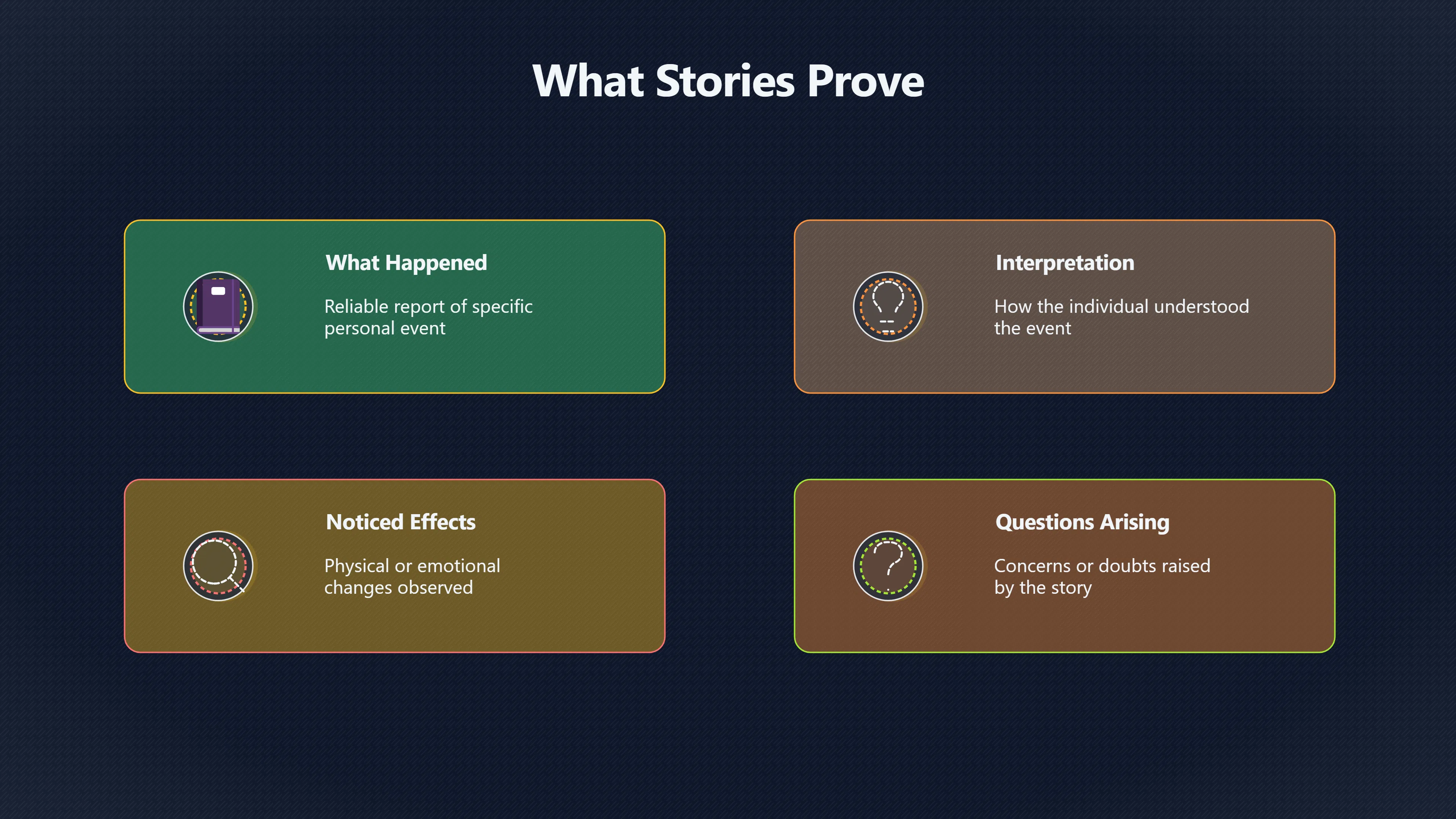
- What happened to them.
- How they interpreted the event.
- What effects they noticed.
- What concerns or questions arose from the experience.
- Why the experience mattered to them.
If someone says, “This treatment helped me,” that is evidence about their experience. If they say, “Therefore the treatment works for everyone,” they have moved beyond what their experience alone can establish.
This distinction matters because individual outcomes are shaped by many factors: chance, timing, background conditions, expectations, other interventions and ordinary variation. A single experience rarely provides enough information to separate these influences. That is why researchers rely on larger samples, comparison groups and systematic observation when trying to determine what generally works or what usually happens.
The value of a story often lies in its ability to humanise a question rather than settle it. A patient account may reveal a side effect that deserves investigation. A worker’s account may expose a safety problem. A family’s experience may highlight a gap in public services. In these cases, the story functions as a signal rather than a verdict.
Questions that move a story toward evidence
A useful way to avoid overclaiming is to ask what additional information would be needed before turning a personal account into a broader conclusion.
When hearing a story, several questions help clarify its evidential weight.
Is this a common outcome or a rare one?
One person experiencing an outcome does not reveal how frequently it occurs.
Suppose a friend says a particular diet transformed their health. The important next question is not whether the transformation happened, but whether similar results occur consistently across many people. Without that wider context, it is impossible to know whether the experience represents a typical outcome or an exception.
What is the comparison?
Many misconceptions arise because people compare “after” with “before” but never compare against an alternative explanation.
If symptoms improve after a treatment, the treatment may deserve credit. But symptoms might also have improved because of natural recovery, lifestyle changes, measurement error or random fluctuation. Establishing causation requires comparing outcomes against what would likely have happened otherwise.
The same principle appears in public-health surveillance systems. For example, the US Vaccine Adverse Event Reporting System collects reports of health events that occur after vaccination, but official guidance repeatedly notes that reports alone cannot establish causation. Such reports are used as signals that require further investigation rather than proof that a vaccine caused a reported event.[CDC]cdc.govAbout the Vaccine Adverse Event Reporting System (VAERS)7 Aug 2024 — A VAERS report alone does not indicate whether a vaccine caused o…[VAERS]vaers.hhs.govData - HHS.gov8 May 2025 — While very important in monitoring vaccine safety, VAERS reports alone cannot be used to determine if a vaccin…
Are there other stories pointing in different directions?
People often encounter only the stories that support their existing beliefs.
A person who joins an online group dedicated to a treatment, investment strategy or lifestyle choice may be exposed mainly to success stories. Yet unseen failures may be equally common or even more common. Looking for contrasting experiences helps reveal whether a narrative is broadly representative or selectively visible.
Does systematic evidence agree?
Personal stories and systematic evidence should not be treated as enemies. The key question is whether they point in the same direction.
When a large body of evidence supports what many individuals report, the anecdote becomes a useful illustration of a broader finding. When individual stories and broader evidence diverge, the discrepancy becomes something to investigate rather than a reason to discard one side automatically.

Why stories remain important even when they are not proof
A common misconception is that because anecdotes cannot settle general claims, they have little value. In practice, many important discoveries begin with observations from individuals.
Patients report unexpected symptoms. Consumers describe unusual product failures. Citizens draw attention to emerging problems. Researchers often use such observations as starting points for more rigorous investigation.
Stories can contribute in at least three important ways.
First, they help identify questions worth studying. A recurring pattern in personal reports may point researchers toward a genuine phenomenon that deserves systematic examination.
Second, they reveal dimensions of experience that statistics alone may miss. Numbers can show that a treatment changes a symptom score. Personal accounts can show what that change feels like in everyday life.
Third, stories make abstract evidence understandable. A statistical trend may tell us that a problem exists, but a personal account helps explain what the trend means for real people.
Some medical scholars have argued that narratives remain valuable precisely because they capture aspects of illness, recovery and quality of life that standard measurements may overlook. The challenge is not replacing evidence with stories, but integrating the two appropriately.[PLOS]journals.plos.orgPLOS“Anecdotal Evidence”: Why Narratives Matter to Medical Practiceby R Campo · 2006 · Cited by 31 — The anecdote is rife with such diffi…
How to correct without dismissing the person
People often become defensive when their experiences are treated as irrelevant. Effective correction focuses on the claim rather than attacking the storyteller.
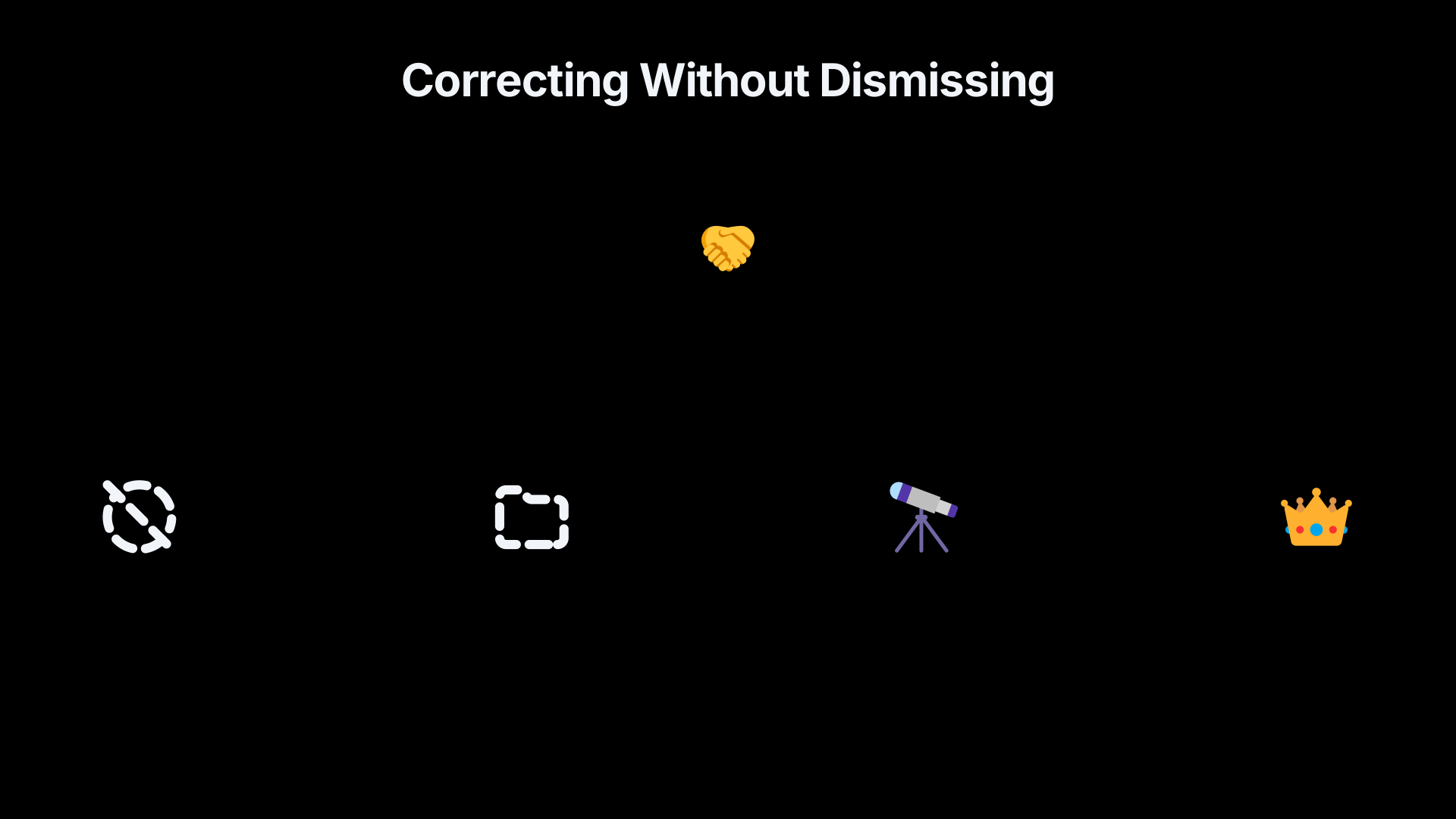
A helpful response usually follows three steps.
Acknowledge the experience.
Recognise that the event may have been significant, frightening, beneficial or memorable. Doing so respects the person without automatically endorsing their conclusion.
Separate the experience from the generalisation.
Statements such as “I believe that happened” and “I am not sure it tells us what usually happens” can coexist. The first addresses the story; the second addresses the broader claim.
Expand the evidence base.
Instead of arguing over whether the anecdote is true, introduce additional evidence that helps answer the larger question. The goal is to widen the frame rather than invalidate the person’s experience.
Consider the difference between these responses:
- “That story means nothing.”
- “That sounds like a real experience. The question is whether it represents a common pattern or an unusual case.”
The second response preserves dignity while encouraging better reasoning.
A practical rule for using stories responsibly
A useful rule of thumb is to match the strength of the claim to the strength of the evidence.
Personal experience can support statements such as:
- “This happened to me.”
- “This is one possible outcome.”
- “This issue deserves investigation.”
- “This example illustrates a broader pattern.”
It is usually insufficient by itself to support statements such as:
- “This always happens.”
- “This is what most people experience.”
- “This proves the cause.”[webmd.com]webmd.comVAERS and Vaccine Safety: What You Need to KnowThis is a myth. VAERS reports alone don't determine whether vaccines cause or play a role…
- “This settles the debate.”
Research on anecdotal persuasion shows why this distinction is difficult in practice. People often find vivid personal accounts more persuasive than statistical information when issues feel personally relevant or emotionally charged.[IDEAS]ideas.repec.orgIDEAS/Re PEc When poignant stories outweigh cold hard facts: A metaIDEAS/RePEcWhen poignant stories outweigh cold hard facts: A meta…February 2, 2020 — by TH Freling · 2020 · Cited by 113 — The objecti…[RePEc]ideas.repec.orgIDEAS/Re PEc When poignant stories outweigh cold hard facts: A metaIDEAS/RePEcWhen poignant stories outweigh cold hard facts: A meta…February 2, 2020 — by TH Freling · 2020 · Cited by 113 — The objecti…
The most reliable approach is therefore not to reject stories but to place them in the right evidential role. Stories can reveal possibilities, generate hypotheses, illustrate realities and remind us that data describe real people. They become misleading only when a single experience is asked to carry the weight of a general conclusion.
Amazon book picks
Further Reading
Books and field guides related to How to respect stories without overclaiming. Use these as the next step if you want deeper reading beyond the article.
Calling Bullshit
Helps readers evaluate claims and anecdotes without dismissing lived experience.
Thinking, Fast and Slow
Explains why vivid anecdotes often outweigh statistical evidence.

Scout Mindset
First published 2021. Subjects: Economics, Psychology, Cognition, Skepticism, Critical thinking.
eBay marketplace picks
Marketplace Samples
Example marketplace items related to this page. Use the search link to explore similar finds on eBay.



Endnotes
1.
Source: ideas.repec.org
Title: IDEAS/Re PEc When poignant stories outweigh cold hard facts: A meta
Link:https://ideas.repec.org/a/eee/jobhdp/v160y2020icp51-67.html
Source snippet
IDEAS/RePEcWhen poignant stories outweigh cold hard facts: A meta...February 2, 2020 — by TH Freling · 2020 · Cited by 113 — The objecti...
Published: February 2, 2020
2.
Source: cdc.gov
Link:https://www.cdc.gov/vaccine-safety-systems/vaers/index.html
Source snippet
About the Vaccine Adverse Event Reporting System (VAERS)7 Aug 2024 — A VAERS report alone does not indicate whether a vaccine caused o...
3.
Source: journals.plos.org
Link:https://journals.plos.org/plosmedicine/article?id=10.1371%2Fjournal.pmed.0030423
Source snippet
PLOS“Anecdotal Evidence”: Why Narratives Matter to Medical Practiceby R Campo · 2006 · Cited by 31 — The anecdote is rife with such diffi...
4.
Source: wonder.cdc.gov
Link:https://wonder.cdc.gov/wonder/help/vaers.html
Source snippet
Adverse Events Reporting System (VAERS) HelpWhile very important in monitoring vaccine safety, VAERS reports alone cannot be used to dete...
5.
Source: wonder.cdc.gov
Link:https://wonder.cdc.gov/vaers.html
Source snippet
Vaccine Adverse Event Reporting System (VAERS)...8 May 2025 — While very important in monitoring vaccine safety, VAERS reports alone can...
Published: May 2025
6.
Source: youtube.com
Title: Research Review: Anecdotes vs Statistics
Link:https://www.youtube.com/watch?v=VtxLQ6KEPEY
Source snippet
Anecdotal Evidence - Good or Bad?...
7.
Source: youtube.com
Title: Anecdotal Evidence
Link:https://www.youtube.com/watch?v=6DoZN6Yxn9Q
Source snippet
Data-Driven Decisions: Numbers vs. Anecdotes...
8.
Source: vaers.hhs.gov
Link:https://vaers.hhs.gov/data.html
Source snippet
Data - HHS.gov8 May 2025 — While very important in monitoring vaccine safety, VAERS reports alone cannot be used to determine if a vaccin...
Published: May 2025
9.
Source: vaers.hhs.gov
Link:https://vaers.hhs.gov/faq.html
Source snippet
FAQs - HHS.govVAERS accepts reports of adverse events following vaccination without judging the cause or seriousness of the event. VAERS...
10.
Source: pubmed.ncbi.nlm.nih.gov
Link:https://pubmed.ncbi.nlm.nih.gov/26209838/
Source snippet
monitoring in the Vaccine Adverse Event Reporting...by TT Shimabukuro · 2015 · Cited by 691 — Generally, VAERS data cannot be used to de...
11.
Source: pmc.ncbi.nlm.nih.gov
Title: VAERS data interpreted alone or out of context can lead to erroneous
Link:https://pmc.ncbi.nlm.nih.gov/articles/PMC4632204/
Source snippet
monitoring in the Vaccine Adverse Event Reporting...by TT Shimabukuro · 2015 · Cited by 699 — Generally, VAERS data cannot be used to de...
12.
Source: sciencedirect.com
Link:https://www.sciencedirect.com/science/article/abs/pii/S0264410X12014181
Source snippet
Causality assessment of adverse events reported to the...by AM Loughlin · 2012 · Cited by 46 — Generally, VAERS data cannot be used to d...
13.
Source: sciencedirect.com
Link:https://www.sciencedirect.com/science/article/abs/pii/S0264410X15009822
Source snippet
Safety monitoring in the Vaccine Adverse Event Reporting...by TT Shimabukuro · 2015 · Cited by 699 — Generally, VAERS data cannot be use...
14.
Source: publichealth.jhu.edu
Title: what vaers is and isnt
Link:https://publichealth.jhu.edu/2022/what-vaers-is-and-isnt
Source snippet
VAERS Is (And Isn't) | Johns Hopkins3 May 2022 — While VAERS cannot determine whether an adverse event was caused by a vaccination, patte...
Published: May 2022
15.
Source: Wikipedia
Title: Anecdotal evidence
Link:https://en.wikipedia.org/wiki/Anecdotal_evidence
Source snippet
Anecdotal evidenceAnecdotal evidence (or anecdata [1]) is evidence based on descriptions and reports of individual, personal experien...
16.
Source: reuters.com
Link:https://www.reuters.com/article/fact-check/vaers-and-faers-data-shown-does-not-prove-covid-19-vaccine-adverse-events-and-de-idUSL2N2OE1ZA/
Source snippet
VAERS and FAERS data shown does not prove COVID-19...2 Jul 2021 — This is missing context: both the VAERS and FAERS websites make clear...
17.
Source: fda.gov
Title: vaccine adverse event reporting system vaers questions and answers
Link:https://www.fda.gov/[vaccines
Source snippet
VAERS reports generally cannot be used to determine if a vaccine caused or contributed to an adverse event or illness. Some events may oc...
18.
Source: webmd.com
Link:https://www.webmd.com/vaccines/vaers-and-vaccine-safety
Source snippet
VAERS and Vaccine Safety: What You Need to KnowThis is a myth. VAERS reports alone don't determine whether vaccines cause or play a role...
Additional References
19.
Source: researchgate.net
Link:https://www.researchgate.net/publication/340313878_When_poignant_stories_outweigh_cold_hard_facts_A_meta-analysis_of_the_anecdotal_bias
Source snippet
A meta-analysis of the anecdotal biasHowever, we found no evidence that positive anecdotes increased outcomes more than statistical evide...
20.
Source: researchgate.net
Title: 339107956 The impact of anecdotal information on medical decision making
Link:https://www.researchgate.net/publication/339107956_The_impact_of_anecdotal_information_on_medical_decision-making
Source snippet
The impact of anecdotal information on medical decision-...8 Feb 2020 — Knowing how anecdotal evidence factors into people's decisions i...
21.
Source: youtube.com
Link:https://www.youtube.com/watch?v=75wDuKhCY7A
Source snippet
VERIFY: VAERS database alone isn't evidence that COVID...'You can't draw any conclusions by looking at VAERS,' Johns Hopkins vaccine exp...
22.
Source: consumerreports.org
Link:https://www.consumerreports.org/misinformation/government-data-misused-to-question-covid-19-vaccine-safety-a1167679946/
Source snippet
Government Data Being Misused to Question COVID-19...Oct 4, 2021 — “While very important in monitoring vaccine safety, VAERS reports alo...
23.
Source: researchgate.net
Link:https://www.researchgate.net/publication/13468757_Using_anecdotal_information_in_evidence-based_health_care_Heresy_or_necessity
Source snippet
Despite their power and influence, they are sometimes misused, and sometimes undervalued...
24.
Source: reddit.com
Link:https://www.reddit.com/r/PetPeeves/comments/18grwkz/people_who_think_anecdotal_evidence_is_more/
Source snippet
ill something worth noting (until deemed an extreme or outlier --...Read more...
25.
Source: bmjgroup.com
Link:https://bmjgroup.com/is-the-us-reporting-system-for-vaccine-safety-broken/
Source snippet
pposed to be user-friendly, responsive, and transparent.Read more...
26.
Source: pubmed.ncbi.nlm.nih.gov
Link:https://pubmed.ncbi.nlm.nih.gov/39183199/
Source snippet
impact medical decisions even when presented...by EN Line · 2024 · Cited by 9 — We found that reading anecdotes for either artificial or...
27.
Source: academia.edu
Link:https://www.academia.edu/161291478/When_poignant_stories_outweigh_cold_hard_facts_A_meta_analysis_of_the_anecdotal_bias
Source snippet
vidence is more persuasive-statistical or anecdotal information...
28.
Source: factcheck.org
Link:https://www.factcheck.org/2023/02/scicheck-posts-falsely-claim-cdc-official-admitted-covid-19-vaccines-cause-debilitating-illnesses/
Source snippet
Posts Falsely Claim CDC Official Admitted COVID-19...20 Feb 2023 — “As an early warning system, VAERS cannot prove that a vaccine caused...
Topic Tree