Within Uncertainty
When Feelings Override Evidence in News Judgments
Strong emotional reactions can make false information seem credible even when evidence is available.
On this page
- Emotional versus analytic processing
- Why false stories spread easily
- Reducing emotionally driven misinformation
Page outline Jump by section
Introduction
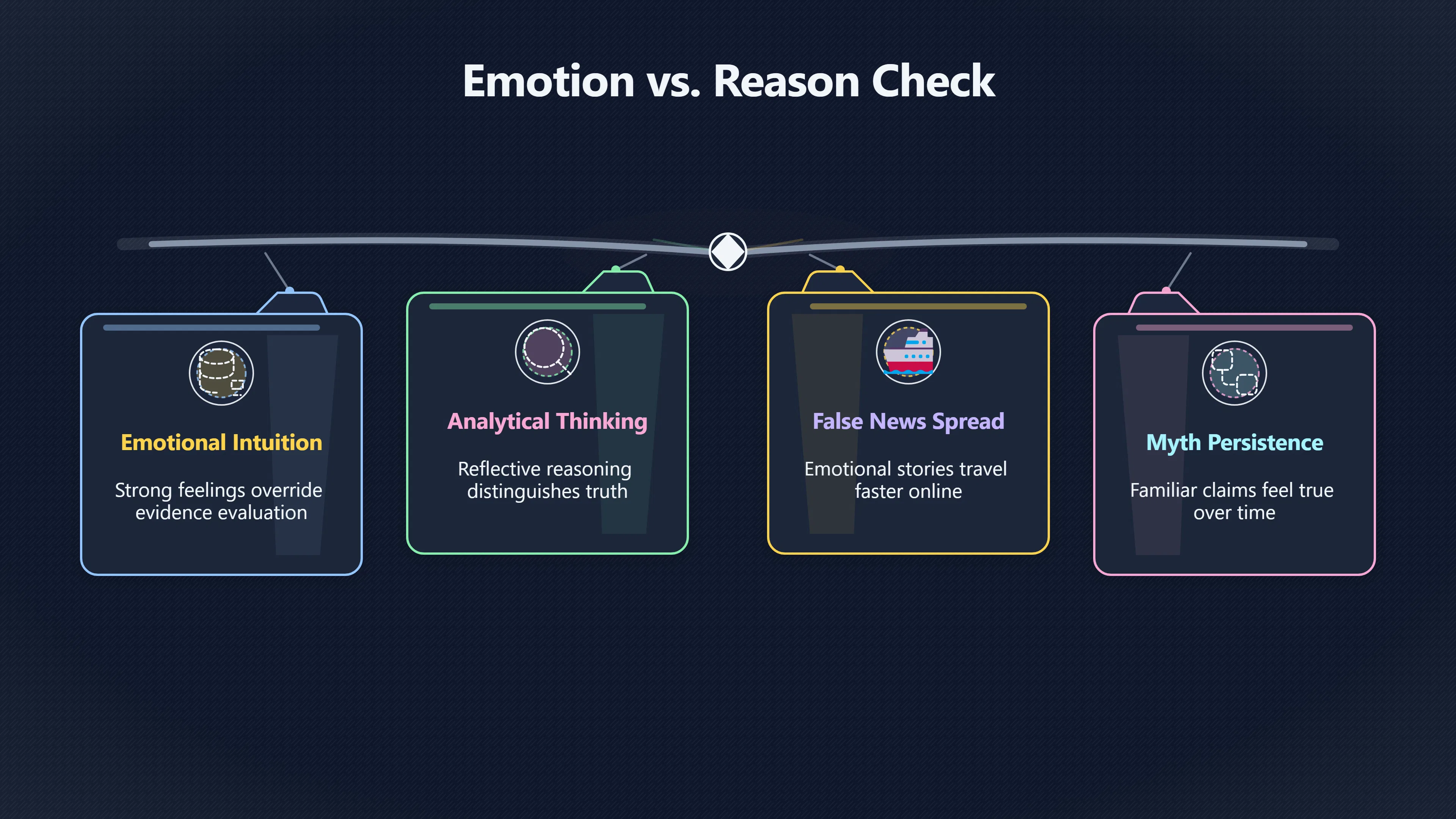
False information often succeeds not because people lack access to evidence, but because emotional reactions can shape judgement before evidence is examined. Within the broader relationship between emotion, uncertainty and myth acceptance, fake news provides a particularly clear example of how feelings can override careful evaluation. Stories that provoke fear, anger, outrage, hope or anxiety frequently feel compelling and memorable, creating a sense of truth that is not necessarily supported by facts. Research consistently shows that people who rely more heavily on emotional intuition are more likely to believe false news headlines, while those who engage in reflective, analytical thinking are better able to distinguish genuine information from misinformation.[PMC]pmc.ncbi.nlm.nih.govPMCReliance on emotion promotes belief in fake newsNIHby C Martel · 2020 · Cited by 764 — Moreover, analytic thinking is associated with lower trust in fake news sources (Pennycook a…
 The result is a powerful vulnerability in modern information environments. Emotional content attracts attention, spreads rapidly through social networks, and can make myths and misconceptions appear credible even when contradictory evidence is readily available.[MIT News]news.mit.edustudy twitter false news travels faster true stories 0308MIT NewsStudy: On Twitter, false news travels faster than true stories8 Mar 2018 — Researchers from the Media Lab and Sloan found that hu…
Emotional Versus Analytic Processing
One of the strongest findings in misinformation research is that emotional and analytical modes of thinking do not contribute equally to judging news accuracy.
A series of studies by Gordon Pennycook, David Rand and colleagues found that individuals who score higher on measures of reflective reasoning are substantially better at distinguishing true headlines from false ones. Their work challenges the idea that people mainly believe fake news because of political loyalty or motivated reasoning. Instead, susceptibility is more strongly associated with failing to engage in careful evaluation of claims.[PubMed]pubmed.ncbi.nlm.nih.govLazy, not biased: Susceptibility to partisan fake news is…by G Pennycook · 2019 · Cited by 2782 — Lazy, not biased: Susceptibili… ScienceDirect Research examining emotional reasoning reaches a complementary conclusion. In experiments involving news headlines[sciencedirect.com]sciencedirect.com•. Falling for fake news is more a result of a lack of thinking than partisanship.Read more…, participants who reported relying more on emotion when forming beliefs were significantly more likely to accept false stories as accurate. At the same time, analytical thinking predicted greater resistance to misinformation.[PMC]pmc.ncbi.nlm.nih.govtate and emotional response to misinformation and consider individuals' prior beliefs as…Read more…
This does not mean emotions are inherently irrational. Emotions provide useful signals about importance, risk and social relevance. The problem emerges when emotional responses become a substitute for evidence evaluation. A headline that triggers outrage may feel true because it aligns with an immediate emotional reaction. A frightening claim may seem credible because it activates concerns about safety. In such cases, feelings become a shortcut for determining truth.[PMC]pmc.ncbi.nlm.nih.govReliance on emotion promotes belief in fake news. Cognitive Research: Principles and Implications. 2020;5(1):47. doi…
For myths and misconceptions, this mechanism is particularly important. A false story does not need strong evidence if it produces a strong emotional impression.
Why False Stories Spread Easily
Emotion influences not only belief but also sharing behaviour.
Research on misinformation diffusion shows that false stories frequently spread faster and reach more people than true stories. One reason is that false claims are often designed to be emotionally engaging. They emphasise threat, outrage, surprise or scandal—qualities that encourage people to react immediately rather than investigate carefully.[MIT News]news.mit.edustudy twitter false news travels faster true stories 0308MIT NewsStudy: On Twitter, false news travels faster than true stories8 Mar 2018 — Researchers from the Media Lab and Sloan found that hu…
Psychological studies suggest several mechanisms behind this pattern:
- Emotional arousal encourages rapid judgement. Strong feelings reduce the likelihood that people will pause to verify a claim.[PMC]pmc.ncbi.nlm.nih.govPMCThe impact of misinformation on the COVID-19 pandemicSince the inception of the current pandemic, COVID-19 related misinformation has played a role in defaulting control of the situation.Rea…
- Novel and surprising information attracts attention. False stories often present dramatic explanations that stand out from ordinary reporting.[MIT News]news.mit.edustudy twitter false news travels faster true stories 0308MIT NewsStudy: On Twitter, false news travels faster than true stories8 Mar 2018 — Researchers from the Media Lab and Sloan found that hu…
- Emotion increases sharing motivation. People frequently share content because it expresses feelings or signals group concerns, not because they have verified its accuracy.[American Psychological Association]apa.orghow why misinformation spreadsAmerican Psychological AssociationHow and why does misinformation spread?29 Nov 2023 — People are more likely to share misinformation whe…
- Repeated exposure creates familiarity. Familiar claims can feel more believable over time, even when they are false.[Time]time.comHow Your Brain Tricks You Into Believing Fake NewsSam Wineburg and his team at Stanford University have conducted research showing that Americans of all ages struggle to critically assess…
These factors help explain why myths persist despite corrections. Emotional impact often arrives first, while fact-checking requires slower cognitive effort.
Dataset Evidence: Emotion and Belief in Fake News
One influential dataset comes from Martel, Pennycook and Rand’s research on emotional reasoning and fake news. Across multiple studies, participants evaluated the accuracy of both genuine and fabricated news headlines while researchers measured their tendency to rely on emotion versus analytical reflection.
The central finding was straightforward: greater reliance on emotion predicted stronger belief in fake news, whereas greater analytical thinking predicted better discernment between true and false information. Importantly, the effect remained even after accounting for political orientation and other demographic factors. The results suggested that emotional reasoning itself contributes to vulnerability to misinformation.[PMC]pmc.ncbi.nlm.nih.govPMCReliance on emotion promotes belief in fake newsNIHby C Martel · 2020 · Cited by 764 — Moreover, analytic thinking is associated with lower trust in fake news sources (Pennycook a…
The significance of this dataset lies in what it reveals about myth acceptance. People do not necessarily believe false stories because they lack intelligence or information. Instead, they may process information through an emotional lens that prioritises immediate feelings over evidence quality. This finding aligns with broader research showing that uncertainty-related emotions can push people toward intuitive narratives and away from careful verification.[PMC]pmc.ncbi.nlm.nih.govtate and emotional response to misinformation and consider individuals' prior beliefs as…Read more…[PMC]pmc.ncbi.nlm.nih.govReliance on emotion promotes belief in fake news. Cognitive Research: Principles and Implications. 2020;5(1):47. doi…
Which Emotions Are Most Influential?
Not all emotions affect misinformation in the same way.
Fear and anxiety can increase receptiveness to alarming claims, particularly during crises. During the COVID-19 pandemic, researchers documented how emotionally charged misinformation exploited public uncertainty and concern about health risks. Fear-inducing messages were associated with increased misperceptions, while emotionally constructive corrective messages sometimes reduced them.[ScienceDirect]sciencedirect.com•. Falling for fake news is more a result of a lack of thinking than partisanship.Read more…[PMC]pmc.ncbi.nlm.nih.govPMCThe impact of misinformation on the COVID-19 pandemicSince the inception of the current pandemic, COVID-19 related misinformation has played a role in defaulting control of the situation.Rea…
Anger appears especially important for misinformation sharing. One study of COVID-19 misinformation found that angry individuals were more likely to perceive false claims as scientifically credible and were more willing to spread them.[Misinformation Review]misinforeview.hks.harvard.eduanger contributes to the spread of covid 19 misinformationMisinformation ReviewAnger contributes to the spread of COVID-19 misinformationby J Han · 2020 · Cited by 107 — A survey conducted over S…
Large-scale analyses of misinformation content also show that false stories frequently contain stronger negative emotional signals—including fear, anger and disgust—than accurate reporting. These emotions attract engagement and can increase the visibility of misleading claims online. Nature[Diva Portal]diva-portal.orgdetecting COVID-19 fake news on social mediaby B Farhoudinia · 2024 · Cited by 26 — Fake news had a greater prevalence of negative emotio…
The common thread is not any single emotion but emotional intensity. Highly emotional content captures attention and can suppress the reflective processes needed to evaluate evidence.
Reducing Emotionally Driven Misinformation
Research suggests that reducing susceptibility to fake news does not require eliminating emotion. Instead, it requires creating conditions that encourage reflection before judgement.
Several approaches have shown promise:
Encouraging accuracy-focused thinking. Studies repeatedly find that reminding people to consider whether information is true improves their ability to identify misinformation. Analytical engagement acts as a protective factor.[PubMed]pubmed.ncbi.nlm.nih.govLazy, not biased: Susceptibility to partisan fake news is…by G Pennycook · 2019 · Cited by 2782 — Lazy, not biased: Susceptibili…
Creating a pause before sharing. Emotional reactions are often immediate, whereas verification requires time. Small delays or prompts can reduce impulsive sharing of false claims.[American Psychological Association]apa.orghow why misinformation spreadsAmerican Psychological AssociationHow and why does misinformation spread?29 Nov 2023 — People are more likely to share misinformation whe…
Teaching source evaluation skills. Research on digital literacy shows that people become less vulnerable when they learn to investigate sources rather than relying on emotional impressions, visual presentation or familiarity.[Time]time.comHow Your Brain Tricks You Into Believing Fake NewsSam Wineburg and his team at Stanford University have conducted research showing that Americans of all ages struggle to critically assess…
Reducing unnecessary emotional escalation. Corrections framed in ways that reduce fear and hostility may be more effective than confrontational fact-checking, especially during periods of uncertainty.[ScienceDirect]sciencedirect.com•. Falling for fake news is more a result of a lack of thinking than partisanship.Read more…
Why This Matters for Myths and Misconceptions
The connection between emotional reasoning and fake news helps explain why myths remain persuasive even in information-rich societies. Evidence alone does not determine what people believe. Emotional reactions influence which claims attract attention, feel plausible and become memorable.
When uncertainty is high, emotionally satisfying explanations can appear more convincing than complex evidence-based accounts. Fake news exploits this tendency by providing narratives that generate strong feelings and rapid certainty. Understanding this process reveals that combating myths is not only a matter of supplying facts; it also requires recognising how emotions shape the way people judge those facts in the first place.[PMC]nih.govPMC7860927nih.govCOVID-19–Induced Fear in Infoveillance Studies: Pilot Meta …by S Geronikolou · 2021 · Cited by 9 — The aim of this pilot study i…[PMC]nih.govPMC8012428PMCby D Pehlivanoglu · 2021 · Cited by 106 — (2020) employed full articles and found that people with high compared to those with low nee…
Amazon book picks
Further Reading
Books and field guides related to When Feelings Override Evidence in News Judgments. Use these as the next step if you want deeper reading beyond the article.
The Skeptics' Guide to the Universe
Provides practical tools for spotting misinformation.
eBay marketplace picks
Marketplace Samples
Example marketplace items related to this page. Use the search link to explore similar finds on eBay.



Endnotes
1.
Source: pmc.ncbi.nlm.nih.gov
Title: PMCReliance on emotion promotes belief in fake news
Link:https://pmc.ncbi.nlm.nih.gov/articles/PMC7539247/
Source snippet
NIHby C Martel · 2020 · Cited by 764 — Moreover, analytic thinking is associated with lower trust in fake news sources (Pennycook a...
2.
Source: news.mit.edu
Title: study twitter false news travels faster true stories 0308
Link:https://news.mit.edu/2018/study-twitter-false-news-travels-faster-true-stories-0308
Source snippet
MIT NewsStudy: On Twitter, false news travels faster than true stories8 Mar 2018 — Researchers from the Media Lab and Sloan found that hu...
3.
Source: sciencedirect.com
Link:https://www.sciencedirect.com/science/article/abs/pii/S001002771830163X
Source snippet
•. Falling for fake news is more a result of a lack of thinking than partisanship.Read more...
4.
Source: pmc.ncbi.nlm.nih.gov
Link:https://pmc.ncbi.nlm.nih.gov/articles/PMC11656008/
Source snippet
tate and emotional response to misinformation and consider individuals' prior beliefs as...Read more...
5.
Source: time.com
Title: How Your Brain Tricks You Into Believing Fake News
Link:https://time.com/5362183/the-real-fake-news-crisis/
Source snippet
Sam Wineburg and his team at Stanford University have conducted research showing that Americans of all ages struggle to critically assess...
6.
Source: pmc.ncbi.nlm.nih.gov
Link:https://pmc.ncbi.nlm.nih.gov/articles/PMC8991995/
Source snippet
Reliance on emotion promotes belief in fake news. Cognitive Research: Principles and Implications. 2020;5(1):47. doi...
7.
Source: sciencedirect.com
Link:https://www.sciencedirect.com/science/article/abs/pii/S0277953623004896
Source snippet
Hope appeal corrections can decrease COVID-19 misperceptions.Read more...
8.
Source: pmc.ncbi.nlm.nih.gov
Title: PMCThe impact of misinformation on the COVID-19 pandemic
Link:https://pmc.ncbi.nlm.nih.gov/articles/PMC9114791/
Source snippet
Since the inception of the current pandemic, COVID-19 related misinformation has played a role in defaulting control of the situation.Rea...
9.
Source: nature.com
Link:https://www.nature.com/articles/s41599-024-03083-5
Source snippet
Emotions unveiled: detecting COVID-19 fake news on...by B Farhoudinia · 2024 · Cited by 26 — Sentiment analysis indicated that cre...
10.
Source: diva-portal.org
Link:https://www.diva-portal.org/smash/get/diva2%3A1858788/FULLTEXT01.pdf
Source snippet
detecting COVID-19 fake news on social mediaby B Farhoudinia · 2024 · Cited by 26 — Fake news had a greater prevalence of negative emotio...
11.
Source: sciencedirect.com
Link:https://www.sciencedirect.com/science/article/pii/S0167865524001089/pdf
Source snippet
motions to identify misinformation in social networks.Read more...
12.
Source: sciencedirect.com
Link:https://www.sciencedirect.com/science/article/pii/S1566253524000782
Source snippet
Emotion detection for misinformation: A reviewby Z Liu · 2024 · Cited by 99 — The specific query used was as follows: (emotion OR sentime...
13.
Source: sciencedirect.com
Title: Previous article in issue Read mor
Link:https://www.sciencedirect.com/science/article/pii/S2589750020303150
Source snippet
Review What social media told us in the time of COVID-19by SF Tsao · 2021 · Cited by 1057 — For COVID-19, social media can have a crucial...
14.
Source: sciencedirect.com
Link:https://www.sciencedirect.com/science/article/abs/pii/S0191886921003378
Source snippet
A neglected reality of mass media during COVID-19by SP Giri · 2021 · Cited by 99 — This study was performed to explore the effect of COVI...
15.
Source: sciencedirect.com
Link:https://www.sciencedirect.com/science/article/abs/pii/S0747563222001170
Source snippet
Lazy, not biased: Susceptibility to partisan fake news is better explained by lack of reasoning than by motivated reasoning. Cognition. (...
16.
Source: sciencedirect.com
Link:https://www.sciencedirect.com/science/article/pii/S1364661321000516
Source snippet
Review The Psychology of Fake Newsby G Pennycook · 2021 · Cited by 2095 — Concern about fake news was redoubled in 2020 in the face of wi...
17.
Source: ide.mit.edu
Title: RBrief Rand Fake News final
Link:https://ide.mit.edu/wp-content/uploads/2021/03/RBrief_Rand_Fake-News_final.pdf
Source snippet
ON EMOTION PROMOTES BELIEF IN FAKE...by C Martel · Cited by 764 — We study the role of emotion in susceptibility to believing fake news...
18.
Source: nature.com
Link:https://www.nature.com/articles/s41598-022-11488-y
Source snippet
Examining the impact of sharing COVID-19 misinformation...by G Verma · 2022 · Cited by 152 — Experts have speculated that consuming misi...
19.
Source: nature.com
Link:https://www.nature.com/articles/s41599-023-01813-9
Source snippet
Distractions, analytical thinking and falling for fake newsby A Kwek · 2023 · Cited by 24 — We take Pennycook and Rand's (2019) observati...
20.
Source: nature.com
Link:https://www.nature.com/articles/s44159-021-00006-y
Source snippet
& Rand, D. G. Lazy, not biased: susceptibility to partisan fake news is better explained by lack of reasoning than by motivated...Read more...
21.
Source: nature.com
Title: Why people share misinformation on social media?
Link:https://www.nature.com/articles/s41599-025-05511-6
Source snippet
M Wu · 2025 · Cited by 3 —... study explored how social media affordances relate to users' misinformation sharing.... fake new...
22.
Source: pubmed.ncbi.nlm.nih.gov
Link:https://pubmed.ncbi.nlm.nih.gov/29935897/
Source snippet
Lazy, not biased: Susceptibility to partisan fake news is...by G Pennycook · 2019 · Cited by 2782 — Lazy, not biased: Susceptibili...
23.
Source: apa.org
Title: how why misinformation spreads
Link:https://www.apa.org/topics/journalism-facts/how-why-misinformation-spreads
Source snippet
American Psychological AssociationHow and why does misinformation spread?29 Nov 2023 — People are more likely to share misinformation whe...
24.
Source: misinforeview.hks.harvard.edu
Title: anger contributes to the spread of covid 19 misinformation
Link:https://misinforeview.hks.harvard.edu/article/anger-contributes-to-the-spread-of-covid-19-misinformation/
Source snippet
Misinformation ReviewAnger contributes to the spread of COVID-19 misinformationby J Han · 2020 · Cited by 107 — A survey conducted over S...
25.
Source: Wikipedia
Title: COVID 19
Link:https://en.wikipedia.org/wiki/COVID-19
Source snippet
Covid-19Coronavirus disease 2019 (COVID-19) is a contagious disease caused by the coronavirus SARS-CoV-2. Starting in January 2020, th...
Published: January 2020
26.
Source: science.org
Link:https://www.science.org/doi/10.1126/science.adl2829
Source snippet
Misinformation exploits outrage to spread online28 Nov 2024 — We tested a hypothesis that misinformation exploits outrage to spread onlin...
Additional References
27.
Source: pledgeproject.eu
Link:https://www.pledgeproject.eu/fear-anger-and-uncertainty-when-disinformation-feeds-on-emotions-in-natural-disasters/
Source snippet
Fear, anger and uncertainty: when disinformation feeds on...6 Nov 2025 — This heightened emotional state, often compounded by an initial...
28.
Source: arxiv.org
Title: fake news from genuine news and to understand the spread of rumors.Read more
Link:https://arxiv.org/abs/2311.00671
Source snippet
[2311.00671] Emotion Detection for Misinformation: A Reviewby Z Liu · 2023 · Cited by 92 — However, the huge volumes of misinformation (e...
29.
Source: fondationdescartes.org
Title: Why do people believe in fake news?Pennycook, G., & Rand, D
Link:https://www.fondationdescartes.org/en/2020/05/why-do-people-believe-in-fake-news/
Source snippet
G. (2019). Lazy, not biased: Susceptibility to partisan fake news is better explained by lack of reasoning than by motivated reasoning...
30.
Source: csh.ac.at
Link:https://csh.ac.at/project/emotional-misinformation-the-interplay-of-emotion-and-misinformation-spreading-on-social-media/
Source snippet
News Outlets Jula Lühring misinformation fake news disinformation. NewsGuard: Study Finds No Bias Against Conservative News Outlets. News...
31.
Source: iast.fr
Link:https://www.iast.fr/sites/default/files/IAST/wp/wp_iast_127.pdf
Source snippet
ake news, in three additional studies we tested an intervention to make people inhibit...
32.
Source: iast.fr
Title: Emotion may predict susceptibility to fake news but
Link:https://www.iast.fr/publications/emotion-may-predict-susceptibility-fake-news-emotion-regulation-does-not-help
Source snippet
fake news but emotion regulation... spread of misinformation, we must understand which psychological processes influence susceptibility...
33.
Source: papers.ssrn.com
Link:https://papers.ssrn.com/sol3/Delivery.cfm/SSRN_ID3197692_code2434952.pdf?abstractid=3165567&mirid=1
Source snippet
ssrn.comLazy, not biased: Susceptibility to partisan fake news is...This suggests that motivated reasoning is not leading people to pref...
34.
Source: business.pitt.edu
Title: how emotions fuel fake news on social media
Link:https://www.business.pitt.edu/how-emotions-fuel-fake-news-on-social-media/
Source snippet
emotions fuel fake news on social media - Pitt Business“I think that the majority would be people who, if they had their emotions raised...
35.
Source: research.sabanciuniv.edu
Title: The findings of the statistical test.Read
Link:https://research.sabanciuniv.edu/id/eprint/48549/1/10570503.Bahareh_Farhoudinia.pdf
Source snippet
COVID-19 CASE STUDY by BAHAREH FARHOUDINIA...by B Farhoudinia · 2023 · Cited by 2 — The results show that fake news expresses negative e...
36.
Source: scholarsarchive.library.albany.edu
Title: Barack Obama will be on the new
Link:https://scholarsarchive.library.albany.edu/cgi/viewcontent.cgi?article=3830&context=legacy-etd
Source snippet
role of emotion in the perception of (fake) newsby AM Wilck · 2021 — These researchers explored the relationship between specific emotion...
Topic Tree