Within Media Literacy
A simple checklist for suspicious claims
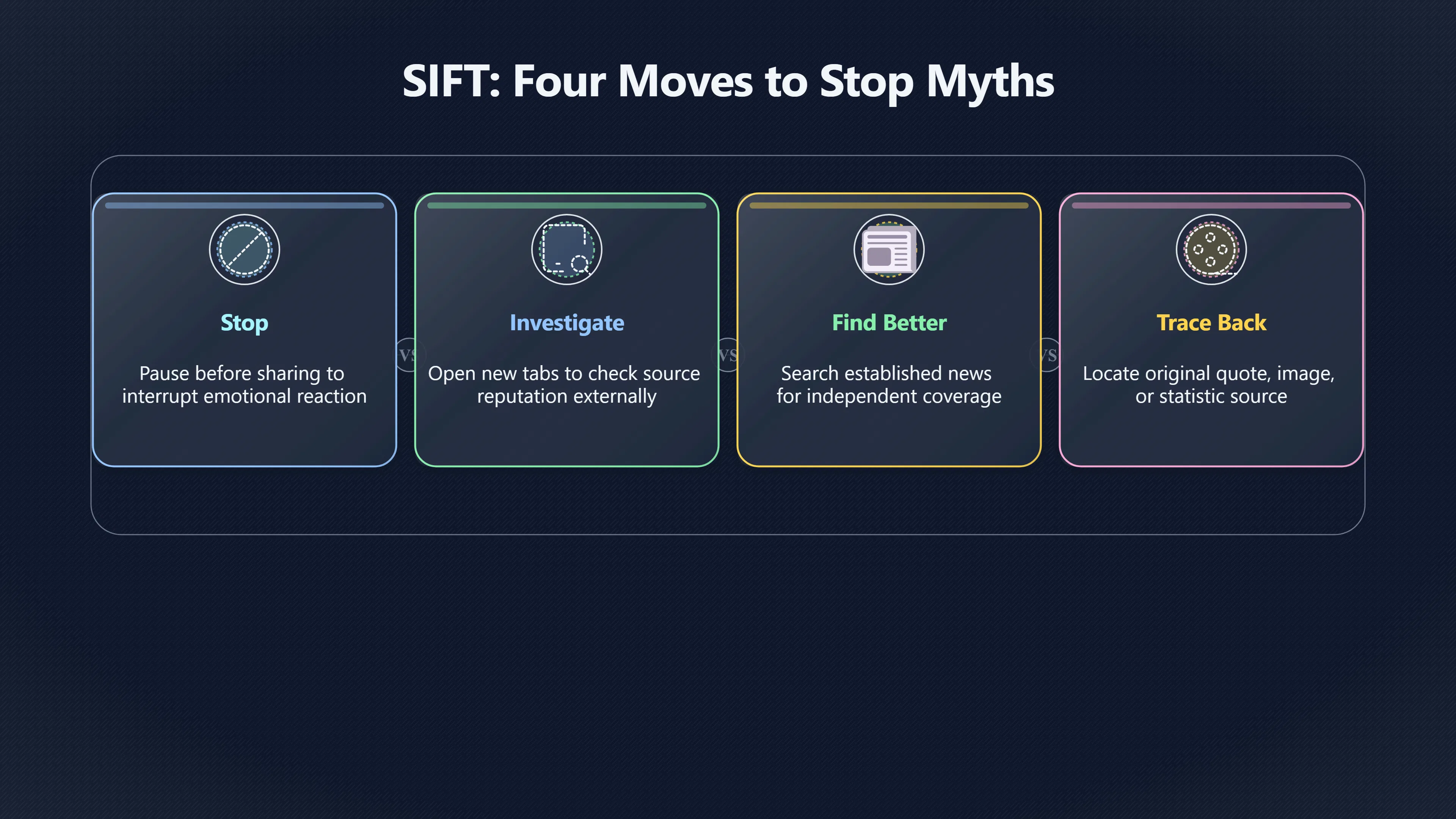
The SIFT method turns media literacy into a simple routine: stop, investigate, find better coverage, and trace the claim.
On this page
- Why stopping first changes the outcome
- How to investigate and compare coverage
- How to trace claims back to context
Page outline Jump by section
Introduction
The SIFT method is a practical fact-checking routine designed for the moment when a claim appears on a social feed, in a message group, or in a headline that seems urgent, surprising, or emotionally powerful. Developed by digital literacy researcher Mike Caulfield, SIFT stands for Stop, Investigate the source, Find better coverage, and Trace claims back to their original context. Rather than asking people to become experts in every topic they encounter, SIFT provides a quick process for deciding whether a claim deserves attention, trust, or sharing.[guides.lib.wayne.edu]guides.lib.wayne.eduStop, Investigate, Find, Trace: What is SIFT?Research Guides11 Mar 2021 — SIFT is an evaluation strategy developed by digital literacy expert Michael Caulfield (Washington State Univ…
 Its importance in myth prevention is straightforward: false or misleading claims often spread because people react immediately. SIFT inserts a deliberate pause before amplification. By slowing down, checking the source, comparing coverage, and locating the original evidence, users can catch many myths before they become part of wider public conversation.[mediahelpingmedia.org]mediahelpingmedia.orgSIF T for fact-checkingSIFT for fact-checkingMarch 30, 2025 — 30 Mar 2025 — SIFT teaches students how to critically evaluate information online through four ste…
Why stopping first changes the outcome
The first step—Stop—looks deceptively simple. Yet it addresses one of the strongest advantages myths possess: speed.
Many misleading claims are designed to provoke an immediate reaction. They may trigger anger, fear, excitement, outrage, or a sense of urgency. The goal is often not careful consideration but rapid sharing. SIFT asks people to interrupt that cycle before reading deeply, commenting, or reposting.[mediahelpingmedia.org]mediahelpingmedia.orgSIF T for fact-checkingSIFT for fact-checkingMarch 30, 2025 — 30 Mar 2025 — SIFT teaches students how to critically evaluate information online through four ste…[2library.scottsdalecc.edu]library.scottsdalecc.edu1. STOP; 2. Investigate the Source; 3. Find Better Coverage; 4.Trace Claims Back to the Original Source. First, STOP!Read more…
Stopping does not mean assuming a claim is false. It means asking a few basic questions:
- Do I know this source?
- Why am I inclined to believe or reject this claim?
- Am I reacting emotionally?
- Is there any reason to share this before checking it?
This brief pause changes behaviour because it shifts attention from the claim itself to the process of verification. Researchers and educators who use SIFT emphasise that people are often most vulnerable to misinformation when they respond automatically rather than deliberately.[library.scottsdalecc.edu]library.scottsdalecc.edu1. STOP; 2. Investigate the Source; 3. Find Better Coverage; 4.Trace Claims Back to the Original Source. First, STOP!Read more…[lucidea]lucidea.comcountering misinformation using the sift methodThe SIFT Method to Counter Misinformation in School…25 Nov 2025 — The SIFT Method developed by Mike Caulfield is one strategy that can… A common example is the recurring celebrity death hoax. Such stories often gain traction because users share them immediately after seeing adramatic headline. A short pause followed by a quick search frequently reveals that no credible reporting exists.[guides.lib.wayne.edu]guides.lib.wayne.eduStop · Investigate the Source · Find Better Coverage · Trace Claims, Quotes, and Media Back to Their Original Context · Resources…Read…
How to investigate and compare coverage
Investigate the source
The second step focuses on understanding who is behind a claim before evaluating the claim itself.
A key idea behind SIFT is that users should not remain on the original page trying to judge credibility from appearance alone. Professional fact-checkers often practise what is known as lateral reading: opening new tabs and looking elsewhere on the web for information about the source, author, organisation, or website.[guides.lib.byu.edu]guides.lib.byu.eduMCOM 320: Source Evaluation (SIFT) - Research Guides11 Feb 2026 — It consists of four moves: Stop, Investigate the source, find better co…[2libguides.ucmerced.edu]libguides.ucmerced.eduWeb Evaluation & News Sources: The SIFT MethodBoth can be used. In fact, "Stop, Investigate, Find Better Coverage, and Trace Claims (SIFT)…Read more…
Questions to ask include:
- Who operates this website or account?
- What expertise does the author have?
- What is the organisation known for?
- What do independent sources say about it?
This approach is important because unreliable sources can look professional. Modern websites can imitate the visual cues of legitimate journalism, scientific communication, or public institutions. SIFT therefore prioritises reputation and independent verification over design quality or presentation.[guides.lib.wayne.edu]guides.lib.wayne.eduStop, Investigate, Find, Trace: What is SIFT?Research Guides11 Mar 2021 — SIFT is an evaluation strategy developed by digital literacy expert Michael Caulfield (Washington State Univ…
Find better coverage
The third step recognises that sometimes the easiest way to evaluate a claim is not to analyse the original source at all.
If a claim is important and true, there is often better reporting available elsewhere. Searching for coverage from established news organisations, specialist publications, recognised experts, or fact-checking services can quickly reveal whether a broader evidence base exists. guides.lib.wayne.edu[2guides.lib.virginia.edu]guides.lib.virginia.eduDo other sources corroborate or contradict the original claim?Read moreSIFT - Source Evaluation - LibGuides at UVa Library30 Sept 2025 — Find Better Coverage: Search for other sources that cover the same info…
This step is especially useful when dealing with:
- Breaking news claims
- Health and science stories
- Viral social media posts[researchgate.net]researchgate.netPDF) S.I.F.T.-ing Through the C.R.A.A.P.: Teaching Lateral…29 Jul 2025 — PDF | On Jul 29, 2025, Andrew D Sutherland published S.I.F.T…
- Political allegations
- Extraordinary statistics
The goal is not merely to find another source repeating the same statement. It is to locate coverage that independently verifies, contextualises, or challenges the claim. SIFT guidance frequently encourages looking for evidence of expert consensus rather than relying on a single article or post.[mediahelpingmedia.org]mediahelpingmedia.orgSIF T for fact-checkingSIFT for fact-checkingMarch 30, 2025 — 30 Mar 2025 — SIFT teaches students how to critically evaluate information online through four ste…[Learning essentials]learningessentials.auckland.ac.nzLearning essentials SIFT framework | Learning essentialsFind better or other coverage. Sometimes it's less important to know about the source and more importance to assess their claim.Read more…
An important related practice is what Stanford researchers have called click restraint—scanning search results before opening links rather than clicking the first result immediately. Skilled fact-checkers often compare multiple sources before deciding which ones deserve attention.[guides.lib.wayne.edu]guides.lib.wayne.eduStop · Investigate the Source · Find Better Coverage · Trace Claims, Quotes, and Media Back to Their Original Context · Resources…Read…
How to trace claims back to context
The final step addresses a common way myths survive: information is separated from its original setting.
Quotes are shortened. Images are reused years after the events they supposedly depict. Statistics are copied without explanation. Screenshots circulate without links to the original material. By the time a claim reaches social media, crucial context may have disappeared.[openoregon.pressbooks.pub]openoregon.pressbooks.pubThe SIFT Method –Introduction to Finding Information3 days ago — In these cases you will want to trace the claim, quote, or media back to the source, so y…
Tracing means locating the earliest accessible source and examining it directly.
For a quote, that may mean finding the full speech, interview, or document. For a statistic, it may mean locating the original study or dataset. For a photograph, it may involve reverse-image searching to determine when and where it first appeared. For a video clip, it may require watching the full recording rather than a short edited excerpt.[guides.lib.virginia.edu]guides.lib.virginia.eduDo other sources corroborate or contradict the original claim?Read moreSIFT - Source Evaluation - LibGuides at UVa Library30 Sept 2025 — Find Better Coverage: Search for other sources that cover the same info…[2openoregon.pressbooks.pub]openoregon.pressbooks.pubThe SIFT Method –Introduction to Finding Information3 days ago — In these cases you will want to trace the claim, quote, or media back to the source, so y…
This step frequently reveals that a claim is not entirely fabricated but has been distorted through omission or selective presentation. A genuine quote may have been taken out of context. A real image may be presented as evidence for a different event. A statistic may be accurate but interpreted incorrectly. Tracing back to the original source helps distinguish between evidence and the story built around that evidence.[guides.lib.virginia.edu]guides.lib.virginia.eduDo other sources corroborate or contradict the original claim?Read moreSIFT - Source Evaluation - LibGuides at UVa Library30 Sept 2025 — Find Better Coverage: Search for other sources that cover the same info…
Where SIFT works best against myths
SIFT is particularly effective against myths that spread through speed and repetition rather than through detailed argument.
Examples include:
- Viral rumours after major events
- Misleading memes and screenshots
- Out-of-context quotations
- Manipulated images
- Claims attributed to unnamed experts
- Social media posts presenting extraordinary facts without evidence
In these situations, a full investigation may be unnecessary. A few minutes of SIFT-based checking often reveals whether the claim rests on credible information or on recycled misinformation.[mediahelpingmedia.org]mediahelpingmedia.orgSIF T for fact-checkingSIFT for fact-checkingMarch 30, 2025 — 30 Mar 2025 — SIFT teaches students how to critically evaluate information online through four ste…[2libguides.hacc.edu]libguides.hacc.eduIt is based on an approach used by professional fact-checkers.Read moreEvaluating Sources: SIFT Method - Introduction to Research6 Feb 2026 — SIFT is a series of steps to take when evaluating the reliability…
The method is also intentionally lightweight. Unlike lengthy evaluation checklists, SIFT is designed for ordinary online behaviour. Its value lies in creating a repeatable habit that can be used before sharing content rather than after a myth has already spread.[guides.lib.wayne.edu]guides.lib.wayne.eduStop · Investigate the Source · Find Better Coverage · Trace Claims, Quotes, and Media Back to Their Original Context · Resources…Read…

The key implementation lesson
The strength of SIFT is not that it guarantees perfect judgement. Rather, it changes the sequence of actions people take when encountering suspicious information.
Instead of reading deeply first, trusting appearances, and sharing quickly, SIFT encourages users to pause, investigate externally, compare independent coverage, and locate original evidence. Those four moves align closely with the practices used by professional fact-checkers and digital literacy educators because they target the points where misinformation most often gains momentum.[libguides.hacc.edu]libguides.hacc.eduIt is based on an approach used by professional fact-checkers.Read moreEvaluating Sources: SIFT Method - Introduction to Research6 Feb 2026 — SIFT is a series of steps to take when evaluating the reliability…[2guides.lib.byu.edu]guides.lib.byu.eduMCOM 320: Source Evaluation (SIFT) - Research Guides11 Feb 2026 — It consists of four moves: Stop, Investigate the source, find better co…
For myth prevention, that shift is crucial. The method turns media literacy from an abstract principle into a practical routine that can be applied in seconds, creating a small but powerful barrier between seeing a claim and helping it spread.[mediahelpingmedia.org]mediahelpingmedia.orgSIF T for fact-checkingSIFT for fact-checkingMarch 30, 2025 — 30 Mar 2025 — SIFT teaches students how to critically evaluate information online through four ste…
Amazon book picks
Further Reading
Books and field guides related to A simple checklist for suspicious claims. Use these as the next step if you want deeper reading beyond the article.
The Skeptics' Guide to the Universe
Explains cognitive biases, misinformation, and evidence-based reasoning.
A field guide to lies
First published 2016. Subjects: Critical thinking, Fallacies (Logic), Reasoning, Statistics, Social aspects.
eBay marketplace picks
Marketplace Samples
Example marketplace items related to this page. Use the search link to explore similar finds on eBay.



Endnotes
1.
Source: guides.lib.wayne.edu
Title: Stop, Investigate, Find, Trace: What is SIFT?
Link:https://guides.lib.wayne.edu/sift
Source snippet
Research Guides11 Mar 2021 — SIFT is an evaluation strategy developed by digital literacy expert Michael Caulfield (Washington State Univ...
2.
Source: mediahelpingmedia.org
Title: SIF T for fact-checking
Link:https://mediahelpingmedia.org/basics/sift-for-fact-checking/
Source snippet
SIFT for fact-checkingMarch 30, 2025 — 30 Mar 2025 — SIFT teaches students how to critically evaluate information online through four ste...
Published: March 30, 2025
3.
Source: libguides.hacc.edu
Title: It is based on an approach used by professional fact-checkers.Read more
Link:https://libguides.hacc.edu/IntroductiontoReseach/SIFT
Source snippet
Evaluating Sources: SIFT Method - Introduction to Research6 Feb 2026 — SIFT is a series of steps to take when evaluating the reliability...
4.
Source: library.scottsdalecc.edu
Link:https://library.scottsdalecc.edu/SIFT
Source snippet
1. STOP; 2. Investigate the Source; 3. Find Better Coverage; 4.Trace Claims Back to the Original Source. First, STOP!Read more...
5.
Source: lucidea.com
Title: countering misinformation using the sift method
Link:https://lucidea.com/blog/countering-misinformation-using-the-sift-method/
Source snippet
The SIFT Method to Counter Misinformation in School...25 Nov 2025 — The SIFT Method developed by Mike Caulfield is one strategy that can...
6.
Source: pressbooks.pub
Title: The SIFT Method –
Link:https://pressbooks.pub/introtocollegeresearch/chapter/the-sift-method/
Source snippet
Investigate the source. Find better coverage. Trace claims, quotes and media to the original context.Read more...
7.
Source: guides.lib.wayne.edu
Link:https://guides.lib.wayne.edu/sift/find
Source snippet
Stop · Investigate the Source · Find Better Coverage · Trace Claims, Quotes, and Media Back to Their Original Context · Resources...Read...
8.
Source: guides.lib.byu.edu
Link:https://guides.lib.byu.edu/mcom320/evaluatesources
Source snippet
MCOM 320: Source Evaluation (SIFT) - Research Guides11 Feb 2026 — It consists of four moves: Stop, Investigate the source, find better co...
9.
Source: libguides.ucmerced.edu
Title: Web Evaluation & News Sources: The SIFT Method
Link:https://libguides.ucmerced.edu/news/evaluation/sift-method
Source snippet
Both can be used. In fact, "Stop, Investigate, Find Better Coverage, and Trace Claims (SIFT)...Read more...
10.
Source: guides.lib.virginia.edu
Title: Do other sources corroborate or contradict the original claim?Read more
Link:https://guides.lib.virginia.edu/c.php?g=1483059&p=11057026
Source snippet
SIFT - Source Evaluation - LibGuides at UVa Library30 Sept 2025 — Find Better Coverage: Search for other sources that cover the same info...
11.
Source: openoregon.pressbooks.pub
Title: The SIFT Method –
Link:https://openoregon.pressbooks.pub/findinginfo/chapter/four-moves/
Source snippet
Introduction to Finding Information3 days ago — In these cases you will want to trace the claim, quote, or media back to the source, so y...
12.
Source: clark.libguides.com
Link:https://clark.libguides.com/evaluating-information/SIFT
Source snippet
Information: SIFT (The Four Moves)15 Jan 2026 — Use the SIFT method to help you analyze information, especially news or other online media...
13.
Source: uscupstate.libguides.com
Link:https://uscupstate.libguides.com/AdamsEngl101/SIFT
Source snippet
the SIFT Method - ENGL U101 - Adams - Library Guides24 Mar 2026 — "SIFT" in research stands for "Stop, Investigate, Find, Trace" and is a...
14.
Source: eosgmbh.com
Title: the sift method
Link:https://eosgmbh.com/en/the-sift-method/
Source snippet
Enterprise Open Systems (EOS)The SIFT method11 Mar 2025 — It consists of four steps: Stop, Investigate, Find better coverage, Trace claim...
15.
Source: learningessentials.auckland.ac.nz
Title: Learning essentials SIFT framework | Learning essentials
Link:https://learningessentials.auckland.ac.nz/finding-information/evaluating-sources/sift-framework/
Source snippet
Find better or other coverage. Sometimes it's less important to know about the source and more importance to assess their claim.Read more...
16.
Source: guides.lib.uchicago.edu
Link:https://guides.lib.uchicago.edu/c.php?g=1241077&p=9082322
Source snippet
SIFT Method - Evaluating Resources and Misinformation30 Jun 2025 — The SIFT method is an evaluation strategy developed by digital literac...
17.
Source: guides.lib.uw.edu
Link:https://guides.lib.uw.edu/research/evaluate/sift
Source snippet
Check reputable news sources (the UW Libraries news databases will be helpful) to...Read more...
18.
Source: guides.lib.lsu.edu
Link:https://guides.lib.lsu.edu/hnrs2000/SIFT
Source snippet
· I: Investigate the Source · F: Find Better Coverage · T: Trace Claims, Quotes, and Media Back to the Original Context.Read more...
19.
Source: library.uwsuper.edu
Link:https://library.uwsuper.edu/evaluation/SIFT
Source snippet
We have more fact checking and lateral reading sources available, too. Trace claims, quotes, and media back to the original content.Read...
Additional References
20.
Source: researchgate.net
Link:https://www.researchgate.net/publication/394079043_SIFT-ing_Through_the_CRAAP_Teaching_Lateral_Reading_to_Address_Social_Media_Misinformation
Source snippet
(PDF) S.I.F.T.-ing Through the C.R.A.A.P.: Teaching Lateral...29 Jul 2025 — PDF | On Jul 29, 2025, Andrew D Sutherland published S.I.F.T...
21.
Source: smu.ca
Link:https://www.smu.ca/webfiles/SIFT_Method_final.pdf
Source snippet
“SIFT”: A Method for Evaluating Information SourcesTaking the time to stop, investigate the information source, find better coverage, and...
22.
Source: guides.library.charlotte.edu
Title: Understanding and Evaluating Sources: SIFT
Link:https://guides.library.charlotte.edu/c.php?g=1499262&p=11347573
Source snippet
Research Guides5 Mar 2026 — The four moves—Stop, Investigate the source, Find better coverage, and Trace claims to the original context—g...
23.
Source: pubmed.ncbi.nlm.nih.gov
Link:https://pubmed.ncbi.nlm.nih.gov/39471397/
Source snippet
Notebooks to Teach Critical Digital Literacyby E Spracklin · 2025 · Cited by 8 — The reflection notebooks equip students with critical kn...
24.
Source: colab.plymouthcreate.net
Title: SIFT and news literacy sep 8 2022 CoLab
Link:https://colab.plymouthcreate.net/wp-content/uploads/2022/09/SIFT-and-news-literacy-sep-8-2022-CoLab.pdf
Source snippet
SIFT to Evaluate News (and other) Information...SIFT was developed by Mike Caulfield, a Keene State graduate, who currently works a rese...
25.
Source: hapgood.us
Title: SIFT (The Four Moves)
Link:https://hapgood.us/2019/06/19/sift-the-four-moves/
Source snippet
SIFT (The Four Moves) - Hapgood19 Jun 2019 — We call the “things to do” moves and there are four of them: The four moves: Stop, In...
26.
Source: youtube.com
Title: How to use the SIFT method to evaluate information
Link:https://www.youtube.com/watch?v=oV856tqU1wA
Source snippet
Mike Caulfield on the SIFT method for digital literacy...
27.
Source: youtube.com
Title: Mike Caulfield on the SIFT method for digital literacy
Link:https://www.youtube.com/watch?v=kYJ557m75W4
Source snippet
Lateral reading and the SIFT method explained...
28.
Source: guides.libs.uga.edu
Link:https://guides.libs.uga.edu/c.php?g=350399&p=10565905
Source snippet
4425R (Gallagher): Fact Checking AI12 May 2026 — INTL 4425R (Gallagher): Fact Checking AI Tips and Frameworks. The SIFT method asks you t...
Published: May 2026
29.
Source: lib.jjay.cuny.edu
Link:https://lib.jjay.cuny.edu/c.php?g=288333&p=11044074
Source snippet
Stop before you read; Investigate the source; Find better coverage; Trace claims, quotes and media to the original context. You...Read more...
Topic Tree