Within Concept Change
The Questions That Reveal Misconceptions
Good diagnostic questions expose the model behind an answer, not just whether a student chose the right option.
On this page
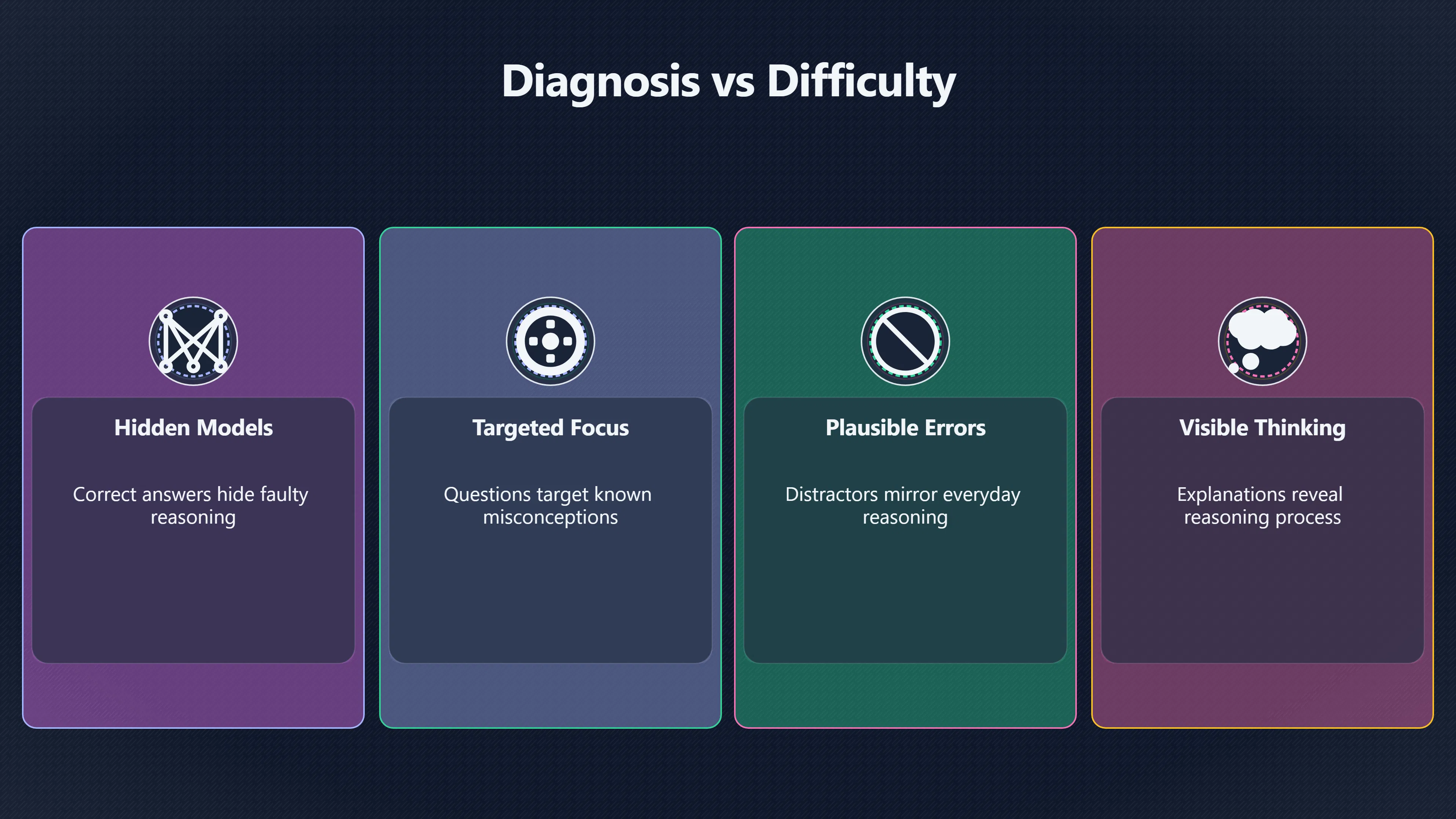
- Why answers alone can hide faulty reasoning
- How distractors map to common misconceptions
- Using explanations as formative assessment
Page outline Jump by section
Introduction
A student who chooses the correct answer can still hold the wrong idea. That is the central challenge of diagnosing misconceptions in science learning. Many students learn to recognise keywords, eliminate unlikely options, or repeat memorised explanations without changing the underlying model they use to make sense of the world. Diagnostic questions are designed to expose that hidden model.
 In conceptual change teaching, the goal is not simply to identify who is right and who is wrong. It is to uncover how students are reasoning before instruction moves on. Well-designed diagnostic questions reveal whether a learner thinks heavier objects fall faster, whether they believe electric current is “used up” in a circuit, or whether they think plants obtain most of their mass from soil. The value lies in making invisible thinking visible, allowing teachers to respond to specific misconceptions rather than generic errors. Research on formative assessment, concept inventories and science misconceptions consistently shows that eliciting students’ reasoning is a critical step in conceptual change.[National Academies]nationalacademies.orgNational AcademiesHow People Learn: Bridging Research and Practice (1999)The use of frequent formative assessment helps make students' th…[National]nationalacademies.orgNational AcademiesHow People Learn: Bridging Research and Practice (1999)The use of frequent formative assessment helps make students' th…
Why Answers Alone Can Hide Faulty Reasoning
Many classroom questions measure recall rather than understanding. A student may correctly state that seasons are caused by Earth’s axial tilt but still privately believe that summer occurs when Earth is closer to the Sun. The correct statement has been learned, but the earlier explanation remains intact.
This problem has been documented across science education research. Students often carry stable explanatory frameworks that survive years of instruction because assessments reward the production of correct answers without probing the reasoning underneath them. Conceptual change researchers therefore argue that assessment must focus on students’ mental models, not just outcomes.[National Academies]nationalacademies.orgNational AcademiesHow People Learn: Bridging Research and Practice (1999)The use of frequent formative assessment helps make students' th…[National]nationalacademies.orgNational AcademiesHow People Learn: Bridging Research and Practice (1999)The use of frequent formative assessment helps make students' th…
A useful diagnostic question typically has three characteristics:
- It targets a known misconception rather than a random mistake.
- It requires students to commit to an explanation.
- It provides information that can guide teaching decisions.
Consider a question about motion:
A ball rolls across a smooth surface after being pushed. Why does it keep moving?
A traditional test might ask for the correct law. A diagnostic version offers explanations that correspond to different mental models:
- The force from the push stays inside the ball.
- The ball keeps moving because no force is needed once motion begins.
- Air pushes the ball forward.
- The ball moves because motion naturally continues unless another force changes it.
Each option reveals a different understanding of force and motion. Even incorrect responses become useful evidence.
The key shift is that the teacher is not merely counting errors. The teacher is identifying patterns of thinking.
What Makes a Question Diagnostic Rather Than Difficult?
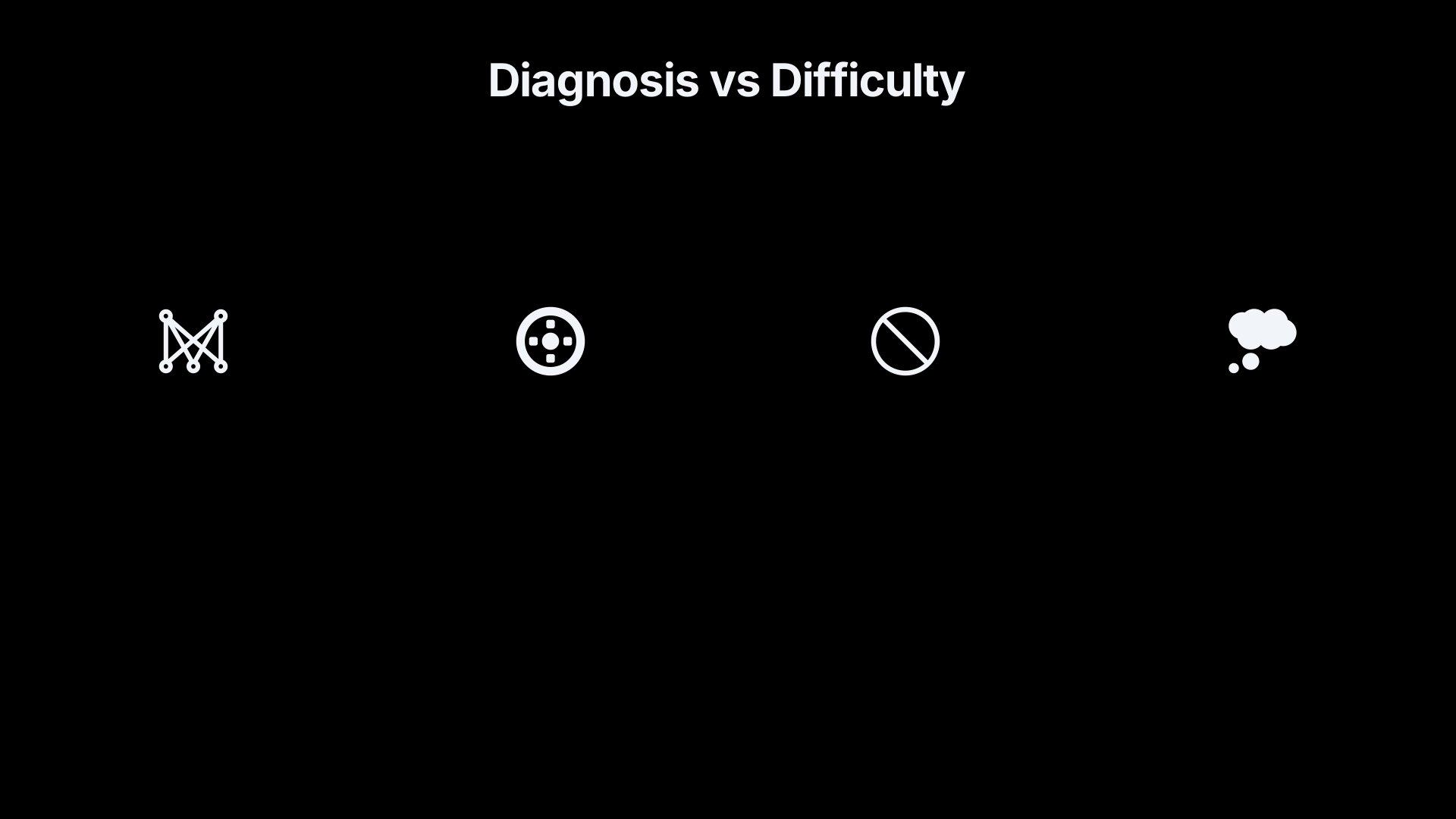
A difficult question is not automatically diagnostic. Some questions are hard because they involve complex calculations, unfamiliar vocabulary or confusing wording. Students may fail them for many reasons.
Diagnostic questions are different. Their purpose is to discriminate between competing explanations.
For example, asking students to calculate the current in a circuit may reveal mathematical mistakes. Asking whether the current is larger before or after a bulb reveals a conceptual belief about whether electricity is consumed as it moves through the circuit.
Research on science assessment emphasises that formative assessment becomes powerful when it uncovers the ideas students are using, not simply the answers they produce. Teachers can then adapt instruction based on the specific misconceptions that emerge.[dokumen.pub]dokumen.pubment, particularly formative assessment, is beneficial for student learning; and a…[2fame-michigan.nyc3.cdn.digitaloceanspaces.com]fame-michigan.nyc3.cdn.digitaloceanspaces.comThe Formative Assessment Process: Scienceby AW Gotwals —Science Education (National Research Council. [NRC], 2012)iv. The Framework summarizes research that suggests that students learn best wh…
Practical diagnostic questions often focus on:
- Prediction before observation.
- Explanation of everyday phenomena.
- Comparison between similar situations.
- Identification of causes rather than outcomes.
- Justification of an answer.
The explanation matters as much as the choice itself.
How Distractors Map to Common Misconceptions
The most effective multiple-choice diagnostic questions use distractors deliberately. A distractor is an incorrect option, but in diagnostic assessment it is not merely a wrong answer. It is a representation of a known misconception.
Research on concept inventories and diagnostic instruments shows that high-quality distractors are often developed from interviews, classroom observations and written student explanations. The distractors are built from actual student thinking rather than guesses about what students might misunderstand.[PMC]pmc.ncbi.nlm.nih.govDiagnostic of students' misconceptions using the Biological…by AC Queloz · 2017 · Cited by 82 — Concept inventories, constructed ba…[PMC]pmc.ncbi.nlm.nih.govnih.govMultiple-Choice Item Distractor Development Using Topic…by J Shin · 2019 · Cited by 130 — We describe and demonstrate a systema…
Consider a biology example:
Where does most of a tree’s mass come from as it grows?
Possible answers might include:
- Water from the soil.
- Minerals from the soil.
- Carbon dioxide from the air.
- Fertiliser added by gardeners.
The incorrect options are not random. They correspond to common beliefs that plants obtain their substance from soil or nutrients. Selecting one of these responses reveals a specific misconception about photosynthesis and biomass.
This approach underlies many concept inventories, which are specialised assessment tools designed to measure conceptual understanding rather than factual recall. Unlike ordinary tests, concept inventories undergo extensive development to ensure that distractors correspond to common misconceptions.[Wikipedia]WikipediaConcept inventoryOctober 1, 2025 — A concept inventory is a criterion-referenced test designed to help determine whether a student has an accurate working…[Taylor & Francis Online]tandfonline.com23752696.2018.1433546@rhep20.2018.3.issue V1Taylor & Francis OnlineUsing concept inventories to measure understandingby D Sands · 2018 · Cited by 154 — A concept inventory is a mult…
Physics education provides one of the best-known examples through the Force Concept Inventory, which was created to uncover persistent misconceptions about Newtonian mechanics. Later analyses of student response patterns found that incorrect answers often cluster into recognisable misconception groups, demonstrating that wrong answers frequently reflect coherent alternative models rather than isolated mistakes.[VTechWorks]vtechworks.lib.vt.eduech Works Rethinking the Force Concept InventoryRethinking the Force Concept Inventory - VTechWorksby MA Norris · 2021 · Cited by 6 — Distractor analysis of concept inventory…

Why Plausible Wrong Answers Matter
A poor distractor is obviously wrong. Students reject it without revealing anything about their thinking.
A strong distractor feels plausible because it mirrors everyday reasoning.
For example:
- “Heavier objects fall faster” reflects everyday observation of paper and stones.
- “Plants eat soil” reflects visible plant roots and disappearing nutrients.
- “Current gets used up” reflects everyday experiences of fuel consumption.
When students choose these options, teachers gain access to the explanatory framework behind the answer.
Research on distractor design increasingly treats these options as diagnostic tools rather than test fillers. Their value lies in revealing conceptual gaps that can be addressed through instruction.[Tips for Teachers by Craig Barton]tipsforteachers.co.ukTips for Teachers by Craig BartonDeveloping, Analyzing, and Using Distractors for Multiple-…by MJ Gierl · 2017 · Cited by 338 — In thi…[PMC]pmc.ncbi.nlm.nih.govDiagnostic of students' misconceptions using the Biological…by AC Queloz · 2017 · Cited by 82 — Concept inventories, constructed ba…
Using Explanations as Formative Assessment
Multiple-choice questions can reveal misconceptions, but explanations often reveal even more.
A student may select the scientifically correct answer for the wrong reason. Conversely, a student may choose an incorrect option while demonstrating partially correct reasoning.
This is why many diagnostic approaches combine answer selection with explanation prompts. Two-tier and multi-tier diagnostic assessments are built around this principle. Students first select an answer and then explain why they chose it. Researchers have found that this structure improves the identification of misconceptions because it distinguishes guessing from genuine understanding.[IJLTER]ijlter.orgThe Development of Two-Tier Instrument Based On…The Development of Two-Tier Instrument Based On Distractor to Assess Conceptual…[MDPI]mdpi.comThe Effectiveness and Sustainability of Tier Diagnostic…by H Ma · 2025 · Cited by 14 — Misconception tier diagnostic technologies (MTD…
In classroom practice, explanations do not need to be lengthy. Teachers often use:
- One-sentence justifications.
- Think-pair-share discussions.
- Mini whiteboard responses.
- Verbal reasoning during class questioning.
- Short written predictions before demonstrations.
The important feature is that students reveal the reasoning process.
National Research Council reports on learning and assessment have repeatedly argued that formative assessment should make student thinking visible. When teachers can see the ideas students are using, they are better positioned to support conceptual change.[National Academies]nationalacademies.orgNational AcademiesHow People Learn: Bridging Research and Practice (1999)The use of frequent formative assessment helps make students' th…[National]nationalacademies.orgNational AcademiesHow People Learn: Bridging Research and Practice (1999)The use of frequent formative assessment helps make students' th…
Diagnostic Questions at Lesson “Hinge Points”
A diagnostic question is most useful when it influences what happens next.
One common implementation strategy is the hinge-point question: a carefully chosen question placed at a critical stage in a lesson. The teacher uses student responses to decide whether to continue, reteach or challenge understanding further.
Science education guidance has highlighted diagnostic questioning as particularly valuable at these moments because it exposes misconceptions before they become reinforced. Rather than discovering misunderstandings on an end-of-unit test, teachers identify them while there is still time to respond.[Research Schools Network]researchschool.org.ukchallenging misconceptions in scienceThey go beyond a typical multiple-choice…Read more… [2EEF]
For example:
- Before teaching Newton’s laws, ask students to predict what happens when forces stop acting.
- Before teaching photosynthesis, ask where plant mass originates.
- Before teaching electric circuits, ask whether current changes as it passes through a bulb.
The responses determine the next instructional move.
A class in which most students select the same misconception requires a different response from a class where understanding is already developing.
Common Mistakes When Using Diagnostic Questions
Even strong diagnostic questions can lose their value if they are used poorly.
One common mistake is treating them as graded tests. If students fear penalties for revealing misunderstandings, they may guess strategically rather than reveal genuine thinking.
Another mistake is immediately correcting answers without exploring reasoning. The diagnostic opportunity is lost when the teacher focuses only on identifying the right option.
Other implementation problems include:
- Using distractors that do not reflect real misconceptions.
- Asking too many questions that probe recall rather than reasoning.
- Moving on before discussing why different answers were chosen.
- Assuming one correct response means conceptual change has occurred.
Research on formative assessment consistently emphasises that evidence of thinking becomes useful only when it informs teaching decisions. Assessment is not the endpoint; it is part of the instructional process.[dokumen.pub]dokumen.pubment, particularly formative assessment, is beneficial for student learning; and a…[ScienceDirect]sciencedirect.comFormative assessment practices in science educationby V Atasoy · 2022 · Cited by 29 — This study aimed to examine qualitative studies on…
From Diagnosis to Conceptual Change
Diagnostic questions are valuable because misconceptions are often hidden. Students may appear successful while continuing to interpret science through older explanatory frameworks.
By designing questions that target known misconceptions, using distractors linked to common beliefs, and requiring explanations rather than simple answers, teachers gain access to the reasoning students bring into the classroom. That information becomes the starting point for conceptual change.
The most effective diagnostic questions therefore do more than measure learning. They expose the ideas that learning must replace, refine or reorganise. In science education, that visibility is often the difference between memorising a correct statement and genuinely changing how the world is understood.[Research Schools Network]researchschool.org.ukchallenging misconceptions in scienceThey go beyond a typical multiple-choice…Read more…[National]nationalacademies.orgNational AcademiesHow People Learn: Bridging Research and Practice (1999)The use of frequent formative assessment helps make students' th…
Amazon book picks
Further Reading
Books and field guides related to The Questions That Reveal Misconceptions. Use these as the next step if you want deeper reading beyond the article.
Making Sense of Secondary Science
First published 1993. Subjects: Study and teaching (Secondary), Teaching Methods & Materials, Curriculum planning, Science, Science & Tec...
eBay marketplace picks
Marketplace Samples
Example marketplace items related to this page. Use the search link to explore similar finds on eBay.



Endnotes
1.
Source: dokumen.pub
Link:https://dokumen.pub/classroom-assessment-and-the-national-science-education-standards-1nbsped-9780309504645-9780309069984.html
Source snippet
ment, particularly formative assessment, is beneficial for student learning; and a...
2.
Source: fame-michigan.nyc3.cdn.digitaloceanspaces.com
Title: The Formative Assessment Process: Scienceby AW Gotwals —
Link:https://fame-michigan.nyc3.cdn.digitaloceanspaces.com/_legacy/wp-content/uploads/2022/05/FAMEGuide_Science.pdf
Source snippet
Science Education (National Research Council. [NRC], 2012)iv. The Framework summarizes research that suggests that students learn best wh...
3.
Source: sciencedirect.com
Link:https://www.sciencedirect.com/science/article/abs/pii/S0191491X22000633
Source snippet
Formative assessment practices in science educationby V Atasoy · 2022 · Cited by 29 — This study aimed to examine qualitative studies on...
4.
Source: pmc.ncbi.nlm.nih.gov
Link:https://pmc.ncbi.nlm.nih.gov/articles/PMC5426623/
Source snippet
Diagnostic of students' misconceptions using the Biological...by AC Queloz · 2017 · Cited by 82 — Concept inventories, constructed ba...
5.
Source: pmc.ncbi.nlm.nih.gov
Link:https://pmc.ncbi.nlm.nih.gov/articles/PMC6524712/
Source snippet
nih.govMultiple-Choice Item Distractor Development Using Topic...by J Shin · 2019 · Cited by 130 — We describe and demonstrate a systema...
6.
Source: Wikipedia
Title: Concept inventory
Link:https://en.wikipedia.org/wiki/Concept_inventory
Source snippet
October 1, 2025 — A concept inventory is a criterion-referenced test designed to help determine whether a student has an accurate working...
Published: October 1, 2025
7.
Source: ijlter.org
Link:https://www.ijlter.org/index.php/ijlter/article/view/1650/0
Source snippet
The Development of Two-Tier Instrument Based On...The Development of Two-Tier Instrument Based On Distractor to Assess Conceptual...
8.
Source: mdpi.com
Link:https://www.mdpi.com/2071-1050/17/7/3145
Source snippet
The Effectiveness and Sustainability of Tier Diagnostic...by H Ma · 2025 · Cited by 14 — Misconception tier diagnostic technologies (MTD...
9.
Source: mdpi.com
Title: Rethinking Science Education Practices: Shifting from Investigation
Link:https://www.mdpi.com/2227-7102/15/1/73
Source snippet
January 13, 2025 — This paper introduces a Comprehensive Inquiry-Based Science Education (CIBSE) Framework, grounded in responsive teachi...
Published: January 13, 2025
10.
Source: sciencedirect.com
Link:https://www.sciencedirect.com/science/article/abs/pii/S1871187124002712
Source snippet
Analysis of distractors in mathematics questions and their...by AZ Özdemir · 2025 · Cited by 6 — The aim of this study is to examine whe...
11.
Source: nationalacademies.org
Link:https://www.nationalacademies.org/read/9457/chapter/4
Source snippet
National AcademiesHow People Learn: Bridging Research and Practice (1999)The use of frequent formative assessment helps make students' th...
12.
Source: nationalacademies.org
Link:https://www.nationalacademies.org/read/9847/chapter/4
Source snippet
Chapter: 2 The Case for Strengthening Assessment in the Science Classroom.Read more...
13.
Source: nationalacademies.org
Link:https://www.nationalacademies.org/read/11625/chapter/
Source snippet
(2007). Taking Science to School: Learning and Teaching Science in Grades K-8. Committee on Science Learning...Read more...
14.
Source: nationalacademies.org
Link:https://www.nationalacademies.org/read/5287/chapter/5
Source snippet
Descriptions and examples of some common misconceptions in science. Methods to identify misconceptions.Read more...
15.
Source: tandfonline.com
Title: 23752696.2018.1433546@rhep20.2018.3.issue V1
Link:https://www.tandfonline.com/doi/full/10.1080/23752696.2018.1433546%40rhep20.2018.3.issue-V1
Source snippet
Taylor & Francis OnlineUsing concept inventories to measure understandingby D Sands · 2018 · Cited by 154 — A concept inventory is a mult...
16.
Source: vtechworks.lib.vt.edu
Title: ech Works Rethinking the Force Concept Inventory
Link:https://vtechworks.lib.vt.edu/items/e308cf67-e65b-4e81-9893-860174de0214
Source snippet
Rethinking the Force Concept Inventory - VTechWorksby MA Norris · 2021 · Cited by 6 — Distractor analysis of concept inventory...
17.
Source: tipsforteachers.co.uk
Link:https://tipsforteachers.co.uk/wp-content/uploads/2025/06/Research-Developing-Analyzing-and-Using-Distractors-for-Multiple-Choice-Tests-in-Education.pdf
Source snippet
Tips for Teachers by Craig BartonDeveloping, Analyzing, and Using Distractors for Multiple-...by MJ Gierl · 2017 · Cited by 338 — In thi...
18.
Source: nationalacademies.org
Link:https://www.nationalacademies.org/read/9596/chapter/5
Source snippet
Chapter: 4 Classroom Assessment and InquiryThe National Science Education Standards point out that “assessments provide an operational de...
19.
Source: researchschool.org.uk
Title: challenging misconceptions in science
Link:https://researchschool.org.uk/news/challenging-misconceptions-in-science
Source snippet
They go beyond a typical multiple-choice...Read more...
20.
Source: tipsforteachers.co.uk
Link:https://tipsforteachers.co.uk/research-using-diagnostic-classroom-assessment-one-question-at-a-time/
Source snippet
Tips for Teachers by Craig BartonResearch: Using Diagnostic Classroom Assessment: One...29 Nov 2024 — Use diagnostic items daily as a fo...
Additional References
21.
Source: researchgate.net
Link:https://www.researchgate.net/publication/300823945_An_Analysis_of_Science_Concept_Inventories_and_Diagnostic_Tests_Commonalities_and_Differences
Source snippet
(PDF) An Analysis of Science Concept Inventories and...11 Apr 2016 — This research study was a literature review of over seventy science...
22.
Source: flaguide.org
Link:https://www.flaguide.org/extra/download/cat/diagnostic/diagnostic.pdf
Source snippet
Conceptual Diagnostic TestsA conceptual diagnostic test aims to assess students' conceptual understanding of key ideas in a discipline, e...
23.
Source: diagnosticquestions.com
Link:https://diagnosticquestions.com/
Source snippet
Diagnostic QuestionsDiagnostic Questions is a world leading assessment tool that provides detailed insights into student understanding in...
24.
Source: nwabr.org
Link:https://www.nwabr.org/sites/default/files/0Formative_Assessment_HinR.pdf
Source snippet
Formative AssessmentStudents begin the unit with an activity in which they consider their prior knowledge and identify misconceptions the...
25.
Source: merriam-webster.com
Link:https://www.merriam-webster.com/dictionary/national
Source snippet
NATIONAL Definition & Meaning3 days ago — 1. of or relating to a nation; national boundaries; the national flag. 2. nationalist. 3. compr...
26.
Source: researchgate.net
Link:https://www.researchgate.net/publication/5673406_Recognizing_Student_Misconceptions_through_Ed%27s_Tools_and_the_Biology_Concept_Inventory
Source snippet
Recognizing Student Misconceptions through Ed's Tools...Concept inventories can provide diagnostic results to help identify students' un...
27.
Source: issues.org
Link:https://issues.org/alberts-2/
Source snippet
Restoring Science to Science EducationNational Research Council, Taking Science to School: Learning and Teaching Science in Grades K-8, R...
28.
Source: ejmste.com
Link:https://www.ejmste.com/download/a-review-and-comparison-of-diagnostic-instruments-to-identify-students-misconceptions-in-science-4429
Source snippet
Eurasia JournalA Review and Comparison of Diagnostic Instruments to...by DK Gurel · 2015 · Cited by 937 — This article addresses the imp...
29.
Source: api.pageplace.de
Link:https://api.pageplace.de/preview/DT0400.9781935155683_A51120942/preview-9781935155683_A51120942.pdf
Source snippet
Science LearningSection 3 continues with a chapter summarizing the National Research. Council's (NRC) report on design principles for sta...
30.
Source: researchgate.net
Link:https://www.researchgate.net/publication/334535943_A_Review_of_Students%27_Common_Misconceptions_in_Science_and_Their_Diagnostic_Assessment_Tools
Source snippet
A Review of Students' Common Misconceptions in Science...6 Mar 2026 — This study revealed that 33 physics, 12 chemistry, and 15 biology...
Topic Tree