Within Mythcraft
When Common Sense Leads US Wrong
A claim can feel sensible because it simplifies experience, not because reliable sources support it.
On this page
- Why plausibility is seductive
- Testing predictions against evidence
- Better questions to ask
Page outline Jump by section
Introduction
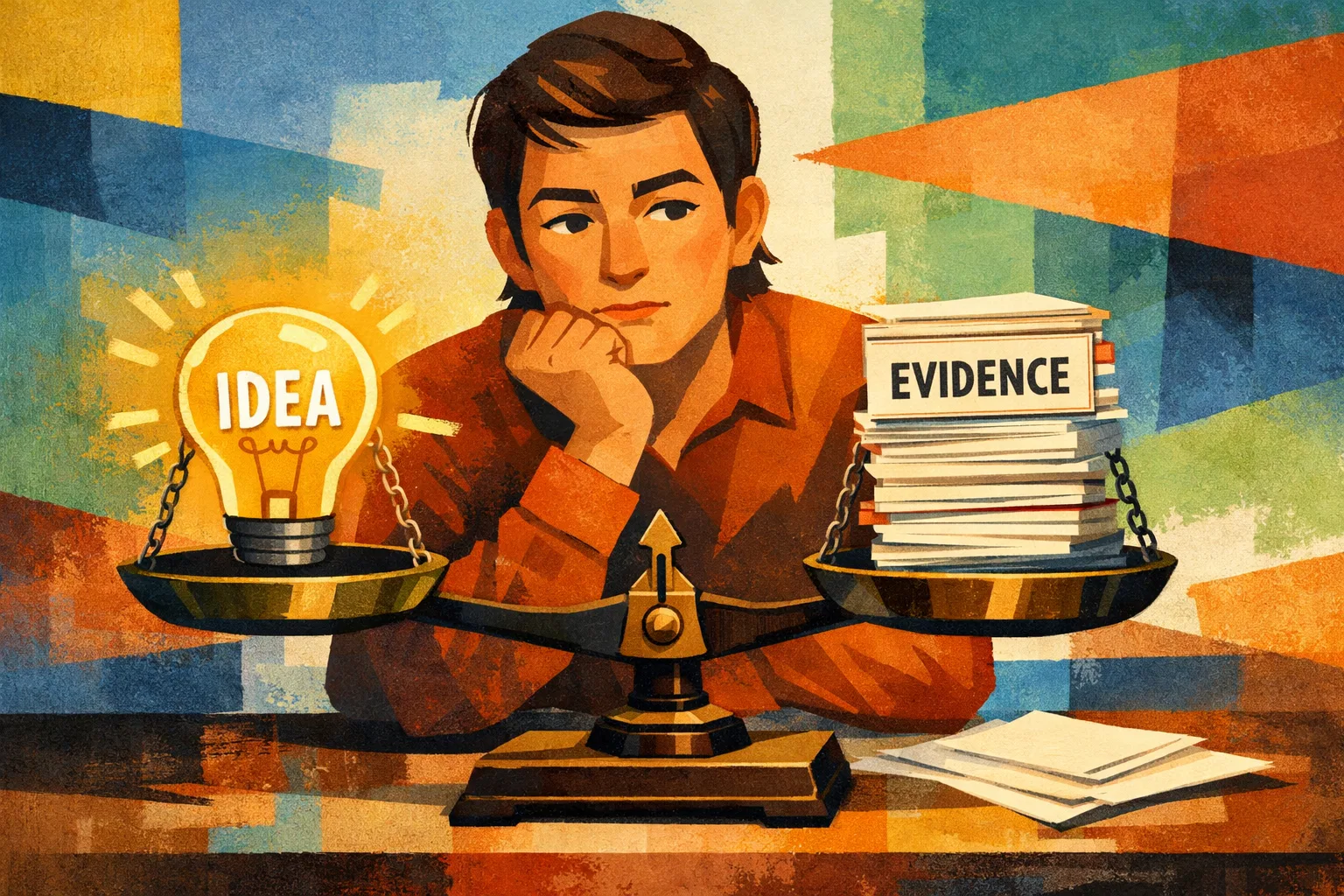
Common sense is useful for everyday navigation, but it is a weak evidence test. A claim can feel sensible because it compresses messy experience into a simple story, not because it has been checked against reliable evidence. That is why many myths and misconceptions survive: they sound right before anyone asks what should follow if they were true.
The danger is not that common sense is always wrong. It is that plausibility can arrive too quickly. A neat explanation can borrow authority from familiarity, personal experience, cultural habit or hindsight. In misinformation research, people are often more vulnerable when attention is pulled away from accuracy, and accuracy prompts can improve the quality of what people share online. That finding matters because it shows that the first question should not be “Does this sound reasonable?” but “What would I expect to see if it were true, and do we actually see it?”[Nature]nature.comShifting attention to accuracy can reduce misinformation…by G Pennycook · 2021 · Cited by 1593 — The results show that subtly sh…
Why plausibility is seductive
Common-sense claims often work because they feel economical. They reduce uncertainty, offer a vivid cause and give the listener a usable shortcut. “People only use 10 per cent of their brains” sounds attractive because it turns the mystery of human potential into a simple reserve-capacity story. “Students learn best when taught in their learning style” sounds humane and personalised. “Full moons make people behave strangely” sounds like a pattern many nurses, police officers or teachers might feel they have noticed.
The problem is that these claims can be psychologically satisfying before they are evidentially strong. Neuroscientists reject the 10 per cent brain myth: MIT’s McGovern Institute describes it as “100 per cent a myth”, noting that scientists believe we use the whole brain every day, while Scientific American reported neurologist Barry Gordon’s blunt assessment that the claim is badly wrong. The myth survives because it preserves the appealing idea that hidden mental powers are waiting to be unlocked.[mit]mcgovern.mit.eduIn fact, scientists believe that we use our entire brain every dayMIT McGovern InstituteDo we only use 10 percent of our brain?January 26, 2024 — 26 Jan 2024 — The idea that we use 10 percent of our brai…
Learning styles offer a similar lesson. It feels sensible that visual learners should learn best visually and auditory learners auditorily. Yet the important claim is not merely that people have preferences; it is that matching instruction to those preferences improves learning. Reviews and education summaries repeatedly find little or no support for that matching hypothesis. The University of Michigan’s teaching centre states that no study has shown that teaching to an identified learning style improves retention, learning outcomes or student success, and a 2025 review by John Hattie and Gregory Donoghue says there is no evidence that matching learning styles to teaching styles makes much positive difference.[Online Teaching]onlineteaching.umich.eduthe myth of learning stylesthe myth of learning styles
This is why “it makes sense” is not the same as “it is probably true”. Plausibility is often a property of the story, not of the world. A myth can be elegant, memorable and socially useful while still failing when tested.
The hidden weakness: common sense explains after the fact
Common sense is especially poor when it is used to explain outcomes that have already happened. Once we know the result, we can usually build a story that makes it appear natural. This is the logic behind hindsight bias: people tend to see past events as more predictable after they know how those events turned out.[The Decision Lab]thedecisionlab.comSource details in endnotes.
That matters for myths because many misconceptions are not born as formal theories. They grow from after-the-fact explanation. A treatment “worked” after someone tried it. A crime happened under a full moon. A child performed better after receiving a teaching method that matched their supposed style. A public figure succeeded because of one personality trait. Each story can feel coherent when told backwards.
Duncan Watts’s work on the failure of common sense in social explanation is useful here because it highlights a common trap: explanations can be persuasive after an outcome is known even when they would not have helped us predict the outcome in advance. Public descriptions of his book Everything Is Obvious (Once You Know the Answer) stress this point: common-sense reasoning can mislead people into thinking they understand human behaviour and complex social systems better than they do.[Google Books]books.google.comSource details in endnotes.
The test is simple but demanding: could the same common-sense reasoning have predicted the opposite outcome? If so, it is not strong evidence. For example, if a student improves after personalised instruction, common sense may say, “Of course, people learn best in their preferred way.” If the student does not improve, another common-sense story is ready: “Of course, real learning requires challenge beyond comfort.” Both sound reasonable. Only a properly designed comparison can tell which explanation has evidence behind it.
Testing predictions against evidence
A stronger evidence test begins by turning a plausible claim into a prediction. If the claim is true, what should reliably happen? What should not happen? What would count against it?
For learning styles, the prediction is not vague. If matching works, then students identified as visual learners should learn the same material better when taught visually, while students with a different style should learn better when taught in their matched way. That interaction is the key test. The continuing weakness of evidence for this pattern is why the learning-styles claim remains a myth despite its intuitive appeal.[PMC]pmc.ncbi.nlm.nih.govPMCNudging Social Media toward AccuracyNIHby G Pennycook · 2022 · Cited by 126 — We review research that shows how a simple nudge or prompt that shifts attention to accur…
For full-moon beliefs, the prediction is also testable. If the lunar cycle meaningfully affects psychiatric crises, admissions or violent behaviour, those outcomes should rise in detectable patterns around particular moon phases. Studies often fail to find such patterns. A Swiss Medical Weekly study reported no connection between lunar cycles and psychiatric inpatient admissions, discharge rates or length of stay, and a 2026 emergency psychiatry study likewise concluded that the moon had no significant influence on psychiatric emergency consultations at population level.[smw.ch]smw.chSource details in endnotes.
For misinformation, the prediction may concern behaviour rather than a factual claim. If people share false claims mainly because they deeply prefer falsehoods that flatter their side, accuracy reminders might not do much. But experiments reviewed by Pennycook and colleagues find that small prompts shifting attention to accuracy can improve the quality of news people share. That does not mean bias is irrelevant; it means the “people believe what they want to believe” explanation is too simple.[Nature]nature.comOpen source on nature.com.
Good evidence tests often make myths less comfortable because they remove the protection of vagueness. “It stands to reason” becomes “what would we observe?” A claim that cannot survive that move may still be a useful metaphor, but it should not be treated as knowledge.
Why personal experience can mislead
Personal experience is not worthless, but it is a narrow sample. It is shaped by what a person noticed, remembered, expected and repeated. That makes it especially vulnerable to myths that fit a familiar pattern.
One mechanism is cognitive fluency: information that is easy to process can feel more credible. Repetition can also create the illusory truth effect, where familiar claims are more likely to be judged true, even when they are false. This helps explain why a claim that has circulated for years may feel like common sense simply because it has become easy to recognise.[The Decision Lab]thedecisionlab.comSource details in endnotes.
Another mechanism is confirmation bias. Raymond Nickerson’s widely cited review describes confirmation bias as the tendency to seek or interpret evidence in ways that are partial to existing beliefs, expectations or hypotheses. In everyday terms, once someone suspects that full moons bring chaos, they are more likely to notice memorable full-moon incidents and less likely to count all the ordinary full-moon shifts when nothing unusual happened.[UC San Diego Pages]pages.ucsd.eduUC San Diego Pages Confirmation Bias: A Ubiquitous Phenomenon in ManyUC San Diego Pages Confirmation Bias: A Ubiquitous Phenomenon in Many
This is why many myths do not feel like myths from the inside. They feel like accumulated observation. The weak point is not usually that people are inventing experiences; it is that experience alone rarely supplies a fair comparison group. Without counting misses as well as hits, and ordinary cases as well as vivid ones, the mind can mistake salience for evidence.
Better questions to ask
The practical alternative to common sense is not cynicism. It is disciplined curiosity. Instead of treating plausibility as a verdict, treat it as the beginning of a check.
A better evidence test asks:[wired.com]wired.comSource details in endnotes.
- What exactly is being claimed? “People have learning preferences” is weaker and more plausible than “matching teaching to those preferences improves learning outcomes.”
- What would follow if it were true? A real effect should produce observable differences, not just satisfying anecdotes.
- What comparison is missing? Many myths rely on examples without asking what happens in similar cases where the supposed cause is absent.
- Could the opposite also sound like common sense? If both the claim and its opposite can be made to feel obvious, plausibility is doing little evidential work.
- What do higher-quality sources say? Prefer systematic reviews, controlled studies, official statistics, primary research and expert institutions over repeated slogans or isolated stories.
- What would change your mind? A claim that has no imaginable disconfirming evidence is closer to belief-protection than evidence-testing.
These questions are especially important for myths and misconceptions because the false claim often contains a grain of truth. People do differ in preferences. The brain does have untapped potential for learning and adaptation. Emergency workers may genuinely remember intense nights around a full moon. But a grain of truth can support a misleading generalisation if the stronger version of the claim is never tested.

The right role for common sense
Common sense is best treated as a hypothesis generator, not a judge. It can suggest where to look, what might matter and which claims deserve testing. It becomes risky when it is used to stop inquiry.
In everyday life, common sense helps with low-stakes, familiar situations where feedback is quick: do not touch a hot pan, bring an umbrella when the sky is dark, be wary of an offer that seems too good to be true. But myths and misconceptions often concern systems where feedback is delayed, noisy or easy to misread: learning, health, crime, politics, memory, risk and human behaviour. In those areas, intuition may point in a useful direction, but it cannot substitute for evidence.
The strongest habit is to separate two questions that people often blend together: “Can I imagine why this might be true?” and “Has it survived a fair test?” Myths thrive in the gap between those questions. Common sense makes the first question easy. Evidence is what answers the second.
Amazon book picks
Further Reading
Books and field guides related to When Common Sense Leads US Wrong. Use these as the next step if you want deeper reading beyond the article.
The Skeptics' Guide to the Universe
Provides tools for testing claims against evidence.
eBay marketplace picks
Marketplace Samples
Example marketplace items related to this page. Use the search link to explore similar finds on eBay.


Endnotes
1.
Source: nature.com
Link:https://www.nature.com/articles/s41586-021-03344-2
Source snippet
Shifting attention to accuracy can reduce misinformation...by G Pennycook · 2021 · Cited by 1593 — The results show that subtly sh...
2.
Source: pmc.ncbi.nlm.nih.gov
Title: PMCNudging Social Media toward Accuracy
Link:https://pmc.ncbi.nlm.nih.gov/articles/PMC9082967/
Source snippet
NIHby G Pennycook · 2022 · Cited by 126 — We review research that shows how a simple nudge or prompt that shifts attention to accur...
3.
Source: mcgovern.mit.edu
Title: In fact, scientists believe that we use our entire brain every day
Link:https://mcgovern.mit.edu/2024/01/26/do-we-use-only-10-percent-of-our-brain/
Source snippet
MIT McGovern InstituteDo we only use 10 percent of our brain?January 26, 2024 — 26 Jan 2024 — The idea that we use 10 percent of our brai...
Published: January 26, 2024
4.
Source: pmc.ncbi.nlm.nih.gov
Title: PMCHindsight Bias and Developing Theories of Mind
Link:https://pmc.ncbi.nlm.nih.gov/articles/PMC3649066/
5.
Source: books.google.com
Link:https://books.google.com/books/about/Everything_is_Obvious.html?id=n531Hz9qtp4C
6.
Source: pmc.ncbi.nlm.nih.gov
Title: PMCThe Learning Styles Myth is Thriving in Higher Education
Link:https://pmc.ncbi.nlm.nih.gov/articles/PMC4678182/
7.
Source: smw.ch
Link:https://smw.ch/index.php/smw/article/download/2616/4138?inline=1
8.
Source: nature.com
Link:https://www.nature.com/articles/s44159-021-00006-y
9.
Source: scholar.google.com
Link:https://scholar.google.com/citations?hl=en&user=AIbJenwAAAAJ
10.
Source: books.google.com
Title: Everything is Obvious
Link:https://books.google.com/books/about/Everything_is_Obvious.html?id=J8uwpwAACAAJ
11.
Source: ide.mit.edu
Title: Pennycook et al Shifting attention to accuracy
Link:https://ide.mit.edu/sites/default/files/publications/Pennycook%20et%20al%20-%20Shifting%20attention%20to%20accuracy.pdf
12.
Source: onlineteaching.umich.edu
Title: the myth of learning styles
Link:https://onlineteaching.umich.edu/articles/the-myth-of-learning-styles/
13.
Source: thedecisionlab.com
Link:https://thedecisionlab.com/biases/hindsight-bias
14.
Source: thedecisionlab.com
Title: The Decision Lab Illusory truth effect
Link:https://thedecisionlab.com/biases/illusory-truth-effect
15.
Source: pages.ucsd.edu
Title: UC San Diego Pages Confirmation Bias: A Ubiquitous Phenomenon in Many
Link:https://pages.ucsd.edu/~mckenzie/nickersonConfirmationBias.pdf
16.
Source: Wikipedia
Title: Hindsight bias
Link:https://en.wikipedia.org/wiki/Hindsight_bias
17.
Source: frontiersin.org
Link:https://www.frontiersin.org/journals/psychology/articles/10.3389/fpsyg.2024.1430953/full
Additional References
18.
Source: researchgate.net
Link:https://www.researchgate.net/publication/242124604_Metacognitive_Experiences_and_the_Intricacies_of_Setting_People_Straight_Implications_for_Debiasing_and_Public_Information_Campaigns
19.
Source: researchgate.net
Link:https://www.researchgate.net/publication/316486755_Cognitive_Biases_and_Their_Influence_on_Critical_Thinking_and_Scientific_Reasoning_A_Practical_Guide_for_Students_and_Teachers
20.
Source: binodshankar.com
Link:https://binodshankar.com/book-summaries/50-great-myths-of-popular-psychology-shattering-widespread-misconceptions-about-human-behavior/
21.
Source: wired.com
Link:https://www.wired.com/2015/01/need-know-learning-styles-myth-two-minutes
22.
Source: facebook.com
Link:https://www.facebook.com/AmericanPsychologicalAssociation/posts/you-keep-seeing-the-same-claim-made-over-and-over-onlineso-it-must-be-true-right/1290086699819665/
23.
Source: atlantic-books.co.uk
Link:https://atlantic-books.co.uk/book/everything-is-obvious/
24.
Source: facebook.com
Link:https://www.facebook.com/groups/310277441973955/posts/877231828611844/
25.
Source: apa.org
Link:https://www.apa.org/education-career/k12/learners
26.
Source: tedxmidatlantic.com
Link:https://tedxmidatlantic.com/talks/duncan-watts-the-myth-of-common-sense/
27.
Source: nirandfar.com
Link:https://www.nirandfar.com/obvious/
Topic Tree