Within Mental Models
Why Natural Health Myths Feel Coherent
Natural health myths feel convincing when safety, distrust, and personal testimony all reinforce the same simple model.
On this page
- The hidden model behind 'natural means safe'
- Why anecdotes beat statistics inside the model
- How corrections can replace the whole frame
Page outline Jump by section
Introduction
Natural health myths often survive because they offer more than a single mistaken claim. They provide a complete way of understanding health, illness, risk and trust. Within that framework, natural is assumed to mean safer, the body is believed to heal itself if left undisturbed, modern medicine is viewed as overly artificial or commercially motivated, and personal experience is treated as the most trustworthy form of evidence. When these ideas reinforce one another, the result is a coherent mental model rather than a collection of disconnected beliefs. Research on health misinformation shows that such models are often sustained by intuitive reasoning, emotional appeal and distrust of institutions, making them resistant to simple fact-checking.[PMC]pmc.ncbi.nlm.nih.govPMCThe role of discomfort in the continued influence effectby MW Susmann 2021 Cited by 90 The present research tested the prediction that retractions of misinformation produce feelings of…
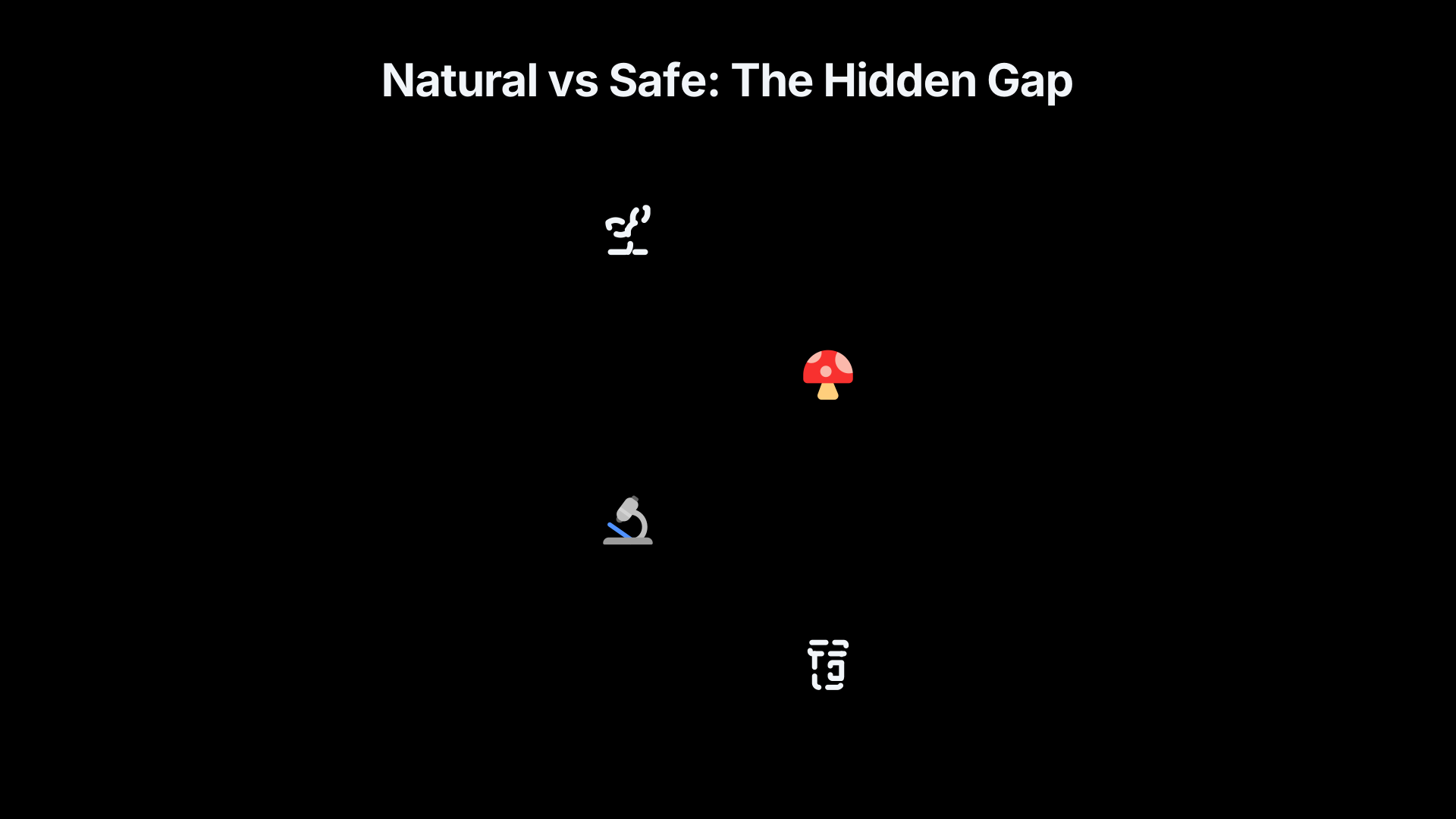 The strength of the model is not that every part is correct. Its strength is that each part appears to explain and confirm the others.
The hidden model behind natural means safe
Many natural health myths begin with a simple intuition: things found in nature seem pure, familiar and unaltered, while laboratory-made products seem artificial and potentially dangerous. Psychologists describe this tendency as the natural-is-better or naturalness bias. Studies repeatedly find that people often prefer products labelled natural, including medicines and vaccines, even when they are told the natural option is less effective or less safe.[ScienceDirect]sciencedirect.comReview The naturalness biasby BP Meier 2025 Cited by 4 Research shows that people have a natural-is-better belief wher…
On its own, a preference for natural products would not create a durable myth. The important step is that the preference becomes part of a wider explanatory system:
- Natural substances are assumed to work in harmony with the body.
- Synthetic substances are assumed to interfere with natural processes.
- Side effects become evidence that a treatment is unnatural.
- Disease is interpreted as a sign that the body has become disconnected from nature.
- Recovery is associated with restoring a natural balance rather than targeting a specific biological mechanism.
Once these assumptions are linked together, they can explain many different situations. A person who feels unwell after taking a medicine may see the experience as proof that artificial interventions are harmful. A story about a herbal remedy helping someone recover becomes evidence that nature provides what the body needs. Each new example appears to confirm the model rather than challenge it.
The problem is that natural and safe are not the same category. Many natural substances are toxic, while many synthetic treatments have undergone extensive testing for safety and effectiveness. Medical organisations regularly warn that natural products can interact with medicines, produce serious side effects and vary greatly in quality.[Mayo Clinic]mayoclinic.orgart 20587690Mayo ClinicNatural vs. safe: Why the two aren't the same16 Aug 2025 "Natural" on the label doesn't mean safe in your body. Learn the tr…
Yet within the mythic model, safety is not primarily assessed through testing or population-level evidence. It is inferred from perceived naturalness.
Why anecdotes beat statistics inside the model
One of the most distinctive features of natural health myths is the elevated status of personal testimony.
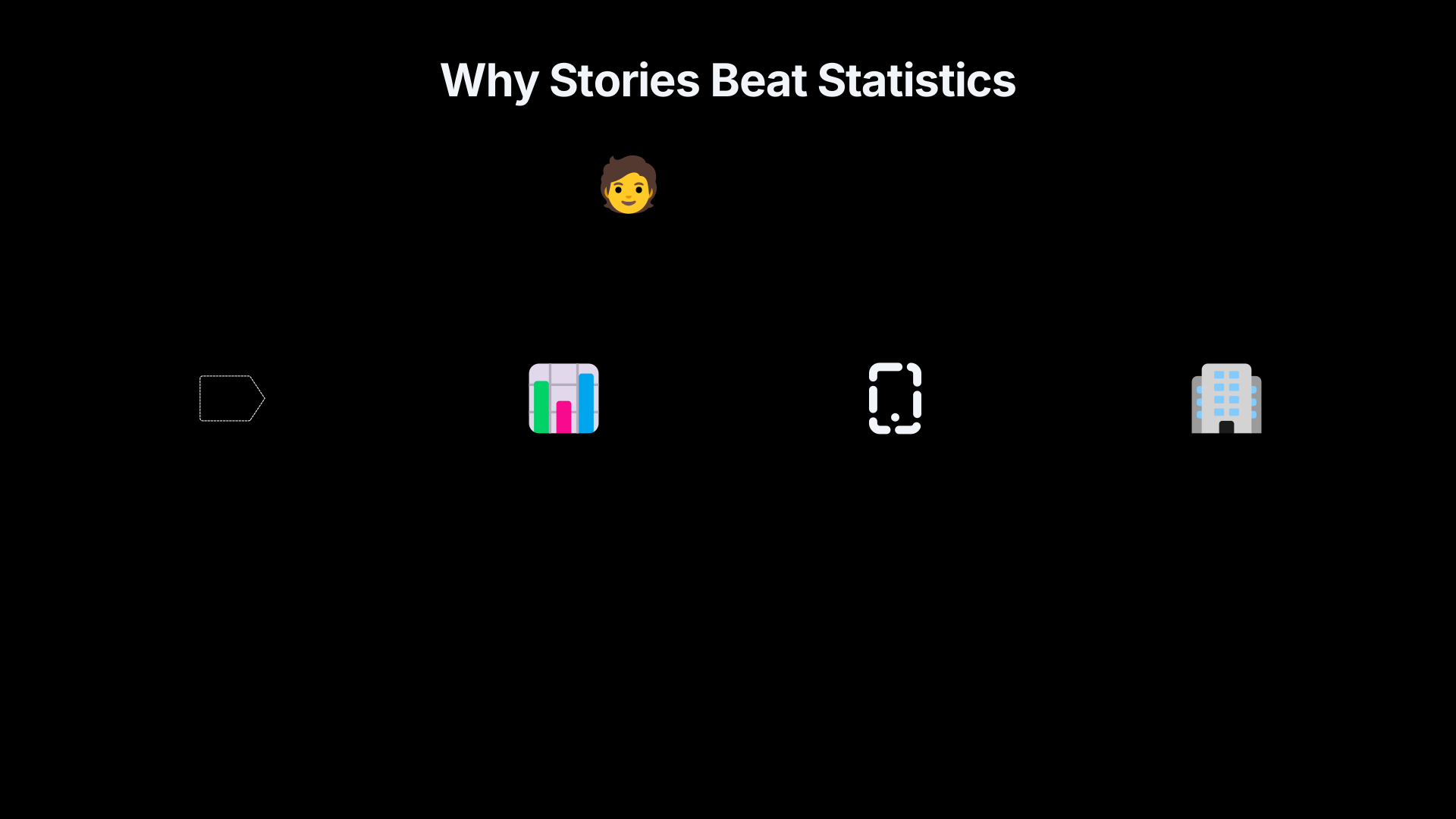
A typical anecdote has all the elements people naturally find persuasive: a named person, a visible problem, a simple intervention and an apparent improvement. It creates a causal story. By contrast, statistical evidence often describes probabilities across thousands of people, making it less emotionally vivid even when it is far more reliable.[Wikipedia]WikipediaAnecdotal evidenceAnecdotal evidence
Within the natural-health model, anecdotes become especially powerful because they fit existing expectations. Consider the following chain of reasoning:
- Natural remedies are believed to be safer.
- Mainstream medicine is viewed with suspicion.
- Someone reports success with a natural remedy.
- The story confirms both earlier assumptions.
The anecdote is therefore doing more than reporting an outcome. It is validating the entire worldview.
This helps explain why contradictory evidence often struggles to gain traction. Large clinical studies are designed to separate genuine treatment effects from coincidence, placebo effects and selective memory. But inside the mythic framework, those studies may be interpreted as products of institutions that are already viewed as untrustworthy. The evidence is rejected not because it is weak but because it originates from the wrong place.
Research on health misinformation consistently finds that distrust of institutions and reliance on intuitive forms of reasoning can make people more receptive to unsupported health claims. Social media environments amplify the effect because emotionally engaging personal stories spread more easily than discussions of methodology or statistical uncertainty.[PMC]pmc.ncbi.nlm.nih.govPMCThe role of discomfort in the continued influence effectby MW Susmann 2021 Cited by 90 The present research tested the prediction that retractions of misinformation produce feelings of…[The Guardian]theguardian.comThe Guardian Are you falling for wellness misinformation online?Here's how to tellOnline wellness misinformation commonly appears on social media as warnings, anecdotal solutions, and unproven remedies…
How distrust completes the picture
A coherent myth requires more than a preferred explanation. It also needs a reason why competing explanations should be ignored.
This is where distrust becomes important. In many natural-health belief systems, pharmaceutical companies, regulators, researchers and medical professionals are not simply viewed as potentially mistaken. They are often portrayed as actors whose incentives make them unreliable sources of information.
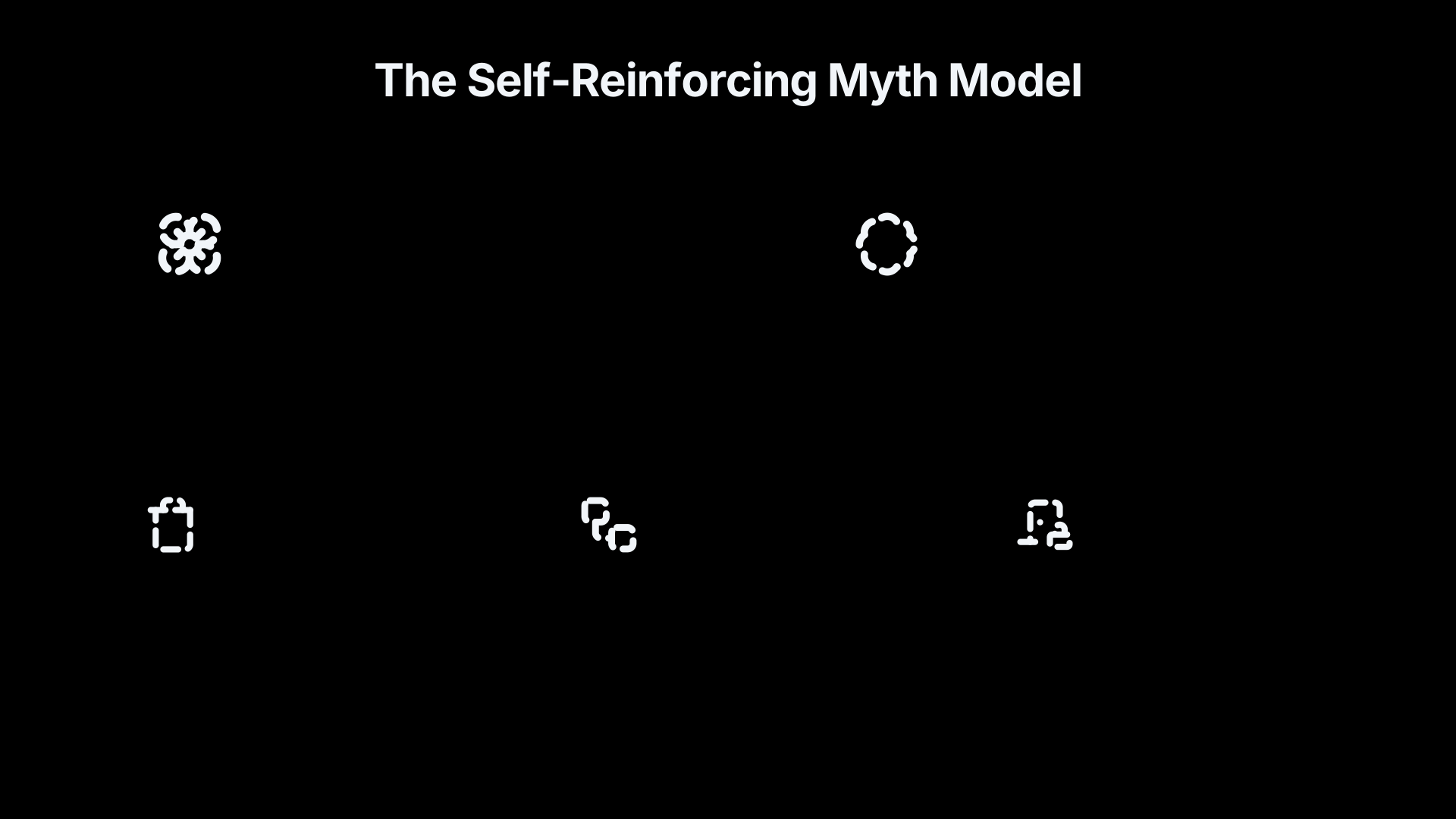
The result is a self-reinforcing structure:
- Natural treatments are assumed to be beneficial.
- Conventional medicine is assumed to be compromised.
- Contradictory evidence is attributed to institutional bias.
- Supporting anecdotes are treated as independent confirmation.
Because every challenge can be interpreted as further evidence of corruption or concealment, the model becomes difficult to falsify. Research examining links between naturalness preferences and conspiratorial thinking suggests that distrust of institutions can strengthen preferences for natural treatments, while naturalness preferences can in turn make anti-institutional explanations seem more plausible.[ResearchGate]researchgate.netResearchGate(PDF) Conspiracy beliefs and the preference for natural…August 29, 2024 2 Aug 2025 This paper provides a comprehensive…
This does not mean that all criticism of medical institutions is irrational. Scientific and medical organisations can make mistakes, and public scepticism sometimes plays a useful role. The issue is that the mythic model often transforms reasonable scrutiny into a blanket assumption that institutional evidence is inherently suspect while personal testimony is inherently trustworthy.
How corrections can replace the whole frame
Correcting a natural health myth is often harder than presenting a contrary fact. If the myth is embedded within a complete model, removing one claim leaves unanswered questions.
For example, telling someone that a particular herbal remedy has not been shown to work may not address the broader assumptions that made the claim persuasive. They may still believe that natural substances are safer, that mainstream medicine suppresses alternatives and that personal experiences reveal truths hidden by formal research.
Research on misinformation and the continued influence effect shows that people frequently continue using outdated or false information after it has been corrected, especially when the correction fails to provide an alternative explanation. Misinformation tends to persist because it occupies a meaningful place within a person’s mental model.[digitalcommons.chapman.edu]digitalcommons.chapman.eduA Meta-Analytic Examination of the Continued Influence of…by N Walter 2019 Cited by 650 Once a mental model is constructed, it h…[University of Bristol]research-information.bris.ac.ukmisinformation and its correction continued influence and successUniversity of BristolMisinformation and Its Correction: Continued Influence and…by S Lewandowsky 2012 Cited by 4713 We look at p…
More effective corrections therefore replace the frame rather than merely attack a fact. Instead of saying:
- Natural remedies do not work.
A stronger correction explains:
- Why some natural substances work and others do not.
- Why safety depends on testing rather than origin.
- Why personal experiences can be sincere yet misleading.
- Why controlled studies are designed to identify genuine effects.
This alternative model preserves a coherent explanation of health decisions while aligning more closely with scientific evidence.
Why coherence matters more than accuracy
Natural health myths endure because they answer several questions at once. They explain what causes illness, whom to trust, how to judge treatments and why conflicting information exists. Their appeal comes less from any single claim than from the way multiple assumptions fit together into a seemingly complete picture.
Understanding that structure changes how misconceptions are viewed. The challenge is not simply correcting an isolated belief about a remedy, supplement or treatment. It is recognising the underlying model that makes the belief feel reasonable. Until that model is replaced with a more convincing explanation, new facts may struggle to find a place in the story people use to make sense of health and medicine.[Nature]nature.comThe psychological drivers of misinformation belief and its…by UKH Ecker 2022 Cited by 1919 In this Review, we describe the…[ScienceDirect]sciencedirect.comReview The naturalness biasby BP Meier 2025 Cited by 4 Research shows that people have a natural-is-better belief wher…
Amazon book picks
Further Reading
Books and field guides related to Why Natural Health Myths Feel Coherent. Use these as the next step if you want deeper reading beyond the article.
Bad Science
Directly tackles alternative medicine claims, anecdotes, and weak evidence.
Thinking, Fast and Slow
Explains cognitive biases that support naturalness bias and anecdotal reasoning.

Do You Believe in Magic?
First published 2013. Subjects: Corrupt practices, Alternative medicine, Complementary Therapies, Deception, Quackery.
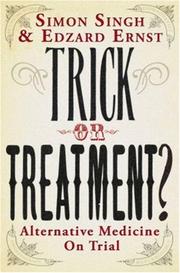
Trick or Treatment?
First published 2008. Subjects: Placebo Effect, Evidence-Based Medicine, Complementary Therapies, Alternative medicine, Quackery.
eBay marketplace picks
Marketplace Samples
Example marketplace items related to this page. Use the search link to explore similar finds on eBay.

Endnotes
1.
Source: pmc.ncbi.nlm.nih.gov
Link:https://pmc.ncbi.nlm.nih.gov/articles/PMC9421549/
Source snippet
Infodemics and health misinformation: a systematic review of...by IJB do Nascimento 2022 Cited by 718 This phenomenon, called a...
2.
Source: nature.com
Link:https://www.nature.com/articles/s44159-021-00006-y
Source snippet
The psychological drivers of misinformation belief and its...by UKH Ecker 2022 Cited by 1919 In this Review, we describe the...
3.
Source: sciencedirect.com
Link:https://www.sciencedirect.com/science/article/pii/S2352250X25001563
Source snippet
Review The naturalness biasby BP Meier 2025 Cited by 4 Research shows that people have a natural-is-better belief wher...
4.
Source: Wikipedia
Title: Anecdotal evidence
Link:https://en.wikipedia.org/wiki/Anecdotal_evidence
5.
Source: researchgate.net
Link:https://www.researchgate.net/publication/383519746_Conspiracy_beliefs_and_the_preference_for_natural_treatments_in_medical_decision-making
Source snippet
ResearchGate(PDF) Conspiracy beliefs and the preference for natural...August 29, 2024 2 Aug 2025 This paper provides a comprehensive...
Published: August 29, 2024
6.
Source: digitalcommons.chapman.edu
Link:https://digitalcommons.chapman.edu/cgi/viewcontent.cgi?article=1061&context=comm_articles
Source snippet
A Meta-Analytic Examination of the Continued Influence of...by N Walter 2019 Cited by 650 Once a mental model is constructed, it h...
7.
Source: pmc.ncbi.nlm.nih.gov
Title: PMCThe role of discomfort in the continued influence effect
Link:https://pmc.ncbi.nlm.nih.gov/articles/PMC8447889/
Source snippet
by MW Susmann 2021 Cited by 90 The present research tested the prediction that retractions of misinformation produce feelings of...
8.
Source: sciencedirect.com
Link:https://www.sciencedirect.com/science/article/pii/S2405457726000422
Source snippet
Exploring nutritional myths and [fake news]({{ 'fake-news/' | relative_url }}): Impact and...by M Capocasa 2026 Cited by 4 Nutritional misinformation represents a sign...
9.
Source: Wikipedia
Title: Naturalistic fallacy
Link:https://en.wikipedia.org/wiki/Naturalistic_fallacy
Source snippet
Naturalistic fallacyThe naturalistic fallacy is the claim that it is possible to define good in terms of merely described entities, pr...
10.
Source: researchgate.net
Link:https://www.researchgate.net/publication/258180567_Misinformation_and_Its_Correction_Continued_Influence_and_Successful_Debiasing
Source snippet
tions of misinformation are so ineffective in memory updating and why...
11.
Source: mayoclinic.org
Title: art 20587690
Link:https://www.mayoclinic.org/tests-procedures/complementary-alternative-medicine/in-depth/natural-vs-safe-health-remedies/art-20587690
Source snippet
Mayo ClinicNatural vs. safe: Why the two aren't the same16 Aug 2025 "Natural" on the label doesn't mean safe in your body. Learn the tr...
12.
Source: theguardian.com
Title: The Guardian Are you falling for wellness misinformation online?
Link:https://www.theguardian.com/wellness/2025/jan/08/health-misinformation-online-tips
Source snippet
Here's how to tellOnline wellness misinformation commonly appears on social media as warnings, anecdotal solutions, and unproven remedies...
13.
Source: research-information.bris.ac.uk
Title: misinformation and its correction continued influence and success
Link:https://research-information.bris.ac.uk/en/publications/misinformation-and-its-correction-continued-influence-and-success/
Source snippet
University of BristolMisinformation and Its Correction: Continued Influence and...by S Lewandowsky 2012 Cited by 4713 We look at p...
14.
Source: youtube.com
Title: The Continued Influence Effect
Link:https://www.youtube.com/watch?v=eZ_hcf01EFw
Source snippet
Why do memories of...The continued influence effect is when misinformation continues to exist in a person's memory even after they've le...
Additional References
15.
Source: behavioralscientist.org
Title: natural is better how the naturalistic fallacy derails public health
Link:https://behavioralscientist.org/natural-is-better-how-the-naturalistic-fallacy-derails-public-health/
Source snippet
How the Appeal To Nature Fallacy Derails Public Health8 Mar 2021 Our preference for things deemed to be natural is so illogical and sys...
16.
Source: journals.sagepub.com
Link:https://journals.sagepub.com/doi/abs/10.1177/1529100612451018
Source snippet
and Its Correction: Continued Influence and...by S Lewandowsky 2012 Cited by 4718 Sources of the continued influence effect: When...
17.
Source: facebook.com
Link:https://www.facebook.com/ThinkingPowers/posts/many-anti-vaccine-arguments-commit-the-appeal-to-nature-fallacy-which-argues-tha/418487423206876/
Source snippet
that something is better or safer because of its perceived naturalness.Read more...
18.
Source: nhs.uk
Link:https://www.nhs.uk/vaccinations/why-vaccination-is-important-and-the-safest-way-to-protect-yourself/
Source snippet
This page explains how vaccines work, what they contain and the most common side...
19.
Source: act-r.psy.cmu.edu
Title: Hough modeling misinformation related effects
Link:https://act-r.psy.cmu.edu/wordpress/wp-content/uploads/2024/07/Hough_modeling_misinformation-related_effects.pdf
Source snippet
misinformation-related effectsby AR HOUGH 2024 Misinformation and its correction: Continued influence and successful debiasing. Psych...
20.
Source: facebook.com
Link:https://www.facebook.com/AdventHealth/posts/misinformation-can-make-caring-for-your-health-feel-overwhelming-but-knowledge-i/1334274045398561/
Source snippet
empowering. Research shows that evidence-based guidance leads...
21.
Source: youtube.com
Title: An Open Conversation About Ayurvedic Medicine @Doctor Mike
Link:http://www.youtube.com/watch?v=ivswTsqCyLc
Source snippet
Psychology of naturalness bias health misinformation Nature & Nurture #102: Dr. Mahzarin Banaji - Myths & Facts About Implicit Bias Natur...
22.
Source: strategian.com
Title: [mental models]({{ ‘mental-models/’ | relative_url }}) misinformation and truth
Link:https://www.strategian.com/2022/12/15/mental-models-misinformation-and-truth/
Source snippet
Mental models: misinformation and truth15 Dec 2022 Misinformation often has an ongoing effect on people's memory and inferential reaso...
23.
Source: cdn.nuffieldbioethics.org
Title: Nuffield Council Naturalness booklet
Link:https://cdn.nuffieldbioethics.org/wp-content/uploads/Nuffield_Council_Naturalness_booklet.pdf
Source snippet
about naturalness in public and political debates...When people describe science, technology or medicine as natural, unnatural or linked...
24.
Source: stmacorpuschristi.com
Link:https://stmacorpuschristi.com/debunking-common-health-myths/
Source snippet
ing the truth behind them with evidence-based insights...
Topic Tree