Within Left Brain
What brain lateralisation really means
Brain functions can be partly lateralised, but that does not mean people learn through one dominant hemisphere.
On this page
- What lateralisation means in neuroscience
- Why specialised regions do not make learner types
- Classroom mistakes caused by overgeneralising brain scans
Page outline Jump by section
Introduction
The idea that some people are left-brain learners while others are right-brain learners comes from a real scientific observation that has been stretched far beyond the evidence. Certain brain functions are partly lateralised, meaning one hemisphere may contribute more strongly to a particular task. Language is often more left-lateralised, while some aspects of spatial attention are more right-lateralised. But neuroscience does not support the claim that people learn through one dominant hemisphere or that students can be divided into reliable learner types based on brain side preference.[PLOS]journals.plos.orgAn Evaluation of the Left-Brain vsRight-Brain Hypothesis with…by JA Nielsen 2013 Cited by 602 We evaluated whether strongly lateralized connections covaried withi…
 The crucial distinction is between specialised functions and whole-person learning styles. Brain lateralisation describes patterns of neural organisation. It does not create separate categories of learners. Modern brain imaging, cognitive science and educational research consistently show that learning depends on networks distributed across both hemispheres, working together through constant communication.[PLOS]journals.plos.orgAn Evaluation of the Left-Brain vsRight-Brain Hypothesis with…by JA Nielsen 2013 Cited by 602 We evaluated whether strongly lateralized connections covaried withi…[Educational Neuroscience]educationalneuroscience.org.ukLeft brain versus right brain thinkersIn the classroom the left brain/right brain myth has resulted in the development of the 'whole-brai…
What lateralisation means in neuroscience
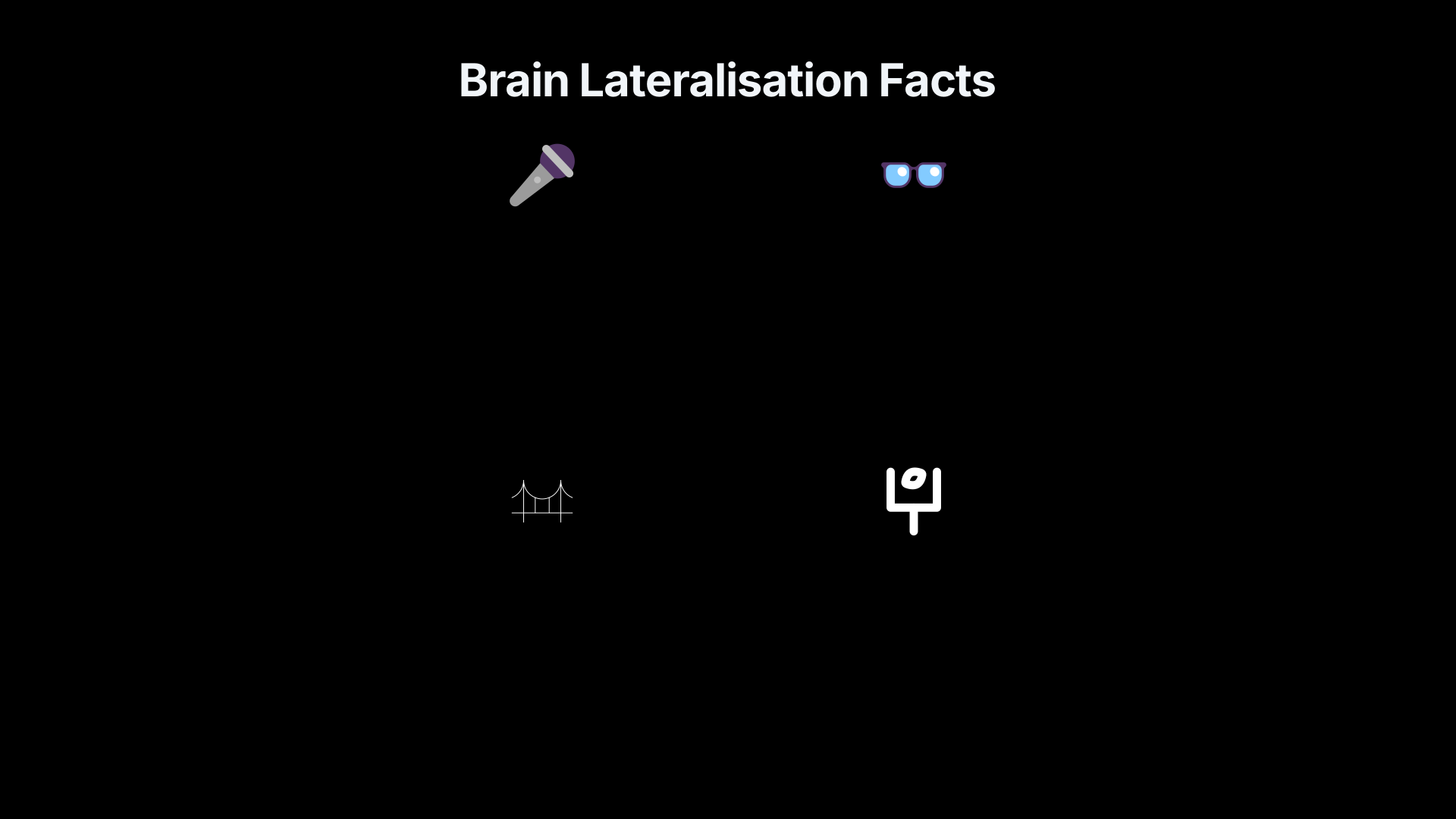
Brain lateralisation refers to the tendency for certain functions to rely more heavily on one hemisphere than the other. It is a matter of relative specialisation, not complete separation.
The most familiar example is language. In most right-handed people, and many left-handed people, language processing is more strongly associated with regions in the left hemisphere. Meanwhile, some aspects of spatial awareness, face recognition and attentional control often show stronger involvement from regions in the right hemisphere.[PLOS]journals.plos.orgAn Evaluation of the Left-Brain vsRight-Brain Hypothesis with…by JA Nielsen 2013 Cited by 602 We evaluated whether strongly lateralized connections covaried withi…
What often gets lost in popular accounts is that these functions are not confined to one side. Even highly lateralised activities involve communication across the brain. Understanding speech, for example, requires more than recognising words. The right hemisphere contributes to tone, rhythm, emotional meaning and broader context. Likewise, mathematical reasoning draws on both numerical processing and spatial representations distributed across multiple regions.[Health]health.comWhat's the Difference Between Your Left Brain and Right Brain?Both sides of the brain work together during most tasks and are connected by brain fibers. While the left hemisphere is traditionally ass…
The brain’s two hemispheres are linked by the corpus callosum, a large bundle of nerve fibres that allows information to move rapidly between sides. Normal cognition depends on this integration. The hemispheres are partners rather than competitors.[Health]health.comWhat's the Difference Between Your Left Brain and Right Brain?Both sides of the brain work together during most tasks and are connected by brain fibers. While the left hemisphere is traditionally ass…
A useful analogy is a football team. Different players have specialised roles, but the team’s performance depends on coordination. Knowing that one player is a defender does not tell you that the entire team is defender-dominant. In the same way, knowing that some brain regions are more active during particular tasks does not justify labelling an entire person according to one hemisphere.

Why specialised regions do not make learner types
The leap from lateralisation to learner categories fails because local specialisation does not automatically become a global personal trait.
One of the most frequently cited studies on this question analysed brain scans from 1,011 individuals aged seven to twenty-nine. Researchers examined whether people consistently showed stronger left-sided or right-sided network organisation across the whole brain. They found lateralised regions, including expected language and attention networks, but they did not find evidence for a general left-brained or right-brained personality type. The authors concluded that the data were not consistent with a global hemispheric dominance phenotype.[PLOS]journals.plos.orgAn Evaluation of the Left-Brain vsRight-Brain Hypothesis with…by JA Nielsen 2013 Cited by 602 We evaluated whether strongly lateralized connections covaried withi…
This finding matters because the learner-type claim requires something much stronger than local specialisation. For the myth to be true, people would need to show a broad and consistent pattern in which one hemisphere dominates many different forms of thinking and learning. Brain imaging has not supported that idea.[PLOS]journals.plos.orgAn Evaluation of the Left-Brain vsRight-Brain Hypothesis with…by JA Nielsen 2013 Cited by 602 We evaluated whether strongly lateralized connections covaried withi…
Several additional problems weaken the learner-type model:
- Different skills rely on different networks. A student may be strong in writing, music and geometry for different reasons involving different brain systems.
- Learning changes the brain. Neural organisation adapts through practice and experience. Fixed learner categories do not fit this flexibility.
- Task demands matter more than personality labels. The same person may use different cognitive strategies depending on the subject, difficulty level and prior knowledge.
- Individual differences exist, but not in a simple two-group pattern. Variation in memory, attention, motivation and background knowledge explains far more about learning outcomes than supposed hemisphere dominance. Taylor & Francis Online[Educational Neuroscience]educationalneuroscience.org.ukLeft brain versus right brain thinkersIn the classroom the left brain/right brain myth has resulted in the development of the 'whole-brai…
In other words, people differ, but those differences do not neatly align with a left-brain versus right-brain divide.
Why creativity is not a right-brain skill
Creativity is often presented as the strongest evidence for right-brain learners. Popular diagrams routinely place art, imagination and intuition on the right side, while assigning logic and analysis to the left.
Research paints a much more complicated picture.
Creative work typically involves generating ideas, evaluating them, combining concepts, recalling memories, monitoring goals and refining outputs. These processes recruit multiple brain systems across both hemispheres. A composer writing music, an engineer solving a design problem and a novelist planning a story all rely on distributed networks rather than a single creative side of the brain.[Frontiers]frontiers.mediaFRONTIERS is the science journalism initiative funded by the European Research Council to design a residency program for journal…
The same applies to analytical tasks. Mathematical reasoning, often described as a left-brain activity, frequently depends on spatial processing associated with right-hemisphere networks. Reading combines language systems with visual processing, attention and memory systems spread across the brain.[Health]health.comWhat's the Difference Between Your Left Brain and Right Brain?Both sides of the brain work together during most tasks and are connected by brain fibers. While the left hemisphere is traditionally ass…
This is one reason the left-brain/right-brain framework survives despite being misleading. Real cognitive activities rarely fit into the tidy categories promoted by popular psychology.
How brain scans became oversimplified classroom stories
Many educational neuromyths begin with a genuine scientific finding and then expand into claims the original research never supported.
Early studies of patients with brain injuries and later research on split-brain patients showed that the hemispheres can contribute differently to certain functions. These findings were important and scientifically valid. However, popular culture transformed them into a broader story about personality, intelligence and learning preferences.[Health]health.comWhat's the Difference Between Your Left Brain and Right Brain?Both sides of the brain work together during most tasks and are connected by brain fibers. While the left hemisphere is traditionally ass…
Brain imaging added another source of confusion. Colourful scans showing activity in one region can create the impression that a task is happening entirely in that location. In reality, such images often highlight areas with comparatively stronger activity while leaving out the wider network involved. A scan showing left-hemisphere language activation does not mean the right hemisphere is uninvolved.[OECD]oecd.orgUnderstanding the Brain: The Birth of a Learning ScienceThis has led to the instigation of many national initiatives in OECD countrie…
The visual appeal of neuroscience can make weak claims appear authoritative. Educational researchers have repeatedly warned that neuroscience findings are especially vulnerable to oversimplification when translated into classroom products, training programmes or commercial teaching systems.[Frontiers]frontiers.mediaFRONTIERS is the science journalism initiative funded by the European Research Council to design a residency program for journal…[Frontiers]frontiersin.orgResearch network for academics to stay up-to-date with…
Classroom mistakes caused by overgeneralising brain scans
The most direct harm from the learner-type myth is not scientific confusion but educational decision-making.
When teachers or parents believe a child is fundamentally left-brained or right-brained, they may start interpreting behaviour through that label. A pupil who enjoys drawing might be described as a right-brain learner and subtly steered away from analytical challenges. A mathematically confident student might be viewed as naturally logical but less creative. These assumptions can narrow opportunities rather than expand them.[EdCan]edcan.caneuromyths in educationNeuromyths in EducationSep 29, 2015 Typically, according to this misconception, left-brain learners are more analytical and logica…
The myth also encourages teaching methods aimed at matching instruction to presumed hemisphere dominance. Yet there is no strong evidence that students learn better when lessons are designed around left-brain or right-brain classifications. Reviews of educational neuromyths consistently identify this as a misconception rather than an evidence-based practice.[Frontiers]ch.linkedin.comis a leading research publisher. Our role is to provide the world's scientists with a rigorous and efficient publishing experience.Read more…
A more productive approach focuses on factors that are observable and measurable:
- Prior knowledge of the topic
- Quality and frequency of practice
- Feedback and correction
- Attention and engagement
- Working memory demands
- Clarity of explanations
- Opportunities for retrieval and application
These factors have far stronger links to learning outcomes than hemisphere labels.[Frontiers]ch.linkedin.comis a leading research publisher. Our role is to provide the world's scientists with a rigorous and efficient publishing experience.Read more…
Why the myth remains persuasive
Despite decades of criticism, belief in left-brain and right-brain learner types remains widespread. Surveys of teachers in multiple countries have found that neuromyths are common, including the belief that learners can be categorised according to hemispheric dominance.[Frontiers]ch.linkedin.comis a leading research publisher. Our role is to provide the world's scientists with a rigorous and efficient publishing experience.Read more…[Frontiers]ch.linkedin.comis a leading research publisher. Our role is to provide the world's scientists with a rigorous and efficient publishing experience.Read more…
Part of the appeal is simplicity. The theory offers an easy explanation for complex differences between learners. It turns a difficult questionwhy people vary in interests, strengths and learning outcomesinto a memorable two-category system.
The idea also feels intuitively true because people do have preferences and talents. Some students enjoy artistic activities, others prefer structured analysis. The mistake is assuming that these differences originate from one hemisphere taking charge of learning. Current evidence points instead to a far more interconnected brain, where specialised regions contribute to complex networks and where learning emerges from cooperation across those networks.[PLOS]journals.plos.orgAn Evaluation of the Left-Brain vsRight-Brain Hypothesis with…by JA Nielsen 2013 Cited by 602 We evaluated whether strongly lateralized connections covaried withi…[Taylor & Francis Online]tandfonline.comTaylor & Francis OnlineBeyond left and right: Learning is a whole-brain processby DD Shin 2022 Cited by 12 The argument of left- an…
Understanding lateralisation correctly leads to a more interesting conclusion than the myth itself. The brain does contain specialised systems, but those systems do not divide humanity into left-brained and right-brained learners. The most important feature of learning is not dominance by one hemisphere but the integration of many regions working together.[PLOS]journals.plos.orgAn Evaluation of the Left-Brain vsRight-Brain Hypothesis with…by JA Nielsen 2013 Cited by 602 We evaluated whether strongly lateralized connections covaried withi…[Taylor & Francis Online]tandfonline.comTaylor & Francis OnlineBeyond left and right: Learning is a whole-brain processby DD Shin 2022 Cited by 12 The argument of left- an…
Amazon book picks
Further Reading
Books and field guides related to What brain lateralisation really means. Use these as the next step if you want deeper reading beyond the article.
![Cover for THE TELL- TALE BRAIN [Paperback] [Jan 01, 2012] V S RAMACHANDRAN](https://covers.openlibrary.org/b/id/8764503-M.jpg)
THE TELL- TALE BRAIN [Paperback] [Jan 01, 2012] V S RAMACHANDRAN
First published 2012.

Livewired
First published 2020. Subjects: Physiology, Internal medicine, Brain, Neuroplasticity, Learning.
The learning brain
First published 2005. Subjects: Education, Neuropsychology, Learning, Brain, Physiology.

The brain
First published 2015. Subjects: SCIENCE / Life Sciences / Biology / General, Brain, Self, SCIENCE / Life Sciences / Neuroscience, Neurosc...
eBay marketplace picks
Marketplace Samples
Example marketplace items related to this page. Use the search link to explore similar finds on eBay.
Endnotes
1.
Source: journals.plos.org
Title: An Evaluation of the Left-Brain vs
Link:https://journals.plos.org/plosone/article?id=10.1371%2Fjournal.pone.0071275
Source snippet
Right-Brain Hypothesis with...by JA Nielsen 2013 Cited by 602 We evaluated whether strongly lateralized connections covaried withi...
2.
Source: health.com
Title: What’s the Difference Between Your [Left Brain]({{ ‘left-brain/’ | relative_url }}) and Right Brain?
Link:https://www.health.com/left-brain-vs-right-brain-8709991
Source snippet
Both sides of the brain work together during most tasks and are connected by brain fibers. While the left hemisphere is traditionally ass...
3.
Source: oecd.org
Link:https://www.oecd.org/content/dam/oecd/en/publications/reports/2007/06/understanding-the-brain-the-birth-of-a-learning-science_g1gh76fd/9789264029132-en.pdf
Source snippet
Understanding the Brain: The Birth of a Learning ScienceThis has led to the instigation of many national initiatives in OECD countrie...
4.
Source: oecd.org
Link:https://www.oecd.org/en/publications/2007/06/understanding-the-brain-the-birth-of-a-learning-science_g1gh76fd.html
Source snippet
Understanding the Brain: The Birth of a Learning ScienceThis book provides new insights about learning by synthesising existing and emerg...
5.
Source: edcan.ca
Title: neuromyths in education
Link:https://www.edcan.ca/articles/neuromyths-in-education/
Source snippet
Neuromyths in EducationSep 29, 2015 Typically, according to this misconception, left-brain learners are more analytical and logica...
6.
Source: one.oecd.org
Link:https://one.oecd.org/document/EDU/CERI/CD%282008%2913/en/pdf
Source snippet
EDU/CERI/CD(2008)1313 May 2008 Over the past few years, there has been a growing number of misconceptions circulating about the brain ...
Published: May 2008
7.
Source: oecd.org
Link:https://www.oecd.org/en/publications/understanding-the-brain-the-birth-of-a-learning-science_9789264029132-en.html
Source snippet
Understanding the Brain: The Birth of a Learning ScienceThis book provides new insights about learning by synthesising existing and emerg...
8.
Source: frontiers.media
Link:https://frontiers.media/
Source snippet
FRONTIERS is the science journalism initiative funded by the European Research Council to design a residency program for journal...
9.
Source: tandfonline.com
Link:https://www.tandfonline.com/doi/abs/10.1080/00405841.2022.2096386
Source snippet
Taylor & Francis OnlineBeyond left and right: Learning is a whole-brain processby DD Shin 2022 Cited by 12 The argument of left- an...
10.
Source: educationalneuroscience.org.uk
Link:https://educationalneuroscience.org.uk/wordpress/resources/neuromyth-or-neurofact/left-brain-versus-right-brain-thinkers/
Source snippet
Left brain versus right brain thinkersIn the classroom the left brain/right brain myth has resulted in the development of the 'whole-brai...
11.
Source: frontiersin.org
Link:https://www.frontiersin.org/journals/education/articles/10.3389/feduc.2023.1147498/full
Source snippet
It tries to combat neuromyths: beliefs that appear grounded in neuroscientific research...Read more...
12.
Source: frontiersin.org
Link:https://www.frontiersin.org/journals/education/articles/10.3389/feduc.2021.665752/full
Source snippet
FrontiersReview on the Prevalence and Persistence of Neuromyths...by F Grospietsch 2021 Cited by 87 The neuromyth that logic is lo...
13.
Source: frontiersin.org
Link:https://www.frontiersin.org/journals/psychology/articles/10.3389/fpsyg.2012.00429/full
Source snippet
FrontiersNeuromyths in Education: Prevalence and Predictors of...by S Dekker 2012 Cited by 1263 The present study investigated the...
14.
Source: frontiersin.org
Link:https://www.frontiersin.org/journals/psychology/articles/10.3389/fpsyg.2017.01314/full
Source snippet
Dispelling the Myth: Training in Education or Neuroscience...by K Macdonald 2017 Cited by 448 The next most frequently endorsed ne...
15.
Source: frontiersin.org
Link:https://www.frontiersin.org/journals/psychology/articles/10.3389/fpsyg.2020.591923/full
Source snippet
The Persistence of Neuromyths in the Educational Settingsby M Torrijos-Muelas 2021 Cited by 262 After two decades of publications o...
16.
Source: frontiersin.org
Link:https://www.frontiersin.org/journals/psychology/articles/10.3389/fpsyg.2021.719692/full
Source snippet
terventions to Dispel Neuromyths in Educational Settings...by L Rousseau 2021 Cited by 69 Neuromyths are misconceptions...
17.
Source: frontiersin.org
Link:https://www.frontiersin.org/journals/psychology/articles/10.3389/fpsyg.2017.00804/full
Source snippet
FrontiersBrain Knowledge and the Prevalence of Neuromyths...by M Papadatou-Pastou 2017 Cited by 190 (2015) surveyed 238 teachers a...
18.
Source: educationalneuroscience.org.uk
Link:https://educationalneuroscience.org.uk/wordpress/resources/neuromyth-or-neurofact/
Source snippet
Common misconceptions about the brainCommon misconceptions about the brain Left brain versus right brain thinkers Fish oils improve l...
19.
Source: frontiersin.org
Link:https://www.frontiersin.org/
Source snippet
Research network for academics to stay up-to-date with...
20.
Source: frontiersin.org
Link:https://www.frontiersin.org/journals/psychology/articles/10.3389/fpsyg.2023.1252239/full
Source snippet
Neuromyths and knowledge about intellectual giftedness in...by A Schmitt 2023 Cited by 19 Understanding brain functioning and inte...
21.
Source: frontiersin.org
Link:https://www.frontiersin.org/journals/education/articles/10.3389/feduc.2020.602451/full
Source snippet
How Common Is Belief in the Learning Styles Neuromyth...by PM Newton 2020 Cited by 205 Self-reported belief in matching instructio...
22.
Source: frontiersin.org
Link:https://www.frontiersin.org/journals/psychology/articles/10.3389/fpsyg.2023.1139911/full
Source snippet
Prevalence of neuromyths among psychology studentsby V Novak-Geiger 2023 Cited by 23 The largest significant difference was discove...
23.
Source: ch.linkedin.com
Link:https://ch.linkedin.com/company/frontiers
Source snippet
is a leading research publisher. Our role is to provide the world's scientists with a rigorous and efficient publishing experience.Read more...
24.
Source: Wikipedia
Title: Frontiers Media
Link:https://en.wikipedia.org/wiki/Frontiers_Media
Source snippet
Frontiers MediaFrontiers Media SA is a publisher of peer-reviewed, open access, scientific journals [2] currently active in science, t...
25.
Source: frontiersfoundation.org
Link:https://www.frontiersfoundation.org/
Source snippet
Frontiers Research Foundation: HomeA not-for profit organization based in Lausanne, Switzerland, was established in 2006 by Henry and Kam...
26.
Source: youtube.com
Link:https://www.youtube.com/%40FrontiersIn
Source snippet
FrontiersFrontiers is a leading research publisher, publishing groundbreaking discoveries by experts from around the world....more. Fron...
27.
Source: frontierspartnerships.org
Link:https://www.frontierspartnerships.org/journals
Source snippet
Journals | Frontiers Publishing PartnershipsFrontier's is publishing 140 peer-reviewed open-access journals with Impact Factors on 46 jou...
Additional References
28.
Source: researchgate.net
Link:https://www.researchgate.net/publication/337731017_The_Myth_of_Left-vs_Right-Brain_Learning
Source snippet
(PDF) The Myth of Left-vs Right-Brain LearningThis paper explores the myth of hemispheric dominance in learning, and provides advice to e...
29.
Source: cis.org.au
Link:https://www.cis.org.au/publication/knowledge-is-power-what-do-teachers-believe-about-learning/
Source snippet
The Centre for Independent StudiesKnowledge is power: What do teachers believe about...by T Jha The belief that students can be left-b...
30.
Source: unisc.edu.au
Link:https://www.unisc.edu.au/about/unisc-news/news-archive/2025/april/students-are-neither-left-nor-right-brained-how-some-early-childhood-educators-get-this-neuromyth-and-others-wrong
Source snippet
Students are neither left nor right brained: how some early...Apr 16, 2025 Myth 1: 'teaching to different learning styles will improve...
31.
Source: lthechat.com
Title: 186 [debunking]({{ ‘debunking/’ | relative_url }}) neuromyths in education what psychology really tells us
Link:https://lthechat.com/2020/10/11/lthechat186-debunking-neuromyths-in-education-what-psychology-really-tells-us/
Source snippet
#LTHEchat185: Debunking Neuromyths in Education...Oct 11, 2020 Recent research has suggested that among college-level staff, 97% and 7...
32.
Source: research-portal.uu.nl
Title: neuromyths in education prevalence and predictors of misconceptio
Link:https://research-portal.uu.nl/en/publications/neuromyths-in-education-prevalence-and-predictors-of-misconceptio/
Source snippet
in education: Prevalence and predictors of...by S Dekker 2012 Cited by 1288 The OECD's Brain and Learning project (2002) emphasize...
33.
Source: pmc.ncbi.nlm.nih.gov
Title: PMCAn Evaluation of the Left-Brain vs
Link:https://pmc.ncbi.nlm.nih.gov/articles/PMC3743825/
Source snippet
Right-Brain Hypothesis with...by JA Nielsen 2013 Cited by 602 We evaluated whether strongly lateralized connections covaried withi...
34.
Source: landmark.edu
Title: neuromyths are misconceptions about the brain dangerous
Link:https://www.landmark.edu/research-and-training/blog/neuromyths-are-misconceptions-about-the-brain-dangerous
Source snippet
Neuromyths: are misconceptions about the brain dangerous?Jan 31, 2020 Since the report was published, study after study has shown that...
35.
Source: executiveeducation.wharton.upenn.edu
Link:https://executiveeducation.wharton.upenn.edu/thought-leadership/wharton-at-work/2023/05/insights-from-neuroscience/
Source snippet
Right/Left Brain Myth and More Neuroscience InsightLeft brain people, with the other side of the brain dominant, are more logical and a...
36.
Source: cliffsnotes.com
Link:https://www.cliffsnotes.com/study-notes/7239655
Source snippet
Left-Brain Versus Right-Brain Myth (pdf)For one, students may be taught material in methods that are not actually effective...
37.
Source: uofuhealth.utah.edu
Title: no evidence right brained vs left brained
Link:https://uofuhealth.utah.edu/newsroom/news/2013/no-evidence-right-brained-vs-left-brained
Source snippet
You're "Right-Brained" or "Left-Brained?" Think Again.Aug 20, 2013 Research findings from University of Utah neuroscientists assert tha...
Topic Tree