Within Health Claims
How to Correct Health Myths Kindly
Correcting a health myth from someone close works better when the response protects the relationship as well as the facts.
On this page
- Why direct debunking can feel like an attack
- How to separate care from the false claim
- What a useful replacement explanation gives people
Page outline Jump by section
Introduction
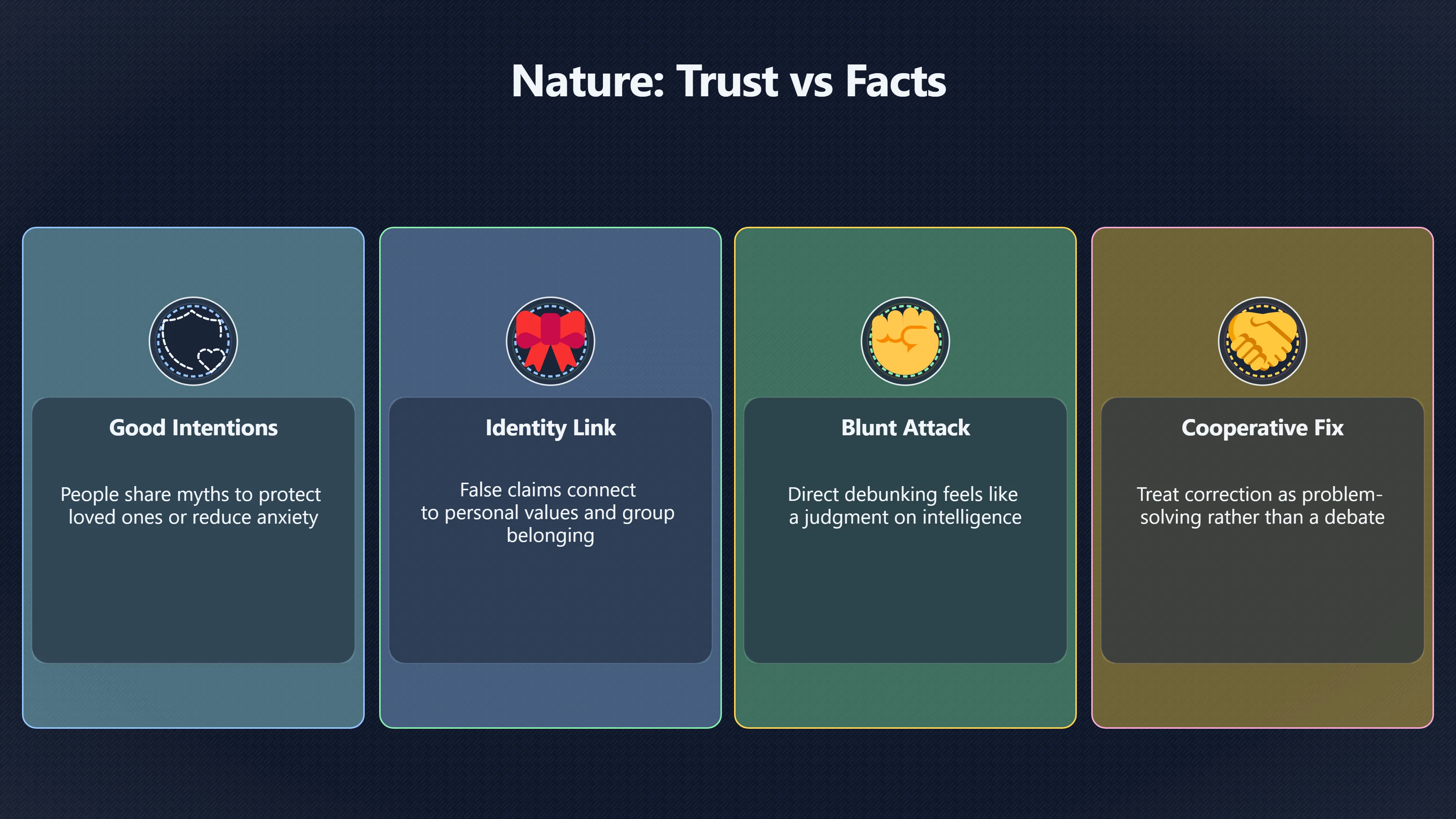
Correcting a health myth from someone you love is rarely just a fact-checking problem. The person sharing the claim may be trying to protect you, help a child, support a sick relative or reduce their own anxiety. That good intention does not make the claim accurate, but it does change how correction works. A blunt response can feel less like a discussion about evidence and more like a judgement on someone’s care, intelligence or values.
 Research on misinformation repeatedly finds that false health claims often persist because they become connected to trust, identity and emotion, not simply because people lack information. Effective correction therefore works on two levels at once: it addresses the inaccurate claim while protecting the relationship that carried it. The goal is not to “win” an argument. It is to reduce harm, preserve trust and make it easier for someone to update their understanding without feeling humiliated or cornered.[Nature]nature.comThe psychological drivers of misinformation belief and its…by UKH Ecker · 2022 · Cited by 1916 — In this Review, we describe the…[Ecker Memory & Cognition Lab]emc-lab.orgecker.2022.nrp preprintEcker Memory & Cognition Lab1 The Psychological Drivers of Misinformation Belief and its…by UKH Ecker · Cited by 1916 — First, the mos…
Why Direct Debunking Can Feel Like an Attack
Many people imagine misinformation correction as a simple exchange: one person says something false, another person provides the facts, and the issue is resolved. Real conversations with family members, partners and close friends rarely work that way.
When someone shares a health myth, they may be expressing deeper concerns beneath the claim itself. A message about vaccines may really be about fear of side effects. A rumour about cancer treatments may reflect desperation after a diagnosis. A warning about food additives may come from a wish to keep children safe.
If the response immediately labels the claim as “nonsense”, the person may hear something different from what was intended:
- “You are gullible.”
- “You are a bad parent.”
- “You cannot be trusted.”
- “Your concerns do not matter.”
This reaction is one reason health misinformation can survive correction. People often defend beliefs that have become linked to identity, belonging or personal experience. Researchers describe psychological barriers that make belief revision difficult even after misinformation is corrected.[Nature]nature.comThe psychological drivers of misinformation belief and its…by UKH Ecker · 2022 · Cited by 1916 — In this Review, we describe the…
The popular idea that corrections inevitably backfire and strengthen false beliefs has been overstated. Large reviews suggest that factual corrections generally help more than they harm. However, effectiveness depends heavily on how the correction is delivered and whether the recipient feels respected enough to consider it. PMC[Harvard Public Health]hsph.harvard.eduHarvard Public HealthCountering health misinformation: 5 lessons from an expert…The backfire effect — when correcting misinformation o…
A useful mindset is to treat the conversation as a cooperative problem-solving exercise rather than a debate. The more a discussion resembles a status contest, the more likely people are to defend their original position.
How to Separate Care From the False Claim
One of the most effective moves in a difficult conversation is to separate the intention from the information.
Instead of responding only to the myth, acknowledge the concern that motivated it.
Consider the difference between these responses:
- “That’s completely false.”
- “I can see why that would worry people. I looked into it because I was concerned too.”
The second approach validates the emotion without validating the claim.
This distinction matters because many health myths travel through trusted relationships. Public-health research on infodemics repeatedly highlights the importance of trusted messengers and community relationships in shaping how people receive information. People are often more open to correction when they believe the other person understands their concerns rather than dismissing them. ScienceDirect[NCBI]ncbi.nlm.nih.govNCBIKey Concepts and Definitions in Infodemic Managementby A Ishizumi · 2023 · Cited by 6 — In such situations, it is particularly important to leverage networks of trusted messengers who a…
Useful phrases include:
- “I know you’re trying to help.”
- “I understand why that sounds alarming.”
- “I had the same question when I first heard it.”
- “Let’s see where this claim came from.”
These responses lower defensiveness while creating room for evidence.
They also avoid a common mistake: arguing against motives that were never the problem. The issue is not that a parent cares about their child or that a friend wants to protect someone from illness. The issue is that the information being used to express that care is unreliable.
Ask Questions Before Providing Facts
People often become more receptive when they explain their own reasoning out loud.
Instead of immediately delivering a correction, ask questions that encourage reflection:
- “Where did you first hear that?”
- “What evidence convinced you?”
- “Do you know whether doctors or researchers have tested that claim?”
- “What would change your mind about it?”
These questions serve two purposes.
First, they reveal whether the person firmly believes the claim or is merely passing it along. Research suggests people sometimes share misinformation because it feels emotionally compelling or socially important, not because they have carefully evaluated it.[Nature]nature.comThe psychological drivers of misinformation belief and its…by UKH Ecker · 2022 · Cited by 1916 — In this Review, we describe the…
Second, questions help people examine weaknesses in a claim themselves. A person who realises they cannot identify a credible source may become more open to alternative information than someone who feels forced into retreat.
The conversation shifts from “I am correcting you” to “We are evaluating this together.”
What a Useful Replacement Explanation Gives People
One reason myths persist is that they often provide a simple explanation for something frightening.
A correction that only says “that’s wrong” creates an information gap. People still want an explanation for what happened, whom to trust and what action to take.
Research on misinformation correction consistently finds that debunking works better when it includes an alternative explanation rather than a simple denial. People need a replacement story that makes sense of the situation.[Ecker Memory & Cognition Lab]emc-lab.orgecker.2022.nrp preprintEcker Memory & Cognition Lab1 The Psychological Drivers of Misinformation Belief and its…by UKH Ecker · Cited by 1916 — First, the mos…[Annenberg School for Communication]asc.upenn.edudebunking study suggests ways counter misinformation and correct fake newsAnnenberg School for CommunicationDebunking Study Suggests Ways to Counter Misinformation…12 Sept 2017 — Debunking is more effective —…
For example:
Less effective
“Vaccines don’t cause infertility.”
More effective[asc.upenn.edu]asc.upenn.edudebunking study suggests ways counter misinformation and correct fake newsAnnenberg School for CommunicationDebunking Study Suggests Ways to Counter Misinformation…12 Sept 2017 — Debunking is more effective —…
“Large studies have looked for fertility problems after vaccination and have not found evidence of them. The rumour began after misinterpreted claims online, but researchers have continued tracking fertility outcomes and have not found the effect people feared.”
The second response gives people somewhere to go mentally after abandoning the myth.
A useful replacement explanation usually includes three elements:
- A clear factual account What the evidence actually shows.
- An explanation for the misunderstanding Where the rumour came from or why it sounded convincing.
- A practical next step A trusted source, clinician conversation or evidence-based action.
Without this replacement structure, misinformation can continue influencing judgement even after people recognise that parts of it were inaccurate. Researchers call this the “continued influence effect”.[PLOS]journals.plos.orgA failure to replicate familiarity or fear-driven backfire effectsby UKH Ecker · 2023 · Cited by 48 — Individuals often continue to r…[ResearchGate]researchgate.netThese recommendations pertain to the ways in which corrections should be…Read more…

When Personal Stories Matter More Than Statistics
Health myths often spread through stories rather than studies.
A relative may say:
“My neighbour took this supplement and got better.”
The challenge is that a scientific explanation can feel emotionally weaker than a vivid personal account.
This does not mean abandoning evidence. It means recognising that people process information through both emotion and reasoning.
Narrative-based corrections sometimes help because they connect evidence to real human experiences. For example, a discussion about vaccine safety may become more meaningful when combined with a story from a trusted doctor, patient or family member rather than relying solely on percentages and graphs. Researchers studying narrative corrections have found potential benefits, though results vary depending on how stories are used.[ScienceDirect]sciencedirect.comTrusted messengers and trusted messages: The role for…by AK Shen · 2023 · Cited by 104 — We sought to explore the trust a…
A balanced approach often works best:
- acknowledge the story;
- explain why individual experiences can be misleading;
- connect the discussion back to broader evidence.
For instance:
“I’m glad your neighbour recovered. The difficult part is that people often improve for many reasons at the same time. That’s why researchers compare large groups of people to see whether a treatment is actually responsible.”

Choosing the Right Moment
Not every myth requires an immediate confrontation.
A family dinner, a funeral, a hospital waiting room or a heated social-media thread may be the worst possible setting for a productive discussion.
Timing affects whether people can process new information. If someone is frightened, grieving or angry, emotional regulation may matter more than fact correction in that moment.
Consider:
- correcting privately rather than publicly;
- waiting until emotions settle;
- focusing on one claim instead of ten;
- choosing the highest-risk misinformation first.
Public-health researchers increasingly frame misinformation as a problem of trust and relationships as much as information itself. Building trust often requires repeated conversations rather than a single decisive correction. Taylor & Francis Online[National Academies]nationalacademies.orgNavigating Infodemics and Building Trust During Public…The Misinformation Unit learned that that public health infodemic management ef…
This is particularly important with older relatives, close friends or long-standing family dynamics where the relationship will continue long after the specific myth is forgotten.
What to Do When the Myth Could Cause Immediate Harm
Kindness does not require passivity.
Some claims create genuine health risks. Advice to stop prescribed medication, avoid emergency treatment, refuse critical vaccines during outbreaks or use dangerous “cures” may require a firmer response.
In these situations:
- state clearly that the claim is unsupported or dangerous;
- provide a reliable alternative source immediately;
- encourage consultation with qualified healthcare professionals;
- focus on the specific harmful action rather than attacking the person’s character.
The aim remains respectful communication, but the urgency changes. Health misinformation can affect treatment decisions, risk perception and health behaviour, which is why organisations such as the World Health Organization describe misinformation and infodemics as public-health threats rather than mere communication problems.[World Health Organization]who.intWorld Health OrganizationInfodemicAn infodemic is too much information including false or misleading information in digital and physical…[World Health Organization]who.intWorld Health OrganizationInfodemicAn infodemic is too much information including false or misleading information in digital and physical…
A practical rule is that the greater the potential harm, the more important it becomes to correct the claim—even if the conversation feels uncomfortable.
Why Repeated Small Corrections Often Work Better
People rarely abandon a health myth after hearing one perfect argument.
Beliefs usually change gradually. Someone may reject a correction today, revisit it weeks later and eventually modify their view after multiple conversations and experiences.
This is one reason experts increasingly encourage consistent, calm correction rather than silence. Evidence suggests that factual corrections are generally effective and that fears of inevitable backlash have often been exaggerated. Repeated exposure to accurate information, especially from trusted sources, can reduce belief in misinformation over time.[Harvard Public Health]hsph.harvard.eduHarvard Public HealthCountering health misinformation: 5 lessons from an expert…The backfire effect — when correcting misinformation o… PMC The most productive outcome is often modest rather than dramatic:[pmc.ncbi.nlm.nih.gov]pmc.ncbi.nlm.nih.govThe backfire effect after correcting misinformation is strongly…by B Swire-Thompson · 2022 · Cited by 111 — The backfire effect is…
- a relative becomes less certain about a rumour;
- a friend decides to verify claims before sharing them;
- a parent speaks with a healthcare professional before acting.
Those changes may seem small, but they interrupt the chain through which health myths spread among people who trust one another.
In families and friendships, successful correction is rarely measured by winning an argument. It is measured by preserving enough trust that accurate information still has a chance to be heard the next time it matters.[NCBI]ncbi.nlm.nih.govNCBIKey Concepts and Definitions in Infodemic Managementby A Ishizumi · 2023 · Cited by 6 — In such situations, it is particularly important to leverage networks of trusted messengers who a…[ScienceDirect]sciencedirect.comTrusted messengers and trusted messages: The role for…by AK Shen · 2023 · Cited by 104 — We sought to explore the trust a…
Amazon book picks
Further Reading
Books and field guides related to How to Correct Health Myths Kindly. Use these as the next step if you want deeper reading beyond the article.
Foolproof: Why We Fall for Misinformation and How to Build Im...
Explains why people believe false claims and how to correct them effectively.

Truth Vaccine
Explains why people believe false claims and how to correct them effectively.
eBay marketplace picks
Marketplace Samples
Example marketplace items related to this page. Use the search link to explore similar finds on eBay.


Endnotes
1.
Source: nature.com
Link:https://www.nature.com/articles/s44159-021-00006-y
Source snippet
The psychological drivers of misinformation belief and its...by UKH Ecker · 2022 · Cited by 1916 — In this Review, we describe the...
2.
Source: who.int
Link:https://www.who.int/health-topics/infodemic
Source snippet
World Health OrganizationInfodemicAn infodemic is too much information including false or misleading information in digital and physical...
3.
Source: researchgate.net
Link:https://www.researchgate.net/publication/258180567_Misinformation_and_Its_Correction_Continued_Influence_and_Successful_Debiasing
Source snippet
These recommendations pertain to the ways in which corrections should be...Read more...
4.
Source: pmc.ncbi.nlm.nih.gov
Link:https://pmc.ncbi.nlm.nih.gov/articles/PMC9283209/
Source snippet
The backfire effect after correcting misinformation is strongly...by B Swire-Thompson · 2022 · Cited by 111 — The backfire effect is...
5.
Source: hsph.harvard.edu
Link:https://hsph.harvard.edu/research/health-communication/resources/countering-health-misinformation-lessons/
Source snippet
Harvard Public HealthCountering health misinformation: 5 lessons from an expert...The backfire effect — when correcting misinformation o...
6.
Source: journals.plos.org
Link:https://journals.plos.org/plosone/article?id=10.1371%2Fjournal.pone.0281140
Source snippet
A failure to replicate familiarity or fear-driven backfire effectsby UKH Ecker · 2023 · Cited by 48 — Individuals often continue to r...
7.
Source: sciencedirect.com
Link:https://www.sciencedirect.com/science/article/abs/pii/S0264410X23001809
Source snippet
Trusted messengers and trusted messages: The role for...by AK Shen · 2023 · Cited by 104 — We sought to explore the trust a...
8.
Source: ncbi.nlm.nih.gov
Title: NCBIKey Concepts and Definitions in Infodemic Management
Link:https://www.ncbi.nlm.nih.gov/books/n/spr9783031277894/ch2/
Source snippet
by A Ishizumi · 2023 · Cited by 6 — In such situations, it is particularly important to leverage networks of trusted messengers who a...
9.
Source: pmc.ncbi.nlm.nih.gov
Link:https://pmc.ncbi.nlm.nih.gov/articles/PMC9421549/
Source snippet
and health misinformation: a systematic review of...by IJB do Nascimento · 2022 · Cited by 716 — This phenomenon, called an infodemic, i...
10.
Source: sciencedirect.com
Link:https://www.sciencedirect.com/science/article/pii/S0738399125006202
Source snippet
Effectiveness and determinants of narrative-based...by T Okuhara · 2025 · Cited by 3 — Narrative-based corrections show the...
11.
Source: who.int
Link:https://www.who.int/europe/news/item/01-09-2022-infodemics-and-misinformation-negatively-affect-people-s-health-behaviours–new-who-review-finds
Source snippet
World Health OrganizationInfodemics and misinformation negatively affect people's...1 Sept 2022 — The systematic review found that peopl...
12.
Source: who.int
Link:https://www.who.int/health-topics/infodemic/understanding-the-infodemic-and-misinformation-in-the-fight-against-covid-19
Source snippet
al and physical environments during a disease outbreak...
13.
Source: who.int
Title: disinformation and public health
Link:https://www.who.int/news-room/questions-and-answers/item/disinformation-and-public-health
Source snippet
6 Feb 2024 — This WHO questions and answers page looks at how health-related disinformation has emerged as a threat to public health and...
14.
Source: who.int
Link:https://www.who.int/europe/news/item/25-01-2024-addressing-dangerous-health-narratives-in-emergencies–an-operational-toolkit
Source snippet
Addressing dangerous health narratives in emergencies25 Jan 2024 — Infodemics occur when too much information, including false or mislead...
15.
Source: emc-lab.org
Title: ecker.2022.nrp preprint
Link:https://www.emc-lab.org/uploads/1/1/3/6/113627673/ecker.2022.nrp_preprint.pdf
Source snippet
Ecker [Memory]({{ 'memory/' | relative_url }}) & Cognition Lab1 The Psychological Drivers of Misinformation Belief and its...by UKH Ecker · Cited by 1916 — First, the mos...
16.
Source: asc.upenn.edu
Title: debunking study suggests ways counter misinformation and correct fake news
Link:https://www.asc.upenn.edu/news-events/news/debunking-study-suggests-ways-counter-misinformation-and-correct-fake-news
Source snippet
Annenberg School for CommunicationDebunking Study Suggests Ways to Counter Misinformation...12 Sept 2017 — Debunking is more effective —...
17.
Source: nationalacademies.org
Link:https://www.nationalacademies.org/read/27188
Source snippet
Navigating Infodemics and Building Trust During Public...The Misinformation Unit learned that that public health infodemic management ef...
18.
Source: pmc.ncbi.nlm.nih.gov
Link:https://pmc.ncbi.nlm.nih.gov/articles/PMC9077350/
Source snippet
by S Rubinelli · 2022 · Cited by 72 — It identifies competencies to manage and monitor infodemics, to design, conduct and evaluate app...
19.
Source: pmc.ncbi.nlm.nih.gov
Link:https://pmc.ncbi.nlm.nih.gov/articles/PMC8715407/
Source snippet
by B Swire-Thompson · 2021 · Cited by 79 — The current paper investigated how altering the format of corrections influences people's s...
20.
Source: pmc.ncbi.nlm.nih.gov
Link:https://pmc.ncbi.nlm.nih.gov/articles/PMC9958229/
Source snippet
In particular, derision constitutes most of the emotional responses...R...
21.
Source: pmc.ncbi.nlm.nih.gov
Link:https://pmc.ncbi.nlm.nih.gov/articles/PMC11375383/
Source snippet
Comprehensive Analysis of COVID-19 Misinformation...by S Kisa · 2024 · Cited by 127 — This infodemic led to confusion, mistrust in healt...
22.
Source: guides.library.ubc.ca
Link:https://guides.library.ubc.ca/healthmisinformation/communication
Source snippet
Health Misinformation7 Mar 2025 — Backfire Effect: the tendency to believe more deeply in a piece of misinformation after receiving a cor...
Additional References
23.
Source: news-medical.net
Link:https://www.news-medical.net/news/20240304/Empathetic-correction-of-misinformation-can-improve-attitudes-towards-vaccination-study-shows.aspx
Source snippet
Empathetic correction of misinformation can improve...4 Mar 2024 — An international study has shown for the first time how empathetic co...
24.
Source: centerforhealthsecurity.org
Link:https://centerforhealthsecurity.org/sites/default/files/2023-04/230407-nasempaper.pdf
Source snippet
Johns Hopkins Center for Health SecurityInfodemic Management Approaches Leading up to, During...To overcome barriers to communication w...
25.
Source: publichealthcollaborative.org
Link:https://publichealthcollaborative.org/wp-content/uploads/2024/11/The-Public-Health-Communicators-Guide-to-Misinformation.pdf
Source snippet
The Public Health Communicators Guide to MisinformationBuilding continued trust in public health requires communicators to learn how to i...
26.
Source: joint-research-centre.ec.europa.eu
Link:https://joint-research-centre.ec.europa.eu/jrc-news-and-updates/misinformation-and-disinformation-both-prebunking-and-debunking-work-fighting-it-2024-10-25_en
Source snippet
Joint Research CentreMisinformation and disinformation: both prebunking and...25 Oct 2024 — A JRC-led study recently published in Nature...
27.
Source: reutersinstitute.[politics]({{ ‘politics/’ | relative_url }}). ox.ac.uk
Link:https://reutersinstitute.politics.ox.ac.uk/infodemic-how-people-six-countries-access-and-rate-news-and-information-about-coronavirus
Source snippet
the 'infodemic': how people in six countries access...15 Apr 2020 — In this report, we use survey data collected in late March and early...
28.
Source: firstdraftnews.org
Title: the psychology of misinformation why its so hard to correct
Link:https://firstdraftnews.org/articles/the-psychology-of-misinformation-why-its-so-hard-to-correct/
Source snippet
The backfire effect is the theory that a correction can strengthen belief in misinformation. It has been broken down...Read more...
29.
Source: cpha.ca
Link:https://www.cpha.ca/finding-public-healths-voice-infodemic
Source snippet
ncluding false or misleading information in digital and physical...Read more...
30.
Source: tandfonline.com
Link:https://www.tandfonline.com/doi/full/10.1080/09581596.2025.2535084
Source snippet
Taylor & Francis OnlineTrust and the infodemic: reframing information threats in...by H Dwyer · 2025 · Cited by 4 — focusing on rebuildi...
31.
Source: mcmasterforum.org
Title: Living Evidence Synthesis
Link:https://www.mcmasterforum.org/docs/default-source/product-documents/living-evidence-syntheses/living-evidence-synthesis-22-1—impact-of-strategies-to-mitigate-health-related-misinformation-in-diverse-settings-and-populations.pdf?sfvrsn=720c472b_5
Source snippet
Impact of strategies to mitigate...15 Apr 2024 — For instance, one older evidence synthesis found that correcting misinformation has a m...
32.
Source: post.parliament.uk
Title: covid 19 misinformation
Link:https://post.parliament.uk/covid-19-misinformation/
Source snippet
parliament.ukCOVID-19 misinformation23 Apr 2020 — Most cases of misinformation are found on social media. Misinformation can lead to publ...
Topic Tree