Within Debunking
Show the trick that made the myth plausible
A strong correction shows the trick behind a claim, such as cherry-picking, false context, edited media, or source confusion.
On this page
- Common misleading techniques corrections should expose
- How much mechanism is enough for a reader
- Examples from charts, images, quotes, and captions
Page outline Jump by section
Introduction
A strong debunk does more than replace a false claim with a correct fact. It also shows the reader why the claim looked convincing in the first place. Many myths survive because they use a recognisable persuasive trick: a chart that hides part of the data, a genuine photo paired with the wrong caption, a quote stripped of context, or a single expert presented as if they outweigh an entire field. When a correction exposes that mechanism, readers gain something more durable than a fact-check. They learn how the deception worked.
 Research on misinformation correction increasingly emphasises that explaining misleading techniques can make people more resistant to similar claims in the future. Rather than treating every rumour as a unique problem, effective debunks reveal recurring patterns such as cherry-picking, false context, conspiracy framing, and fake expertise.[Center for Climate Change Communication]climatechangecommunication.orgFake news: False information, often of a sensational nature, that mimics news media…Read more…
SDM Lab
Within the fact-warning-explanation correction structure, this is the stage where the debunk answers a crucial question: “What made this myth seem believable?” The answer should be specific enough to reveal the trick, but simple enough that readers can remember it later.
Show the trick that made the myth plausible
A correction often fails when it assumes the audience was persuaded only because they lacked information. In reality, many misleading claims contain a fragment of truth, a striking visual, or a plausible-sounding interpretation. The debunk becomes more persuasive when it identifies that feature directly.
Consider two versions of the same correction
“The claim is false.”
“The claim is false because it uses a real photograph from 2018 and falsely labels it as a picture from yesterday’s event.”
The second explanation gives readers a mechanism. It tells them what happened to the evidence.
This matters because misinformation frequently relies on predictable rhetorical techniques rather than entirely invented facts. The Debunking Handbook and related misinformation research argue that exposing those techniques helps replace the false narrative with a more accurate mental model.[Center for Climate Change Communication]climatechangecommunication.orgFake news: False information, often of a sensational nature, that mimics news media…Read more…[Laboratory of Tree-Ring Research]ltrr.arizona.eduLaboratory of Tree-Ring Research The Debunking Handbookby S Lewandowsky — 20Debunking Handbookby S Lewandowsky — 20. The techniques include cherry picking, conspiracy theories and fake experts. Another alternative…
A useful explanation usually answers three questions:
What evidence is being shown?
How has that evidence been altered, framed, or interpreted misleadingly?
What does the complete evidence actually show?
Readers do not need a lecture on critical thinking. They need a clear explanation of the specific manoeuvre used in the claim they encountered.
Common misleading techniques corrections should expose
Many debunks become stronger when they explicitly name the technique being used. Naming the pattern helps readers recognise it elsewhere.
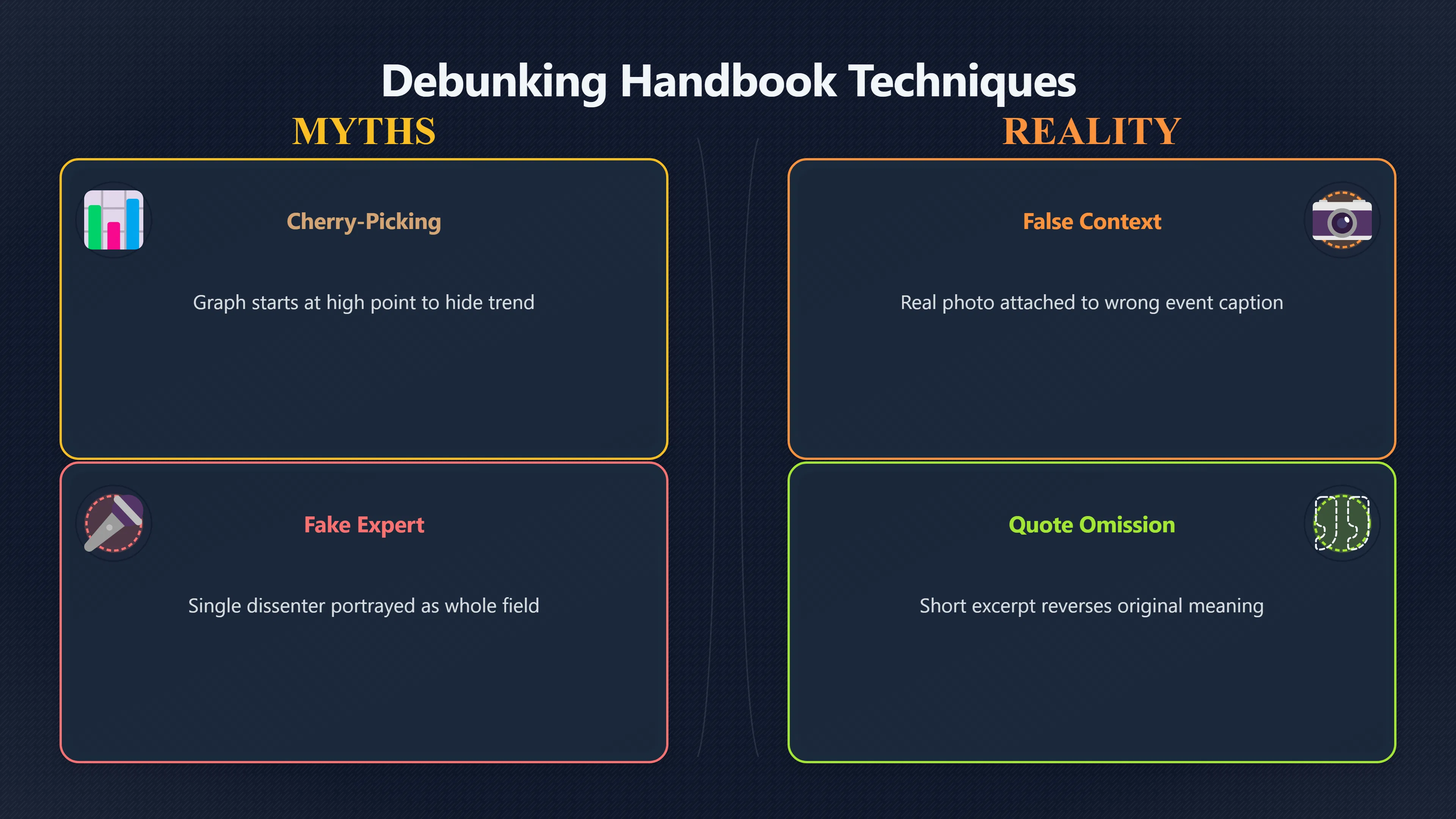
Cherry-picking
Cherry-picking occurs when someone selects a narrow slice of evidence that supports a conclusion while ignoring the larger body of evidence.
A common example involves charts. A graph might begin at an unusually high point or end at an unusually low point to create the impression of a trend that disappears when more years are included.
A strong debunk does not merely provide the full dataset. It explains the selection process:
The graph begins in an unusually warm year, making later temperatures appear flat. When the complete record is shown, the long-term warming trend remains visible.
Research on science denial and misinformation repeatedly identifies selectivity or cherry-picking as one of the most common misleading tactics.
Cranky Uncle[American Federation of Teachers]aft.orgSource details in endnotes.
False context
False-context claims use genuine material but attach incorrect background information.
The image is real. The video is real. The event happened. The deception lies in when, where, or why it is presented.
Examples include
A photograph from one country presented as if it came from another.
Footage from years earlier reposted as breaking news.
A routine event framed as evidence of a conspiracy.
First Draft’s work on information disorder identifies false context as a major category of misinformation because authentic content often carries more persuasive power than fabricated material.
First Draft
The correction should therefore focus on provenance:
When was the image created?
Where did it originate?
What was happening in the original setting?
Source confusion and fake expertise
Some claims gain credibility by presenting a source as more authoritative than it actually is.
This can happen when
A commentator is introduced as a specialist outside their field.
A single dissenter is portrayed as representative of expert opinion.
Credentials are exaggerated.
An organisation with an official-sounding name is presented as an independent research body.
The misleading element is not necessarily the person’s existence. It is the impression of authority.
Debunks are stronger when they explain the gap between appearance and expertise rather than simply attacking the individual. Research on misinformation and science denial identifies fake experts as a recurring persuasive technique across many subjects.
Cranky Uncle[American Federation of Teachers]aft.orgSource details in endnotes.
Misleading framing and captions
Sometimes the factual content remains unchanged while the interpretation is manipulated.
For example:
A caption highlights one detail while omitting another.
A statistic is technically correct but presented without an important denominator.
An isolated incident is framed as if it represents a widespread pattern.
In these cases, the correction should identify the missing context rather than only repeating the accurate number.
How much mechanism is enough for a reader?
A common mistake in debunking is over-explaining.
Readers generally do not need a complete methodological audit. They need enough information to understand the failure point.
The most effective explanations tend to identify a single decisive mechanism:
The graph excludes earlier data.
The quote leaves out the next sentence.
The image predates the event.
The expert lacks relevant expertise.
The statistic compares incompatible categories.
The goal is not to turn every correction into a university seminar. It is to provide a memorable explanation that can compete with the simplicity of the myth itself.
Research on debunking consistently shows the importance of supplying an alternative explanation rather than leaving a gap. Exposing the misleading technique works best when it becomes part of that replacement explanation.[Center for Climate Change Communication]climatechangecommunication.orgFake news: False information, often of a sensational nature, that mimics news media…Read more…[Skeptical Science]skepticalscience.comDebunking Handbook Part 5 Filling gap with alternative explanationmisinformation. The Handbook will be available as a free… The techniques include cherry picking, conspiracy theories and fake experts…
A useful rule is proportionality:
Small misunderstanding → brief explanation.
Complex manipulation → more detailed explanation.
Deliberate multi-step deception → walk through the process step by step.
The explanation should be long enough to make the correction feel complete, but not so detailed that the reader loses track of the main fact.

Examples from charts
Charts often appear objective because they look mathematical. That visual authority can make misleading design choices especially powerful.
A debunk should show readers where the distortion occurs.
Common examples include
Truncated axes
A chart that starts the vertical axis at 90 instead of zero can make a small difference appear dramatic.
The correction should explain that the visual effect comes from the scale, not from a large change in the underlying numbers.
Selective time ranges
A graph might begin during an unusually high or low year.
The correction should explain why that starting point was chosen and what happens when the full dataset is displayed.
Comparing incompatible measures
Two lines may appear comparable even though they represent different units, populations, or time periods.
The debunk should identify the mismatch explicitly.
When readers understand the design choice that produced the misleading impression, they become less likely to be persuaded by similar charts in the future.
Examples from images and video
Visual misinformation often succeeds because people assume seeing is believing.
Yet many misleading visual claims rely on context rather than fabrication.
Recycled images
A real image from one event is reused to illustrate another event.
The correction should establish:
The original date.
The original location.
The original subject.
Research on visual misinformation increasingly highlights out-of-context imagery as one of the most common forms of deceptive content online.[arXiv]arxiv.orgOpen-Domain, Content-based, Multi-modal Fact-checking of Out-of-Context Images via Online ResourcesNovember 30, 2021…
Cropping
A photograph may exclude relevant people, objects, or surroundings.
The correction should compare the cropped image with the wider scene and explain what information disappeared.
Edited video
A clip may be shortened, slowed, sped up, rearranged, or stripped of surrounding footage.
Rather than simply declaring the video misleading, an effective debunk identifies the specific edit and shows how it changed the interpretation.
Examples from quotes and headlines
Quotes often become misleading through omission rather than invention.
A short excerpt can reverse the meaning of a statement when surrounding sentences are removed.
A useful correction explains:
What was omitted.
Whether the omission changed the meaning.
What the speaker was discussing in the complete passage.
The same principle applies to headlines.
Information-disorder research has identified “false connection” as a recurring problem in which headlines, captions, or visuals do not accurately represent the underlying content.[Media Freedom Resource Centre OBCT]rcmediafreedom.euMedia Freedom Resource Centre OBCTUnderstanding Information DisorderAn essential guide by Claire Draft, First Draft US director and co-fo…
Instead of merely stating that the headline is wrong, a stronger debunk identifies the disconnect:
The headline implies the study found a causal link. The study actually reported a correlation and explicitly warned against causal conclusions.
That explanation teaches the reader how the impression was created.
Turning a correction into a reusable lesson
The most effective debunks solve two problems at once. They correct the immediate claim, and they help readers recognise similar tactics later.
This does not require turning every fact-check into a catalogue of logical fallacies. It simply means revealing the specific mechanism that made the myth persuasive.
A reader who learns that a viral image used false context can recognise the same tactic in another post. A reader who understands cherry-picking can look more carefully at future graphs. A reader who sees how a quote was truncated becomes more cautious about isolated excerpts.
This is why the explanation stage of a debunk matters so much. Facts answer the question of what is true. Exposing the misleading technique answers the equally important question of why the falsehood seemed convincing at all. By showing the trick, the correction becomes easier to remember, easier to trust, and harder to mislead again. SDM Lab[Science]science.orgPsychological inoculation improves resilience against…by J Roozenbeek · 2022 · Cited by 632 — We show that psychological inoculation c…
eBay marketplace picks
Marketplace Samples
Example marketplace items related to this page. Use the search link to explore similar finds on eBay.
Endnotes
1.
Source: rcmediafreedom.eu
Link:https://www.rcmediafreedom.eu/Resources/Manuals/Understanding-Information-Disorder
Source snippet
Media Freedom Resource Centre OBCTUnderstanding Information DisorderAn essential guide by Claire Draft, First Draft US director and co-fo...
2.
Source: arxiv.org
Link:https://arxiv.org/abs/2112.00061
Source snippet
Open-Domain, Content-based, Multi-modal Fact-checking of Out-of-Context Images via Online ResourcesNovember 30, 2021...
Published: November 30, 2021
3.
Source: arxiv.org
Link:https://arxiv.org/abs/2408.09939
4.
Source: climatechangecommunication.org
Link:https://www.climatechangecommunication.org/wp-content/uploads/2023/09/DebunkingHandbook2020.pdf
Source snippet
[Fake news]({{ 'fake-news/' | relative_url }}): False information, often of a sensational nature, that mimics news media...Read more...
5.
Source: ltrr.arizona.edu
Title: Laboratory of Tree-Ring Research The Debunking Handbookby S Lewandowsky — 20
Link:https://www.ltrr.arizona.edu/~katie/kt/natsgc/Debunking_Handbook.pdf
Source snippet
Debunking Handbookby S Lewandowsky — 20. The techniques include cherry picking, conspiracy theories and fake experts. Another alternative...
6.
Source: skepticalscience.com
Title: Debunking Handbook Part 5 Filling gap with alternative explanation
Link:https://skepticalscience.com/Debunking-Handbook-Part-5-Filling-gap-with-alternative-explanation.html
Source snippet
misinformation. The Handbook will be available as a free... The techniques include cherry picking, conspiracy theories and fake experts...
7.
Source: aft.org
Link:https://www.aft.org/ae/winter2021-2022/cook
8.
Source: science.org
Link:https://www.science.org/doi/10.1126/sciadv.abo6254
Source snippet
Psychological inoculation improves resilience against...by J Roozenbeek · 2022 · Cited by 632 — We show that psychological inoculation c...
9.
Source: nature.com
Link:https://www.nature.com/articles/d41586-023-00899-0
Source snippet
How to battle misinformation with Sander van der Linden14 Apr 2023 — Psychologist Sander van der Linden talks to Nature about the science...
Additional References
10.
Source: inoculation.science
Link:https://inoculation.science/the-debunking-handbook/
Source snippet
The Debunking HandbookMisinformation is false information that is spread either by mistake or with [intent]({{ 'intent/' | relative_url }}) to mislead. When there is inten...
11.
Source: reteclima.it
Link:https://www.reteclima.it/wp-content/uploads/Cook_2019_climate_misinformation-1.pdf
Source snippet
In Chiluwa, I. & Samoilenko, S. (Eds.). Handbook of Research on Deception, Fake News, and...Read more...
12.
Source: geoethics.org
Title: resources to give facts a fighting chance against misinformation
Link:https://www.geoethics.org/post/resources-to-give-facts-a-fighting-chance-against-misinformation
Source snippet
expert advice about debunking misinformation. It contains... The five general tactics were conspiracy, selectivity (cherry-picking), fak...
13.
Source: thegreatsimplification.com
Link:https://www.thegreatsimplification.com/episode/212-john-cook
Source snippet
Fake Experts · Logical Fallacies · Impossible Expectations · Cherry-Picking · Conspiracy Theories...
14.
Source: research-information.bris.ac.uk
Title: University of Bristol Lewandowsky, S., & Van Der Linden, S
Link:https://research-information.bris.ac.uk/files/263813879/FINAL_Revision_ERSP_inoc_paper_4SvdL.pdf
Source snippet
(2021). Counteringby S Lewandowsky · 2021 · Cited by 1108 — We review a number of techniques that can boost people's resilience to misinf...
15.
Source: education.umd.edu
Title: 10 14 20 debunking handbook 2020 countering misinformation
Link:https://education.umd.edu/news/10-14-20-debunking-handbook-2020-countering-misinformation
Source snippet
Handbook 2020: Countering MisinformationOct 14, 2020 — The Debunking Handbook 2020 aims to do just that by summarizing the current state...
16.
Source: crankyuncle.com
Title: a history of flicc the 5 techniques of science denial
Link:https://crankyuncle.com/a-history-of-flicc-the-5-techniques-of-science-denial/
Source snippet
Cranky UncleA history of FLICC: the 5 techniques of science denialMar 24, 2020 — The five general tactics were conspiracy, selectivity (c...
17.
Source: commonslibrary.org
Title: disinformation and 7 common forms of information disorder
Link:https://commonslibrary.org/disinformation-and-7-common-forms-of-information-disorder/
Source snippet
16 Jul 2024 — Disinformation is false or misleading piece of information spread with the intention to deceive or cause harm.Read more...
18.
Source: facebook.com
Link:https://www.facebook.com/AmericanPsychologicalAssociation/posts/some-of-the-same-tricks-keep-showing-up-in-misinformation-no-matter-the-topic-dr/1230824229079246/
Source snippet
defined as information that's either false or misleading, and...Read more...
19.
Source: firstdraftnews.org
Title: First Draft Understanding Information disorder
Link:https://firstdraftnews.org/long-form-article/understanding-information-disorder/
Source snippet
First DraftUnderstanding Information disorder - First Draft NewsThe challenge in this age of information disorder is that satire is used...
Topic Tree