Within Common Sense
Why outcomes seem obvious after they happen
Hindsight bias lets people build convincing explanations after an outcome, even when the same logic could predict the opposite.
On this page
- How backwards stories gain false authority
- The opposite outcome test for weak explanations
- Why social behavior is hard to predict from common sense
Page outline Jump by section
Introduction
Hindsight bias makes weak explanations feel stronger than they really are. Once an outcome is known, people often reconstruct the past so that the result appears predictable, sensible and even inevitable. A business failure suddenly looks like the obvious consequence of poor leadership. A political upset becomes easy to explain through one decisive factor. A medical treatment seems clearly effective because recovery followed it.
 This matters because many myths and misconceptions survive through backwards explanation rather than successful prediction. After an event happens, people can usually build a convincing story about why it happened. The danger is that a story that fits the known ending can feel like evidence, even when the same reasoning could have been used to explain a different ending. Psychologists call this hindsight bias, or the knew-it-all-along effect. Research beginning with Baruch Fischhoff’s work in the 1970s showed that people consistently remember events as having been more predictable after learning the outcome.[The Decision Lab]thedecisionlab.comThe Decision LabHindsight BiasHindsight bias, or the knew-it-all-along, is the tendency to claim currents events were to happen even thou…
How backwards stories gain false authority
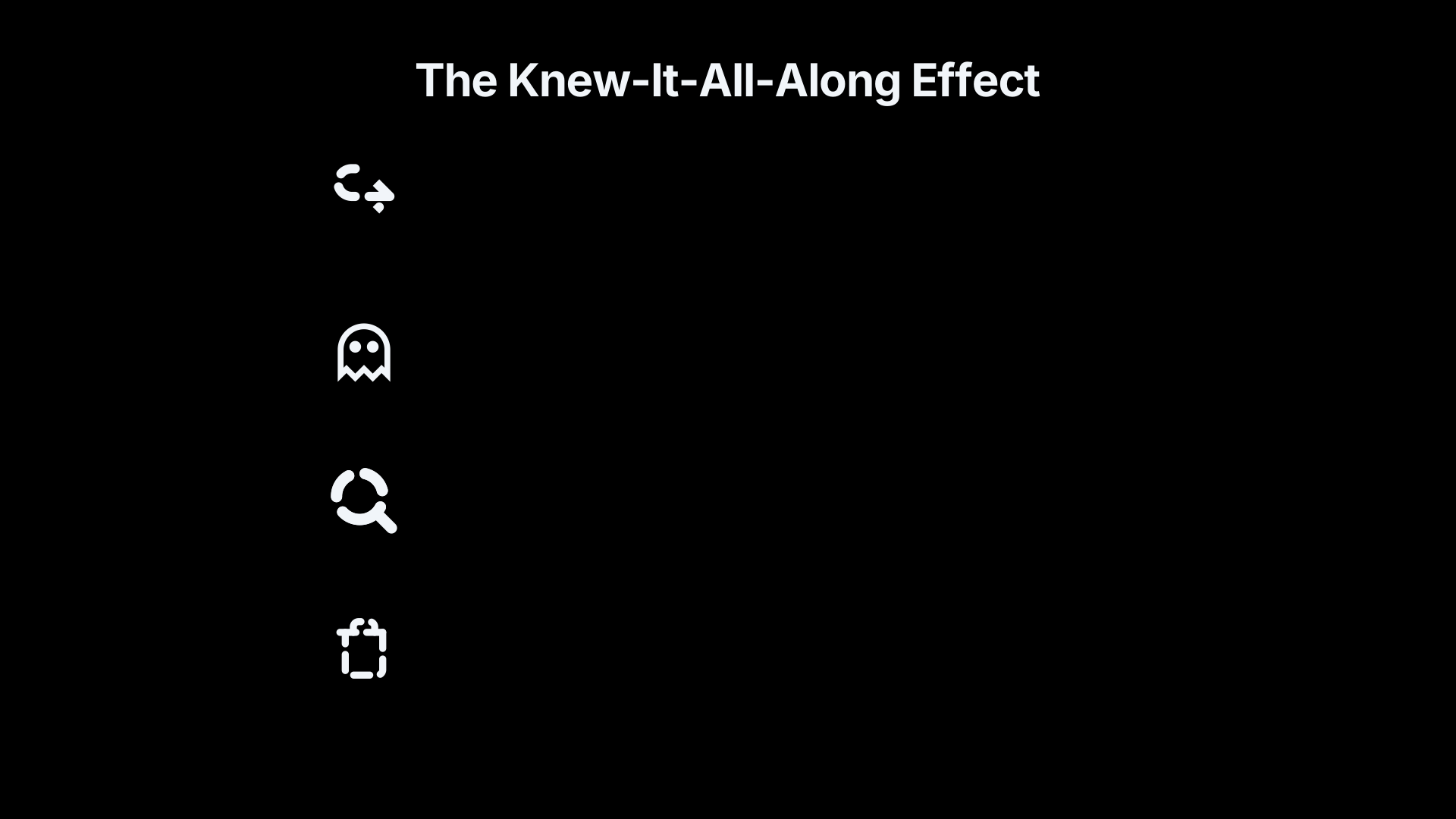
The power of hindsight comes from a simple psychological shift. Before an event, many outcomes are possible. After the event, only one outcome is visible. The alternatives fade into the background.
Once the ending is known, people begin connecting facts that support it. Information that once seemed ambiguous becomes evidence that the result was bound to happen. Contradictory clues receive less attention or are forgotten entirely. Researchers describe this as a tendency to reconstruct previous beliefs in light of new knowledge, creating the feeling that the outcome was foreseeable all along.[Wikipedia]WikipediaHindsight biasHindsight bias[2Universitt Tbingen Publikationsserver]publikationen.uni-tuebingen.deUniversitt Tbingen Publikationsserver I knew it all alongUniversitt Tbingen PublikationsserverI knew it all along - Hindsight bias before and after the fact.The author concluded that knowledge…
A classic example came from Fischhoff and Ruth Beyth’s studies of political events. Participants estimated the likelihood of several possible outcomes before a major diplomatic trip by US President Richard Nixon. After the trip, people remembered the actual outcome as having seemed more likely than they had originally judged it to be. Knowledge of the ending changed their memory of what they thought beforehand.[Wikipedia]WikipediaHindsight biasHindsight bias ScienceDirect This creates a misleading impression of understanding. If an explanation fits the result neatly[sciencedirect.com]sciencedirect.comCertainty and Uncertainty: The Two Faces of the Hindsight…by L Werth 2002 Cited by 50 Hindsight Bias is a person's tendency, a…, it feels informative. Yet the explanation may only appear powerful because the outcome is already known.
Consider how sports commentary often works. After a team wins, analysts emphasise discipline, leadership and tactical intelligence. If the same team loses, the discussion may focus on complacency, poor decisions or lack of creativity. Many of the underlying facts remain unchanged. What changes is which facts are selected and arranged into a narrative.
The explanation feels authoritative because it is coherent. Coherence, however, is not the same thing as predictive power.
Why explanations become more convincing after failure or success
Hindsight bias does not simply make outcomes seem predictable. It also makes causes appear clearer than they really were.
When people know the ending, they often underestimate how much uncertainty existed beforehand. This is especially true for social events involving many interacting factors. Elections, cultural trends, viral online content, business success and public opinion shifts all emerge from complicated systems where chance, timing and network effects matter.
After success, observers tend to identify a trait that supposedly caused it:
- The entrepreneur succeeded because of vision.
- The artist became famous because of talent.
- The politician won because of authenticity.
After failure, equally plausible stories appear:
- The entrepreneur failed because of arrogance.
- The artist failed because of poor marketing.
- The politician lost because of weak messaging.
The explanations often sound persuasive because they connect real characteristics to a known result. Yet their persuasive force depends heavily on already knowing which result occurred.
Duncan Watts has argued that many explanations of social behaviour confuse understandability with causality. Once people know what happened, they can usually generate a reasonable-sounding account of why it happened. The existence of such an account does not prove that the identified causes genuinely predicted the outcome.[PubMed]pubmed.ncbi.nlm.nih.govCommon sense and sociological explanationsby DJ Watts 2014 Cited by 232 Sociologists have long advocated a sociological appro…
This distinction is easy to miss because human beings are natural storytellers. Understanding a sequence of events feels very similar to having predicted it. Psychologically, the two experiences can become blurred.
The opposite-outcome test for weak explanations
One of the simplest ways to expose hindsight-driven reasoning is to ask whether the same explanation could have supported the opposite result.
Imagine a commentator explaining a company’s success:
The company succeeded because it took bold risks.
Now imagine the company had failed.
The explanation might become:
The company failed because it took reckless risks.
The same factrisk-takingsupports opposite conclusions.
This is the hallmark of a weak after-the-fact explanation. It adapts itself to the outcome rather than constraining expectations beforehand.
The opposite-outcome test asks a straightforward question:
If the result had gone the other way, would this explanation still sound convincing?
If the answer is yes, then the explanation may have little predictive value.
This does not mean the explanation is necessarily false. Risk-taking may genuinely matter. The problem is that the explanation has not demonstrated why one outcome was more likely than another before the fact.
Psychologists studying hindsight bias have found that considering alternative outcomes can reduce the feeling that what happened was inevitable. When people actively imagine realistic alternatives, the actual outcome appears less uniquely determined and less obviously predictable.[Carlson School of Management]carlsonschool.umn.eduvohs et al 2012 hindsight biasCarlson School of ManagementScience Perspectives on Psychologicalby NJ Roese 2012 Cited by 920 This inverse relation between counte…
That is why good evidence usually requires prospective testing rather than retrospective storytelling. The crucial question is not whether a story can explain the result now. The question is whether it would have distinguished among possible outcomes before they occurred.

Why social behaviour is especially vulnerable to hindsight
Hindsight bias becomes particularly powerful in discussions of human behaviour because social systems generate enormous amounts of interpretive material.
People’s actions rarely have a single clear cause. Personality, incentives, social pressure, institutions, timing, chance encounters and broader cultural conditions all interact. Because there are so many possible influences, it is usually easy to find a set of factors that seem to fit whatever happened.
This creates a recurring pattern in public discussion:
- An unexpected event occurs.
- Observers search for causes.
- Certain details are selected as decisive.
- The selected details are arranged into a coherent story.
- The story creates the impression that the event should have been expected.
The result is a feeling of certainty that did not exist beforehand.
Watts has repeatedly argued that social outcomes often look more predictable in retrospect than they really are. His work on complex social systems suggests that even with extensive information, important outcomes can remain difficult to forecast because small differences and random variation can have large effects.[arXiv]arxiv.orgarXiv Exploring limits to prediction in complex social systemsExploring limits to prediction in complex social systemsFebruary 2, 2016…
This helps explain why myths about social behaviour persist. People remember explanations that fit visible outcomes. They rarely compare those explanations against all the other plausible stories that could have been told had events unfolded differently.

How hindsight keeps misconceptions alive
Many misconceptions survive because they are reinforced by memorable examples rather than systematic tests.
A person tries a remedy and recovers. Recovery becomes proof that the remedy worked.
An investor makes money following a simple rule. The profit becomes proof that the rule predicts markets.
A parent adopts a new educational technique and a child improves. The improvement becomes proof that the technique caused the change.
In each case, the explanation feels compelling because it is attached to a real outcome. Yet the same confidence often disappears when similar cases that ended differently are examined.
Hindsight bias encourages selective learning. Successful cases receive explanations. Failed cases are forgotten, reinterpreted or treated as exceptions. Over time, the surviving stories create the illusion that a rule has been repeatedly confirmed.
The process is especially powerful because people do not experience hindsight bias as a bias. They experience it as understanding. The feeling that an outcome makes sense is mistaken for evidence that the outcome was predictable.
What separates explanation from evidence
A useful explanation does more than make the past seem reasonable. It narrows expectations before events occur.
The strongest safeguard against hindsight-driven misconceptions is to ask predictive questions:
- What outcomes would this explanation predict?
- What outcomes would count against it?
- Could the same reasoning explain the opposite result?
- Was the prediction recorded before the outcome was known?
These questions force a shift from storytelling to testing.
The central lesson is not that explanations are worthless. Explanations are essential. The problem arises when explanation is judged only after the ending is known. Once outcomes are visible, almost any event can be made to look like common sense. That appearance of obviousness is precisely why hindsight bias is such a powerful engine of myths and misconceptions. It transforms uncertainty into apparent inevitability and turns weak explanations into stories that feel self-evidently true.
Amazon book picks
Further Reading
Books and field guides related to Why outcomes seem obvious after they happen. Use these as the next step if you want deeper reading beyond the article.
Thinking, Fast and Slow
Contains influential discussion of hindsight and judgment errors.
Mistakes Were Made (but Not by Me) Third Edition
Explains post-hoc rationalisation and self-justification.
The Skeptics' Guide to the Universe
Provides practical methods for challenging intuitive explanations.

The art of thinking clearly
First published 2013. Subjects: nonfiction, psychology, Errors, Développement d'aptitudes, Prise de décision (Relations humaines).
eBay marketplace picks
Marketplace Samples
Example marketplace items related to this page. Use the search link to explore similar finds on eBay.


Endnotes
1.
Source: Wikipedia
Title: Hindsight bias
Link:https://en.wikipedia.org/wiki/Hindsight_bias
2.
Source: sciencedirect.com
Link:https://www.sciencedirect.com/science/article/pii/S0749597801929760
Source snippet
Certainty and Uncertainty: The Two Faces of the Hindsight...by L Werth 2002 Cited by 50 Hindsight Bias is a person's tendency, a...
3.
Source: sciencedirect.com
Title: ScienceDirect Hindsight Bias
Link:https://www.sciencedirect.com/topics/biochemistry-genetics-and-molecular-biology/hindsight-bias
Source snippet
Hindsight Bias - an overviewIn the 1970s, Baruch Fischoff was concerned with professionals such as clinicians' or politicians exaggerated...
4.
Source: arxiv.org
Title: arXiv Exploring limits to prediction in complex social systems
Link:https://arxiv.org/abs/1602.01013
Source snippet
Exploring limits to prediction in complex social systemsFebruary 2, 2016...
Published: February 2, 2016
5.
Source: sciencedirect.com
Link:https://www.sciencedirect.com/science/article/pii/074959789090020A
Source snippet
The...Re...
6.
Source: sciencedirect.com
Link:https://www.sciencedirect.com/science/article/abs/pii/S0022103121000573
Source snippet
Retrospective and prospective hindsight bias: Replications...by J Chen 2021 Cited by 23 In this study, we asked participants to pr...
7.
Source: thedecisionlab.com
Link:https://thedecisionlab.com/biases/hindsight-bias
Source snippet
The Decision LabHindsight BiasHindsight bias, or the knew-it-all-along, is the tendency to claim currents events were to happen even thou...
8.
Source: publikationen.uni-tuebingen.de
Title: Universitt Tbingen Publikationsserver I knew it all along
Link:https://publikationen.uni-tuebingen.de/xmlui/bitstream/handle/10900/83951/Doktorarbeit_Druckexemplar.pdf?sequence=1
Source snippet
Universitt Tbingen PublikationsserverI knew it all along - Hindsight bias before and after the fact.The author concluded that knowledge...
9.
Source: lesswrong.com
Title: hindsight bias
Link:https://www.lesswrong.com/lw/il/hindsight_bias
Source snippet
16 Aug 2007 Hindsight bias is sometimes called the I-knew-it-all-along effect. Fischhoff and Beyth (1975) presented students with histo...
10.
Source: pubmed.ncbi.nlm.nih.gov
Link:https://pubmed.ncbi.nlm.nih.gov/25811066/
Source snippet
Common sense and sociological explanationsby DJ Watts 2014 Cited by 232 Sociologists have long advocated a sociological appro...
11.
Source: carlsonschool.umn.edu
Title: vohs et al 2012 hindsight bias
Link:https://carlsonschool.umn.edu/sites/carlsonschool.umn.edu/files/2026-01/vohs-et-al-2012-hindsight-bias.pdf
Source snippet
Carlson School of ManagementScience Perspectives on Psychologicalby NJ Roese 2012 Cited by 920 This inverse relation between counte...
12.
Source: facebook.com
Link:https://www.facebook.com/Bookcafe04/posts/you-think-you-understand-why-things-happen-you-do-not-and-neither-does-anyone-el/122322355982329240/
Source snippet
"Everything is Obvious (Once You Know...3 May 2026 "Everything is Obvious (Once You Know the Answer)" is a book about why common sense...
Published: May 2026
Additional References
13.
Source: reddit.com
Link:https://www.reddit.com/r/explainlikeimfive/comments/b5txsf/eli5_what_is_the_difference_between_outcome_bias/
Source snippet
ELI5: What is the difference between Outcome Bias and...Hindsight bias makes people think that the event should have been predicted/pred...
14.
Source: researchgate.net
Link:https://www.researchgate.net/publication/232494530_The_knew-it-all-along_effect
15.
Source: fs.blog
Link:https://fs.blog/is-everything-obvious-once-you-know-the-answer/
Source snippet
In this way, Watts says, we deceive ourselves into believing that we can make predictions that are impossible. By providing...Read...
16.
Source: researchportal.port.ac.uk
Title: controllability and hindsight components understanding opposite h
Link:https://researchportal.port.ac.uk/en/publications/controllability-and-hindsight-components-understanding-opposite-h
Source snippet
opposite hindsight biases for self-relevant...by H Blank 2010 Cited by 34 The first points to an influence of perceived control ov...
17.
Source: pmc.ncbi.nlm.nih.gov
Link:https://pmc.ncbi.nlm.nih.gov/articles/PMC3084020/
Source snippet
Bias from 3 to 95 Years of Age - PMCby DM Bernstein 2011 Cited by 183 Upon learning the outcome to a problem, people tend to believ...
18.
Source: facebook.com
Link:https://www.facebook.com/groups/1030279464977625/posts/1459905702014997/
Source snippet
e can easily predict or explain social phenomena with simple...Read more...
19.
Source: profrjstarr.com
Title: hindsight bias why we always knew it all along
Link:https://profrjstarr.com/cognitive-biases/hindsight-bias-why-we-always-knew-it-all-along
Source snippet
Hindsight Bias: Why We Always Knew It All AlongJan 27, 2025 After something happens, it always seems obviousbecause your mind rewrote...
20.
Source: penntoday.upenn.edu
Title: penn duncan watts commonalities common sense
Link:https://penntoday.upenn.edu/news/penn-duncan-watts-commonalities-common-sense
Source snippet
commonalities of common sense | Penn Today23 Jan 2024 Researchers from Penn develop a framework for quantifying common sense, findings...
21.
Source: duncanjwatts.com
Title: Explaining Explanation Syllabus | DJW
Link:https://duncanjwatts.com/teaching/explaining-explanation-syllabus/
Source snippet
Duncan WattsIn the social sciences we often use the word explanation as if (a) we know what we mean by it, and (b) we mean the same thi...
22.
Source: youtube.com
Title: Prediction and Explanation in Social Science Duncan Watts”
Link:https://www.youtube.com/watch?v=0O6COXI0cx8
Source snippet
Abstract: Historically, social scientists have sought out explanations... Prediction and Explanation in Social Science Duncan Watts...
Topic Tree