Within Sciencey Words
The Brain Words That Sell Weak Explanations
Irrelevant brain language can make ordinary explanations feel more satisfying even when it adds no real support.
On this page
- What seductive neuroscience detail does
- Why dopamine and pathways are easy to overuse
- How to separate explanation from decoration
Page outline Jump by section
Introduction
Brain-based language often feels persuasive because it seems to bring us closer to the machinery of human behaviour. An explanation that mentions neurons, dopamine, brain circuits or neural pathways can sound more concrete and scientific than one that does not. The problem is that neuroscience terms do not automatically make an explanation better. In some cases, they merely decorate an explanation that is otherwise weak, circular or unsupported.
 This effect has been studied directly. Researchers found that people without specialist training judged explanations of psychological phenomena as more satisfying when they included neuroscience information, even when that information was irrelevant to the logic of the explanation. The extra brain language did not improve the explanation itself, but it changed how convincing the explanation felt.[PMC]pmc.ncbi.nlm.nih.govThe Seductive Allure of Neuroscience Explanations - PMC - NIHby DS Weisberg · 2008 · Cited by 1694 — Crucially, the neuroscience infor…
Within the broader problem of science-sounding language in weak claims, neuroscience jargon is especially powerful because the brain occupies a unique cultural position. It is associated with intelligence, medicine, technology and hard science. As a result, references to the brain can create an impression of depth even when they add little evidence.
What Seductive Neuroscience Detail Does
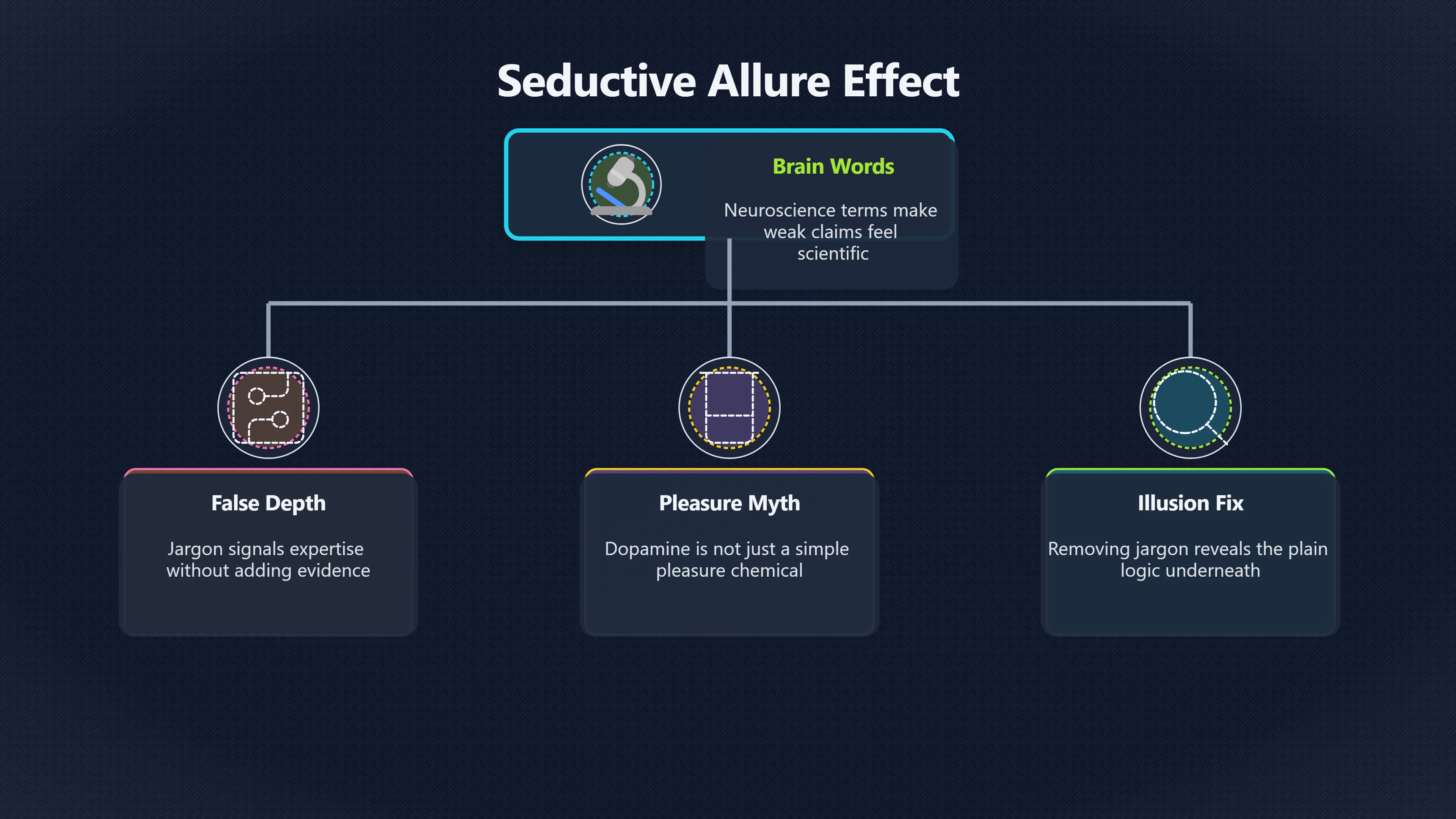
One of the most influential demonstrations of this phenomenon came from experiments by Deena Weisberg and colleagues. Participants read explanations of psychological effects that were either genuinely informative or clearly flawed. Some versions included additional neuroscience information that experts agreed was irrelevant to the explanation. Non-experts consistently rated explanations containing the neuroscience material as more satisfying, even when the underlying explanation remained poor.[PMC]pmc.ncbi.nlm.nih.govMidbrain dopamine neurons are well known for their strong responses to rewards and their critical role in positive motivation.Read more…
The key point is that the brain information did not make the explanation more accurate. Instead, it appeared to signal that a scientific explanation had been provided. Researchers described this as a “seductive allure” because the neuroscience language attracted approval beyond its actual explanatory value. PMC[Cambridge University Press & Assessment]cambridge.orgCambridge University Press & AssessmentDeconstructing the seductive allure of neuroscience…by DS Weisberg · 2015 · Cited by 188 — Prev…
This matters because many myths and misconceptions are not presented as obvious pseudoscience. They often mimic legitimate scientific communication. A claim about motivation may invoke neural circuitry. A wellness programme may discuss brain rewiring. A self-help product may reference neurotransmitters. The presence of these terms can encourage readers to assume that a strong scientific foundation exists even when the evidence is weak or absent.
Later research explored why this effect occurs. Part of the answer appears to be that neuroscience information is perceived as fundamental. People often regard explanations that descend to the level of the brain as deeper or more complete, even when the added detail does not actually explain the phenomenon in question.[ScienceDirect]sciencedirect.comThe seductive allure is a reductive allure: People prefer…by EJ Hopkins · 2016 · Cited by 143 — People may judge explanat…
Why Dopamine and Pathways Are Easy to Overuse
Few neuroscience terms have become as widespread in popular culture as “dopamine”. It appears in discussions of productivity, addiction, motivation, social media use, shopping habits and personal success. The scientific reality is more complicated.
Dopamine is a neurotransmitter involved in multiple functions, including motivation, learning, movement, attention and reward-related processes. It is not simply a “pleasure chemical” that can explain every enjoyable or undesirable behaviour. Neuroscientists have spent decades refining their understanding of dopamine’s role in the brain, and contemporary accounts emphasise its involvement in learning, prediction and motivational processes rather than a single feeling of pleasure. PMC[Cleveland Clinic]my.clevelandclinic.org22581 dopamineclevelandclinic.orgDopamine: What It Is, Function & Symptoms23 Mar 2022 — Dopamine is a neurotransmitter made in your brain. It's known a…
Yet in weak explanations, dopamine often becomes a catch-all mechanism. A claim may assert that someone procrastinates because of dopamine, buys products because of dopamine, or follows a trend because of dopamine. The word creates an impression of biological precision, but the actual explanation may be little more than a relabelling of behaviour.
A similar problem occurs with references to “neural pathways”, “brain circuitry” or “reward systems”. These are legitimate scientific concepts, but they can be inserted into explanations without clarifying how a proposed mechanism produces the claimed outcome. Saying that a habit is caused by a reward pathway sounds sophisticated, but unless the explanation identifies evidence, causal links and measurable effects, the phrase may add little beyond scientific flavouring.[@neurochallenged]neuroscientificallychallenged.com@neurochallengedKnow Your Brain: Reward SystemBased on brain stimulation experiments and the increasingly recognized importance of dopami…
This is why neuroscience jargon can be attractive in advertising, wellness marketing and popular commentary. It offers a vocabulary that sounds specific without necessarily requiring specific evidence.
How Brain Language Creates an Illusion of Understanding
People naturally prefer explanations that feel complete. Brain-based wording often supplies a sense of completion because it appears to answer the question “why?” at a deeper level.
Consider the difference between these two statements:
- “People repeat rewarding behaviours because they learn from rewarding experiences.”
- “People repeat rewarding behaviours because activation of dopamine pathways reinforces neural learning mechanisms.”
The second statement sounds more technical. It may even sound more scientific. Yet unless the neuroscience details are necessary and supported by evidence, the explanation may not actually tell the reader anything more useful than the first statement.
Researchers investigating the seductive allure effect found that neuroscience information can sometimes mask weaknesses in explanations rather than correct them. Poor explanations appeared more acceptable when wrapped in brain terminology. PMC PubMed This tendency reflects a broader cognitive shortcut. When readers encounter specialised language associated with a respected scientific field[pmc.ncbi.nlm.nih.gov]pmc.ncbi.nlm.nih.govMidbrain dopamine neurons are well known for their strong responses to rewards and their critical role in positive motivation.Read more…, they may treat the explanation as more credible before carefully evaluating its logic. The neuroscience vocabulary functions as a cue of expertise.
Importantly, this does not mean neuroscience itself is unreliable. The problem arises when references to the brain are used as substitutes for evidence rather than as parts of an evidence-based explanation.
How to Separate Explanation From Decoration
A useful way to evaluate neuroscience-heavy claims is to ask what would remain if the brain words were removed.
If deleting terms such as “dopamine”, “neural pathway”, “brain circuit” or “prefrontal activation” leaves the explanation essentially unchanged, those terms may be functioning as decoration rather than as essential evidence.
Several questions can help:
- Does the neuroscience information directly support the conclusion, or is it merely associated with it?
- Does the claim identify evidence showing that the proposed brain mechanism produces the stated outcome?
- Is the brain terminology explaining a process, or simply renaming it?
- Would the explanation still seem convincing if the technical words were translated into plain language?
Strong scientific explanations become clearer when translated into simpler terms. Weak explanations often lose much of their apparent force once the jargon is removed.
Why This Matters for Myths and Misconceptions
Many modern misconceptions are not built around rejecting science. Instead, they borrow the language of science. Neuroscience provides particularly powerful material because it combines technical complexity with public fascination. References to brain chemistry, neurotransmitters and neural networks can make claims sound evidence-based even when the evidence is thin.
The research on the seductive allure of neuroscience suggests that readers should be cautious whenever brain terminology seems to be doing most of the persuasive work. An explanation is not strengthened simply because it mentions neurons, pathways or dopamine. The important question is whether those details genuinely improve the explanation and are supported by evidence. When they do, neuroscience can illuminate behaviour. When they do not, they may merely make a weak explanation feel stronger than it is. PMC[Cambridge University Press & Assessment]cambridge.orgCambridge University Press & AssessmentDeconstructing the seductive allure of neuroscience…by DS Weisberg · 2015 · Cited by 188 — Prev…
Amazon book picks
Further Reading
Books and field guides related to The Brain Words That Sell Weak Explanations. Use these as the next step if you want deeper reading beyond the article.
The Skeptics' Guide to the Universe
Covers misuse of neuroscience and scientific authority.
You are Not So Smart
Explains cognitive biases behind persuasive but weak explanations.
Thinking, Fast and Slow
Helps explain why scientific-sounding details can feel convincing.
eBay marketplace picks
Marketplace Samples
Example marketplace items related to this page. Use the search link to explore similar finds on eBay.



Endnotes
1.
Source: pmc.ncbi.nlm.nih.gov
Link:https://pmc.ncbi.nlm.nih.gov/articles/PMC2778755/
Source snippet
The Seductive Allure of Neuroscience Explanations - PMC - NIHby DS Weisberg · 2008 · Cited by 1694 — Crucially, the neuroscience infor...
2.
Source: cambridge.org
Link:https://www.cambridge.org/core/journals/judgment-and-decision-making/article/deconstructing-the-seductive-allure-of-neuroscience-explanations/568C206CD761E70374975276BBF69737
Source snippet
Cambridge University Press & AssessmentDeconstructing the seductive allure of neuroscience...by DS Weisberg · 2015 · Cited by 188 — Prev...
3.
Source: sciencedirect.com
Link:https://www.sciencedirect.com/science/article/abs/pii/S0010027716301585
Source snippet
The seductive allure is a reductive allure: People prefer...by EJ Hopkins · 2016 · Cited by 143 — People may judge explanat...
4.
Source: pmc.ncbi.nlm.nih.gov
Link:https://pmc.ncbi.nlm.nih.gov/articles/PMC3032992/
Source snippet
Midbrain dopamine neurons are well known for their strong responses to rewards and their critical role in positive motivation.Read more...
5.
Source: pubmed.ncbi.nlm.nih.gov
Title: Pub Med The seductive allure of neuroscience explanations
Link:https://pubmed.ncbi.nlm.nih.gov/18004955/
Source snippet
seductive allure of neuroscience explanations - PubMedby DS Weisberg · 2008 · Cited by 1667 — Explanations of psychological phenomena see...
6.
Source: my.clevelandclinic.org
Title: 22581 dopamine
Link:https://my.clevelandclinic.org/health/articles/22581-dopamine
Source snippet
clevelandclinic.orgDopamine: What It Is, Function & Symptoms23 Mar 2022 — Dopamine is a neurotransmitter made in your brain. It's known a...
7.
Source: neuroscientificallychallenged.com
Link:https://neuroscientificallychallenged.com/posts/know-your-brain-reward-system
Source snippet
@neurochallengedKnow Your Brain: Reward SystemBased on brain stimulation experiments and the increasingly recognized importance of dopami...
8.
Source: synapse.substack.com
Title: the seductive allure of neuroscience
Link:https://synapse.substack.com/p/the-seductive-allure-of-neuroscience
Source snippet
Seductive Allure of Neuroscience Explanations - SynapseIt turns out that the presence of neuroscience drastically improved the subjects'...
Additional References
9.
Source: linkedin.com
Link:https://www.linkedin.com/pulse/seductive-allure-neuroscience-explanations-ben-hutchinson
Source snippet
The Seductive Allure of Neuroscience ExplanationsThe authors proposed that neuroscience information in explanations may interfere with pe...
10.
Source: scribd.com
Link:https://www.scribd.com/document/937334443/The-Seductive-Allure-of-Neuroscience-Explanations
Source snippet
The Seductive Allure of Neuroscience ExplanationsThe study investigates why explanations of psychological phenomena are perceived as more...
11.
Source: chegg.com
Link:https://www.chegg.com/homework-help/questions-and-answers/adding-irrelevant-neuroscience-information-explanation-psychological-phenomenon-makes-expl-q138530891
Source snippet
Solved Adding irrelevant neuroscience information to anFeb 5, 2024 — This effect has been termed the "seductive allure of neuroscience ex...
12.
Source: discovermagazine.com
Title: critiquing a classic the seductive allure of neuroscience explanations 4911
Link:https://www.discovermagazine.com/critiquing-a-classic-the-seductive-allure-of-neuroscience-explanations-4911
Source snippet
The Seductive Allure of Neuroscience ExplanationsJan 7, 2009 — Explore the seductive allure of neuroscience and how it impacts perception...
13.
Source: youtube.com
Link:https://www.youtube.com/watch?v=Wa8_nLwQIpg&vl=en
Source snippet
2-Minute Neuroscience: DopamineDopamine is a monoamine and catecholamine neurotransmitter with many functions in the nervous system rangi...
14.
Source: youtube.com
Link:https://www.youtube.com/watch?v=f7E0mTJQ2KM
Source snippet
2-Minute Neuroscience: Reward SystemThe reward system refers to a group of structures that are activated whenever we experience something...
15.
Source: osf.io
Link:https://osf.io/3y7v9/overview
Source snippet
xplanations of psychological phenomena when those explanations contain neuroscience...Read more...
16.
Source: researchgate.net
Title: 235412019 The Seductive Allure of Seductive Allure
Link:https://www.researchgate.net/publication/235412019_The_Seductive_Allure_of_Seductive_Allure
Source snippet
(PDF) The Seductive Allure of "Seductive Allure"Feb 1, 2016 — Weisenberg and colleagues note that neuroscience may have a "seductive allu...
17.
Source: safetyinsights.org
Title: the seductive allure of neuroscience explanations
Link:https://safetyinsights.org/2025/07/26/the-seductive-allure-of-neuroscience-explanations/
Source snippet
26 Jul 2025 — The authors proposed that neuroscience information in explanations may interfere with people's ability to judge the quality...
18.
Source: studocu.com
Link:https://www.studocu.com/en-us/document/the-pennsylvania-state-university/seminars-in-neuroscience-i/the-seductive-allure-of-neuroscience-in-psychological-explanations-j-cogn/140890562
Source snippet
ions of psychological explanations, revealing that irrelevant neuroscience...
Topic Tree