Within Left Brain
When brain labels shrink expectations
Calling a child left-brained or right-brained can turn a temporary preference into a false limit on what they are expected to learn.
On this page
- How labels change teacher and pupil expectations
- Why strengths should not become fixed limits
- Better questions when a pupil struggles
Page outline Jump by section
Introduction
Calling a pupil left-brained or right-brained may sound harmless, but classroom labels can quietly narrow expectations. The central problem is not only that the left-brain/right-brain learner idea lacks strong scientific support. It is also that labels can change how adults interpret ability, effort and potential. Once a child is seen as the creative one or the logical one, teachers may unconsciously offer different challenges, feedback and opportunities. Pupils can begin to absorb those expectations themselves.
 Research on teacher expectations has long shown that beliefs about students can influence classroom interactions and achievement. While the evidence does not support dramatic claims that labels permanently determine outcomes, it does show that expectations can shape motivation, confidence and access to learning opportunities. When brain-based learner labels are treated as fixed truths, they risk turning temporary preferences or strengths into artificial limits.[Educational Neuroscience]educationalneuroscience.org.ukEducational NeuroscienceLeft brain versus right brain thinkersThe implication of the left brain/right brain myth is that some people are…[Western Kentucky University]people.wku.eduWestern Kentucky UniversityPygmalion in the ClassroomThe results of the Oak School experiment provide further evidence that one person's…[3Bpb Us E1]bpb-us-e1.wpmucdn.comBpb Us E1Pygmalion in the classroomPygmalion in the classroom - CDNby R Rosenthal Cited by 15636 What Rosenthal and Jacobson hoped to determine by this experiment was t…
How labels change teacher and pupil expectations
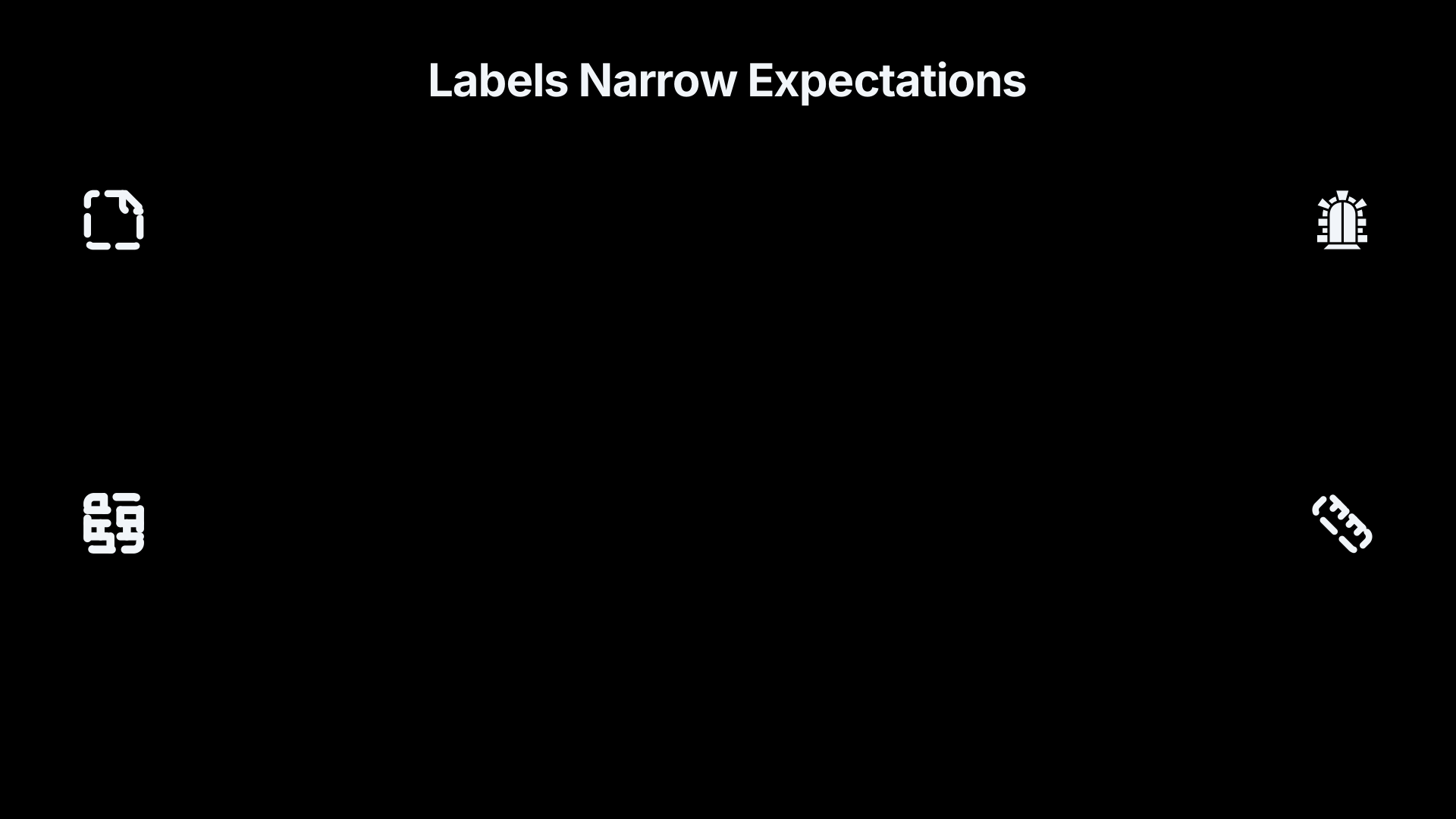
The left-brain/right-brain myth encourages a subtle shift from describing behaviour to defining identity.
A teacher might observe that one pupil currently enjoys drawing diagrams and another prefers written explanations. That observation can be useful. The problem begins when the observation becomes a stable category: She is right-brained or He is left-brained. At that point, a temporary learning preference can start to look like a biological destiny.
Research on teacher expectations helps explain why this matters. The classic Pygmalion studies proposed that expectations can become self-fulfilling prophecies. When teachers expect higher achievement, they may provide more encouragement, richer feedback, extra wait time after questions and more challenging work. Students often respond to those signals.[EBSCO]ebsco.comPygmalion effect (Rosenthal effect) | EducationThe Pygmalion effect operates as a self-fulfilling prophecy, where positive expectati…[Western Kentucky University]people.wku.eduWestern Kentucky UniversityPygmalion in the ClassroomThe results of the Oak School experiment provide further evidence that one person's…[3Bpb Us E1]bpb-us-e1.wpmucdn.comBpb Us E1Pygmalion in the classroomPygmalion in the classroom - CDNby R Rosenthal Cited by 15636 What Rosenthal and Jacobson hoped to determine by this experiment was t…
In a classroom shaped by brain labels, the process can work in less obvious ways:
- A pupil labelled creative may receive praise for imagination but less encouragement in mathematics or analytical writing.
- A pupil labelled logical may be pushed towards technical subjects while receiving fewer opportunities to develop artistic confidence.
- Struggles may be interpreted as evidence that a task lies outside the learner’s brain type rather than as a normal part of learning.
- Teachers may lower expectations without realising it, offering easier tasks or less demanding questions.
These decisions rarely appear as deliberate discrimination. They often emerge through hundreds of small classroom interactions that communicate what adults think a pupil can become.
Educational neuroscience organisations have repeatedly warned that the left-brain/right-brain myth wrongly implies that some learners are naturally suited to particular tasks because of hemisphere dominance. The available evidence does not support that conclusion.[Educational Neuroscience]educationalneuroscience.org.ukEducational NeuroscienceLeft brain versus right brain thinkersThe implication of the left brain/right brain myth is that some people are…[Dana]dana.orgwhen the myth is the message neuromyths and educationDana FoundationWhen the Myth is the Message: Neuromyths and EducationNeuromyth #3: Hemispheric dominance (whether you are left-brained…
When pupils start believing the label
Labels do not only affect teachers. Students often use adult descriptions to understand themselves.
A child repeatedly told that they are not a maths person or that they are a right-brained learner may begin to interpret setbacks as proof that success is impossible in certain subjects. Instead of seeing difficulty as temporary, they may see it as confirmation of an underlying limitation.
This overlaps with research on mindsets. Carol Dweck’s work distinguishes between a fixed mindset, in which abilities are viewed as largely unchangeable, and a growth mindset, in which abilities are seen as developable through learning and practice. Although growth mindset research is often simplified in popular discussion, a consistent finding is that beliefs about whether abilities can change influence how students respond to challenge and failure. PMC[Teaching Commons]teachingcommons.stanford.eduAs discussed in their paper on academic tenacity…Read more…
A left-brain/right-brain label can easily function as a fixed-mindset message. It suggests that success flows from an inherited cognitive type rather than from practice, instruction and persistence.
Why strengths should not become fixed limits
One reason the left-brain/right-brain myth remains attractive is that it begins with something real: people do have strengths, interests and preferred ways of approaching tasks.
The mistake is assuming that current strengths reveal permanent boundaries.
A pupil who writes well may genuinely find writing easier than drawing. Another may show unusual talent in music while struggling with algebra. Those differences deserve attention. But educational decisions become risky when strengths are treated as ceilings as well as advantages.
The distinction matters because learning often involves developing weaker areas rather than merely reinforcing existing ones. If a student is repeatedly directed towards what they already do well, they may never discover abilities that require more time to emerge.
Consider a pupil who enjoys art and receives a right-brained label. Teachers and parents may unintentionally reinforce the idea that science, mathematics or formal reasoning are less suitable paths. Yet success in science frequently depends on creativity, visual thinking and imagination. Likewise, success in the arts often depends on planning, analysis and sustained practice. Real-world expertise rarely follows the neat division suggested by the myth. Taylor & Francis Online[University of Strathclyde]strath.ac.ukUniversity of StrathclydeCreative Neuroscienceby W Strathclyde The neuromyth which I will focus on here is the idea that one side of yo…
The neuroscience itself points in the same direction. Research has found local patterns of hemispheric specialisation, but not evidence that people are globally left-brained or right-brained learners. Learning depends on networks distributed across the brain rather than a single dominant hemisphere controlling educational potential.[Educational Neuroscience]educationalneuroscience.org.ukEducational NeuroscienceLeft brain versus right brain thinkersThe implication of the left brain/right brain myth is that some people are…[Monash]research.monash.eduMonash UniversityThe myth of the left- Vs right-brain learningby KA Allen 2019 Cited by 34 This paper explores the myth of hemisphe…
The opportunity cost of narrow expectations
The damage from labels is often indirect.
A pupil may never be explicitly told that they cannot succeed in a subject. Instead, they receive fewer invitations to try. They may be recommended different courses, offered different enrichment activities or given different kinds of praise.
Over time, these choices accumulate.
Research on self-fulfilling prophecies suggests that expectation effects are usually modest rather than dramatic. Modern reviews do not support exaggerated claims that teacher beliefs alone determine intelligence or destiny. Yet even small expectation effects can matter when repeated across years of schooling.[Wikipedia]WikipediaPygmalion effectPygmalion effect
The practical concern is therefore not a single label or comment. It is the gradual narrowing of possibilities.
Better questions when a pupil struggles
When a learner has difficulty, a brain-type explanation often feels satisfying because it is simple. It appears to answer the question immediately.
She isn’t analytical.
He isn’t creative.
[She is right-brained.]unisc.edu.auStudents are neither left nor right brained: how some early…16 Apr 2025 Students are neither left nor right brained: how some early…
[He is left-brained.]dana.orgwhen the myth is the message neuromyths and educationDana FoundationWhen the Myth is the Message: Neuromyths and EducationNeuromyth #3: Hemispheric dominance (whether you are left-brained…
The problem is that these explanations stop investigation too early.
More useful questions focus on factors that can actually change:
- Does the pupil understand the vocabulary needed for the task?
- Have they had enough practice?
- Is working memory overloaded by too many instructions at once?
- Are they receiving clear feedback?
- Do they have misconceptions that need correcting?
- Is motivation affected by previous experiences of failure?
- Are there gaps in prior knowledge that make the current task harder?
These questions direct attention towards teaching, support and learning conditions rather than presumed neurological identities.
A pupil struggling with algebra, for example, may need stronger foundations in arithmetic, more guided practice or different examples. A pupil struggling with creative writing may need exposure to models, planning techniques or confidence-building feedback. Neither difficulty requires a claim about hemisphere dominance.
What teachers can do instead of using brain-type labels
Avoiding limiting labels does not mean pretending all pupils learn in identical ways. Differences in interests, knowledge, confidence and experience are real. The goal is to describe those differences without turning them into fixed categories.
Several classroom habits can help:
Describe behaviours, not identities.
Instead of saying You are a right-brained learner, a teacher might say, You seem to find diagrams helpful at the moment.
Praise strategies and progress.
Feedback focused on effort, methods and improvement communicates that ability can develop. Bing Nursery School[Teaching Commons]teachingcommons.stanford.eduAs discussed in their paper on academic tenacity…Read more…
Keep opportunities broad.
Students who excel in one area should still encounter challenge in other domains rather than being channelled into a narrow track too early.
Treat strengths as starting points.
A strength can be used to support learning elsewhere. Artistic skills can support science learning; analytical skills can support creative projects.
Expect growth in multiple directions.
Children often surprise adults when given sustained opportunity and support. Expectations should leave room for that possibility.

Why the myth matters beyond neuroscience
The debate over left-brain and right-brain learners is sometimes presented as a technical dispute about brain science. In schools, however, the more important issue is often expectation.
Even if the label seems positive, it can encourage teachers and pupils to see ability as fixed, specialised and biologically predetermined. Modern research does not support the idea that students belong to stable left-brained or right-brained learning categories. More importantly, the label can influence how opportunities are distributed and how students imagine their own futures. Monash University[Educational Neuroscience]educationalneuroscience.org.ukEducational NeuroscienceLeft brain versus right brain thinkersThe implication of the left brain/right brain myth is that some people are…[Frontiers]frontiersin.orgReview on the Prevalence and Persistence of Neuromyths…by F Grospietsch 2021 Cited by 90 The neuromyth that logic is located in…
The safer approach is to recognise strengths without turning them into limits. A pupil may have preferences, interests and talents today, but those characteristics are not reliable maps of everything they will be capable of learning tomorrow.
Amazon book picks
Further Reading
Books and field guides related to When brain labels shrink expectations. Use these as the next step if you want deeper reading beyond the article.
Why Don't Students Like School?
Addresses cognitive misconceptions and practical classroom expectations.
Mindset
Explains how fixed labels and beliefs about ability can shape expectations and achievement.
Make It Stick
Challenges simplistic learner labels and focuses on what actually improves learning.
How Learning Happens
Connects research evidence to classroom practice without relying on learner labels.
eBay marketplace picks
Marketplace Samples
Example marketplace items related to this page. Use the search link to explore similar finds on eBay.

Endnotes
1.
Source: ebsco.com
Link:https://www.ebsco.com/research-starters/education/pygmalion-effect-rosenthal-effect
Source snippet
Pygmalion effect (Rosenthal effect) | EducationThe Pygmalion effect operates as a self-fulfilling prophecy, where positive expectati...
2.
Source: dana.org
Title: when the myth is the message neuromyths and education
Link:https://dana.org/article/when-the-myth-is-the-message-neuromyths-and-education/
Source snippet
Dana FoundationWhen the Myth is the Message: Neuromyths and EducationNeuromyth #3: Hemispheric dominance (whether you are left-brained...
3.
Source: research.monash.edu
Link:https://research.monash.edu/en/publications/the-myth-of-the-left-vs-right-brain-learning/
Source snippet
Monash UniversityThe myth of the left- Vs right-brain learningby KA Allen 2019 Cited by 34 This paper explores the myth of hemisphe...
4.
Source: pmc.ncbi.nlm.nih.gov
Link:https://pmc.ncbi.nlm.nih.gov/articles/PMC8299535/
Source snippet
What Can Be Learned from Growth Mindset Controversies?by DS Yeager 2020 Cited by 1428 This article seeks to answer recent questi...
5.
Source: Wikipedia
Title: Pygmalion effect
Link:https://en.wikipedia.org/wiki/Pygmalion_effect
6.
Source: Wikipedia
Title: Pygmalion (play)
Link:https://en.wikipedia.org/wiki/Pygmalion_%28play%29
Source snippet
Pygmalion (play)Pygmalion is a play written by Bernard Shaw in 1912, named after the Greek mythological figure. It was first presented...
7.
Source: Wikipedia
Title: Pygmalion (mythology)
Link:https://en.wikipedia.org/wiki/Pygmalion_%28mythology%29
Source snippet
Pygmalion (mythology)In Greek mythology, Pygmalion was a legendary figure of Cyprus. He is most familiar from Ovid's narrative poem Me...
8.
Source: people.wku.edu
Link:https://people.wku.edu/steve.groce/RosenthalJacobson-PygmalionintheClassroom.pdf
Source snippet
Western Kentucky UniversityPygmalion in the ClassroomThe results of the Oak School experiment provide further evidence that one person's...
9.
Source: bpb-us-e1.wpmucdn.com
Title: Bpb Us E1Pygmalion in the classroom
Link:https://bpb-us-e1.wpmucdn.com/sites.tufts.edu/dist/d/804/files/2017/02/Pygmalion-in-the-Classroom.pdf
Source snippet
Pygmalion in the classroom - CDNby R Rosenthal Cited by 15636 What Rosenthal and Jacobson hoped to determine by this experiment was t...
10.
Source: educationalneuroscience.org.uk
Link:https://educationalneuroscience.org.uk/wordpress/resources/neuromyth-or-neurofact/left-brain-versus-right-brain-thinkers/
Source snippet
Educational NeuroscienceLeft brain versus right brain thinkersThe implication of the [left brain]({{ 'left-brain/' | relative_url }})/right brain myth is that some people are...
11.
Source: teachingcommons.stanford.edu
Link:https://teachingcommons.stanford.edu/teaching-guides/foundations-course-design/learning-activities/growth-mindset-and-enhanced-learning
Source snippet
As discussed in their paper on academic tenacity...Read more...
12.
Source: strath.ac.uk
Link:https://www.strath.ac.uk/humanities/education/blog/creativeneuroscience/
Source snippet
University of StrathclydeCreative Neuroscienceby W Strathclyde The neuromyth which I will focus on here is the idea that one side of yo...
13.
Source: frontiersin.org
Link:https://www.frontiersin.org/journals/education/articles/10.3389/feduc.2021.665752/full
Source snippet
Review on the Prevalence and Persistence of Neuromyths...by F Grospietsch 2021 Cited by 90 The neuromyth that logic is located in...
14.
Source: frontiersin.org
Link:https://www.frontiersin.org/journals/education/articles/10.3389/feduc.2023.1275126/full
Source snippet
Literature review on teachers' mindsets, growth-oriented...by S Laine 2023 Cited by 51 This literature review focuses on earlier r...
15.
Source: sowiso.com
Title: growth mindset
Link:https://www.sowiso.com/blog/growth-mindset/
Source snippet
in math: How to help your students thrive25 Jan 2022 Students with a growth mindset in math see their mistakes as opportunities, take o...
Additional References
16.
Source: the-learning-agency.com
Link:https://the-learning-agency.com/insights/[debunking
Source snippet
Debunking The 'Learning Styles' NeuromythBelief in the idea of learning styles is popular despite research showing little evidence that t...
17.
Source: penbridgeschool.org.uk
Link:https://penbridgeschool.org.uk/learn-with-us/growth-mindset/
Source snippet
Growth MindsetA growth mindset is a belief that you can develop your skills and talents through hard work, the right strategies, and guid...
18.
Source: crownhouse.co.uk
Link:https://www.crownhouse.co.uk/pygmalion-in-the-classroom
Source snippet
Pygmalion in the ClassroomThe 'Pygmalion phenomenon' is the self-fulfilling prophecy embedded in teachers' expectations. Simply put, when...
19.
Source: tll.mit.edu
Link:https://tll.mit.edu/teaching-resources/inclusive-classroom/growth-mindset/
Source snippet
Teaching + Learning LabGrowth MindsetResearch indicates that students' beliefs about the nature of intelligence and ability significantly...
20.
Source: academic.oup.com
Link:https://academic.oup.com/book/3396/chapter/144496662
Source snippet
oup.com3 The Once Raging and Still Smoldering Pygmalion ControversyThis chapter reviews the earliest empirical research demonstrating tha...
21.
Source: unisc.edu.au
Link:https://www.unisc.edu.au/about/unisc-news/news-archive/2025/april/students-are-neither-left-nor-right-brained-how-some-early-childhood-educators-get-this-neuromyth-and-others-wrong
Source snippet
Students are neither left nor right brained: how some early...16 Apr 2025 Students are neither left nor right brained: how some early...
22.
Source: associazionepsicologieurope.com
Link:https://associazionepsicologieurope.com/2025/07/04/the-power-of-expectations-understanding-the-self-fulfilling-prophecy-pygmalion-and-golem-effects/
Source snippet
The Power of Expectations: Understanding the Self-Fulfilling...by WT Matters 2025 The Pygmalion effect, also known as the Rosenthal...
23.
Source: eric.ed.gov
Link:https://eric.ed.gov/?id=EJ1366084
Source snippet
Left and Right: Learning Is a Whole-Brain Processby DD Shin 2022 Cited by 12 The argument of left- and right-brain learning is the...
24.
Source: lthechat.com
Title: 186 debunking neuromyths in education what psychology really tells us
Link:https://lthechat.com/2020/10/11/lthechat186-debunking-neuromyths-in-education-what-psychology-really-tells-us/
Source snippet
#LTHEchat185: Debunking Neuromyths in Education...Oct 11, 2020 Recent research has suggested that among college-level staff, 97% and 7...
25.
Source: youtube.com
Link:https://www.youtube.com/watch?v=hiiEeMN7vbQ
Source snippet
Developing a Growth Mindset with Carol DweckShould you tell your kids they are smart or talented? Professor Carol Dweck answers this ques...
Topic Tree