Within Old Stories
Knowing it is false is not enough
People may recall that a claim was false while still using it to judge motives, risks or blame.
On this page
- Correction memory versus later judgement
- Why old inferences survive factual recall
- How to test whether a correction really worked
Page outline Jump by section
Introduction
A correction can succeed in one sense and fail in another. People may accurately remember that a claim was withdrawn, disproved or labelled false, yet still rely on it when judging motives, assigning blame or explaining what happened. Research on the continued influence effect shows that the real challenge is not simply storing the correction in memory. It is updating the reasoning built around the original claim. When that update does not happen, the false information can continue shaping later judgements even among people who know it was wrong.[Ecker Memory & Cognition Lab]emc-lab.orgEcker Memory & Cognition LabManipulating the strength of misinformation encoding and its…May 13, 2011 — by UKH Ecker · 2011 · Cited by…
 This distinction matters because public debates often treat correction as a memory problem. If someone remembers the fact-check, the assumption is that the misinformation has been neutralised. The evidence points to a more complicated reality. Corrections frequently reduce the influence of a myth, but they do not automatically stop people using that myth when they interpret events, estimate risks or decide who was responsible.[Ecker Memory & Cognition Lab]emc-lab.orgEcker Memory & Cognition LabManipulating the strength of misinformation encoding and its…May 13, 2011 — by UKH Ecker · 2011 · Cited by…
Correction memory versus later judgement
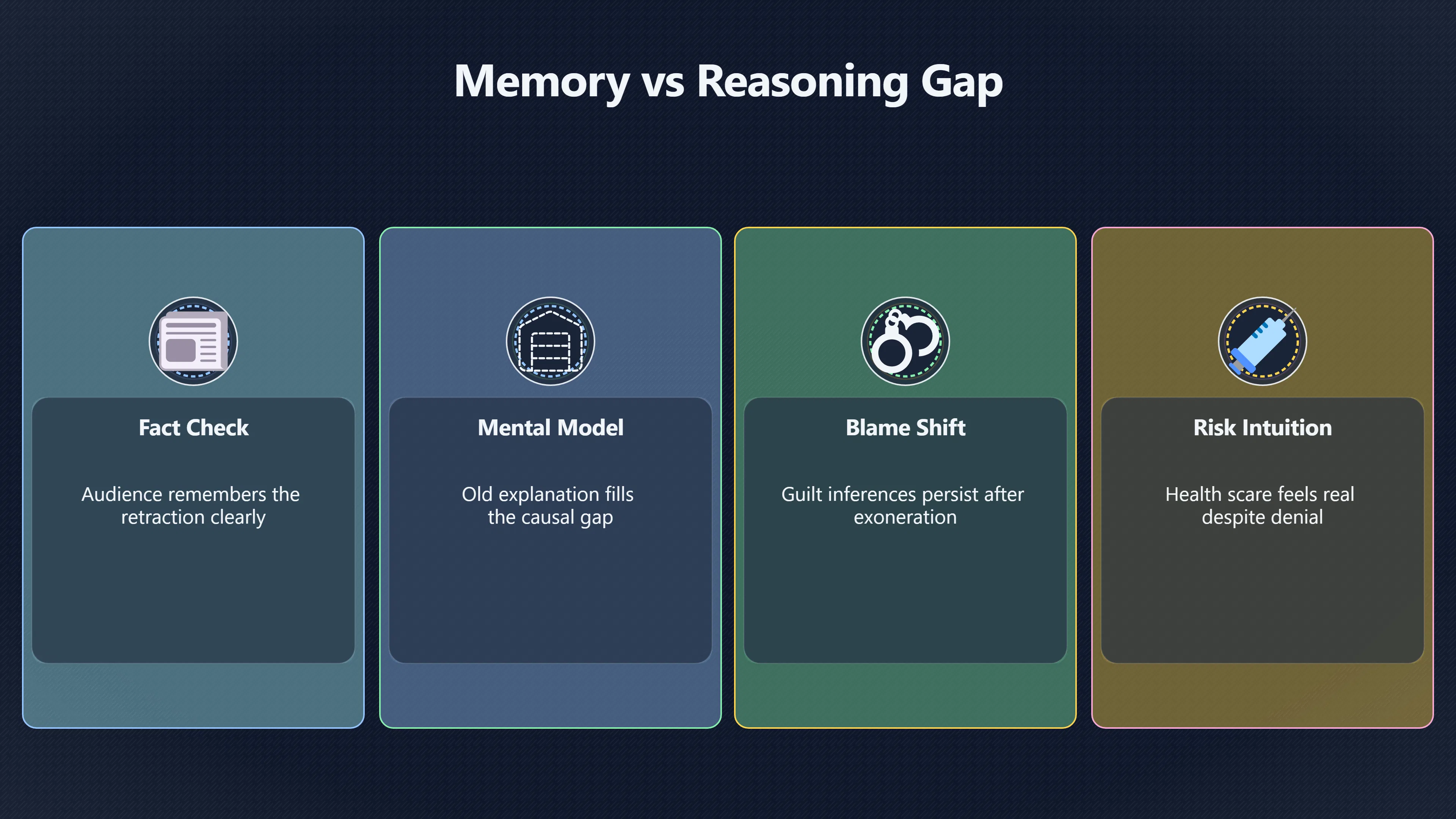
One of the most important findings in misinformation research is that remembering a correction and reasoning from that correction are not the same task.
In classic continued influence experiments, participants receive a piece of information and later receive a clear retraction. Afterwards, many can correctly report that the information was withdrawn. Yet when asked to explain an event, they still incorporate the retracted detail into their answers. Researchers have repeatedly found this pattern across different scenarios, including accidents, crimes, political claims and public controversies.[ResearchGate]researchgate.netResearch Gate(PDF) The continued influence of misinformation in memoryIn a dynamic world, information in memory is frequently outdated, corrected, or replaced.Read more…[Ecker Memory & Cognition Lab]emc-lab.orgEcker Memory & Cognition LabManipulating the strength of misinformation encoding and its…May 13, 2011 — by UKH Ecker · 2011 · Cited by…
The difference becomes clearer if memory and judgement are separated:
- Memory question: “Was that claim later corrected?”
- Reasoning question: “What caused this event?”
- Judgement question: “Who is responsible?”
- Risk question: “How worried should we be?”
A person may answer the memory question correctly while still allowing the original misinformation to influence the other three. The correction exists in memory, but it has not fully replaced the earlier explanation.[ResearchGate]researchgate.netResearch Gate(PDF) The continued influence of misinformation in memoryIn a dynamic world, information in memory is frequently outdated, corrected, or replaced.Read more…
This is why researchers often measure more than factual recall. Simply showing that participants remember a retraction does not prove that the misinformation has stopped affecting their thinking. The stronger test is whether their later explanations and decisions change.[appstate.figshare.com]appstate.figshare.cominterventions to limit the continued influence effect acrossM. (2014) The continued influence effect: The persistence of misinformation in memory and reasoning following correction. In Rapp, D. N…
Why old inferences survive factual recall
The persistence of misinformation is often linked to the role it plays inside a person’s mental model of events.
When people encounter a story, they do not store isolated facts. They build a rough explanation connecting causes, motives and outcomes. If a false claim fills an important explanatory role, removing it creates a gap. The correction may mark the claim as inaccurate, but the underlying need for an explanation remains.[Ecker Memory & Cognition Lab]emc-lab.orgEcker Memory & Cognition LabManipulating the strength of misinformation encoding and its…May 13, 2011 — by UKH Ecker · 2011 · Cited by…
The warehouse-fire experiments that became a landmark in this field illustrate the problem. Participants learned that flammable materials supposedly stored in a cupboard had intensified a fire. Later they were told the cupboard had actually been empty. Even when participants remembered the correction, many continued referring to the flammable materials when explaining why the fire was severe. The misinformation remained useful because it answered questions that the correction alone did not address.[ResearchGate]researchgate.netResearch Gate(PDF) The continued influence of misinformation in memoryIn a dynamic world, information in memory is frequently outdated, corrected, or replaced.Read more…
In practical terms, people often retain:
- A sense that a suspect remains suspicious after exoneration.
- A feeling that a rumour reveals something important about a public figure.
- An intuition that a health scare must have had some factual basis.
- An impression that a disproven accusation still says something about character or risk.
The original claim may no longer be accepted as literally true, but its implications survive. The person remembers the correction while continuing to reason from traces of the earlier story.[ScienceDirect]sciencedirect.comScienceDirect He did it!She did it! No, she did not! Multiple causal…by UKH Ecker · 2015 · Cited by 164 — Two types of misinformation effects are discussed in…
Why blame and motive are especially difficult to update
Historical and contemporary examples suggest that corrections struggle most when misinformation helps explain intent, guilt or responsibility.
A false claim about hidden motives can become the organising principle for how people understand an event. Once that framework exists, later corrections must compete with an already coherent narrative. Simply stating that a claim was inaccurate may remove a fact while leaving the broader interpretation intact.[Sage Journals]journals.sagepub.comSage JournalsMisinformation and Its Correction: Continued Influence and…by S Lewandowsky · 2012 · Cited by 4713 — We look at people's…
This helps explain why accusations can remain damaging even after formal retractions. In experimental settings, participants sometimes continue making guilt-related inferences after an allegation has been withdrawn. The correction reduces the effect, but often does not erase it.[Ecker Memory & Cognition Lab]emc-lab.orgEcker Memory & Cognition LabManipulating the strength of misinformation encoding and its…May 13, 2011 — by UKH Ecker · 2011 · Cited by…
The same pattern has appeared in public controversies. Claims connecting vaccines and autism, or linking political actors to disputed allegations, have often continued influencing public reasoning after major corrections or contrary evidence emerged. The continued influence effect does not mean people wholly reject the correction. Rather, parts of the earlier interpretation continue to shape how they assess risk and causation.[Ecker Memory & Cognition Lab]emc-lab.orgEcker Memory & Cognition LabManipulating the strength of misinformation encoding and its…May 13, 2011 — by UKH Ecker · 2011 · Cited by… ResearchGate Because motive and blame involve interpretation rather than simple fact recall[researchgate.net]researchgate.netResearch Gate(PDF) The continued influence of misinformation in memoryIn a dynamic world, information in memory is frequently outdated, corrected, or replaced.Read more…, they provide more room for misinformation to linger.
The role of psychological discomfort
Another reason corrections may fail is that they can create an uncomfortable state of uncertainty.
When a correction removes an explanation, people are left with unanswered questions. Why did the event happen? Who was responsible? What should replace the rejected claim? Research has found that retractions can produce psychological discomfort, and that this discomfort is associated with continued reliance on misinformation.[PMC]pmc.ncbi.nlm.nih.govPMCThe role of discomfort in the continued influence effectby MW Susmann · 2021 · Cited by 90 — The present research tested the prediction that retractions of misinformation produce feelings of…
From this perspective, the problem is not only memory. It is also cognitive stability. A flawed explanation can feel preferable to having no explanation at all.
This helps explain why simple negations often underperform. A correction that says “this is false” may succeed factually while leaving the audience with a less satisfying account of events. The old claim remains available as a familiar way to restore coherence.[PMC]pmc.ncbi.nlm.nih.govPMCThe role of discomfort in the continued influence effectby MW Susmann · 2021 · Cited by 90 — The present research tested the prediction that retractions of misinformation produce feelings of…
How to test whether a correction really worked
A common mistake is to evaluate corrections only by checking whether people remember them.
Researchers increasingly distinguish between two different outcomes:
TestWhat it measuresRecall testWhether people remember the correction occurredInference testWhether people stop using the misinformation when reasoningJudgement testWhether blame, trust or risk estimates changeDecision testWhether choices reflect the correction rather than the myth
A correction may perform well on the first measure and poorly on the others. That is why studies of the continued influence effect often ask participants to explain events or make judgements rather than merely recall facts.[ResearchGate]researchgate.netResearch Gate(PDF) The continued influence of misinformation in memoryIn a dynamic world, information in memory is frequently outdated, corrected, or replaced.Read more…[ScienceDirect For communicators]sciencedirect.comScienceDirect He did it!She did it! No, she did not! Multiple causal…by UKH Ecker · 2015 · Cited by 164 — Two types of misinformation effects are discussed in…, this distinction has practical consequences. A public-health agency, newsroom or fact-checker may find that audiences can repeat the correction accurately. Yet if those same audiences continue making decisions based on the original misinformation, the correction has only partially succeeded.[Ecker Memory & Cognition Lab]emc-lab.orgEcker Memory & Cognition LabManipulating the strength of misinformation encoding and its…May 13, 2011 — by UKH Ecker · 2011 · Cited by…
The strongest corrections therefore aim to change reasoning, not just memory. They provide an alternative explanation, replace the missing causal link and give people a new account to use when they later think about the issue. Research consistently finds that this kind of replacement is more effective than a bare retraction.[ResearchGate]researchgate.netResearch Gate(PDF) The continued influence of misinformation in memoryIn a dynamic world, information in memory is frequently outdated, corrected, or replaced.Read more…
The memory gap at the centre of misinformation
The key lesson from the continued influence effect is that knowledge and use are different things. People can know that a statement was false and still rely on it when interpreting the world.
That gap explains why myths sometimes survive despite successful fact-checking. The correction may be present in memory, but the older claim remains embedded in explanations, intuitions and judgements. Measuring success therefore requires more than asking whether people remember the correction. The crucial question is whether they have stopped using the misinformation when they reason about causes, responsibility and risk.[Ecker Memory & Cognition Lab]emc-lab.orgEcker Memory & Cognition LabManipulating the strength of misinformation encoding and its…May 13, 2011 — by UKH Ecker · 2011 · Cited by…[Ecker Memory & Cognition Lab]emc-lab.orgEcker Memory & Cognition LabManipulating the strength of misinformation encoding and its…May 13, 2011 — by UKH Ecker · 2011 · Cited by…
Amazon book picks
Further Reading
Books and field guides related to Knowing it is false is not enough. Use these as the next step if you want deeper reading beyond the article.
Mistakes Were Made (but Not by Me) Third Edition
Explains resistance to updating beliefs.

Mistakes Were Made (But Not by Me)
First published 2007. Subjects: Fouten, Vergissingen, Cognitive dissonance, Self-deception, Rechtvaardiging.
eBay marketplace picks
Marketplace Samples
Example marketplace items related to this page. Use the search link to explore similar finds on eBay.

Endnotes
1.
Source: researchgate.net
Title: Research Gate(PDF) The continued influence of misinformation in memory
Link:https://www.researchgate.net/publication/247317334_The_continued_influence_of_misinformation_in_memory_What_makes_a_correction_effective
Source snippet
In a dynamic world, information in memory is frequently outdated, corrected, or replaced.Read more...
2.
Source: sciencedirect.com
Title: ScienceDirect He did it!
Link:https://www.sciencedirect.com/science/article/abs/pii/S0749596X15001035
Source snippet
She did it! No, she did not! Multiple causal...by UKH Ecker · 2015 · Cited by 164 — Two types of misinformation effects are discussed in...
3.
Source: appstate.figshare.com
Title: interventions to limit the continued influence effect across
Link:https://appstate.figshare.com/articles/thesis/Interventions_to_Limit_the_Continued_Influence_Effect_Across_Contexts/30334174/1/files/58815109.pdf
Source snippet
M. (2014) The continued influence effect: The persistence of misinformation in memory and reasoning following correction. In Rapp, D. N...
4.
Source: researchgate.net
Title: Research Gate(PDF) He did it!
Link:https://www.researchgate.net/publication/281618768_He_did_it_She_did_it_No_she_did_not_Multiple_causal_explanations_and_the_continued_influence_of_misinformation
Source snippet
She did it! No, she did not! Multiple causal...Two types of misinformation effects are discussed in the literature—the post-event misinf...
5.
Source: pmc.ncbi.nlm.nih.gov
Title: PMCThe role of discomfort in the continued influence effect
Link:https://pmc.ncbi.nlm.nih.gov/articles/PMC8447889/
Source snippet
by MW Susmann · 2021 · Cited by 90 — The present research tested the prediction that retractions of misinformation produce feelings of...
6.
Source: sciencedirect.com
Link:https://www.sciencedirect.com/science/article/pii/S0010027724002865
Source snippet
Relative source credibility affects the continued influence...by CV Hey · 2025 · Cited by 6 — The Continued Influence Effect (CIE) is th...
7.
Source: youtube.com
Title: The Continued Influence Effect
Link:https://www.youtube.com/watch?v=eZ_hcf01EFw
Source snippet
Why Misinformation Sticks in Your Brain Even After It's Debunked...
8.
Source: emc-lab.org
Link:https://www.emc-lab.org/uploads/1/1/3/6/113627673/ecker.2011.pbr.pdf
Source snippet
Ecker Memory & Cognition LabManipulating the strength of misinformation encoding and its...May 13, 2011 — by UKH Ecker · 2011 · Cited by...
Published: May 13, 2011
9.
Source: journals.sagepub.com
Link:https://journals.sagepub.com/doi/abs/10.1177/1529100612451018
Source snippet
Sage JournalsMisinformation and Its Correction: Continued Influence and...by S Lewandowsky · 2012 · Cited by 4713 — We look at people's...
10.
Source: emc-lab.org
Link:https://www.emc-lab.org/uploads/1/1/3/6/113627673/ecker.2010.mc.pdf
Source snippet
Ecker Memory & Cognition LabExplicit warnings reduce but do not eliminate the continued...August 27, 2017 — by UKH ECKER · 2010 · Cited...
Published: August 27, 2017
11.
Source: Wikipedia
Link:https://en.wikipedia.org/wiki/Misinformation
Source snippet
MisinformationMisinformation can include inaccurate, incomplete, misleading, or false information as well as selective or half-truths...
Additional References
12.
Source: un.org
Link:https://www.un.org/en/countering-disinformation
Source snippet
Countering DisinformationWhile misinformation refers to the accidental spread of inaccurate information, disinformation is not only inacc...
13.
Source: aec.gov.au
Link:https://www.aec.gov.au/About_AEC/files/eiat/eiat-disinformation-factsheet.pdf
Source snippet
Disinformation and MisinformationDisinformation and Misinformation. What is disinformation and misinformation? Misinformation is false in...
14.
Source: apa.org
Link:https://www.apa.org/topics/journalism-facts/misinformation-disinformation
Source snippet
Misinformation and disinformationMisinformation is false or inaccurate information—getting the facts wrong. Disinformation is false infor...
15.
Source: scispace.com
Link:https://scispace.com/pdf/the-continued-influence-of-misinformation-in-memory-what-4tijzg1jh2.pdf
16.
Source: unhcr.org
Link:https://www.unhcr.org/innovation/wp-content/uploads/2022/02/Factsheet-4.pdf
Source snippet
Disinformation. Misinformation is false or inaccurate information. Examples include rumors, insults and pranks. Disinformation is...Read...
17.
Source: theguardian.com
Title: The Guardian US ‘drowning in misinformation’ under RFK Jr, autism advocates say
Link:https://www.theguardian.com/us-news/2026/may/03/trump-administration-rfk-autism-misinformation
Source snippet
US ‘drowning in misinformation’ under RFK Jr, autism advocates say...
18.
Source: esafety.gov.au
Title: [fake news]({{ ‘fake-news/’ | relative_url }}) and misinformation
Link:https://www.esafety.gov.au/key-topics/fake-news-and-misinformation
Source snippet
20 Jan 2026 — Information, images and videos posted online can be untrue or misleading, so check the facts before sharing them.Read more...
19.
Source: youtube.com
Link:https://www.youtube.com/watch?v=H_dHJVH5hPU
Source snippet
The [Debunking]({{ 'debunking/' | relative_url }}) Handbook: How to counter misinformation...
20.
Source: youtube.com
Title: Why Misinformation Sticks in Your Brain Even After It’s Debunked
Link:https://www.youtube.com/watch?v=pxHMGHUs3S4
Source snippet
The Continued Influence of Misinformation — Ullrich Ecker (CHDH Seminar Series 2020)...
21.
Source: pmc.ncbi.nlm.nih.gov
Link:https://pmc.ncbi.nlm.nih.gov/articles/PMC10623619/
Source snippet
by Z Adams · 2023 · Cited by 144 — The consensus view points to advancements in information technology (eg, the Internet, social media...
Topic Tree