Within Memory
Can a Question Change a Memory?
Small wording changes after an event can steer what witnesses later remember without making them dishonest.
On this page
- The car crash wording experiments
- How suggestion becomes remembered detail
- Safer questioning after a witnessed event
Page outline Jump by section
Introduction
A witness does not need to be dishonest for a memory to change. One of the most important findings in memory research is that the wording of a question can alter what a person later remembers about an event. Small changes in language can influence which details people focus on, how they interpret what happened, and even whether they later remember seeing things that were never there. This is one reason psychologists reject the idea that memory works like a recording. Eyewitness recollection remains vulnerable after the event itself, especially during interviews, conversations and repeated retellings. Research on leading questions has shown that suggestion can become woven into memory so thoroughly that witnesses often believe the altered version is their genuine recollection.[Simply Psychology]simplypsychology.orgloftus palmerSimply PsychologyLoftus and Palmer 1974 | Car Crash Experimentby S McLeod · Cited by 2 — Loftus and Palmer (1974) asked people to estimat…[Noba]nobaproject.comNobaEyewitness Testimony and Memory BiasesIn other words, the misinformation in the leading question led to inaccurate memory. This pheno…
Can a Question Change a Memory?
A leading question contains information or assumptions that steer a person towards a particular answer. Instead of simply asking what happened, it subtly suggests what the interviewer expects or believes occurred.
The crucial point is that a leading question can do more than influence a witness’s immediate response. It can affect later memory. A witness who hears a suggested detail may later remember that detail as part of the original event rather than as information introduced afterwards. Psychologists call this the misinformation effect: exposure to misleading post-event information can distort later recall.[Noba]nobaproject.comNobaEyewitness Testimony and Memory BiasesIn other words, the misinformation in the leading question led to inaccurate memory. This pheno…[ScienceDirect]sciencedirect.comScienceDirect Misinformation EffectMisinformation Effect - an overviewThe misinformation effect is the production of distorted, false, or other erroneous or misleading info…
This challenges a common assumption in courts and everyday life. People often think inaccurate testimony comes from lying, carelessness or poor observation. Research suggests a different possibility: sincere witnesses can become less accurate because later questioning changes the way the event is remembered.[PMC]pmc.ncbi.nlm.nih.govPMCExperimental and meta-analytic evidence that sourceby R O’Donnell · 2023 — Experiment 1 used written interview transcripts to deliver misinformation and showed that repetition increased…
The Car-Crash Wording Experiments
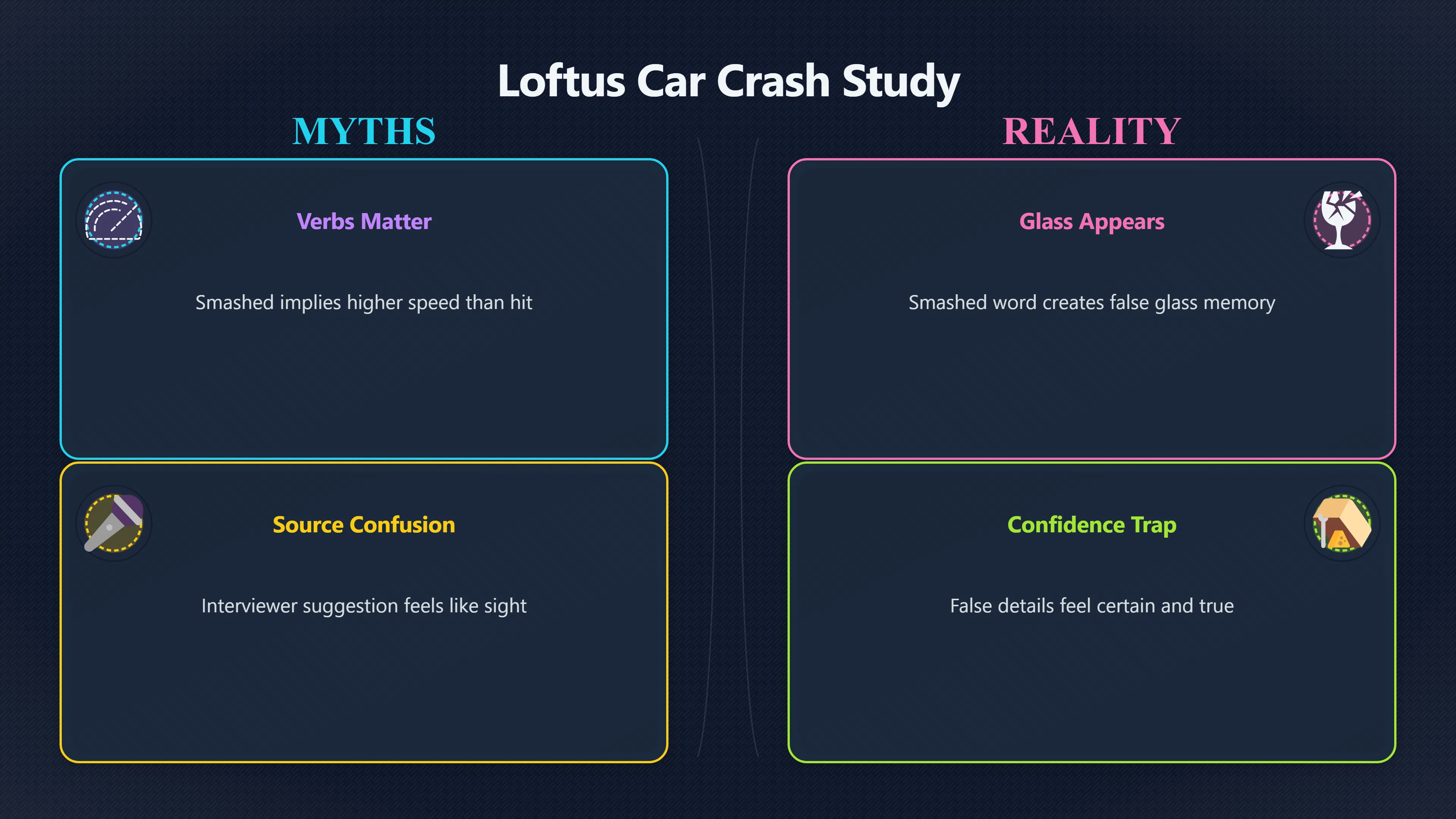
The best-known demonstration comes from psychologist Elizabeth Loftus and colleague John Palmer in 1974. Participants watched films of traffic accidents and were then asked about the speed of the vehicles. The key manipulation involved a single verb. Different groups were asked how fast the cars were going when they “hit”, “collided”, “bumped”, “contacted” or “smashed” into each other.[ScienceDirect]sciencedirect.comScienceDirect Misinformation EffectMisinformation Effect - an overviewThe misinformation effect is the production of distorted, false, or other erroneous or misleading info…
The wording changed participants’ estimates. People who heard “smashed” reported higher speeds than those who heard milder terms such as “hit” or “contacted”. The event itself was identical for all participants. Only the question changed.[ScienceDirect]sciencedirect.comScienceDirect Misinformation EffectMisinformation Effect - an overviewThe misinformation effect is the production of distorted, false, or other erroneous or misleading info…
The more striking result came later. In a follow-up experiment, participants returned about a week after viewing the crash footage and were asked whether they had seen broken glass. No broken glass had appeared in the film. Yet participants exposed to the word “smashed” were more likely to report seeing it. A brief linguistic suggestion had influenced not just interpretation but later memory.[Simply Psychology]simplypsychology.orgloftus palmerSimply PsychologyLoftus and Palmer 1974 | Car Crash Experimentby S McLeod · Cited by 2 — Loftus and Palmer (1974) asked people to estimat…
The experiment became famous because it illustrated how easily memory can be reshaped. A witness may not merely change an answer to satisfy an interviewer. The witness may genuinely come to remember a more severe collision than the one originally observed.[Simply Psychology]simplypsychology.orgloftus palmerSimply PsychologyLoftus and Palmer 1974 | Car Crash Experimentby S McLeod · Cited by 2 — Loftus and Palmer (1974) asked people to estimat…
How Suggestion Becomes Remembered Detail
The brain does not always track where information came from
One explanation involves source monitoring, the process of identifying where a memory originated. People constantly combine information from perception, conversations, news reports, photographs and imagination. Later, they must determine which source produced a particular memory.
Problems arise when a witness remembers a detail but forgets where it came from. The suggested information introduced by an interviewer may later feel indistinguishable from the original experience. Instead of remembering, “The officer mentioned broken glass,” the witness may remember, “I saw broken glass.”[PMC]pmc.ncbi.nlm.nih.govPMCExperimental and meta-analytic evidence that sourceby R O’Donnell · 2023 — Experiment 1 used written interview transcripts to deliver misinformation and showed that repetition increased…
This source confusion is especially likely when the suggestion fits naturally with the event. Broken glass seems plausible after a serious crash. Because it matches expectations, it can be incorporated into the memory reconstruction process with little resistance.[PMC]pmc.ncbi.nlm.nih.govPMCExperimental and meta-analytic evidence that sourceby R O’Donnell · 2023 — Experiment 1 used written interview transcripts to deliver misinformation and showed that repetition increased…
Memory reconstruction fills gaps
Memories rarely contain every detail of an event. When recalling what happened, people reconstruct missing pieces using general knowledge and expectations.
Leading questions can shape this reconstruction. If a witness hears language implying aggression, danger or a particular sequence of events, that implication can become part of the reconstructed memory. The witness is not necessarily inventing details consciously. Rather, the memory system is building a coherent story from available information. Noba[PMC]pmc.ncbi.nlm.nih.govPMCExperimental and meta-analytic evidence that sourceby R O’Donnell · 2023 — Experiment 1 used written interview transcripts to deliver misinformation and showed that repetition increased… The effect is often strongest when the original memory is incomplete. Poor lighting, brief exposure, stress or distraction leave gaps. Suggestions can then provide material that fills those gaps during later recall.[PMC]pmc.ncbi.nlm.nih.govPMCExperimental and meta-analytic evidence that sourceby R O’Donnell · 2023 — Experiment 1 used written interview transcripts to deliver misinformation and showed that repetition increased…

Repetition can strengthen misinformation
Research has also found that repeated exposure to misleading information can increase suggestibility. When misinformation is encountered multiple times, it can become more familiar and therefore more likely to be accepted as true. Familiarity may be mistaken for evidence that the information came from the original event.[PMC]pmc.ncbi.nlm.nih.govPMCExperimental and meta-analytic evidence that sourceby R O’Donnell · 2023 — Experiment 1 used written interview transcripts to deliver misinformation and showed that repetition increased…
Repeated questioning can create a related problem. Witnesses may begin to assume that details repeatedly mentioned by interviewers must be important or accurate. Over time, the distinction between the witnessed event and the later discussion can blur.[ScienceDirect]sciencedirect.comScienceDirect Misinformation EffectMisinformation Effect - an overviewThe misinformation effect is the production of distorted, false, or other erroneous or misleading info…
Why Confidence Often Survives the Distortion
One reason leading questions are so concerning is that altered memories can feel convincing. People often expect uncertainty to accompany error. In reality, confidence and accuracy do not always move together.
Once misinformation becomes integrated into a memory, the resulting recollection can carry the same feeling of certainty as an accurate memory. Witnesses may describe false details confidently because they are reporting what they sincerely believe they remember.[The Decision Lab]thedecisionlab.comThe Decision LabThe Misinformation EffectSince Loftus's research, many legal scholars have questioned the validity of eyewitness testimon…
This helps explain why eyewitness confidence alone can be misleading. A confident witness may be recalling a memory that has already been reshaped by post-event suggestion. The confidence reflects belief in the memory, not necessarily the memory’s accuracy.[JSTOR]jstor.orgRethinking the Reliability of Eyewitness Memoryby JT Wixted · 2018 · Cited by 235 — Thus, we would expect to find that training poli…
When Post-Event Information Comes From More Than Interviews
Police questioning is not the only source of memory distortion. Witnesses can encounter misleading information through conversations with other witnesses, media coverage, social media posts or repeated public discussion of an event.
Studies continue to find that post-event information delivered through modern channels can influence recall. Researchers have shown that misleading information presented through interview transcripts, videos and social-media-style formats can reduce eyewitness accuracy and increase acceptance of false details.[PMC]pmc.ncbi.nlm.nih.govPMCExperimental and meta-analytic evidence that sourceby R O’Donnell · 2023 — Experiment 1 used written interview transcripts to deliver misinformation and showed that repetition increased… PubMed The mechanism remains similar. New information arrives after the event[thedecisionlab.com]thedecisionlab.comThe Decision LabThe Misinformation EffectSince Loftus's research, many legal scholars have questioned the validity of eyewitness testimon…, becomes mixed with the original memory and later feels familiar enough to be remembered as something personally observed.[Taylor & Francis Online]tandfonline.comJournal of Experimental…Read more…
Safer Questioning After a Witnessed Event
Because memory can be altered by suggestion, investigators have developed interviewing approaches designed to minimise contamination.
Several principles are widely recommended:
- Use open-ended questions such as “What do you remember?” rather than questions that suggest an answer.
- Avoid assumptions hidden inside questions, such as presuming a weapon, object or action existed.
- Separate witnesses to reduce contamination from discussion.
- Record initial accounts as soon as reasonably possible before exposure to later information.
- Avoid repeated suggestive questioning that may reinforce misinformation.
- Document exactly how questions were asked so later reviewers can evaluate potential influence. Taylor & Francis Online[National Academies]nationalacademies.orgChapter: 4 Basic Research on Vision and MemoryAccurate eyewitness identification requires that a witness to a crime correctly sense, perc…
The goal is not merely to obtain more information. It is to protect the memory from alteration during the retrieval process itself.

The Real Lesson of Leading Questions
The research on leading questions does not show that eyewitnesses are useless or that every memory is false. Instead, it reveals a more specific and unsettling reality: remembering is an active process. Memories can be reshaped by information encountered after an event, and subtle wording changes can become part of what a witness later experiences as a genuine recollection.[Noba]nobaproject.comNobaEyewitness Testimony and Memory BiasesIn other words, the misinformation in the leading question led to inaccurate memory. This pheno…[ScienceDirect]sciencedirect.comReconstruction of automobile destruction: An example…by EF Loftus · 1974 · Cited by 3699 — Two experiments are reported i…
That is why a question can sometimes change a memory. The danger is not that witnesses are deliberately inventing events. The danger is that the human memory system is reconstructive, and suggestions introduced after the fact can become woven into the story that the witness honestly believes is true.[Simply Psychology]simplypsychology.orgloftus palmerSimply PsychologyLoftus and Palmer 1974 | Car Crash Experimentby S McLeod · Cited by 2 — Loftus and Palmer (1974) asked people to estimat…[PMC]pmc.ncbi.nlm.nih.govPMCExperimental and meta-analytic evidence that sourceby R O’Donnell · 2023 — Experiment 1 used written interview transcripts to deliver misinformation and showed that repetition increased…
Amazon book picks
Further Reading
Books and field guides related to Can a Question Change a Memory?. Use these as the next step if you want deeper reading beyond the article.
Eyewitness Testimony
Directly covers leading questions, misinformation effects, and altered memories.
The Seven Sins of Memory
Rating: 3.5/5 from 5 Google Books ratings
Explains why memory is reconstructive rather than a recording.
The Memory Illusion
Explains how memories can be shaped, altered, and falsely remembered.
The Invisible Gorilla
Shows how perception and memory are less reliable than people assume.
eBay marketplace picks
Marketplace Samples
Example marketplace items related to this page. Use the search link to explore similar finds on eBay.


Endnotes
1.
Source: sciencedirect.com
Title: ScienceDirect Misinformation Effect
Link:https://www.sciencedirect.com/topics/psychology/misinformation-effect
Source snippet
Misinformation Effect - an overviewThe misinformation effect is the production of distorted, false, or other erroneous or misleading info...
2.
Source: pmc.ncbi.nlm.nih.gov
Link:https://pmc.ncbi.nlm.nih.gov/articles/PMC8076587/
Source snippet
These failures and distortions are influenced by several...
3.
Source: sciencedirect.com
Link:https://www.sciencedirect.com/science/article/abs/pii/S0022537174800113
Source snippet
Reconstruction of automobile destruction: An example...by EF Loftus · 1974 · Cited by 3699 — Two experiments are reported i...
4.
Source: pmc.ncbi.nlm.nih.gov
Link:https://pmc.ncbi.nlm.nih.gov/articles/PMC10567586/
Source snippet
Cognitive and neural mechanisms underlying false memoriesby AG Lentoor · 2023 · Cited by 13 — This theory proposed that false memory o...
5.
Source: pmc.ncbi.nlm.nih.gov
Title: PMCExperimental and meta-analytic evidence that source
Link:https://pmc.ncbi.nlm.nih.gov/articles/PMC10492197/
Source snippet
by R O’Donnell · 2023 — Experiment 1 used written interview transcripts to deliver misinformation and showed that [repetition]({{ 'repetition/' | relative_url }}) increased...
6.
Source: sciencedirect.com
Link:https://www.sciencedirect.com/science/article/abs/pii/S2211368117300724
Source snippet
Retrieval-Enhanced Suggestibility: A Retrospective and a...by JCK Chan · 2017 · Cited by 62 — Taking a memory test before b...
7.
Source: jstor.org
Link:https://www.jstor.org/stable/48568428
Source snippet
Rethinking the Reliability of Eyewitness Memoryby JT Wixted · 2018 · Cited by 235 — Thus, we would expect to find that training poli...
8.
Source: sciencedirect.com
Title: Misinformation Effect
Link:https://www.sciencedirect.com/topics/agricultural-and-biological-sciences/misinformation-effect
Source snippet
an overviewResearch on the misinformation effect has a long and rich history in the human memory literature, beginning with the pioneerin...
9.
Source: sciencedirect.com
Title: Misinformation Effect
Link:https://www.sciencedirect.com/topics/social-sciences/misinformation-effect
Source snippet
an overviewThe misinformation effect is particularly useful for understanding factors that can influence eyewitness memory; eyewitnesses...
10.
Source: simplypsychology.org
Title: loftus palmer
Link:https://www.simplypsychology.org/loftus-palmer.html
Source snippet
Simply PsychologyLoftus and Palmer 1974 | Car Crash Experimentby S McLeod · Cited by 2 — Loftus and Palmer (1974) asked people to estimat...
11.
Source: nationalacademies.org
Link:https://www.nationalacademies.org/read/18891/chapter/6
Source snippet
Chapter: 4 Basic Research on Vision and MemoryAccurate eyewitness identification requires that a witness to a crime correctly sense, perc...
12.
Source: pmc.ncbi.nlm.nih.gov
Title: PMCA Behavioral Account of the Misinformation Effect
Link:https://pmc.ncbi.nlm.nih.gov/articles/PMC3213001/
Source snippet
NIHby DM Challies · 2011 · Cited by 33 — However, a few studies have shown that participants' reports may also be influenced by ind...
13.
Source: tandfonline.com
Link:https://www.tandfonline.com/doi/full/10.1080/09658211.2023.2294692
Source snippet
Journal of Experimental...Read more...
14.
Source: thedecisionlab.com
Link:https://thedecisionlab.com/reference-guide/psychology/the-misinformation-effect
Source snippet
The Decision LabThe Misinformation EffectSince Loftus's research, many legal scholars have questioned the validity of eyewitness testimon...
15.
Source: pubmed.ncbi.nlm.nih.gov
Link:https://pubmed.ncbi.nlm.nih.gov/38146968/
Source snippet
nih.govWitnesses' susceptibility to misleading post-event...by SJ Sharman · 2024 · Cited by 4 — This study examined the effect of mislea...
16.
Source: tandfonline.com
Link:https://www.tandfonline.com/doi/full/10.1080/1068316X.2026.2637901
Source snippet
Taylor & Francis OnlineNews as a form of post-event information: the effect of...by Z Crittenden · 2026 — Decades of research into the m...
17.
Source: tandfonline.com
Link:https://www.tandfonline.com/doi/abs/10.1080/13218719.2013.803276
Source snippet
Taylor & Francis OnlineA Review of the Impact of Different Types of Leading...by PV Bowles · 2014 · Cited by 60 — We examined the litera...
18.
Source: pmc.ncbi.nlm.nih.gov
Link:https://pmc.ncbi.nlm.nih.gov/articles/PMC11928514/
Source snippet
by N Dilevski · 2025 · Cited by 3 — The outcomes of the study suggest that investigative interviewers should avoid asking misleading q...
19.
Source: pmc.ncbi.nlm.nih.gov
Link:https://pmc.ncbi.nlm.nih.gov/articles/PMC3143501/
Source snippet
by MF Mendez · 2010 · Cited by 44 — Studies using the Deese/Roedinger–McDermott experimental paradigm indicate that false memories are...
20.
Source: ncbi.nlm.nih.gov
Link:https://www.ncbi.nlm.nih.gov/books/NBK549791/
Source snippet
nih.govPhysiology, Long Term Memory - StatPearls - NCBI Bookshelfby A Almaraz-Espinoza · 2023 · Cited by 14 — Memory is a complex brain f...
21.
Source: Wikipedia
Link:https://en.wikipedia.org/wiki/Memory
Source snippet
MemoryMemory is the faculty of the mind by which data or information is encoded, stored, and retrieved when needed.Read more...
22.
Source: health.harvard.edu
Link:https://www.health.harvard.edu/topics/memory
Source snippet
harvard.eduMemory20 Apr 2026 — In many ways, our memories shape who we are. They make up our internal biographies - the stories we tell o...
23.
Source: ebsco.com
Link:https://www.ebsco.com/research-starters/social-sciences-and-humanities/misinformation-effect
Source snippet
Misinformation effect | Social Sciences and HumanitiesThe misinformation effect refers to the phenomenon where post-event information can...
24.
Source: my.clevelandclinic.org
Link:https://my.clevelandclinic.org/health/articles/memory
Source snippet
clevelandclinic.orgMemory: What It Is, How It Works & Types16 Sept 2024 — Memory is the ability to recall learned information. Many parts...
25.
Source: psychologytoday.com
Link:https://www.psychologytoday.com/au/basics/memory
Source snippet
Psychology Today Australia13 Nov 2025 — Memory is the faculty by which the brain encodes, stores, and retrieves information. It is a reco...
26.
Source: resource.download.wjec.co.uk
Title: loftus and palmer
Link:https://resource.download.wjec.co.uk/vtc/2020-21/el20-21_25-4a/wjec/loftus_and_palmer.pdf
Source snippet
Reconstruction of automobile...Another 50 participants were asked the same question but with the word hit replacing the word smashed. Th...
27.
Source: massolit.io
Title: loftus and palmer 1974
Link:https://massolit.io/options/loftus-and-palmer-1974
Source snippet
Loftus and Palmer (1974) Eye Witness Testimony Dr Evelyn Svingen. Loftus and...Read more...
Additional References
28.
Source: app.nova.edu
Link:https://app.nova.edu/toolbox/instructionalproducts/edd8124/articles/1975-Loftus.pdf
Source snippet
Leading Questions and the Eyewitness ReportIn one study (Loftus, unpublished), 40 people were interviewed about their headaches and about...
29.
Source: scribd.com
Link:https://www.scribd.com/document/679835923/internal-assesment
Source snippet
Loftus and Palmer Car Crash Study Insights | PDF | MemoryThe verb used significantly affected participants' estimates of the vehicles' sp...
30.
Source: nobaproject.com
Link:https://nobaproject.com/modules/eyewitness-testimony-and-memory-biases
Source snippet
NobaEyewitness Testimony and Memory BiasesIn other words, the misinformation in the leading question led to inaccurate memory. This pheno...
31.
Source: labs.la.utexas.edu
Link:https://labs.la.utexas.edu/gilden/files/2016/04/Loftus_Palmer.pdf
Source snippet
utexas.edu108 / William SternelleLoftus and J. C. Palmer, Reconstruction of automobile destruction: An example of the interaction between...
32.
Source: themantic-education.com
Link:https://www.themantic-education.com/ibpsych/2019/02/25/key-study-leading-questions-and-the-misinformation-effect-the-car-crash-study-loftus-and-palmer-1974/
Source snippet
Key Study: Leading questions and the misinformation effect25 Feb 2019 — Loftus and Palmer's first experiment showed how leading questions...
33.
Source: merriam-webster.com
Link:https://www.merriam-webster.com/dictionary/memory
34.
Source: guide.fariaedu.com
Link:https://guide.fariaedu.com/psychology-teacher-articles/cognitive-approach-1/reliability-of-cognitive-processes/the-reliability-of-cognitive-processes-additional-information-on-loftus-and-palmer-1974
Source snippet
misinformation effect. Loftus and Palmer experiments were done on reconstructive memory and the impact of how asking questions to witness...
35.
Source: mayoclinic.org
Link:https://www.mayoclinic.org/healthy-lifestyle/healthy-aging/in-depth/memory-loss/art-20046518
Source snippet
Be physically active every day · 2. Stay mentally active · 3. Spend time with others · 4. Stay organized · 5.Read more...
36.
Source: youtube.com
Link:https://www.youtube.com/watch?v=Yq6u_4xtVh0
Source snippet
Common Law S4 E8: The Psychology of Eyewitness MemoryPsychologist Elizabeth F. Loftus, a leading expert on memory, discusses how her rese...
37.
Source: innocenceproject.org
Link:https://www.innocenceproject.org/wp-content/uploads/2016/02/NAS-Report-ID.pdf
Source snippet
12... E. F. Loftus and H. G. Hoffman, “Misinformation and Memory, the Creation of New.Read more...
Topic Tree