Within Familiarity
When easy thinking feels like evidence
Processing fluency explains why claims that feel easy to read, recall, or recognise can be mistaken for claims that are true.
On this page
- What processing fluency means
- Why ease can be misread as truth
- Everyday myths that exploit fluency
Page outline Jump by section
Introduction
Processing fluency is the mental feeling that something is easy to take in, recognise or remember. In the context of myths and misconceptions, that feeling matters because people often treat ease as a clue. A claim that arrives smoothly can feel more trustworthy than one that requires effort, even when neither claim has been properly checked. This is one of the core mechanisms behind the illusory truth effect: repeated or familiar information becomes easier to process, and that ease can be mistaken for evidence.[Springer]link.springer.comThe effects of repetition frequency on the illusory truth effectby A Hassan · 2021 · Cited by 402 — This finding is known as the…
 The shortcut is usually unconscious. People do not think, “This sentence was easy to read, therefore it is true.” Instead, the brain uses fluency as a rough signal that something is known, familiar or safe. In everyday life that shortcut is often useful. Information that is genuinely familiar is frequently true. The problem is that myths can exploit the same signal. A false claim repeated often enough can begin to produce the same feeling of mental ease as a well-established fact.[ScienceDirect]sciencedirect.comThe illusory truth effect: A review of how repetition…by J Udry · 2024 · Cited by 124 — Repetition increases belief in in…
What processing fluency means
Processing fluency refers to the subjective ease with which information is handled by the mind. Psychologists distinguish several forms of fluency, but they share a common feature: the brain experiences some information as smoother and less effortful than other information.[Wikipedia]WikipediaProcessing fluencyProcessing fluency
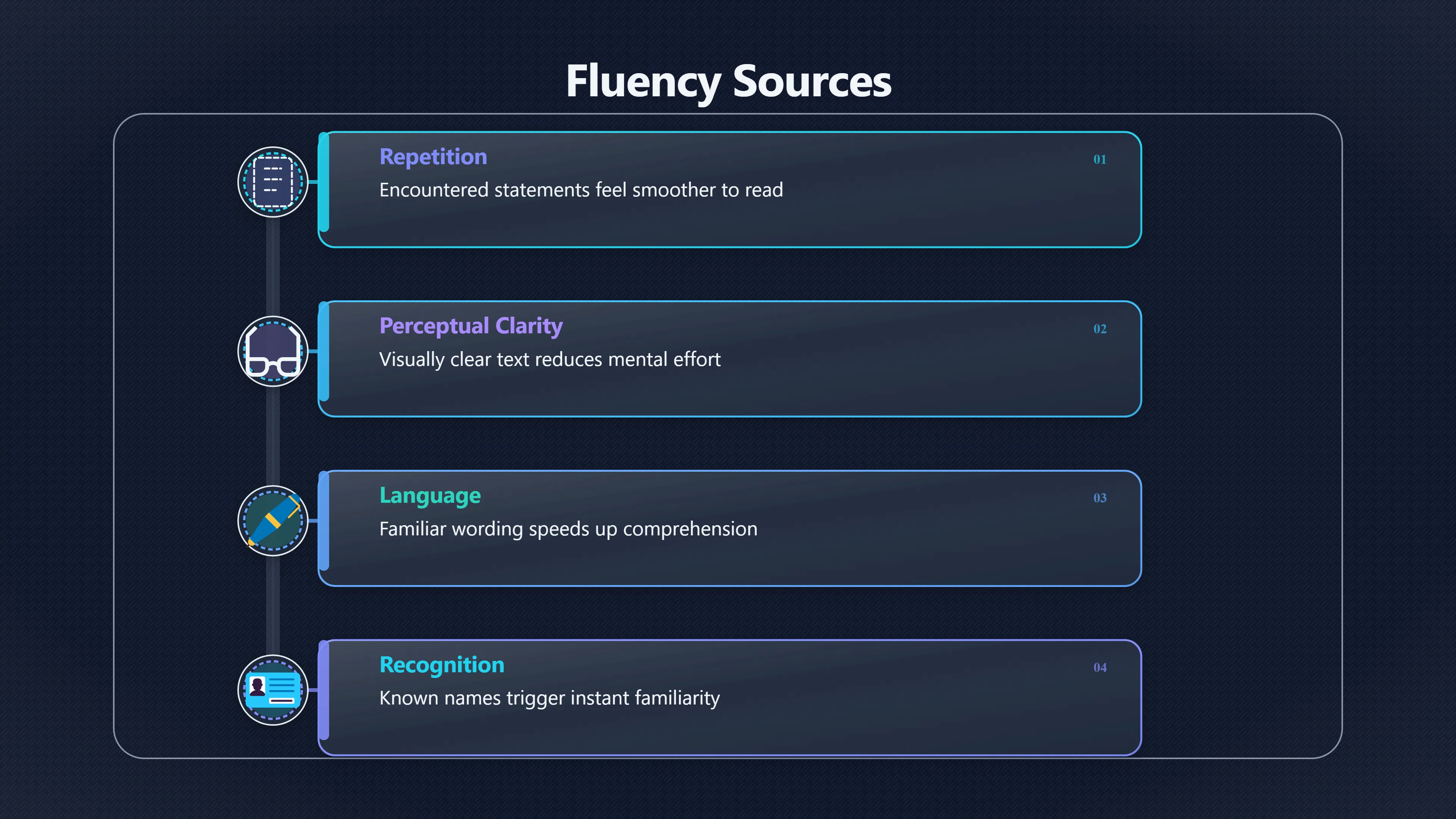
That ease can come from several sources:
- Repetition: a statement has been encountered before.
- Perceptual clarity: text is easy to read or visually clear.
- Simple language: wording is straightforward and familiar.
- Retrieval fluency: related ideas come quickly to mind.
- Recognition: a name, phrase or claim feels known.[Wikipedia]WikipediaIllusory truth effectIllusory truth effect
The important point is that fluency is a feeling, not a fact-check. The mind experiences smooth processing first and only later, if at all, examines why that smoothness occurred. Because fluent information often corresponds to genuine knowledge in everyday life, people learn to treat ease as a useful heuristic. Most of the time that shortcut works reasonably well. The difficulty arises when familiarity has been manufactured through repetition rather than earned through accuracy.[Springer]link.springer.comrepetition increase perceived truth equally for…
Why ease can be misread as truth
The connection between fluency and truth is not entirely irrational. In normal experience, true information often is easier to process. Facts that people encounter repeatedly, concepts they understand well and ideas that fit existing knowledge tend to feel fluent. Over time, the mind learns that ease and accuracy are often correlated.[Springer]link.springer.comDoes repetitionillusory-truth effect and its absence under accuracy-focused…May 13, 2025 — The phenomenon that repetition enhances processing fluency…
Problems emerge when the brain uses that correlation as a shortcut. Instead of asking whether evidence supports a claim, it relies partly on the feeling that the claim “sounds right”. Research on the illusory truth effect shows that repeated statements are more likely to be judged as true than novel statements, even when repetition provides no new evidence. The repeated claim becomes easier to process, and that fluency is interpreted as credibility.[PMC]pmc.ncbi.nlm.nih.govPMCIs it all about the feeling?Affective and (meta-)cognitive… - PMCby A Stump · 2021 · Cited by 27 — However, not only fluency but also affective processes can trig…
One reason the effect is powerful is that people rarely experience fluency as fluency. They experience it as confidence, familiarity or plausibility. The source of the feeling is often invisible. Someone may think a claim seems convincing without realising that its persuasive force comes partly from previous exposure rather than from supporting facts.[PMC]pmc.ncbi.nlm.nih.govPMCIs it all about the feeling?Affective and (meta-)cognitive… - PMCby A Stump · 2021 · Cited by 27 — However, not only fluency but also affective processes can trig…
Researchers have found that even small changes unrelated to evidence can influence truth judgements. Statements written in clearer formats, easier fonts or more accessible language can receive higher credibility ratings simply because they are processed more smoothly. Studies have also found that simpler wording can increase perceived credibility through greater comprehension ease.[Wikipedia]WikipediaFalse memoryFalse memory - WikipediaIllusory truth effect - Wikipedia…
Familiarity without evidence
A key misconception is that familiarity feels similar to verification. After repeated exposure, a claim can acquire a sense of established knowledge even when no one has actually examined whether it is true.
This helps explain why many myths survive for decades. People may not remember where they first heard a claim, but they remember having heard it. The original source fades while the feeling of familiarity remains. Once that happens, recognition itself can become a substitute for evidence.
Research reviewing the illusory truth effect has repeatedly found that repetition can increase belief in statements ranging from everyday trivia to misinformation and conspiracy-related claims. Importantly, the effect is not limited to obviously plausible statements. Repetition can raise perceived truth even for information that contradicts existing knowledge.[ScienceDirect]sciencedirect.comThe illusory truth effect: A review of how repetition…by J Udry · 2024 · Cited by 124 — Repetition increases belief in in…
This does not mean that knowledge becomes irrelevant. Prior knowledge still matters and often helps people reject falsehoods. But fluency can influence initial judgements before people fully retrieve and apply what they know. The result is a subtle competition between evidence and familiarity.[ScienceDirect]sciencedirect.comThe illusory truth effect: A review of how repetition…by J Udry · 2024 · Cited by 124 — Repetition increases belief in in…

Everyday myths that exploit fluency
Many enduring misconceptions are unusually fluent. They are short, memorable and easy to repeat.
Consider several common features:
- They compress complicated topics into a single sentence.
- They use vivid imagery or simple cause-and-effect stories.
- They avoid technical language.
- They are easy to recall in conversation.
- They often circulate through multiple channels at once.[ScienceDirect]sciencedirect.comThe illusory truth effect: A review of how repetition…by J Udry · 2024 · Cited by 124 — Repetition increases belief in in…
A myth such as “we only use 10 per cent of our brain” succeeds partly because it is cognitively economical. It turns a complex scientific subject into a compact and memorable claim. Likewise, health myths often survive because they offer neat explanations that are easier to remember than the more qualified scientific reality.
Fluency can also accumulate across contexts. A person might encounter a claim in a headline, overhear it in conversation, see it referenced in a television programme and later encounter it on social media. Each exposure increases familiarity. Eventually the claim may feel established simply because it has become easy to recognise.[PMC]pmc.ncbi.nlm.nih.govPMCIs it all about the feeling?Affective and (meta-)cognitive… - PMCby A Stump · 2021 · Cited by 27 — However, not only fluency but also affective processes can trig…
The mechanism is particularly relevant online, where users are exposed to large volumes of information at high speed. Many claims are processed only briefly, leaving people with a sense of familiarity rather than a detailed memory of the evidence. Under those conditions, fluency can become an especially influential cue.[ScienceDirect]sciencedirect.comThe illusory truth effect: A review of how repetition…by J Udry · 2024 · Cited by 124 — Repetition increases belief in in…
Why simple presentation can change credibility
One of the most surprising findings in fluency research is that the truth signal can be affected by features unrelated to truth itself.
Experiments have shown that presentation can influence judgement. Information that is visually clearer, easier to pronounce or easier to comprehend often receives more favourable evaluations. In some studies, statements associated with easily pronounced names were judged as more truthful than identical statements linked to difficult-to-pronounce names. Other work found that simpler language increased perceived credibility through greater processing ease.[Wikipedia]WikipediaProcessingProcessing is a free graphics library and integrated development environment (IDE) built for the electronic arts, new media…
These findings reveal an important distinction. People do not evaluate claims in a purely abstract way. They also respond to the experience of processing those claims. A statement can therefore gain credibility from characteristics that have nothing to do with its factual accuracy.
That does not mean clear communication is deceptive. Clarity is generally valuable. The lesson is that ease of understanding and truthfulness are separate qualities. Because they often travel together in everyday life, the mind can sometimes confuse one for the other.[ScienceDirect]sciencedirect.comThe illusory truth effect: A review of how repetition…by J Udry · 2024 · Cited by 124 — Repetition increases belief in in…
Why fluency is so difficult to notice
Processing fluency is persuasive partly because it does not feel like persuasion. People usually notice arguments, evidence and emotional appeals. They rarely notice the feeling that a sentence was easy to process.
This makes fluency a particularly quiet mechanism behind belief formation. A person may be aware that they have seen a claim before, but they are often unaware that this previous exposure is influencing their judgement. The resulting sense of confidence can feel self-generated and objective rather than triggered by familiarity.[PMC]pmc.ncbi.nlm.nih.govPMCIs it all about the feeling?Affective and (meta-)cognitive… - PMCby A Stump · 2021 · Cited by 27 — However, not only fluency but also affective processes can trig…
The challenge for myths and misconceptions is therefore not merely correcting facts. It is separating two mental experiences that often arrive together: “I know this is true” and “this feels familiar”. Processing fluency blurs that boundary. Once familiarity starts to feel like evidence, repeated claims can acquire a credibility they have never actually earned.[Springer]link.springer.comThe effects of repetition frequency on the illusory truth effectby A Hassan · 2021 · Cited by 402 — This finding is known as the…[ScienceDirect]sciencedirect.comThe illusory truth effect: A review of how repetition…by J Udry · 2024 · Cited by 124 — Repetition increases belief in in…
Amazon book picks
Further Reading
Books and field guides related to When easy thinking feels like evidence. Use these as the next step if you want deeper reading beyond the article.
Thinking, Fast and Slow
Processing fluency and cognitive shortcuts are central themes.
Predictably Irrational
First published 2008. Subjects: Psychological aspects of Economics, Economics, Psychological aspects, Decision making, Consumer behavior.
eBay marketplace picks
Marketplace Samples
Example marketplace items related to this page. Use the search link to explore similar finds on eBay.



Endnotes
1.
Source: link.springer.com
Link:https://link.springer.com/article/10.1186/s41235-021-00301-5
Source snippet
The effects of repetition frequency on the illusory truth effectby A Hassan · 2021 · Cited by 402 — This finding is known as the...
2.
Source: pmc.ncbi.nlm.nih.gov
Link:https://pmc.ncbi.nlm.nih.gov/articles/PMC3339024/
Source snippet
The Epistemic Status of Processing Fluency as Source for...by R Reber · 2010 · Cited by 230 — This article combines findings from cog...
3.
Source: sciencedirect.com
Link:https://www.sciencedirect.com/science/article/abs/pii/S2352250X23001811
Source snippet
The illusory truth effect: A review of how repetition...by J Udry · 2024 · Cited by 124 — Repetition increases belief in in...
4.
Source: Wikipedia
Title: Processing fluency
Link:https://en.wikipedia.org/wiki/Processing_fluency
5.
Source: pmc.ncbi.nlm.nih.gov
Link:https://pmc.ncbi.nlm.nih.gov/articles/PMC8116821/
Source snippet
The effects of repetition frequency on the illusory truth effectby A Hassan · 2021 · Cited by 397 — This finding is known as the illus...
6.
Source: pmc.ncbi.nlm.nih.gov
Title: PMCIs it all about the feeling?
Link:https://pmc.ncbi.nlm.nih.gov/articles/PMC8821071/
Source snippet
Affective and (meta-)cognitive... - PMCby A Stump · 2021 · Cited by 27 — However, not only fluency but also affective processes can trig...
7.
Source: link.springer.com
Link:https://link.springer.com/article/10.3758/s13423-025-02836-w
Source snippet
repetition increase perceived truth equally for...
8.
Source: Wikipedia
Title: Illusory truth effect
Link:https://en.wikipedia.org/wiki/Illusory_truth_effect
9.
Source: sciencedirect.com
Link:https://www.sciencedirect.com/science/article/abs/pii/S0010027721002389
Source snippet
Truth feels easy: Knowing information is true enhances...by LS Nahon · 2021 · Cited by 13 — Information is more likely beli...
10.
Source: pmc.ncbi.nlm.nih.gov
Link:https://pmc.ncbi.nlm.nih.gov/articles/PMC12130120/
Source snippet
face of illusory truth: Repetition of information elicits...by A Stump · 2025 · Cited by 3 — A key explanation for this phenomenon, call...
11.
Source: link.springer.com
Title: Does repetition
Link:https://link.springer.com/article/10.1186/s41235-025-00628-3
Source snippet
illusory-truth effect and its absence under accuracy-focused...May 13, 2025 — The phenomenon that repetition enhances processing fluency...
Published: May 13, 2025
12.
Source: processing.org
Link:https://processing.org/
Source snippet
Welcome to Processing! / Processing.orgDownload and open the 'Processing' application. Select something from the Examples. Hit the Run bu...
13.
Source: Wikipedia
Title: False memory
Link:https://en.wikipedia.org/wiki/False_memory
Source snippet
False memory - WikipediaIllusory truth effect - Wikipedia...
14.
Source: Wikipedia
Link:https://en.wikipedia.org/wiki/Processing
Source snippet
ProcessingProcessing is a free graphics library and integrated development environment (IDE) built for the electronic arts, new media...
15.
Source: sciencedirect.com
Link:https://www.sciencedirect.com/science/article/abs/pii/S001002772300241X
Source snippet
The illusory truth effect requires semantic coherence...by J Udry · 2023 · Cited by 14 — Repeated exposure to information increases its'...
16.
Source: sciencedirect.com
Link:https://www.sciencedirect.com/science/article/abs/pii/S0022103111002496
Source snippet
The interactive effects of mood and processing fluency on...by AS Koch · 2012 · Cited by 122 — This study predicted and found that mood...
17.
Source: sciencedirect.com
Link:https://www.sciencedirect.com/science/article/abs/pii/S1053810011002200
Source snippet
processing fluency. Because fluency and truth are frequently correlated in the real world, people learn to use processing fluency as a ma...
18.
Source: illusory.io
Link:https://www.illusory.io/
Source snippet
Train AI language models, conduct market research, or run mission-critical...Read more...
19.
Source: dictionary.cambridge.org
Link:https://dictionary.cambridge.org/dictionary/english-chinese-traditional/illusory
Source snippet
of illusory – English–Traditional Chinese dictionaryILLUSORY translate: 虛假的,幻覺的,不實際的. Learn more in the Cambridge English-Chinese traditi...
20.
Source: dictionary.cambridge.org
Link:https://dictionary.cambridge.org/dictionary/english/processing
Source snippet
English meaning - Cambridge Dictionarythe act of preparing, changing, or treating food or natural substances as a part of an industrial...
21.
Source: ebsco.com
Link:https://www.ebsco.com/research-starters/psychology/illusory-truth-effect
Source snippet
Illusory truth effect | Psychology | Research StartersThe illusory truth effect is a cognitive phenomenon where repeated exposure to fals...
22.
Source: annieduke.substack.com
Title: the illusory truth effect
Link:https://annieduke.substack.com/p/the-illusory-truth-effect
Source snippet
Illusory Truth Effect - by Annie DukeA new study confirms that the repetition of misinformation both leads us to believe things are true...
23.
Source: vocabulary.com
Link:https://www.vocabulary.com/dictionary/illusory
Source snippet
Definition, Meaning & SynonymsAlthough the adjective illusory can describe anything that's based on an illusion, it often has the negativ...
Additional References
24.
Source: nature.com
Link:https://www.nature.com/nature-index/topics/l4/cognitive-fluency-and-judgments-of-truth
Source snippet
Cognitive Fluency and Judgments of TruthCognitive fluency refers to the subjective ease with which information is processed, and it plays...
25.
Source: dictionary.com
Link:https://www.dictionary.com/browse/illusory
Source snippet
ILLUSORY Definition & Meaningadjective · causing illusion; deceptive; misleading. Synonyms: false, specious, fallacious · of the nature o...
26.
Source: merriam-webster.com
Link:https://www.merriam-webster.com/dictionary/illusory
Source snippet
ILLUSORY Definition & Meaningillusory implies a false impression based on deceptive resemblance or faulty observation, or influenced by e...
27.
Source: collinsdictionary.com
Link:https://www.collinsdictionary.com/dictionary/english/illusory
Source snippet
ILLUSORY definition and meaningIf you describe something as illusory, you mean that although it seems true or possible, it is in fact fal...
28.
Source: psychologytoday.com
Link:https://www.psychologytoday.com/us/basics/illusory-truth-effect
29.
Source: itsacademic.co.uk
Link:https://itsacademic.co.uk/processing-fluency
Source snippet
Processing FluencyThis study demonstrates how processing fluency can affect consumer decision-making. The authors show that when informat...
30.
Source: fs.blog
Link:https://fs.blog/illusory-truth-effect/
Source snippet
The Illusory Truth EffectThe illusory truth effect is the reason why advertising works and why propaganda is one of the most powerful too...
31.
Source: news.vanderbilt.edu
Link:https://news.vanderbilt.edu/2020/10/06/study-shows-that-repeated-statements-are-more-often-judged-to-be-true-regardless-of-a-persons-age-or-prior-knowledge/
Source snippet
shows that repeated statements are more often...6 Oct 2020 — This has been replicated many times in existing research studies and is kno...
32.
Source: leadalchemists.com
Link:https://www.leadalchemists.com/marketing-psychology/illusory-truth-effect/
33.
Source: psychologytoday.com
Link:https://www.psychologytoday.com/ca/basics/illusory-truth-effect
Topic Tree