Within Familiarity
When repeated climate claims feel established
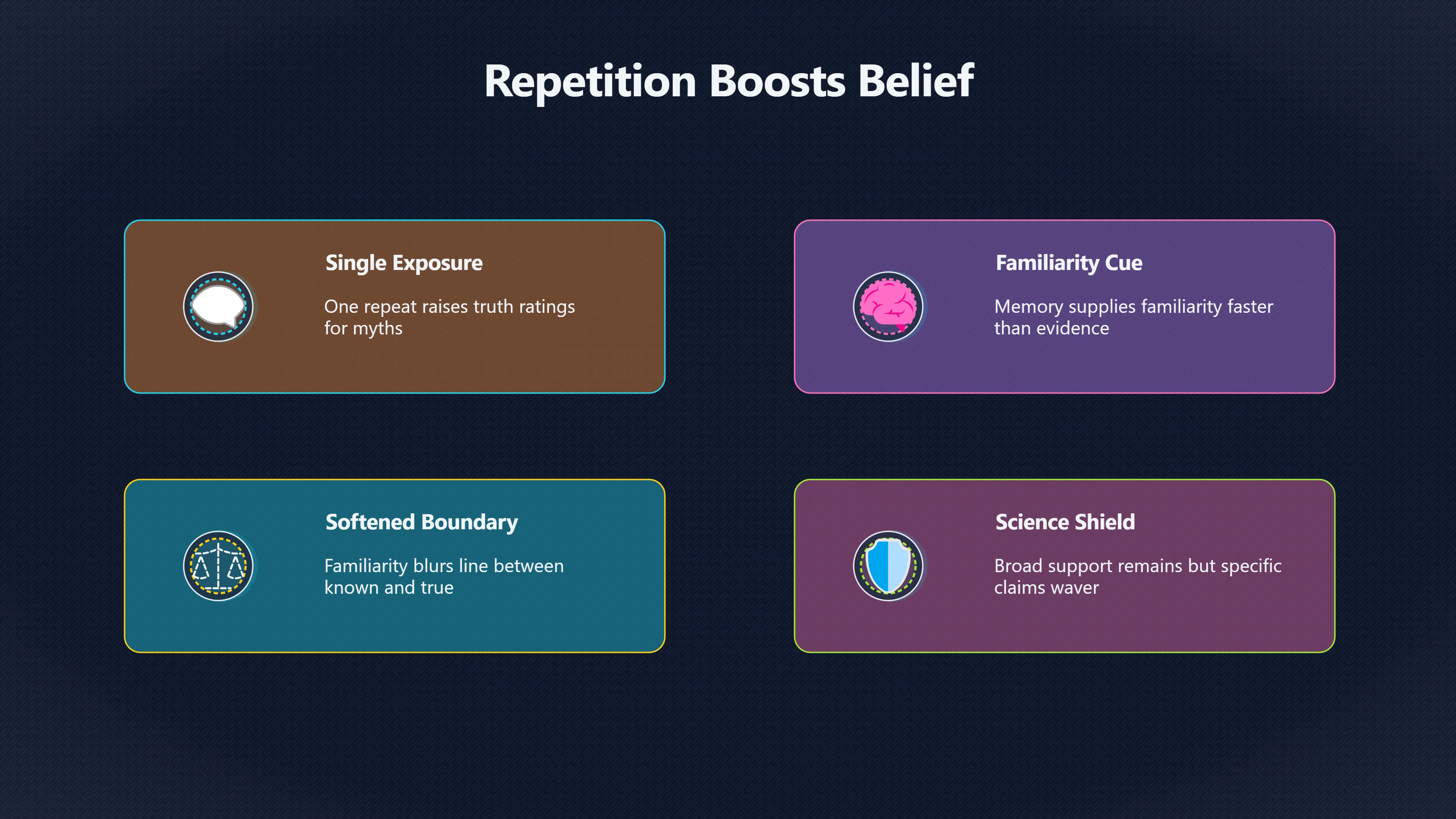
Climate misinformation shows how repetition can raise truth ratings for familiar claims without changing someone's whole worldview.
On this page
- What climate claim repetition studies tested
- Why acceptance of science is not a perfect shield
- How repetition mimics consensus
Page outline Jump by section
Introduction
Repeated climate claims can start to feel established even when the underlying evidence has not changed. A person may encounter the same statement in a headline, a social media post, a comment thread, a political speech and a casual conversation. After enough exposure, memory begins to supply familiarity faster than evidence. The result is not necessarily full belief in climate denial or rejection of climate science. More often, repetition creates a subtle shift: a claim feels less questionable because it feels known.
 Research on climate misinformation has become a useful test case for this process. Studies show that repeated exposure can increase the perceived truth of climate-related claims, including misleading or sceptical ones, even among people who broadly accept mainstream climate science. The effect helps explain why familiar myths can linger in public discussion long after they have been challenged or corrected.[PMC]pmc.ncbi.nlm.nih.govRepetition increases belief in climate-skeptical claims, even…by Y Jiang · 2024 · Cited by 17 — Research with general knowledge cla…
What climate-claim repetition studies tested
Climate misinformation research has often focused on a practical question: does repetition make climate myths seem more credible, even when audiences are generally supportive of climate science?
A 2024 study published in PLOS ONE tested this directly. Researchers presented participants with a mixture of climate-science statements, climate-sceptical statements and neutral weather-related claims. Some statements appeared once, while others were repeated. Participants then rated how true the claims seemed. The key finding was that repetition increased perceived truth across categories. A single repetition was enough to raise truth ratings, including for climate-sceptical claims.[PLOS]journals.plos.orgRepetition increases belief in climate-skeptical claims, even…by Y Jiang · 2024 · Cited by 18 — Research with general knowledge cl…
What makes the result notable is that the sample was not dominated by committed climate sceptics. Most participants broadly endorsed climate science. The study therefore examined something narrower than political conversion. It asked whether familiarity alone could influence judgement. The answer was yes: repetition changed perceived credibility even when participants’ broader attitudes remained aligned with climate science.[PLOS]journals.plos.orgthe future trajectory of climate misinformationby JK Rice · 2026 — 10]: “Like many media effects, the influence of misinformation…
This distinction matters. The findings do not show that one repeated slogan suddenly turns climate-science supporters into denialists. Instead, repetition appears to soften the boundary between a claim being familiar and a claim being supported by evidence. That shift can make misinformation harder to dismiss during later encounters.[USC Dornsife]dornsife.usc.edunew research finds that repetition increases belief in climate misinformationUSC DornsifeNew research finds that repetition increases belief in climate…Aug 12, 2024 — The study found that a single repetition was…
Why acceptance of science is not a perfect shield
A common assumption is that people who understand climate science are largely immune to misinformation. Research suggests the picture is more complicated.
Psychologists describe the underlying mechanism as the illusory truth effect. When people encounter information repeatedly, it becomes easier to process. That feeling of ease, known as processing fluency, can be mistaken for a sign that a statement is true. Importantly, this shortcut can operate before people consciously retrieve their knowledge about the topic.[Wikipedia]WikipediaIllusory truth effectIllusory truth effect
Climate claims are particularly vulnerable to this dynamic because many of them involve technical subjects that most people do not constantly think about. Someone may strongly support climate action yet not immediately recall the details of atmospheric physics, emissions accounting or temperature records during every encounter with a claim. In those moments, familiarity can act as a substitute cue.
The 2024 climate-repetition experiments found exactly this pattern. Participants who endorsed climate science still gave higher truth ratings to repeated sceptical statements than to equivalent statements seen only once. Their broader worldview remained largely intact, but repeated exposure altered how convincing specific claims felt.[PMC]pmc.ncbi.nlm.nih.govA growing body of scholarship investigates the role of misinformation in shaping the debate on climate change.Read more…
This helps explain why misinformation campaigns often focus on repetition rather than airtight evidence. A claim does not need to overturn an entire belief system to be useful. It may only need to introduce uncertainty, create hesitation or make a misleading explanation feel more plausible than it did before.
When memory starts standing in for evidence
The most important confusion created by repetition is not between truth and falsehood. It is between recognition and proof.
People often remember that they have encountered a statement before without remembering where it came from, whether it was disputed or whether it was presented as misinformation in the first place. Over time, the source can fade while familiarity remains.
Consider a recurring claim that climate models are consistently unreliable. A person might first encounter it in a post arguing against climate science, later hear it repeated in a radio discussion, then see it quoted in an article explaining why the claim is misleading. Months later, they may remember the claim itself but not the context. The statement feels familiar, and familiarity can create a sense that the issue remains genuinely unresolved.
Researchers studying misinformation describe this as one reason repetition is powerful. The memory trace for the claim can survive more easily than memory for the correction or source context. What remains is a vague sense that the statement has been encountered many times before.[Wikipedia]WikipediaPLOSPLOS is a nonprofit publisher of open-access journals in science, technology, and medicine and other scientific literature, under…
Climate debates provide fertile ground for this effect because the same narratives often circulate for years. Claims about natural climate cycles, uncertainty in temperature records, renewable-energy reliability or scientific disagreement repeatedly appear in news coverage, political campaigns and online discussions. Even when fact-checkers challenge them, the claim itself continues accumulating familiarity through exposure.[PMC]pmc.ncbi.nlm.nih.govDisinformation as an obstructionist strategy in climate change…by M Gertrudix · 2024 · Cited by 20 — This study examines the scient…[PMC]pmc.ncbi.nlm.nih.govRepetition increases belief in climate-skeptical claims, even…by Y Jiang · 2024 · Cited by 17 — Research with general knowledge cla…

How repetition mimics consensus
Repeated exposure can also create something that feels like social confirmation.
People often use a mental shortcut when evaluating complex issues: if many different sources appear to be discussing the same point, the point may seem widely accepted. In practice, however, apparent agreement can emerge from repeated circulation of the same claim rather than from independent evidence.
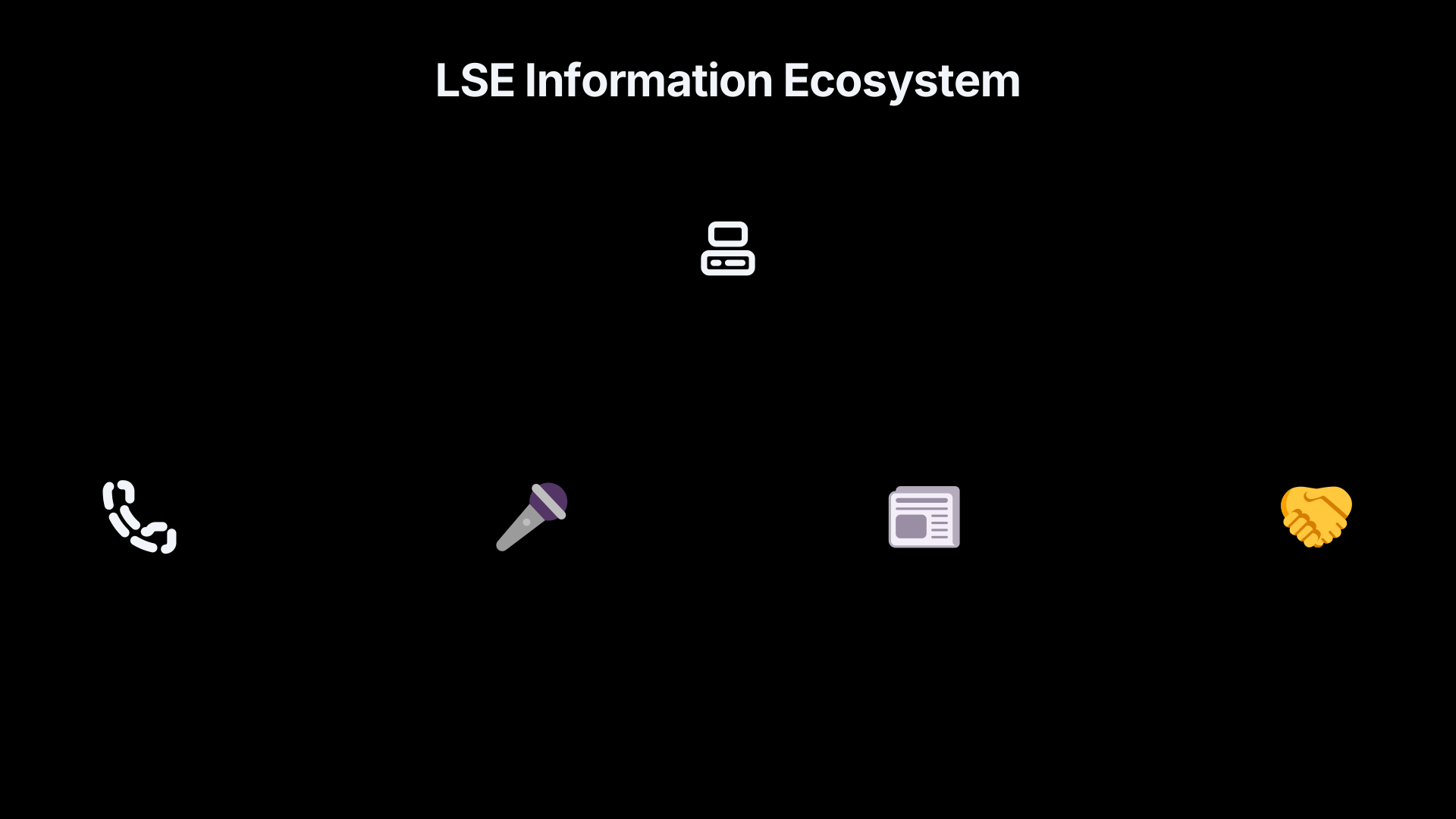
Climate misinformation frequently spreads across multiple channels. A claim may move from a blog to social media, from social media to a political speech, and from there into news coverage discussing the controversy. The audience experiences repeated encounters from different directions, which can create the impression of broad support.[PMC]pmc.ncbi.nlm.nih.govA growing body of scholarship investigates the role of misinformation in shaping the debate on climate change.Read more…
This is one reason climate researchers increasingly focus on information ecosystems rather than isolated false statements. The persuasive force often comes less from the content of a single message than from seeing related messages repeatedly across different contexts.
The effect is especially important for readers who are not closely following climate research. Most people do not independently verify every claim about emissions, temperature trends or energy systems. Instead, they rely partly on cues about what seems established, familiar or widely discussed. Repetition can imitate those cues without providing new evidence.[LSE]lse.ac.ukwhat are climate misinformation and disinformationWhat are climate misinformation and disinformation…22 Apr 2024 — Climate misinformation refers to the spread of inaccurate informat…
Why corrections face a difficult task
The challenge for climate communication is that evidence and familiarity do not spread in the same way.
Scientific findings often arrive with caveats, probabilities and technical explanations. Misleading claims are frequently shorter, simpler and easier to repeat. A slogan can travel across platforms much faster than a detailed explanation of why the slogan is inaccurate.
Researchers studying climate communication therefore argue that factual accuracy alone is not always enough. Accurate information also needs visibility and repetition. If misleading claims are encountered repeatedly while corrections appear only once, audiences may remember the myth more easily than the rebuttal.[psychology.org.au]psychology.org.auFirst, explain the fallacy employed by the myth. Once people…Read more…
Some communication strategies attempt to address this by explaining the misleading technique as well as the factual error. Rather than only repeating the myth and attaching a correction, they teach readers how common forms of climate misinformation work, such as cherry-picking data, relying on fake experts or presenting isolated weather events as evidence against long-term climate trends.[psychology.org.au]psychology.org.auFirst, explain the fallacy employed by the myth. Once people…Read more…
The goal is not merely to replace one statement with another. It is to help people distinguish between a claim feeling familiar and a claim being supported by evidence.
The broader lesson from climate myths
Climate misinformation illustrates a broader feature of human judgement. Repetition does not necessarily rewrite a person’s worldview, but it can reshape how individual claims feel. A statement heard many times may acquire an undeserved sense of credibility because memory supplies familiarity faster than analysis supplies verification.
The climate-repetition studies are valuable because they show this process in a politically charged and scientifically important domain. Even people who generally trust climate science can experience a small rise in perceived truth when sceptical claims are repeated. The finding does not suggest that evidence is powerless. It shows that familiarity is often working alongside evidence, and sometimes competing with it.[PMC]pmc.ncbi.nlm.nih.govDisinformation as an obstructionist strategy in climate change…by M Gertrudix · 2024 · Cited by 20 — This study examines the scient…[PLOS]journals.plos.orgRepetition increases belief in climate-skeptical claims, even…by Y Jiang · 2024 · Cited by 18 — Research with general knowledge cl…
That distinction helps explain why persistent climate myths can survive in public debate. Repetition does not prove a claim. Yet repeated exposure can make a claim feel as though it has already been proven, which is often enough to blur the line between remembering something and knowing it. USC Dornsife[2findanexpert.unimelb.edu.au]findanexpert.unimelb.edu.auRepeating aids believing: climate misinformation feels more…7 Aug 2024 — Climate misinformation may be more effective than we'd like t…
Amazon book picks
Further Reading
Books and field guides related to When repeated climate claims feel established. Use these as the next step if you want deeper reading beyond the article.
Calling Bullshit
Bullshit isn’t what it used to be. Now, two science professors give us the tools to dismantle misinformation and think clearly in a world...
Factfulness
When asked simple questions about global trends -- what percentage of the world's population live in poverty; why the world's population...
Merchants of Doubt
First published 2010. Subjects: Moral and ethical aspects, Science news, Democracy and science, Scientists, Professional ethics.
eBay marketplace picks
Marketplace Samples
Example marketplace items related to this page. Use the search link to explore similar finds on eBay.


Endnotes
1.
Source: pmc.ncbi.nlm.nih.gov
Link:https://pmc.ncbi.nlm.nih.gov/articles/PMC11305575/
Source snippet
Repetition increases belief in climate-skeptical claims, even...by Y Jiang · 2024 · Cited by 17 — Research with general knowledge cla...
2.
Source: journals.plos.org
Link:https://journals.plos.org/plosone/article?id=10.1371%2Fjournal.pone.0307294
Source snippet
Repetition increases belief in climate-skeptical claims, even...by Y Jiang · 2024 · Cited by 18 — Research with general knowledge cl...
3.
Source: dornsife.usc.edu
Title: new research finds that repetition increases belief in climate misinformation
Link:https://dornsife.usc.edu/wrigley/2024/08/12/new-research-finds-that-repetition-increases-belief-in-climate-misinformation/
Source snippet
USC DornsifeNew research finds that repetition increases belief in climate...Aug 12, 2024 — The study found that a single repetition was...
4.
Source: today.usc.edu
Title: how a climate science believer could become a skeptic
Link:https://today.usc.edu/how-a-climate-science-believer-could-become-a-skeptic/
Source snippet
misinformation — can blur people's sense of the truth.... Psychologists refer to this as “truthiness” — or, more formally, the “illusory...
5.
Source: Wikipedia
Title: Illusory truth effect
Link:https://en.wikipedia.org/wiki/Illusory_truth_effect
6.
Source: pmc.ncbi.nlm.nih.gov
Link:https://pmc.ncbi.nlm.nih.gov/articles/PMC8595491/
Source snippet
A growing body of scholarship investigates the role of misinformation in shaping the debate on climate change.Read more...
7.
Source: pmc.ncbi.nlm.nih.gov
Link:https://pmc.ncbi.nlm.nih.gov/articles/PMC11467642/
Source snippet
Disinformation as an obstructionist strategy in climate change...by M Gertrudix · 2024 · Cited by 20 — This study examines the scient...
8.
Source: lse.ac.uk
Title: what are climate misinformation and disinformation
Link:https://www.lse.ac.uk/granthaminstitute/explainers/what-are-climate-misinformation-and-disinformation/
Source snippet
What are climate misinformation and disinformation...22 Apr 2024 — Climate misinformation refers to the spread of inaccurate informat...
9.
Source: psychology.org.au
Link:https://psychology.org.au/community/advocacy-social-issues/environment-climate-change-psychology/resources-for-psychologists-and-others-advocating/the-psychology-of-climate-change-denial
Source snippet
First, explain the fallacy employed by the myth. Once people...Read more...
10.
Source: findanexpert.unimelb.edu.au
Link:https://findanexpert.unimelb.edu.au/news/90353-repeating-aids-believing–climate-misinformation-feels-more-true-through-repetition—even-if-you-back-climate-science
Source snippet
Repeating aids believing: climate misinformation feels more...7 Aug 2024 — Climate misinformation may be more effective than we'd like t...
11.
Source: Wikipedia
Link:https://en.wikipedia.org/wiki/PLOS
Source snippet
PLOSPLOS is a nonprofit publisher of open-access journals in science, technology, and medicine and other scientific literature, under...
12.
Source: journals.plos.org
Link:https://journals.plos.org/climate/article?id=10.1371%2Fjournal.pclm.0000916
Source snippet
the future trajectory of climate misinformationby JK Rice · 2026 — 10]: “Like many media effects, the influence of misinformation...
13.
Source: ebsco.com
Link:https://www.ebsco.com/research-starters/psychology/illusory-truth-effect
Source snippet
This effect is...Read more...
14.
Source: thedecisionlab.com
Link:https://thedecisionlab.com/biases/illusory-truth-effect
Source snippet
Illusory truth effect - The Decision...And yet, even as we propagate misinformation, most of us are anxious about the effects of [fake news]({{ 'fake-news/' | relative_url }})...
Additional References
15.
Source: merriam-webster.com
Link:https://www.merriam-webster.com/dictionary/continued
Source snippet
CONTINUED Definition & Meaning6 days ago — The meaning of CONTINUED is lasting or extending without interruption. How to use continued in...
16.
Source: merriam-webster.com
Link:https://www.merriam-webster.com/dictionary/illusory
Source snippet
ILLUSORY Definition & Meaningillusory implies a false impression based on deceptive resemblance or faulty observation, or influenced by e...
17.
Source: theguardian.com
Link:https://www.theguardian.com/environment/2025/jun/19/climate-misinformation-turning-crisis-into-catastrophe-ipie-report
Source snippet
Analyzing 300 studies, the report identifies fossil fuel companies, rightwing politicians, and some nation states as key sources of false...
18.
Source: theguardian.com
Link:https://www.theguardian.com/australia-news/article/2024/aug/08/repeating-climate-denial-claims-makes-them-seem-more-credible-australian-led-study-finds
Source snippet
illusory truth effect”. The paper is among the first to test the... The findings highlight the dangers of repeating and sharing misinfor...
19.
Source: climatepromise.undp.org
Title: what are climate misinformation and disinformation and how can we tackle them
Link:https://climatepromise.undp.org/news-and-stories/what-are-climate-misinformation-and-disinformation-and-how-can-we-tackle-them
Source snippet
are climate misinformation and disinformation and how...May 1, 2025 — Climate misinformation refers to false or inaccurate information a...
Published: May 1, 2025
20.
Source: genevaenvironmentnetwork.org
Title: disinformation environmental policymaking and the role of geneva
Link:https://www.genevaenvironmentnetwork.org/resources/updates/disinformation-environmental-policymaking-and-the-role-of-geneva/
Source snippet
Disinformation, Environmental Policymaking, and the Role...25 Feb 2026 — In the environmental context, disinformation undermines public...
21.
Source: hsph.harvard.edu
Title: what makes us unwittingly share climate misinformation online
Link:https://hsph.harvard.edu/climate-health-c-change/news/what-makes-us-unwittingly-share-climate-misinformation-online/
Source snippet
climate misinformation. When false or inaccurate climate messages spread online, they can undermine support for environmental policies...
22.
Source: anthropocenemagazine.org
Link:https://www.anthropocenemagazine.org/2024/08/what-seems-most-true-information-that-confirms-your-beliefs-or-information-repeated-over-and-over/
Source snippet
Climate misinformation repeated over and over seems true. Get...Read more...
23.
Source: linkedin.com
Link:https://www.linkedin.com/pulse/repeating-false-skeptical-claims-climate-science-l5qfc
Source snippet
Repeating false, skeptical claims about climate science...The findings underscore the risks of spreading and repeating misinformation...
24.
Source: reddit.com
Link:https://www.reddit.com/r/science/comments/1fryhzw/repeating_a_claim_can_make_it_seem_more/
Source snippet
ect: A review of how repetition increases belief in misinformation...
Topic Tree