Within Mythcraft
How Learners Replace Wrong Ideas
Students often need help replacing a mistaken model, not just adding correct facts on top of it.
On this page
- Coherent but wrong models
- Making the misconception visible
- Building a better explanation
Page outline Jump by section
Introduction
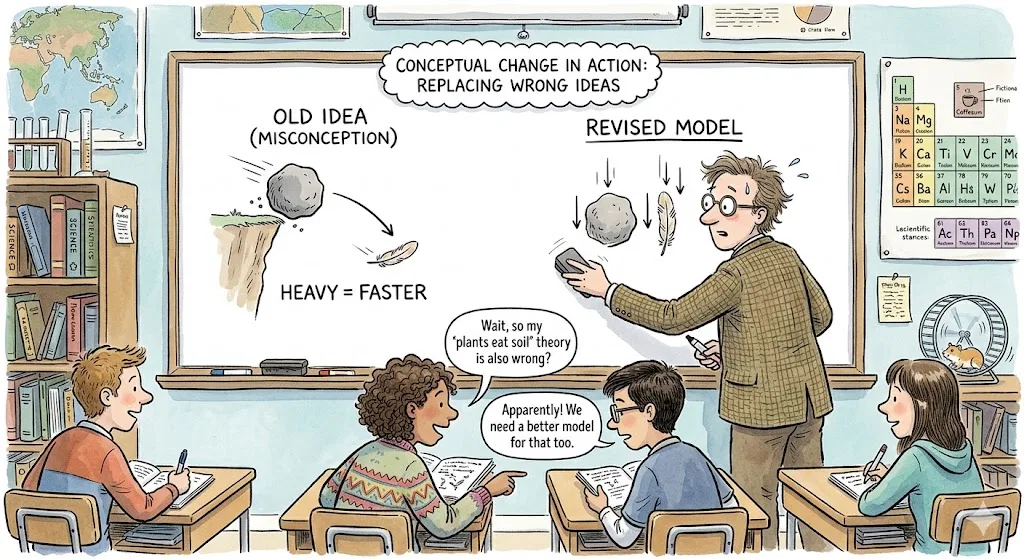
Conceptual change in science learning is the process by which learners replace or reorganise a mistaken explanation, rather than simply memorising a correct fact beside it. This matters because many science misconceptions are not random slips. They are often coherent, experience-based models: heavy things fall faster, seasons happen because Earth is nearer the Sun, plants “eat” soil, electric current is “used up” as it travels round a circuit. These ideas can feel sensible because they explain everyday observations, even when they conflict with scientific accounts.
The practical lesson for schools is clear: telling students the right answer is rarely enough. Effective conceptual change usually requires three moves. First, teachers need to make the learner’s existing model visible. Second, students need a reason to see the limits of that model. Third, the class needs a better explanation that is intelligible, useful and revisited in enough contexts to become the learner’s new way of thinking. The classic conceptual change account by Posner, Strike, Hewson and Gertzog described learning as an interaction between new teaching and the learner’s current ideas, not as a simple transfer of information.[eClass UOA]eclass.uoa.gre Class UOAAccommodation of a scientific conception: Toward a theoryAccommodation of a scientific conception: Toward a theory…August 22, 2006 — by GJ POSNER · Cited by 10835 — It has become a…
Why wrong science ideas can be coherent
A misconception in science can look like a single wrong answer, but it often rests on a deeper explanatory structure. A student who says summer is warmer because Earth is closer to the Sun is not merely misremembering a sentence from class. They are using a plausible everyday rule: closer heat sources feel warmer. The difficulty is that the rule is being applied to a system where axial tilt, sunlight angle and day length matter more than distance.
This is why conceptual change is harder than correction. The National Research Council’s How People Learn stressed that students come to classrooms with prior knowledge, and that this prior knowledge shapes how they notice, interpret and remember new teaching. If those initial understandings are not engaged, learners may fail to grasp new concepts, may learn them only for tests, or may interpret new information through the old model.[National Academies]nationalacademies.orgNational AcademiesHow People Learn: Brain, Mind, Experience, and Schoolby National Research Council · 1999 · Cited by 6127 — This edition…
A well-known illustration comes from A Private Universe, the science education documentary built around interviews about seasons and moon phases. Its educational value is not that some high-achieving students got astronomy questions wrong; it is that their answers revealed stable private explanations which had survived years of schooling. The Annenberg Learner description frames the problem directly: even bright students may retain false ideas about basic science when traditional instruction does not surface and reconstruct those ideas.[Annenberg Learner]learner.orgAnnenberg LearnerA Private UniverseThis video brings into sharp focus the dilemma facing all educators: Why don't even the brightest stud…
For teachers, this changes the diagnosis. The issue is not “students did not listen” or “students lack facts”. Often, students are trying to make sense of science using models that work well enough in everyday life. Conceptual change begins by treating those models as serious objects for instruction.
Coherent but wrong models
The most important implementation shift is to stop treating misconceptions as isolated errors. In many topics, students’ wrong answers cluster because they follow a hidden logic.
In physics, a learner may think a moving object needs a continuing force to keep it going, because everyday objects slow down when pushes stop. In biology, students may imagine evolution as individual organisms deliberately adapting because everyday language says animals “develop traits to survive”. In chemistry, students may treat particles as tiny versions of visible substances, so that particles of a coloured substance are imagined as themselves coloured. These ideas are wrong in scientific terms, but they are not foolish. They are built from perception, language, analogy and prior teaching.
Research overviews of conceptual change theories describe this as a “conceptual ecology”: ideas are connected to other ideas, categories and beliefs about what counts as an explanation. That means replacing one misconception may require adjusting a wider network. A learner cannot fully replace “current is used up” in circuits without also building a better model of current, energy transfer, potential difference and conservation.[Eurasia Journal]ejmste.comIn other.Read moreEurasia JournalAn Overview of Conceptual Change TheoriesOctober 17, 2007 — by G Özdemir · 2007 · Cited by 567 — Misconceptions are theref…
This is also why some students appear to “know” the right answer while still reasoning with the old model. They may repeat that seasons are caused by Earth’s tilt, but when asked to explain a diagram or predict conditions in another hemisphere, the distance-from-the-Sun model returns. Conceptual change is not secure until the new explanation works across examples, diagrams, predictions and unfamiliar cases.
A useful classroom question is therefore not only “Can the student state the correct idea?” but “Which model are they using when they have to explain, predict or choose between alternatives?”

Making the misconception visible
Conceptual change usually starts with evidence of thinking, not with a lecture. Teachers need ways to find out what students currently believe before selecting an intervention. Diagnostic questions are especially useful because they can be designed so that each wrong option corresponds to a known misconception.
The Best Evidence Science Teaching project, developed through the University of York Science Education Group and hosted by STEM Learning, is a practical example of this approach. Its resources are built from research on common misunderstandings, diagnostic questioning, formative assessment and sequenced progression in key secondary science concepts.[University of York]york.ac.ukUniversity of York Best Evidence Science TeachingUniversity of York Best Evidence Science Teaching
A good diagnostic question does more than check recall. It gives the teacher information about the model behind the answer. For example, a question about why a metal spoon feels colder than a wooden spoon at the same room temperature can reveal whether students understand thermal conductivity or believe that metals are inherently “colder”. The response then needs to be planned around the misconception exposed, not around a generic reteaching of the whole topic.
This makes conceptual change a policy and implementation issue, not just a lesson-design preference. Schools need time, materials and assessment cultures that value formative diagnosis. If science teaching is driven mainly by coverage and end-of-unit marks, teachers may discover misconceptions only after they have become embedded. If diagnostic questions are normalised, the misconception becomes visible early enough to work with.
Several practical routines support this:
- Ask for explanations, not just answers. A correct multiple-choice answer can hide faulty reasoning; a short “because…” statement often reveals the model.
- Use distractors deliberately. Wrong options should represent common ways students think, not random errors.
- Return to the same concept in new settings. A learner may handle an idea in one context but revert in another.
- Treat wrong answers as data. Public humiliation makes students conceal their thinking; conceptual change needs students to risk making their current model explicit.
Cognitive conflict helps only when it is carefully handled
One common strategy for conceptual change is cognitive conflict: students make a prediction, observe a result that does not fit their model, and then reconsider the explanation. This can be powerful. A student who thinks heavier objects always fall faster may be unsettled by a demonstration in which objects behave differently from their prediction. A student who thinks plants get most of their mass from soil may need evidence about gases, water and photosynthesis to see why that model is incomplete.
But cognitive conflict is not magic. Students can ignore anomalous evidence, reinterpret it, blame the equipment, treat it as a special case, or memorise the teacher’s explanation without changing their own. Research summaries of conceptual change have repeatedly warned against seeing it as a sudden dramatic replacement of one idea by another. Later accounts stress that change can be slow, partial and context-dependent.[PagePlace]api.pageplace.dePage Place International Handbook of Research on Conceptual ChangePage Place International Handbook of Research on Conceptual Change
That matters for implementation. A discrepant event should not be a classroom trick where the teacher simply reveals that students were wrong. It needs careful framing:
- Students predict what will happen and explain why.
- The class observes or analyses evidence that strains the existing model.
- Students compare their initial explanation with the evidence.
- The teacher introduces or co-constructs the better model.
- Students use the new model to explain related cases.
Without the final steps, cognitive conflict can create confusion rather than understanding. The aim is not to make students feel defeated; it is to make the limits of the old explanation visible and the value of the new explanation clear.
Building a better explanation
A misconception leaves a gap when it is removed. If instruction only says “that is wrong”, learners may keep using the old idea because it still explains something for them. Conceptual change therefore depends on replacement explanations that students can understand and use.
The classic Posner model argued that a new conception is more likely to be accepted when the learner becomes dissatisfied with the old one and finds the new one intelligible, plausible and fruitful. “Fruitful” is especially important: the new idea must help the learner solve problems, make predictions and connect cases better than the old idea did.[eClass UOA]eclass.uoa.gre Class UOAAccommodation of a scientific conception: Toward a theoryAccommodation of a scientific conception: Toward a theory…August 22, 2006 — by GJ POSNER · Cited by 10835 — It has become a…
Refutation text is one evidence-supported way to do this. A refutation text explicitly names a common misconception, explains why it is tempting or wrong, and then presents the scientific explanation. A 2022 meta-analysis found that refutation texts facilitate learning, with the structure working by confronting false beliefs rather than merely presenting correct information beside them.[PMC]pmc.ncbi.nlm.nih.govSource details in endnotes.
For example, a weak textbook paragraph might say: “The seasons are caused by the tilt of Earth’s axis.” A stronger refutation version would add: “Many people think summer happens because Earth is closer to the Sun. That cannot explain why it is summer in the northern hemisphere while it is winter in the southern hemisphere. The better explanation is that Earth’s tilted axis changes the angle and duration of sunlight reaching each hemisphere during the year.”
The difference is not wordiness. The second version helps the learner replace a model. It shows why the old explanation fails, gives a concrete contradiction, and offers a more powerful account.
Good replacement explanations often have these features:
- They respect the starting point. The misconception is treated as understandable, not stupid.
- They explain the failure. Students see where the old model breaks down.
- They provide a usable alternative. The new idea can be applied to predictions, diagrams and new examples.
- They revisit the concept. The teacher returns to the idea across lessons, because one correction rarely produces durable change.
What the research suggests about interventions
The research base does not support one universal conceptual change technique. Instead, it points towards a family of approaches: diagnostic assessment, refutation, analogy, model comparison, cognitive conflict, discussion, prediction, explanation and carefully sequenced practice.
A recent meta-analysis in the Journal of Research in Science Teaching concluded that conceptual change strategies significantly improve science learning, while also distinguishing between approaches such as cognitive conflict, cognitive bridging and ontological category shift. That distinction matters because different misconceptions have different roots. Some require students to revise a belief; others require them to reclassify a concept, such as understanding heat not as a material substance but as energy transfer.[OpenMETU]open.metu.edu.trOpen METUEffectiveness of conceptual change strategies in scienceOpen METUEffectiveness of conceptual change strategies in science
Biology shows the range of the problem. A 2023 systematic review and meta-analysis of conceptual change research in biology found that evolution and photosynthesis were among the most commonly studied topics. That is unsurprising: both topics are rich in everyday misconceptions, from purposeful adaptation in evolution to simplified ideas about plants “feeding” from soil.[ScienceDirect]sciencedirect.comSource details in endnotes.
The implication for teachers and curriculum leaders is that conceptual change should be planned at topic level. A generic instruction to “address misconceptions” is too weak. Departments need to know which misconceptions are common in each unit, how those misconceptions appear in student explanations, which diagnostic questions expose them, and which activities help students build the replacement model.
This is where open-access, research-informed resources can reduce workload. BEST, for instance, organises resources around learning progression, diagnostic questions and response activities, making conceptual change less dependent on each teacher individually rediscovering the research literature.[www.ase.org.uk]ase.org.ukwww.ase.org.uk Best Evidence Science Teaching: researchwww.ase.org.uk Best Evidence Science Teaching: research
Common implementation mistakes
Conceptual change can fail even when teachers know the misconception. The most common failures are not lack of effort, but mismatches between the intervention and the learner’s actual model.
Reteaching the correct fact too quickly. If a class already heard the correct explanation and still holds the misconception, simply saying it again is unlikely to be enough. The teaching has to engage with why the wrong explanation seemed to work.
Using demonstrations as entertainment. A surprising demonstration may be memorable without being understood. Students need to connect the event to an explanation and then use that explanation elsewhere.
Assuming one correct answer means change has happened. Students can learn classroom wording while retaining old reasoning. Transfer questions, explanation prompts and delayed checks are better tests of conceptual change.
Overloading the replacement model. If the scientific explanation is introduced with too many new terms at once, students may retreat to the simpler misconception. Clear sequencing matters.
Treating misconceptions as moral failure. Students are less likely to reveal their thinking if wrong answers are ridiculed. A classroom culture that treats ideas as revisable makes conceptual change more likely.
The deeper point is that misconceptions are often adaptive. They helped the learner make sense of something. A successful intervention does not merely remove them; it gives the learner a more powerful way to think.
What changes for policy and curriculum design
Conceptual change has practical consequences for how science education is organised. It argues against curriculum models that treat learning as a straight line through content coverage. If misconceptions are durable models, then science programmes need planned opportunities to elicit, challenge, rebuild and revisit ideas.
For curriculum design, that means key concepts should be sequenced with known misconceptions in mind. For assessment, it means diagnostic and formative tasks need status alongside summative tests. For teacher development, it means subject knowledge must include knowledge of how students commonly misunderstand the subject. The National Academies’ work on learning emphasises that prior knowledge affects new learning; science policy that ignores this leaves teachers trying to build new understanding on unstable foundations.[National Academies]nationalacademies.orgNational AcademiesHow People Learn: Brain, Mind, Experience, and Schoolby National Research Council · 1999 · Cited by 6127 — This edition…
The intervention logic is not expensive or exotic. It is disciplined:
- identify the misconception most likely to block the next idea;
- make students’ thinking visible before teaching proceeds;
- design a task that exposes the limits of the old model;
- teach a replacement explanation clearly;
- give students repeated chances to use the new model;
- check later whether the change has endured.
This is why conceptual change belongs at the centre of myths and misconceptions in science learning. A myth can be debunked with a correction; a misconception often has to be rebuilt from the inside.
Amazon book picks
Further Reading
Books and field guides related to How Learners Replace Wrong Ideas. Use these as the next step if you want deeper reading beyond the article.
How people learn
First published 1999. Subjects: Learning, Psychology of Learning, Research, Social aspects, Social aspects of Learning.
eBay marketplace picks
Marketplace Samples
Example marketplace items related to this page. Use the search link to explore similar finds on eBay.
Endnotes
1.
Source: eclass.uoa.gr
Title: e Class UOAAccommodation of a scientific conception: Toward a theory
Link:https://eclass.uoa.gr/modules/document/file.php/PHS122/%CE%91%CF%81%CE%B8%CF%81%CE%B1/Posner_Strike_Hewson_Gertzog.pdf
Source snippet
Accommodation of a scientific conception: Toward a theory...August 22, 2006 — by GJ POSNER · Cited by 10835 — It has become a...
Published: August 22, 2006
2.
Source: learner.org
Link:https://www.learner.org/series/a-private-universe/1-a-private-universe/
Source snippet
Annenberg LearnerA Private UniverseThis video brings into sharp focus the dilemma facing all educators: Why don't even the brightest stud...
3.
Source: api.pageplace.de
Title: Page Place International Handbook of Research on Conceptual Change
Link:https://api.pageplace.de/preview/DT0400.9781136578212_A24435677/preview-9781136578212_A24435677.pdf
4.
Source: pmc.ncbi.nlm.nih.gov
Link:https://pmc.ncbi.nlm.nih.gov/articles/PMC8784251/
5.
Source: sciencedirect.com
Link:https://www.sciencedirect.com/science/article/pii/S1747938X23000490
6.
Source: ase.org.uk
Title: www.ase.org.uk Best Evidence Science Teaching: research
Link:https://www.ase.org.uk/system/files/SSR_December_2020_055-063_Atkinson.pdf
7.
Source: sciencedirect.com
Title: Conceptual Change Theory
Link:https://www.sciencedirect.com/topics/psychology/conceptual-change-theory
8.
Source: sciencedirect.com
Link:https://www.sciencedirect.com/science/article/abs/pii/S095947521830817X
9.
Source: ase.org.uk
Link:https://www.ase.org.uk/system/files/JES29%20Harden%20%26%20Waller.pdf
10.
Source: eclass.uoa.gr
Title: Commentary Mayer
Link:https://eclass.uoa.gr/modules/document/file.php/PSYCH139/04.%20%CE%95%CE%B9%CF%83%CE%B1%CE%B3%CF%89%CE%B3%CE%AE%20%CF%83%CF%84%CE%BF%20%CF%80%CF%81%CF%8C%CE%B2%CE%BB%CE%B7%CE%BC%CE%B1%20%CF%84%CE%B7%CF%82%20%CE%B5%CE%BD%CE%BD%CE%BF%CE%B9%CE%BF%CE%BB%CE%BF%CE%B3%CE%B9%CE%BA%CE%AE%CF%82%20%CE%B1%CE%BB%CE%BB%CE%B1%CE%B3%CE%AE%CF%82/Commentary-Mayer.pdf
11.
Source: youtube.com
Title: Conceptual Change in Science Learning
Link:https://www.youtube.com/watch?v=S7bM-p4kR_s
Source snippet
How Students Build Scientific Understanding...
12.
Source: nationalacademies.org
Link:https://www.nationalacademies.org/publications/9853
Source snippet
National AcademiesHow People Learn: Brain, Mind, Experience, and Schoolby National Research Council · 1999 · Cited by 6127 — This edition...
13.
Source: ejmste.com
Title: In other.Read more
Link:https://www.ejmste.com/download/an-overview-of-conceptual-changetheories-4082.pdf
Source snippet
Eurasia JournalAn Overview of Conceptual Change TheoriesOctober 17, 2007 — by G Özdemir · 2007 · Cited by 567 — Misconceptions are theref...
Published: October 17, 2007
14.
Source: york.ac.uk
Title: University of York Best Evidence Science Teaching
Link:https://www.york.ac.uk/education/research/uyseg/research-projects/bestevidencescienceteaching/
15.
Source: open.metu.edu.tr
Title: Open METUEffectiveness of conceptual change strategies in science
Link:https://open.metu.edu.tr/bitstream/handle/11511/104711/J%20Res%20Sci%20Teach%20-%202023%20-%20Pacaci%20-%20Effectiveness%20of%20conceptual%20change%20strategies%20in%20science%20education%20A%20meta%E2%80%90analysis.pdf
16.
Source: nationalacademies.org
Link:https://www.nationalacademies.org/projects/DBASSE-BBCSS-13-06/publication/24783
17.
Source: nationalacademies.org
Link:https://www.nationalacademies.org/read/5287/chapter/5
18.
Source: sk.sagepub.com
Title: conceptual change
Link:https://sk.sagepub.com/ency/edvol/download/encyclopedia-of-education-theory-and-philosophy/chpt/conceptual-change.pdf
19.
Source: ihomschool.org
Title: How People Learn
Link:https://www.ihomschool.org/ourpages/auto/2014/3/6/53101783/HowPeopleLearn.pdf
20.
Source: jstor.org
Link:https://www.jstor.org/stable/40032156
Additional References
21.
Source: researchgate.net
Link:https://www.researchgate.net/publication/358587663_CONCEPTUAL_CHANGE_THEORY_AS_A_TEACHING_STRATEGY_IN_ENVIRONMENTAL_EDUCATION
22.
Source: researchgate.net
Link:https://www.researchgate.net/publication/253300170_Conceptual_change_in_science_teaching_and_teacher_education
23.
Source: brill.com
Link:https://brill.com/display/book/edcoll/9789087904227/BP000005.pdf?srsltid=AfmBOooQQKWpQn-bWNlUiwHK-TcMF-TnGrjRLDlsnPgUDyrTB1nP1Xt8
24.
Source: stem.org.uk
Link:https://www.stem.org.uk/sites/default/files/pages/downloads/BEST_Approaches_Diagnostic%20questions.pdf
25.
Source: nfer.ac.uk
Link:https://www.nfer.ac.uk/media/n3enzjph/assessment_for_learning_in_primary_science_practices_and_benefits.pdf
26.
Source: stem.org.uk
Link:https://www.stem.org.uk/resources/library/collection/440721/best-evidence-science-teaching
27.
Source: openeducat.org
Link:https://openeducat.org/ai/tools/common-misconceptions-identifier/for-science/
28.
Source: researchoutreach.org
Link:https://researchoutreach.org/wp-content/uploads/2022/04/Patrice-Potvin-1.pdf
29.
Source: smu.edu
Link:https://www.smu.edu/provost/cte/resources/-/media/site/provost/cte/teachingresources/how-people-learn.pdf
30.
Source: researchgate.net
Link:https://www.researchgate.net/publication/225757755_Stella_Vosniadou_Ed_International_Handbook_of_Research_on_Conceptual_Change
Topic Tree