Within Learning Styles
Let the content choose the mode
Diagrams, discussion, sound, movement and practice can all help, but the best choice usually depends on the subject matter and learning goal.
On this page
- Why maps, phonics and worked examples need different modes
- How multiple representations can support understanding
- When variety becomes busy rather than useful
Page outline Jump by section
Introduction
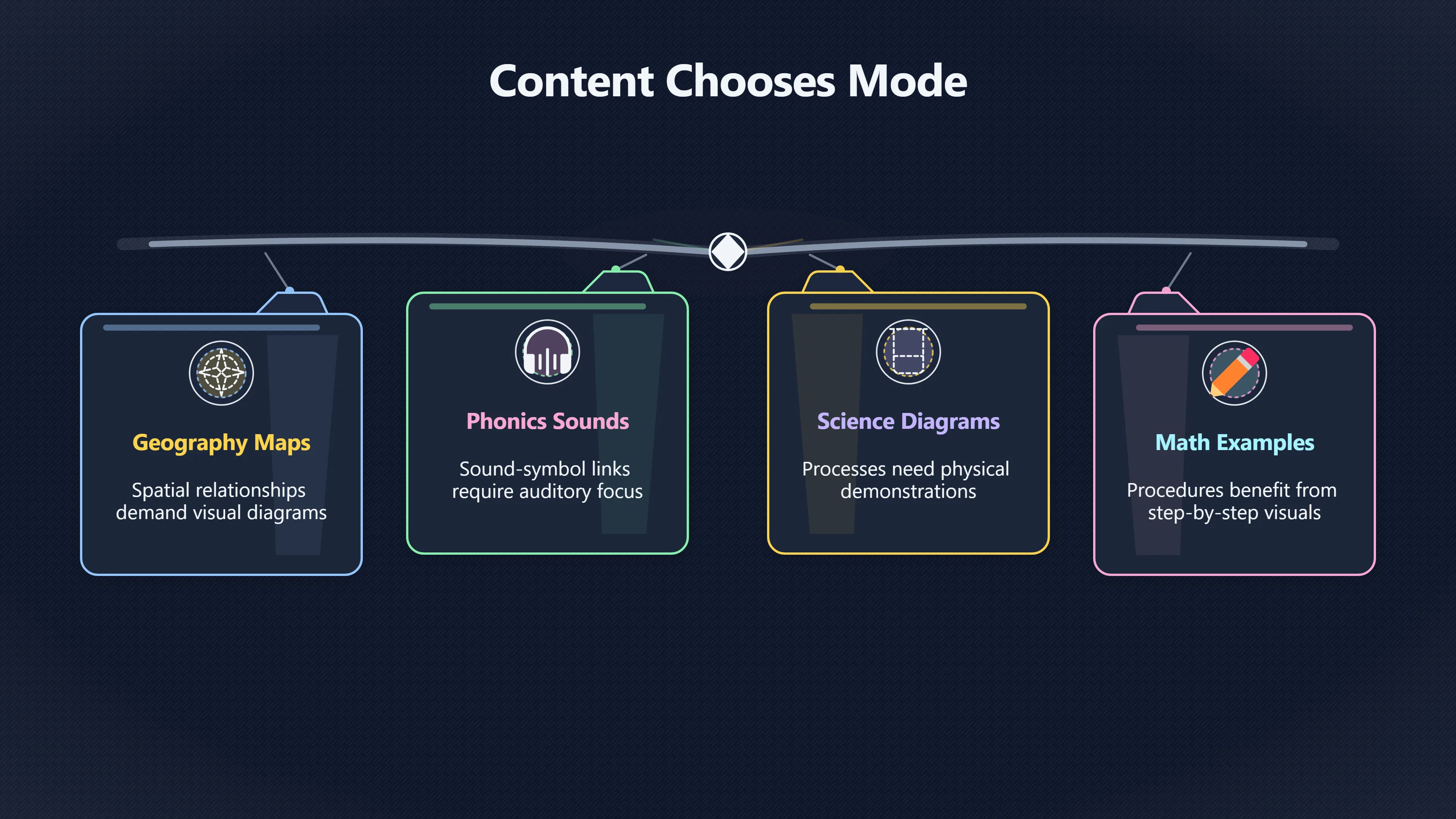
One of the most useful responses to the learning-styles debate is surprisingly simple: let the content choose the mode. Students do not all need completely different sensory channels because they belong to fixed categories such as visual learners or auditory learners. Instead, different topics place different demands on the learner. Maps are visual because geography involves spatial relationships. Phonics requires careful attention to sounds because reading depends partly on soundsymbol correspondences. A science process may need diagrams, words and physical demonstrations because each representation reveals something different. Research reviews have repeatedly found little evidence that matching teaching to a student’s supposed learning style improves outcomes, but strong reasons to match teaching methods to the nature of the material being learned.[PubMed]pubmed.ncbi.nlm.nih.govLearning Styles: Concepts and Evidenceby H Pashler 2008 Cited by 4842 The most common-but not the only-hypothesis about the i…[EEF]educationendowmentfoundation.org.ukOpen source on educationendowmentfoundation.org.uk.
 This shift changes the question from What type of learner is this child? to What kind of understanding does this topic require? Good teaching often uses diagrams, discussion, movement, examples, writing and practice. The key issue is not learner labels but whether a particular mode helps students grasp the content more accurately and remember it more effectively.
Why maps, phonics and worked examples need different modes
The strongest argument against learning-styles thinking is not that teaching should use only one mode. It is that different subjects genuinely benefit from different forms of representation.
A map is not useful because some students are visual learners. It is useful because geographical information often concerns distance, direction, scale and spatial relationships. Turning a map into spoken description alone would usually make the task harder. Likewise, geometry diagrams help because the structure of the problem is spatial. The representation matches the content.[Deakin Blogs]blogs.deakin.edu.auDeakin BlogsUsing Representations for Teaching and Learning in Scienceby J Carolan Cited by 137 They can be used to record precise ob…
Phonics provides the opposite example. Beginning readers must learn relationships between letters and sounds. Listening, speaking, blending sounds and hearing distinctions between phonemes are central parts of the skill. Visual materials still matter, but the learning goal itself requires attention to sound patterns. The instructional choice follows from the nature of reading development rather than from identifying an auditory learner.[deansforimpact.org]deansforimpact.orgLearning styles: what does the research say?April 28, 2016Apr 28, 2016 In their review, Pashler et al found only one study that gave even partial support to the meshing hypothes…
Mathematics offers another clear case. When students encounter a new procedure, many benefit from worked examples that show step-by-step reasoning before independent problem-solving. The advantage comes from reducing unnecessary cognitive load and making expert thinking visible. The effectiveness of the approach depends on the task and the learner’s prior knowledge, not on a personal learning-style profile.[deansforimpact.org]deansforimpact.orgThe Science of Learning | Deans for Impact (DFIMay 19, 2026 The Science of Learning summarizes existing cognitive-science research on how students learn, and connects it to practical…
These examples illustrate a broader principle: instructional modes are tools. Their value depends on what they reveal about the content.
How multiple representations can support understanding
Rejecting learning styles does not mean teaching through a single channel. In many subjects, understanding improves when learners encounter ideas through several carefully connected representations.
Science education provides many examples. Students may learn about the water cycle through a diagram, a written explanation, classroom discussion and observation of a demonstration. Each mode highlights different aspects of the same concept. The diagram shows relationships. The explanation provides causal detail. Discussion allows misconceptions to surface. Observation links the abstract idea to a visible phenomenon.[ResearchGate]researchgate.netResearch Gate The Role of Multiple Representations in Learning ScienceThe Role of Multiple Representations in Learning ScienceJanuary 1, 2008 20 Mar 2020 In this chapter, I discuss studies in…[2isres.org]isres.orgEducation Research Highlights in Mathematics, Science and Technology 2018.Read more…
Research on multiple representations in science and mathematics suggests that learners often gain deeper understanding when they can move between graphs, equations, diagrams, models and verbal explanations. Experts routinely translate ideas across these forms. Learning therefore involves building connections between representations rather than remaining inside a preferred one. Groningen Research Portal[Deakin Blogs]blogs.deakin.edu.auDeakin BlogsUsing Representations for Teaching and Learning in Scienceby J Carolan Cited by 137 They can be used to record precise ob…
This is one reason the learning-styles framework can be misleading. If a student is labelled a visual learner, the label may encourage both teacher and student to rely too heavily on visual material. Yet genuine expertise often requires flexibility. A physicist must interpret graphs, equations and written explanations. A musician reads notation, listens critically and practises movement. A historian works with text, images, timelines and arguments. Restricting learners to a single mode can work against the demands of the discipline itself.[Queen Rania Foundation]qrf.orgQueen Rania FoundationLearning Styles Cost Evidence IMPACTLearners are very unlikely to have a single learning style, so restricting pupi…[My College]my.chartered.collegeways and teaching should be tailored to their learning styles these have been widely debunked by research pervade common nomenclature…
Multiple representations are not the same as multiple learning styles
The distinction is important because the two ideas are often confused.
Multiple representations ask: What combination of formats helps reveal this concept?
[learning styles]structural-learning.comWhat the Research Actually Says Aboutby P Main 2026 Cited by 2 Pashler et al.'s (2008) comprehensive review found virtually no evid… matching asks: Which format fits this learner category?
The first question focuses on the knowledge being taught. The second focuses on assumptions about the learner. Evidence is far stronger for the first approach than the second. Reviews of learning-styles research have repeatedly found little support for the meshing hypothesis, while research on representation and cognitive science continues to show benefits from presenting information in forms that suit the content and learning objective.[PubMed]pubmed.ncbi.nlm.nih.govLearning Styles: Concepts and Evidenceby H Pashler 2008 Cited by 4842 The most common-but not the only-hypothesis about the i…[PMC]pmc.ncbi.nlm.nih.govPMCTeaching and Learning Science through Multipleby J Hansen 2020 Cited by 43 This article describes pedagogical intuitions on best practices for how to sequence visual represen…
When variety becomes busy rather than useful
A common reaction to the learning-styles critique is to conclude that every lesson should contain a visual activity, an audio element, discussion, movement, group work and independent practice. That conclusion creates a different problem.
More modes do not automatically produce more learning.
A diagram can clarify an idea, but an unnecessary diagram can distract from it. Classroom discussion can deepen understanding, but discussion without a clear purpose can consume time without advancing learning. Educational multimedia can become overloaded when students must process decorative images, background music and complex text simultaneously. The question is not whether variety exists but whether it serves the learning goal.[SciSpace]scispace.comparticular access to multimedia has provided an opportunity to pre…
Teachers sometimes feel pressure to demonstrate that they have catered for every supposed learning style in a single lesson. This can encourage activity design that prioritises coverage of modes over clarity of explanation. The result may be cognitive overload rather than improved understanding.[Kumon]kumon.co.ukIdentifying different learning stylesHowever, there is in fact little-to-no evidence to show that adapting teaching methods in this…
Useful variety tends to have a clear justification:
- A diagram reveals structure that words alone hide.
- Discussion exposes misunderstandings.
- Practice strengthens recall and fluency.
- Physical demonstration makes an invisible process visible.
- Writing helps organise and refine thinking.
Less useful variety often exists only to ensure that different activities appear in the lesson.
A practical decision rule for teachers
A content-first approach does not require teachers to ignore individual differences. Students differ in prior knowledge, motivation, language proficiency, confidence and background experiences. Effective teaching adapts to those realities. The evidence challenge is specifically about adapting to fixed learning-style labels.[EEF]educationendowmentfoundation.org.ukEEFAdaptive teaching in practice: using feedback to check7 Jan 2026 Adaptive teaching is about uncovering learning, not just covering…
A more evidence-informed planning sequence looks something like this:
- Define the learning goal.
- Identify what students must understand or be able to do.
- Choose representations that make that understanding visible.
- Check whether students can translate between representations when necessary.
- Adapt instruction in response to student understanding rather than assumed learning styles.
This approach aligns with recent evidence-informed discussions of adaptive teaching, where teachers respond to what pupils actually know and misunderstand instead of relying on predetermined categories.[EEF]educationendowmentfoundation.org.ukEEFAdaptive teaching in practice: using feedback to check7 Jan 2026 Adaptive teaching is about uncovering learning, not just covering…

From learner types to learning tasks
The lasting appeal of learning styles comes from a true observation: students are different. The mistake is assuming that these differences are best captured by stable sensory categories. Research has not supported the idea that students learn better when instruction is matched to such categories.[PubMed]pubmed.ncbi.nlm.nih.govLearning Styles: Concepts and Evidenceby H Pashler 2008 Cited by 4842 The most common-but not the only-hypothesis about the i…[PMC]pmc.ncbi.nlm.nih.govnih.govEvidence-Based Higher Education Is the Learning Styles…by PM Newton 2017 Cited by 468 The basic idea behind the use of…
A more productive principle is that different kinds of knowledge call for different kinds of teaching. Some concepts need pictures. Some need language. Some need demonstration. Many need several representations working together. The crucial decision is not whether a student is visual, auditory or kinaesthetic. It is whether the chosen mode helps reveal the structure of what is being learned. When the content chooses the mode, teaching becomes less about labels and more about understanding.
Amazon book picks
Further Reading
Books and field guides related to Let the content choose the mode. Use these as the next step if you want deeper reading beyond the article.
Why Don't Students Like School?
Argues that instructional methods should fit content demands.
eBay marketplace picks
Marketplace Samples
Example marketplace items related to this page. Use the search link to explore similar finds on eBay.
Endnotes
1.
Source: educationendowmentfoundation.org.uk
Link:https://educationendowmentfoundation.org.uk/education-evidence/teaching-learning-toolkit/learning-styles
2.
Source: deansforimpact.org
Title: Learning styles: what does the research say?
Link:https://www.deansforimpact.org/about/news-and-blog/2016/04/28/learning-styles-what-does-the-research-say
Source snippet
April 28, 2016Apr 28, 2016 In their review, Pashler et al found only one study that gave even partial support to the meshing hypothes...
3.
Source: deansforimpact.org
Title: The Science of Learning | Deans for Impact (DFI)
Link:https://www.deansforimpact.org/tools-and-resources/the-science-of-learning
Source snippet
May 19, 2026 The Science of Learning summarizes existing cognitive-science research on how students learn, and connects it to practical...
Published: May 19, 2026
4.
Source: researchgate.net
Title: Research Gate The Role of Multiple Representations in Learning Science
Link:https://www.researchgate.net/publication/336091089_The_Role_of_Multiple_Representations_in_Learning_Science_Enhancing_Students%27_Conceptual_Understanding_and_Motivation
Source snippet
The Role of Multiple Representations in Learning ScienceJanuary 1, 2008 20 Mar 2020 In this chapter, I discuss studies in...
Published: January 1, 2008
5.
Source: isres.org
Link:https://www.isres.org/the-importance-of-multiple-representations-for-teaching-and-learning-science-97-s.html
Source snippet
Education Research Highlights in Mathematics, Science and Technology 2018.Read more...
6.
Source: pmc.ncbi.nlm.nih.gov
Title: PMCTeaching and Learning Science through Multiple
Link:https://pmc.ncbi.nlm.nih.gov/articles/PMC8693945/
Source snippet
by J Hansen 2020 Cited by 43 This article describes pedagogical intuitions on best practices for how to sequence visual represen...
7.
Source: pmc.ncbi.nlm.nih.gov
Link:https://pmc.ncbi.nlm.nih.gov/articles/PMC5366351/
Source snippet
nih.govEvidence-Based Higher Education Is the Learning Styles...by PM Newton 2017 Cited by 468 The basic idea behind the use of...
8.
Source: pmc.ncbi.nlm.nih.gov
Link:https://pmc.ncbi.nlm.nih.gov/articles/PMC6113575/
Source snippet
Modality-Specific Learning Style Hypothesis: A Mini-Reviewby K Aslaksen 2018 Cited by 93 This mini-review presents literature, whic...
9.
Source: scispace.com
Link:https://scispace.com/pdf/the-impact-of-multiple-representations-of-content-using-19thmbyfjd.pdf
Source snippet
particular access to multimedia has provided an opportunity to pre...
10.
Source: educationendowmentfoundation.org.uk
Link:https://educationendowmentfoundation.org.uk/news/effective-teacher-feedback-understanding-in-adaptive-teaching
Source snippet
EEFAdaptive teaching in practice: using feedback to check7 Jan 2026 Adaptive teaching is about uncovering learning, not just covering...
11.
Source: pmc.ncbi.nlm.nih.gov
Title: PMCIs it really a neuromyth?
Link:https://pmc.ncbi.nlm.nih.gov/articles/PMC11270031/
Source snippet
A meta-analysis of the learning styles...by V Clinton-Lisell 2024 Cited by 25 The review by Pashler et al. (2008) concluded that t...
12.
Source: researchgate.net
Link:https://www.researchgate.net/publication/233600402_Learning_Styles_Concepts_and_Evidence
Source snippet
(PDF) Learning Styles: Concepts and EvidenceThe most commonbut not the onlyhypothesis about the instructional relevance of learning sty...
13.
Source: pubmed.ncbi.nlm.nih.gov
Link:https://pubmed.ncbi.nlm.nih.gov/26162104/
Source snippet
Learning Styles: Concepts and Evidenceby H Pashler 2008 Cited by 4842 The most common-but not the only-hypothesis about the i...
14.
Source: blogs.deakin.edu.au
Link:https://blogs.deakin.edu.au/asell-for-schools-vic/wp-content/uploads/sites/160/2018/03/Carolan-et-al-Teach-Sci_late-version.pdf
Source snippet
Deakin BlogsUsing Representations for Teaching and Learning in Scienceby J Carolan Cited by 137 They can be used to record precise ob...
15.
Source: qrf.org
Link:https://qrf.org/en/node/pdf/1242/pdf
Source snippet
Queen Rania FoundationLearning Styles Cost Evidence IMPACTLearners are very unlikely to have a single learning style, so restricting pupi...
16.
Source: my.chartered.college
Link:https://my.chartered.college/impact_article/releasing-students-from-the-cognitive-straitjacket-of-visual-auditory-kinaesthetic-learning-styles/
Source snippet
ways and teaching should be tailored to their learning styles these have been widely debunked by research pervade common nomenclature...
17.
Source: kumon.co.uk
Link:https://www.kumon.co.uk/blog/identifying-different-learning-styles-in-children
Source snippet
Identifying different learning stylesHowever, there is in fact little-to-no evidence to show that adapting teaching methods in this...
18.
Source: educationendowmentfoundation.org.uk
Link:https://educationendowmentfoundation.org.uk/education-evidence/teaching-learning-toolkit/learning-styles/technical-appendix
Source snippet
Learning styles: Technical AppendixThe idea underpinning learning styles is that individuals all have a particular approach to or style o...
19.
Source: athenify.io
Title: learning styles myth
Link:https://athenify.io/blog/learning-styles-myth
Source snippet
(2008) and numerous follow-up studies found no evidence. The problem: learning styles lead to self-limitation and distract from...Read more...
20.
Source: texasldcenter.org
Title: november 2013
Link:https://texasldcenter.org/education-research-matters/november-2013/
Source snippet
Learning Styles: Concepts and Evidence28 Feb 2024 The specific version of the learning style hypothesis under consideration is what the...
Published: november 2013
21.
Source: engage-education.com
Title: They are ‘tactile’ learners who use movement, testing, trial and error.Read more
Link:https://engage-education.com/blog/learning-styles-kinaesthetic-learner-characteristics/
Source snippet
Learning Styles: Kinaesthetic Learner Characteristics24 Mar 2023 A kinaesthetic learner is someone who needs to be actively engaged in...
22.
Source: structural-learning.com
Title: learning styles
Link:https://www.structural-learning.com/post/learning-styles
Source snippet
What the Research Actually Says Aboutby P Main 2026 Cited by 2 Pashler et al.'s (2008) comprehensive review found virtually no evid...
23.
Source: 3starlearningexperiences.wordpress.com
Title: learning styles hypothesis
Link:https://3starlearningexperiences.wordpress.com/tag/learning-styles-hypothesis/
Source snippet
wordpress.comTag: learning-styles hypothesis - 3-Star learning experiences21 Jul 2015 The required evidence for the learning-styles hyp...
Additional References
24.
Source: educationalneuroscience.org.uk
Link:https://educationalneuroscience.org.uk/wordpress/resources/neuromyth-or-neurofact/children-have-different-learning-styles/
Source snippet
Children have different learning stylesThe Education Endowment Foundation Teaching and Learning Toolkit provides an excellent summary of...
25.
Source: educationendowmentfoundation.org.uk
Link:https://educationendowmentfoundation.org.uk/news/eef-blog-ecf-exploring-the-evidence-prior-knowledge-and-pupil-misconceptions
Source snippet
EEF Blog: ECF Exploring the Evidence: Prior knowledge...by H Madgwick This blog from Research and Policy Manager Harry Madgwick build...
26.
Source: educationendowmentfoundation.org.uk
Link:https://educationendowmentfoundation.org.uk/education-evidence/teaching-learning-toolkit
Source snippet
Teaching and Learning ToolkitTeaching and Learning Toolkit Arts participation Aspiration interventions Behaviour interventions Co...
27.
Source: tes.com
Link:https://www.tes.com/magazine/tes-explains/what-are-learning-styles
Source snippet
What are learning styles? | Tes MagazineThe learning styles theory proposes that individuals are better suited to a particular style of l...
28.
Source: gc-bs.org
Link:https://gc-bs.org/articles/from-styles-to-science-[debunking
Source snippet
Debunking the Learning Styles Myth and Embracing an...Jan 12, 2569 BE Yet beneath this surface of intuitive appeal lies a striking sci...
29.
Source: research.rug.nl
Link:https://research.rug.nl/files/156482873/the_use_of_multiple_representations_in_undergraduate_physics_education_what_do_we_know_and_where_do_95771.pdf
Source snippet
Using multiple representations (MR) such as graphs, symbols, diagrams, and text, is central to teaching and learning in physics classroom...
30.
Source: api.warwickshire.gov.uk
Link:https://api.warwickshire.gov.uk/documents/WCCC
Source snippet
The Education Endowment FoundationThe Sutton Trust-EEF Teaching and Learning Toolkit is an accessible summary of educational research w...
31.
Source: my.chartered.college
Link:https://my.chartered.college/impact_article/the-problem-with-learning-styles-debunking-the-meshing-hypothesis-in-english-language-teaching/
Source snippet
problem with learning styles: debunking the meshing...Feb 22, 2018 The idea that catering to a learner's favoured sensory preference...
32.
Source: educationendowmentfoundation.org.uk
Title: new guide to help education professionals to make best use of research evidence
Link:https://educationendowmentfoundation.org.uk/news/new-guide-to-help-education-professionals-to-make-best-use-of-research-evidence
Source snippet
New guide to help education professionals to make best...11 Jan 2024 A new guide, published by the Education Endowment Foundation (EEF...
33.
Source: uwaterloo.ca
Link:https://uwaterloo.ca/centre-for-teaching-excellence/catalogs/tip-sheets/understanding-your-learning-style
Source snippet
meshing hypothesis, which is the hypothesis that providing instruction based on individuals' preferred learning styles improves learning...
Topic Tree