Within False Info
When disinformation is the wrong label
Calling a false claim disinformation requires evidence of deliberate deception, not just proof that the claim is wrong.
On this page
- The evidence burden for intent
- Mistakes, satire, negligence, and harm
- Safer labels when intent is unclear
Page outline Jump by section
Introduction
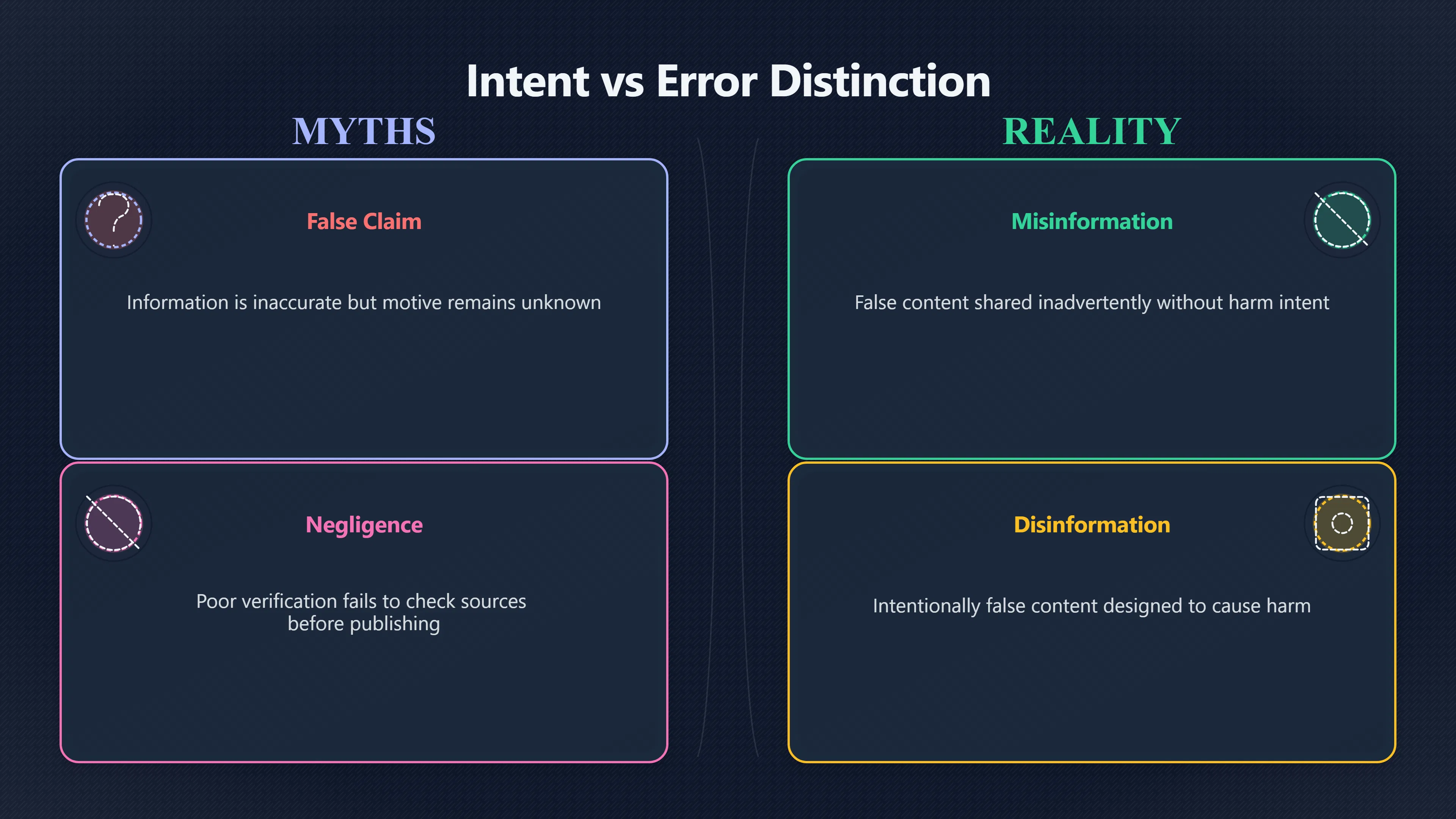
Not every false claim is disinformation. A claim can be inaccurate, misleading, reckless, exaggerated or harmful without being part of a deliberate attempt to deceive. The distinction matters because the defining feature of disinformation is intent: someone knowingly creates or spreads false information in order to mislead, manipulate or cause harm. UNESCO, First Draft and many information-disorder frameworks use intent as the key dividing line between misinformation and disinformation. UNESCO[First Draft]firstdraftnews.orgFirst Draft Understanding Information disorderDisinformation is content that is intentionally false and designed to cause harm. It is motivated by three…
 That creates a practical problem. Intent is often harder to prove than falsity. It is usually easier to show that a statement is wrong than to demonstrate that the speaker knew it was wrong and pushed it anyway. When the label “disinformation” is applied too quickly, ordinary mistakes, confusion, satire, disputed interpretations and good-faith disagreement can all be misclassified as organised deception. At the same time, overusing the term can make genuine influence operations harder to identify because everything starts to look like a coordinated campaign.
The evidence burden for intent
The central question is not simply whether information is false. It is whether there is evidence that deception was deliberate.
Many widely used definitions require more than factual inaccuracy. UNESCO describes misinformation as false information shared inadvertently, while disinformation involves an intention to deceive. First Draft similarly defines disinformation as intentionally false content designed to cause harm.[UNESCO]unesco.orgWhat is Disinformation? Meaning, Definition.Misinformation has a neutral or good underlying intent, whereas disinformation is defin…[UNESCO]unesco.orgWhat is Misinformation? Meaning, Definition.Misinformation is false information that is shared inadvertently, without meaning to ca…
In practice, intent is usually inferred from behaviour rather than directly observed. Researchers, journalists and investigators often look for patterns such as:
- Fabricated documents, altered images or invented quotations.
- Coordinated networks of accounts amplifying the same claim.
- Repeated publication of claims already shown to be false.
- Impersonation of trusted organisations or people.
- Financial, political or strategic incentives tied to the deception.
- Internal communications showing knowledge that the claim was false.
A single false post rarely proves disinformation on its own. Evidence becomes stronger when multiple indicators point in the same direction. Academic work on information disorder repeatedly notes that intent is the most important distinction between misinformation and disinformation, but also one of the hardest elements to establish reliably.[arXiv]arxiv.orgFrameworks, Modeling and Simulations of Misinformation and Disinformation: A Systematic Literature ReviewJune 13, 2024…[Usher Institute]usher.ed.ac.ukUsher Institute False and Misleading Information: An EvidenceUsher InstituteFalse and Misleading Information: An Evidence Summary and…7 May 2026 — Cognitive intent: Terminology emphasising the as…
One reason for caution is that people often continue repeating false claims even after corrections for reasons that do not necessarily involve conscious deception. Memory errors, group loyalty, ideological commitment and motivated reasoning can all contribute to persistence. A person may sincerely believe something that has been disproved.
Why proving motive is harder than proving error
Imagine three people sharing the same false claim:
- A person who misunderstood a news report.
- A political activist who wants a claim to be true and repeats it without checking.
- An organiser who knows the claim is false and spreads it to manipulate public opinion.
The content may be identical. The intent is not.
This is why many scholars argue that content alone is often insufficient for classifying disinformation. Investigations increasingly examine networks, coordination, funding, timing and amplification patterns rather than relying only on whether a statement is false.[arXiv]arxiv.orgFrameworks, Modeling and Simulations of Misinformation and Disinformation: A Systematic Literature ReviewJune 13, 2024…
Calling all three actors disinformation agents would collapse important distinctions between error, negligence and deliberate manipulation.
Mistakes, satire, negligence, and harm
A common misunderstanding is that harmful information must be disinformation. Harm and intent are related questions, but they are not the same.
False information can cause substantial damage even when no deception was intended. Public-health rumours, mistaken eyewitness accounts, viral hoaxes and misidentified suspects have all produced real-world consequences. Yet harm alone does not establish deliberate deceit.[House of Commons Library]commonslibrary.parliament.ukHouse of Commons LibraryDisinformation and its effects on societyJuly 16, 2024 — 16 Jul 2024 — Research indicates that disinformation can…
Several categories are frequently confused with disinformation:
Mistakes and misunderstandings. People misread statistics, share outdated photographs or misunderstand scientific findings. The information may be wrong, but the error itself does not demonstrate a plan to deceive.
Negligence and poor verification. A commentator may fail to check sources before publishing. This can be irresponsible and damaging, but negligence is not automatically evidence of disinformation.
Satire and parody. Satirical content can sometimes be mistaken for factual reporting. The creator’s purpose may be humour, criticism or entertainment rather than deception, even if audiences later misunderstand the material.
Rumours during crises. During emergencies, uncertainty often produces speculation and unverified claims. Some rumours may later prove false without having originated as deliberate deception.
Partisan interpretation. Political actors often present selective evidence or persuasive framing. Some cases may cross into deception, but strong advocacy by itself is not sufficient proof of a disinformation campaign.
These distinctions matter because accusations of disinformation carry moral and political weight. The label can imply not only that a claim is false but that the speaker acted with deceptive intent. Applying it without evidence risks turning factual disputes into accusations about motives.

When organised manipulation is easier to identify
Although intent is difficult to prove in individual cases, it can become more visible when viewed at a larger scale.
Researchers investigating coordinated influence campaigns often look for behavioural evidence rather than relying solely on content analysis. Examples include:
- Networks of fake accounts posting in synchronised patterns.
- State-linked influence operations using covert identities.
- Repeated fabrication across multiple platforms.
- Artificial amplification through bots or purchased engagement.
- Strategic timing around elections, conflicts or crises.
In these situations, the strongest evidence often comes from the surrounding system rather than from any single statement. A misleading post may appear ordinary in isolation but look very different when connected to a broader campaign.
This is one reason experts increasingly distinguish between false content and information operations. A false claim can exist without an organised campaign, while a campaign can involve manipulation techniques that extend beyond factual falsity, including impersonation, coordinated amplification and hidden sponsorship.[arXiv]arxiv.orgFrameworks, Modeling and Simulations of Misinformation and Disinformation: A Systematic Literature ReviewJune 13, 2024…
Overcalling disinformation can therefore create a paradox: focusing exclusively on whether a claim is wrong may distract attention from the more revealing evidence of coordination and strategic behaviour.

Safer labels when intent is unclear
When evidence of deliberate deception is missing, more precise language is usually preferable.
Instead of immediately calling something disinformation, consider whether one of these descriptions fits better:
- False claim: the information is inaccurate, but motive is unknown.
- Misinformation: the information appears false and may be circulating without deceptive intent.
- Unverified claim: available evidence is insufficient.
- Misleading content: the presentation creates a false impression, regardless of intent.
- Out-of-context information: genuine material is being framed misleadingly.
- Rumour: the claim is circulating before reliable verification.
- Propaganda: persuasive political messaging, which may contain true, false or selective information.
- Conspiracy theory: a claim built around alleged secret coordination without adequate evidence.
These labels focus on observable characteristics rather than assumptions about motive. They allow criticism of inaccurate information while avoiding claims that may be difficult to prove.
A useful test before using the word
Before calling something disinformation, ask:
- Is there evidence the claim is false?[jstor.org]jstor.orgFake News, Misinformation and DisinformationOne indicator of a source's possible intention to mislead may be the refusal to correct claim…
- Is there evidence the speaker knew it was false?
- Is there evidence the falsity was intentional rather than mistaken?
- Is there evidence of coordination, fabrication or strategic manipulation?
If the answer to the first question is yes but the others remain uncertain, terms such as misinformation, false claim or misleading content may be more accurate.
Why precision protects public debate
The temptation to use the strongest possible label is understandable, especially when false information appears harmful or politically charged. Yet precision matters.
If every inaccurate statement becomes disinformation, the concept loses analytical value. It becomes harder to distinguish organised deception campaigns from ordinary human error. At the same time, broad accusations of disinformation can discourage legitimate disagreement by treating disputed claims as evidence of malicious intent rather than claims that require examination.
The most useful approach is often a layered one: establish whether a claim is false, assess how it is spreading, examine available evidence about intent, and reserve the label disinformation for cases where deliberate deception is supported rather than merely suspected. That keeps attention on what makes disinformation distinctive in the first place: not just that people were wrong, but that someone appears to have intended to mislead.[APA]apa.orgMisinformation and disinformationMisinformation is false or inaccurate information—getting the facts wrong. Disinformation is false infor…[UNESCO]unesco.orghaving intention to deceive. Explore further with…Read more…[First Draft]firstdraftnews.orgFirst Draft Understanding Information disorderDisinformation is content that is intentionally false and designed to cause harm. It is motivated by three…
Amazon book picks
Further Reading
Books and field guides related to When disinformation is the wrong label. Use these as the next step if you want deeper reading beyond the article.
![Cover for The Death of Truth [Hardcover] Michiko Kakutani](https://covers.openlibrary.org/b/id/9237737-M.jpg)
The Death of Truth [Hardcover] Michiko Kakutani
First published 2018. Subjects: United states, politics and government, 2017-2021, Political culture, Truth.
eBay marketplace picks
Marketplace Samples
Example marketplace items related to this page. Use the search link to explore similar finds on eBay.



Endnotes
1.
Source: unesco.org
Link:https://www.unesco.org/en/query-list/d/disinformation
Source snippet
What is Disinformation? Meaning, Definition.Misinformation has a neutral or good underlying intent, whereas disinformation is defin...
2.
Source: apa.org
Link:https://www.apa.org/topics/journalism-facts/misinformation-disinformation
Source snippet
Misinformation and disinformationMisinformation is false or inaccurate information—getting the facts wrong. Disinformation is false infor...
3.
Source: unesco.org
Link:https://www.unesco.org/en/query-list/m/misinformation
Source snippet
What is Misinformation? Meaning, Definition.Misinformation is false information that is shared inadvertently, without meaning to ca...
4.
Source: arxiv.org
Link:https://arxiv.org/abs/2406.09343
Source snippet
Frameworks, Modeling and Simulations of Misinformation and Disinformation: A Systematic Literature ReviewJune 13, 2024...
Published: June 13, 2024
5.
Source: arxiv.org
Link:https://arxiv.org/abs/2206.12915
Source snippet
Disambiguating Disinformation: Extending Beyond the Veracity of Online ContentJune 26, 2022...
Published: June 26, 2022
6.
Source: arxiv.org
Link:https://arxiv.org/abs/2603.25883
7.
Source: unesco.org
Link:https://www.unesco.org/en/tags/disinformation-0
Source snippet
having intention to deceive. Explore further with...Read more...
8.
Source: unesco.org
Title: What is Misinformation?
Link:https://www.unesco.org/en/tags/misinformation-0
Source snippet
Meaning, Definition.Misinformation is false information that is shared inadvertently, without meaning to cause harm. The terms misinforma...
9.
Source: en.unesco.org
Link:https://en.unesco.org/fightfakenews
Source snippet
30 April 2020. UNESCO handbook on “Journalism, [Fake News]({{ 'fake-news/' | relative_url }}) & Disinformation” to be...Read more...
Published: April 2020
10.
Source: unesco.org
Link:https://www.unesco.org/mil4teachers/en/module4/unit2
Source snippet
Unit 2: The Misinformation and Disinformation Ecosystem11 Apr 2024 — Distinguish the different types of false and misleading content, i.e...
11.
Source: firstdraftnews.org
Title: First Draft Understanding Information disorder
Link:https://firstdraftnews.org/long-form-article/understanding-information-disorder/
Source snippet
Disinformation is content that is intentionally false and designed to cause harm. It is motivated by three...
12.
Source: usher.ed.ac.uk
Title: Usher Institute False and Misleading Information: An Evidence
Link:https://usher.ed.ac.uk/sites/default/files/2026-05/False%20and%20Misleading%20Information%3A%20An%20Evidence%20Summary%20and%20Map%20for%20Policy%20and%20Practice%20.pdf
Source snippet
Usher InstituteFalse and Misleading Information: An Evidence Summary and...7 May 2026 — Cognitive intent: Terminology emphasising the as...
Published: May 2026
13.
Source: commonslibrary.parliament.uk
Link:https://commonslibrary.parliament.uk/disinformation-and-its-effects-on-society/
Source snippet
House of Commons LibraryDisinformation and its effects on societyJuly 16, 2024 — 16 Jul 2024 — Research indicates that disinformation can...
Published: July 16, 2024
14.
Source: firstdraftnews.org
Link:https://firstdraftnews.org/wp-content/uploads/2018/07/infoDisorder_glossary.pdf
Source snippet
Information Disorder: The Essential Glossary | First Draft Newsby C Wardle · 2018 · Cited by 196 — Disinformation Disinformation is false...
15.
Source: ohchr.org
Link:https://www.ohchr.org/sites/default/files/Documents/Issues/Expression/disinformation/5-Others/UNESCO.docx
Source snippet
unescoUNESCO's use of the term “disinformation” as a chapeau covers false and misleading content as regards production, reception, transm...
16.
Source: facebook.com
Link:https://www.facebook.com/unesco.pakistan/posts/-think-before-you-share%EF%B8%8F-disinformation-disinformation-is-generally-used-to-refe/1030883275851844/
Source snippet
UNESCO PakistanDisinformation is false or inaccurate information that is spread with the deliberate intention to deceive, often for polit...
17.
Source: britannica.com
Title: misinformation and disinformation
Link:https://www.britannica.com/topic/misinformation-and-disinformation
Source snippet
Overview, Differences...22 May 2026 — Misinformation is the inadvertent spread of false information without intent to harm, while disinf...
Published: May 2026
18.
Source: Wikipedia
Link:https://en.wikipedia.org/wiki/Disinformation
Source snippet
DisinformationMisinformation can be used to create disinformation when known misinformation is purposefully and intentionally dissemin...
Additional References
19.
Source: boell.de
Link:https://www.boell.de/sites/default/files/2020-08/200825_E-Paper3_ENG.pdf
Source snippet
Causes, Trends, and Their Influence on DemocracyMisinformation, disinformation, and malinformation can be observed as a part of the infor...
20.
Source: jstor.org
Link:https://www.jstor.org/content/oa_chapter_monograph/10.16997/mpub.14614695.6
Source snippet
Fake News, Misinformation and DisinformationOne indicator of a source's possible intention to mislead may be the refusal to correct claim...
21.
Source: medium.com
Link:https://medium.com/1st-draft/information-disorder-part-1-the-essential-glossary-19953c544fe3
Source snippet
Information Disorder, Part 1: The Essential GlossaryThey are increasingly being used as powerful vehicles of disinformation. Misinformati...
22.
Source: medium.com
Link:https://medium.com/1st-draft/information-disorder-part-3-useful-graphics-2446c7dbb485
Source snippet
Information Disorder, Part 3: Useful Graphics | by First DraftMisinformation · Disinformation · Fake News. 218. 218... Agents of disinfo...
23.
Source: princetonlibrary.org
Link:https://princetonlibrary.org/guides/misinformation-disinformation-malinformation-a-guide/
Source snippet
Misinformation, Disinformation & Malinformation: A GuideWardle cofounded First Draft News, a collaborative project to “fight misinformati...
24.
Source: unric.org
Link:https://unric.org/en/unric-library-backgrounder-information-integrity/
Source snippet
UNRIC Library Backgrounder: Information IntegrityMisinformation can be rooted in disinformation as deliberate lies and misleading narrati...
25.
Source: mediadefence.org
Link:https://www.mediadefence.org/ereader/publications/modules-digital-rights-europe/module-5-disinformation-misinformation/false-news/
Source snippet
What is 'False News'? | eReaderLastly, misinformation entails false or misleading content shared inadvertently, lacking the malicious int...
26.
Source: europarl.europa.eu
Link:https://www.europarl.europa.eu/RegData/etudes/STUD/2021/653635/EXPO_STU%282021%29653635_EN.pdf
Source snippet
impact of disinformation on democratic processes and...by C COLOMINA · Cited by 196 — Around the world, disinformation is spreading and...
27.
Source: rcmediafreedom.eu
Title: Understanding Information Disorder We can distinguish: disinformation
Link:https://www.rcmediafreedom.eu/Resources/Manuals/Understanding-Information-Disorder
Source snippet
Understanding Information DisorderWe can distinguish: disinformation - intentionally false content designed to cause harm;; misinformatio...
28.
Source: wisconsinwatch.org
Title: misinformation disinformation a guide to sorting fiction from reality
Link:https://wisconsinwatch.org/2023/07/misinformation-disinformation-a-guide-to-sorting-fiction-from-reality/
Source snippet
Misinformation, disinformation, malinformation: What to knowJul 20, 2023 — Information disorder takes many forms but can be broken down i...
Topic Tree