Within Slogans
When health slogans leave out risk
Simple health rules can mislead when they erase dose, context, trade-offs, and the difference between mild and serious risks.
On this page
- Why dose and context matter
- Natural, chemical, safe, and harmful as misleading shortcuts
- How to write compact health claims without distorting them
Page outline Jump by section
Introduction
Health myths often survive because they sound like useful rules. “Natural is safe.” “Chemicals are dangerous.” “A little is good, so more is better.” These slogans are memorable precisely because they remove the details that make health decisions difficult. The problem is that health risks rarely depend on a substance alone. They depend on dose, duration, route of exposure, individual susceptibility, and the difference between a mild effect and a serious one. When a slogan strips away those conditions, it can turn a partly true observation into a misleading rule.
 In toxicology and risk assessment, one of the oldest principles is that the amount of exposure matters. A substance may be harmless, beneficial, or dangerous depending on how much reaches the body and under what circumstances. Public-health communication therefore focuses not only on hazards but also on exposure and likelihood of harm. PMC[Virginia Department of Health]vdh.virginia.govDepartment of Health Toxicology ExplainedAlmost any chemical can be harmful depending on the dose.Read more…
Why dose and context matter
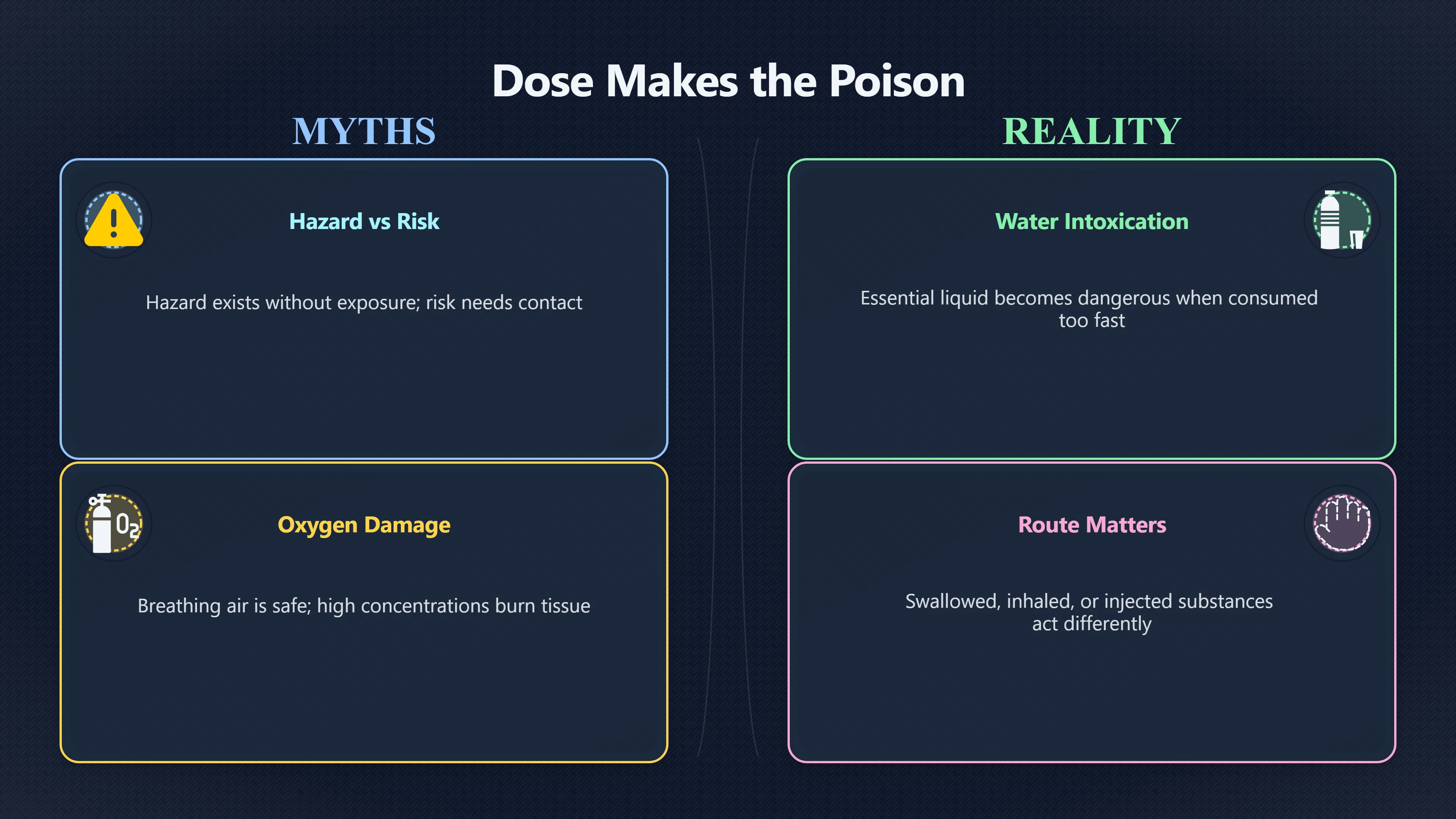
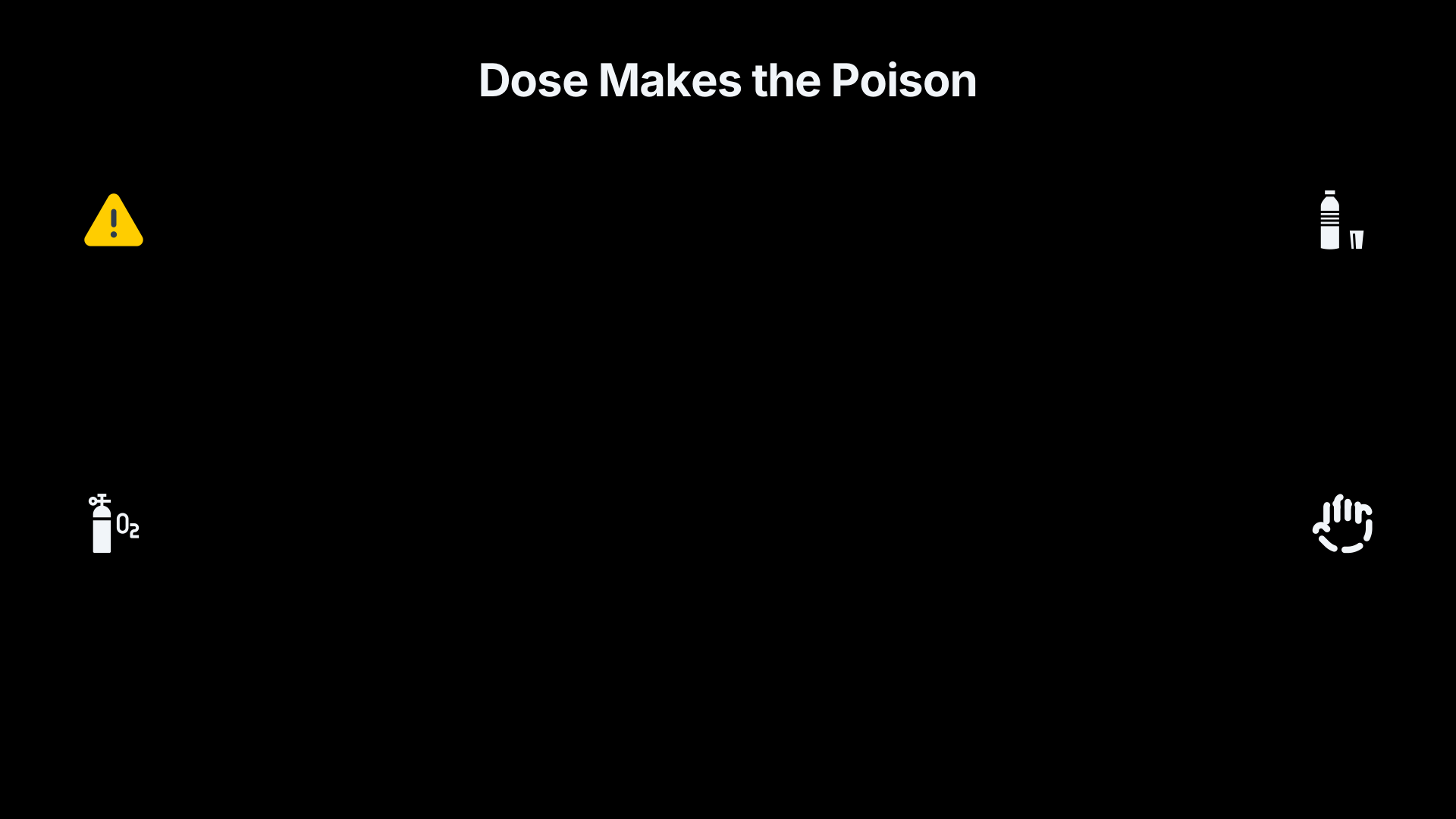
A common mistake in health discussions is to confuse a hazard with a risk. A hazard is something capable of causing harm. Risk depends on whether people are exposed to it, how much they encounter, and for how long.
This distinction explains why short slogans often mislead. A statement such as “this substance is toxic” may be technically correct, yet tell a reader almost nothing about their actual risk. Toxicologists have long relied on the principle often summarised as “the dose makes the poison”: even substances essential for life can become harmful at high enough levels, while many hazardous substances produce little or no effect below certain exposure levels. PMC[Virginia Department of Health]vdh.virginia.govDepartment of Health Toxicology ExplainedAlmost any chemical can be harmful depending on the dose.Read more…
Water provides a simple example. Drinking water is necessary for survival, yet consuming excessive amounts in a short period can cause water intoxication, a potentially dangerous condition. Oxygen is equally essential, but prolonged exposure to unusually high concentrations can damage tissues. These examples are not arguments that water or oxygen are generally dangerous; they illustrate that health effects depend on dose and context rather than category labels.[Chemical Safety Facts]chemicalsafetyfacts.orgChemical Safety Facts“The Dose Makes the Poison”In other words, any chemical—even water and oxygen—can be toxic if too much is ingested or absorbed into the body.Read more… Wikipedia Context includes more than quantity. Exposure route matters as well. A substance swallowed[Wikipedia]WikipediaThe dose makes the poisonThe dose makes the poisonThe dose makes the poison is a proverb intended to indicate a basic principle of toxicology. It is credited t…, inhaled, injected, or absorbed through the skin may produce very different effects. Duration also matters: a brief exposure can differ greatly from repeated exposure over months or years. Toxicologists evaluate dose, frequency, timing, and route together because no single factor gives the whole picture.[virginia]vdh.virginia.govDepartment of Health Toxicology ExplainedAlmost any chemical can be harmful depending on the dose.Read more… Department of Health[Poison Control]poison.orgPoison ControlWhat is a poison? Clarifying poison-related termsConfused about the difference between poison, overdose, toxin and venom? W…
Another simplification hidden by slogans is the assumption that all harms are equal. Health messages often blur the distinction between a temporary symptom, a moderate health effect, and a life-threatening outcome. Yet risk communication depends heavily on both probability and severity. A common side effect and a rare severe complication are not interchangeable, even if both are technically “risks”. Effective communication must explain which outcome is being discussed and how likely it is.[Australian Centre for Disease Control]cdc.gov.auAustralian Centre for Disease ControlCommunicating risks to health from environmental hazardsTypically, communication about risks to huma…[2regulation.org.uk]regulation.org.ukCOMMUNICATING ABOUT RISKS TO PUBLIC HEALTHCommunicating about risks to public health can be of vital importance in many different context…
Natural, chemical, safe, and harmful as misleading shortcuts
Few health slogans have travelled further than “natural means safe”. The appeal is obvious: it turns a complicated evaluation into a simple shopping rule. Unfortunately, nature produces many potent toxins.
The World Health Organization notes that numerous plants, fungi, algae, and other organisms naturally produce toxic compounds that can harm humans. Natural toxins occur in foods, mushrooms, shellfish, and many other sources. Their existence demonstrates that “natural” describes origin, not safety.[World Health Organization]who.intnatural toxins in foodThese toxins are not harmful to the organisms themselves but they may be…Read more…
The opposite slogan, “chemicals are dangerous”, makes a similar mistake. Everything people eat, drink, breathe, and touch consists of chemicals. The word itself says nothing about hazard or risk. Scientific assessment focuses instead on properties, exposure, and dose. Toxicologists routinely emphasise that virtually any chemical can be harmful at sufficiently high exposure levels and that many chemicals are safe at typical levels of use.[virginia]vdh.virginia.govDepartment of Health Toxicology ExplainedAlmost any chemical can be harmful depending on the dose.Read more… Department of Health[2Society of Toxicology (SOT]toxicology.orgntly high doses. • Evidence can come from observational.Read more…
These slogans persist because they offer emotional certainty. “Natural” becomes a proxy for trust, while “chemical” becomes a proxy for fear. Neither shortcut helps people judge real-world risks. A naturally occurring toxin may be highly dangerous, while a synthetic medicine may have substantial benefits with carefully managed risks. Conversely, a natural remedy can have side effects, and a manufactured product can be harmful if misused. The crucial question is not where something came from but what evidence shows about its effects under specific conditions. World Health Organization[Poison Control]poison.orgPoison ControlWhat is a poison? Clarifying poison-related termsConfused about the difference between poison, overdose, toxin and venom? W…
There is also a reverse misconception hidden in some health marketing: “If a little helps, more must help more.” Many biological systems do not work this way. Medicines, supplements, and nutrients often have beneficial ranges beyond which benefits level off or risks increase. The relationship between dose and outcome is frequently more complicated than a straight line. Public-health guidance therefore focuses on recommended amounts rather than assuming that increasing intake always improves health.[WHO]who.intnatural toxins in foodThese toxins are not harmful to the organisms themselves but they may be…Read more…
Why simple slogans spread despite being incomplete
Short health rules succeed because they reduce cognitive effort. They are easy to remember, repeat, and apply. A nuanced explanation that includes dose, timing, uncertainty, and trade-offs is harder to compress into a social-media post or casual conversation.
Risk-communication research repeatedly finds that people understand hazards more accurately when information includes the circumstances under which harm may occur rather than presenting danger as an absolute property. Effective communication therefore describes both the potential outcome and the conditions required for that outcome. PMC[Australian Centre for Disease Control]cdc.gov.auAustralian Centre for Disease ControlCommunicating risks to health from environmental hazardsTypically, communication about risks to huma…
The challenge is that adding context can make a message longer. A slogan can say “avoid chemicals”. An accurate statement may need to explain which chemical, at what exposure level, for whom, and with what evidence. The result is less catchy but more useful.
This tension helps explain why myths often survive corrections. The myth offers a portable rule. The correction offers a conditional explanation. Unless communicators preserve the essential context while keeping messages understandable, the simpler version frequently wins.
How to write compact health claims without distorting them
Health messages do not have to become lengthy technical documents. They can remain concise while preserving the information people need.
A more reliable health claim usually includes at least one of the following elements:
- Dose or amount: “High intakes may increase risk” is more informative than “this is dangerous”.
- Population: “Risk is higher in children” is more useful than a universal warning.
- Probability: “Rare but serious” conveys something different from “common”.
- Severity: Mild discomfort and severe illness should not be merged into a single category.
- Conditions: “When inhaled” or “after prolonged exposure” provides essential context.
- Trade-offs: Benefits and risks should appear together when both matter.
Consider the difference between two statements:
- “Natural products are safer.”
- “Natural products can be beneficial, but safety depends on the substance, dose, and how they are used.”
The second statement is only slightly longer, yet it preserves the key facts needed for informed judgement.
The same principle applies across public health. Good communication does not merely identify a hazard. It explains the exposure, the likely outcome, and the circumstances that change the level of risk. By keeping those elements visible, health messages can remain memorable without becoming misleading.[Australian Centre for Disease Control]cdc.gov.auAustralian Centre for Disease ControlCommunicating risks to health from environmental hazardsTypically, communication about risks to huma…[2regulation.org.uk]regulation.org.ukCOMMUNICATING ABOUT RISKS TO PUBLIC HEALTHCommunicating about risks to public health can be of vital importance in many different context…
Amazon book picks
Further Reading
Books and field guides related to When health slogans leave out risk. Use these as the next step if you want deeper reading beyond the article.
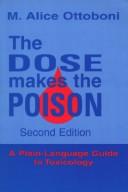
The dose makes the poison
First published 1984. Subjects: Popular works, Toxicology, Ouvrages de vulgarisation, Toxicologie.
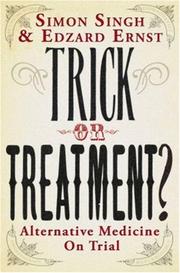
Trick or Treatment?
First published 2008. Subjects: Placebo Effect, Evidence-Based Medicine, Complementary Therapies, Alternative medicine, Quackery.
eBay marketplace picks
Marketplace Samples
Example marketplace items related to this page. Use the search link to explore similar finds on eBay.
Endnotes
1.
Source: pmc.ncbi.nlm.nih.gov
Title: All things are poison and nothing is without poison
Link:https://pmc.ncbi.nlm.nih.gov/articles/PMC4942381/
Source snippet
Paracelsus Revisited: The Dose Concept in a Complex Worldby P Grandjean · 2016 · Cited by 211 — At the time that Paracelsus coined his...
2.
Source: vdh.virginia.gov
Title: Department of Health Toxicology Explained
Link:https://www.vdh.virginia.gov/environmental-health/public-health-toxicology/toxicology-explained/
Source snippet
Almost any chemical can be harmful depending on the dose.Read more...
3.
Source: Wikipedia
Title: The dose makes the poison
Link:https://en.wikipedia.org/wiki/The_dose_makes_the_poison
Source snippet
The dose makes the poisonThe dose makes the poison is a proverb intended to indicate a basic principle of toxicology. It is credited t...
4.
Source: Wikipedia
Link:https://en.wikipedia.org/wiki/Toxicity
5.
Source: poison.org
Link:https://www.poison.org/what-is-a-poison-and-what-is-an-overdose
Source snippet
Poison ControlWhat is a poison? Clarifying poison-related termsConfused about the difference between poison, overdose, toxin and venom? W...
6.
Source: regulation.org.uk
Link:https://www.regulation.org.uk/library/dh_risk_comms_advice.pdf
Source snippet
[COMMUNICATING]({{ 'communicating/' | relative_url }}) ABOUT RISKS TO PUBLIC HEALTHCommunicating about risks to public health can be of vital importance in many different context...
7.
Source: who.int
Title: natural toxins in food
Link:https://www.who.int/news-room/fact-sheets/detail/natural-toxins-in-food
Source snippet
These toxins are not harmful to the organisms themselves but they may be...Read more...
8.
Source: toxicology.org
Link:https://www.toxicology.org/groups/ss/rass/docs/RASS-ISES-Kaden-Webinar.pdf
Source snippet
ntly high doses. • Evidence can come from observational.Read more...
9.
Source: cdn.who.int
Link:https://cdn.who.int/media/docs/default-source/food-safety/publications/chapter5-dose-response.pdf
Source snippet
Chapter 5 Dose–response assessment and derivation of...December 7, 2020 — This approach considers all available dose–response data to...
Published: December 7, 2020
10.
Source: pmc.ncbi.nlm.nih.gov
Link:https://pmc.ncbi.nlm.nih.gov/articles/PMC7437971/
Source snippet
Risk Communication for Environmental Health Practitionersby V Siegel · 2020 · Cited by 3 — CDC's Crisis and Emergency Risk Communicati...
11.
Source: cdc.gov.au
Link:https://www.cdc.gov.au/system/files/2025-10/enhealth-guidance-for-environmental-public-health-professionals-communicating-risks-to-health-from-environmental-hazards_0.pdf
Source snippet
Australian Centre for Disease ControlCommunicating risks to health from environmental hazardsTypically, communication about risks to huma...
12.
Source: chemicalsafetyfacts.org
Title: Chemical Safety Facts“The Dose Makes the Poison”
Link:https://www.chemicalsafetyfacts.org/health-and-safety/the-dose-makes-the-poison/
Source snippet
In other words, any chemical—even water and oxygen—can be toxic if too much is ingested or absorbed into the body.Read more...
Additional References
13.
Source: fda.gov
Link:https://www.fda.gov/media/130216/download
Source snippet
FDA to communicate important new and emerging safety information about marketed products to...Read more...
14.
Source: youtube.com
Link:https://www.youtube.com/watch?v=P0-whz9NaMk
Source snippet
Module 3: Communicating Environmental and Health RisksModule 3 is based on Step 3 in the 5-step Land Reuse Model. It incorporates knowled...
15.
Source: youtube.com
Link:https://www.youtube.com/watch?v=86yCnT1JdZA
16.
Source: infectedbloodinquiry.org.uk
Link:https://www.infectedbloodinquiry.org.uk/sites/default/files/550-575/550-575/WITN3430087%20-%20Communicating%20about%20risks%20to%20public%20health%20-%20Pointers%20to%20Good%20Practice%20-%2001%20Nov%201997.pdf
Source snippet
• Responses to communication will be highly dependent both on recipients'.Read more...
17.
Source: researchgate.net
Link:https://www.researchgate.net/publication/286690361From%27the_dose_makes_the_poison%27to%27the_timing_makes_the_poison%27_Conceptualizing_risk_in_the_synthetic_age
Source snippet
y law and articulated within the discipline of toxicology over the...Read more...
18.
Source: youtube.com
Link:https://www.youtube.com/watch?v=4D9V2SnEOto
Source snippet
Radiation Risk Communication for Public HealthThis training provides an overview of important communication principles within the context...
19.
Source: facebook.com
Link:https://www.facebook.com/wellcomecollection/posts/everything-is-poisonous-nothing-is-poisonous-it-is-all-a-matter-of-dose-claude-b/10157657503353538/?locale=el_GR
Source snippet
It is attributed to the Swiss physician and alchemist...Read more...
20.
Source: oecd.org
Title: 6954d334 en
Link:https://www.oecd.org/content/dam/oecd/en/publications/reports/2002/07/oecd-guidance-document-on-risk-communication-for-chemical-risk-management_53270b93/6954d334-en.pdf
Source snippet
dose-response functions, but to the question of what all this means for human health and environmental protection. Hazard data is hardly...
21.
Source: stacks.cdc.gov
Title: cdc 188408 DS1
Link:https://stacks.cdc.gov/view/cdc/188408/cdc_188408_DS1.pdf
Source snippet
CDC Stacks13 Talking With Patients and the Public About Endocrine-...by S Janssen · 2007 · Cited by 2 — Communication about environmenta...
22.
Source: directorsblog.health.azdhs.gov
Title: AZ Dept
Link:https://directorsblog.health.azdhs.gov/the-dose-makes-the-poison/
Source snippet
of Health Services NewsThe Dose Makes the Poison – AZ Dept. of Health Services News19 Jun 2012 — “All things are poison, and nothing is w...
Topic Tree