Within Backfire
When the Correction Becomes the Problem
Corrections are most fragile when the audience sees the source as hostile, manipulative or poorly justified.
On this page
- Why scepticism changes how corrections land
- Signals that make debunks look hostile
- How trusted messengers reduce correction resistance
Page outline Jump by section
Introduction
People often imagine misinformation correction as a simple contest between truth and falsehood. In practice, another question frequently comes first: who is doing the correcting, and why should they be trusted? Research on misinformation increasingly suggests that many apparent “backfire” reactions are not cases where facts themselves make beliefs stronger. Instead, resistance often emerges when the correction is perceived as manipulative, hostile, partisan or self-interested.
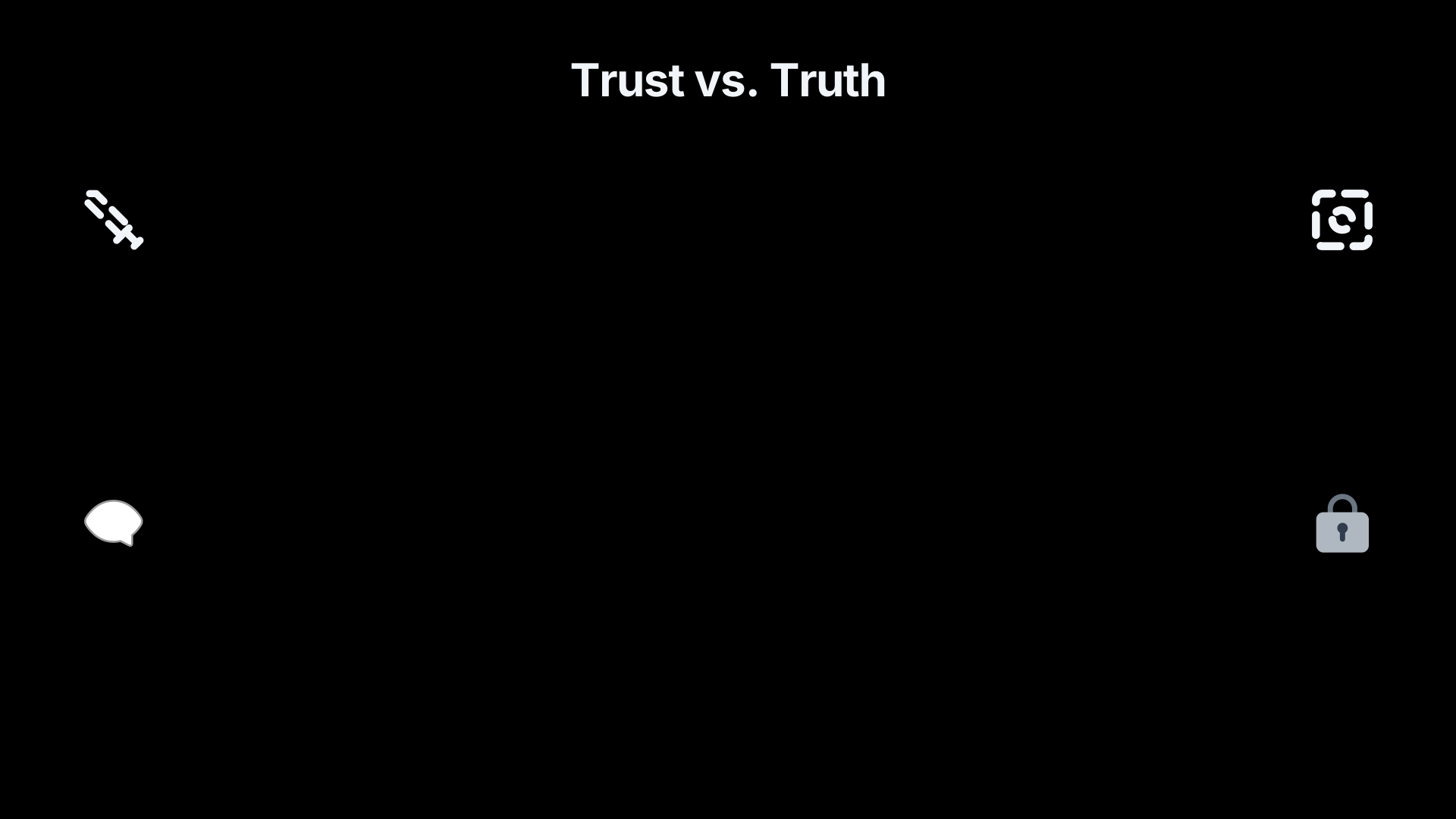 This distinction matters because it changes how correction failures are interpreted. A rejected correction does not necessarily show that people prefer falsehoods. It may show that they doubt the motives, competence or fairness of the messenger. In those situations, the correction becomes part of the conflict rather than a resolution of it. Studies of source credibility, political communication and misinformation correction consistently find that trust shapes whether corrective information is considered legitimate evidence or treated as another attempt at persuasion. Nature[Advances.in]advances.inSource credibility effects in misinformation research: A review…by V Mang · 2024 · Cited by 15 — Source credibility isn't a simple fix…
Why Scepticism Changes How Corrections Land
The popular version of the backfire effect assumes that hearing a correction somehow strengthens attachment to a myth. Modern research paints a more complicated picture. Large reviews and replication studies have found that true backfire effects are rare, but they also show that corrections do not operate in a social vacuum. People evaluate not only the content of a correction but also the source delivering it. PMC PubMed Trust functions as a shortcut for judging information. Most people cannot personally verify every scientific claim[pubmed.ncbi.nlm.nih.gov]pubmed.ncbi.nlm.nih.govFurthermore, we aimed to…Read more…, policy statistic or breaking-news report. Instead, they rely on cues about expertise, honesty and intent. When a correction comes from a source viewed as credible, it is more likely to be processed as useful information. When it comes from a source viewed as hostile or deceptive, the same correction may be interpreted as evidence of manipulation.
This is particularly important in highly polarised environments. A correction from a political opponent, a distrusted institution or a platform already seen as biased may trigger questions about motives before the factual content is even considered. Researchers studying misinformation describe these reactions as barriers to knowledge revision rather than evidence that corrections inherently strengthen myths.[Nature]nature.comThe psychological drivers of misinformation belief and its…by UKH Ecker · 2022 · Cited by 1916 — In this Review, we describe the…
The result can look like a backfire effect from the outside. A person rejects the correction and retains the original belief. Yet the mechanism is different. The problem is not that the correction made the myth more convincing. The problem is that the correction itself failed a trust test.
Signals That Make Debunks Look Hostile
People rarely evaluate corrections in purely factual terms. Tone, framing and social context all influence whether a correction appears informative or threatening.
Several signals tend to make corrective information look suspicious:
- Visible contempt or ridicule. Corrections that mock believers can be interpreted as status attacks rather than factual explanations.
- Partisan branding. Information strongly associated with a political camp may be discounted by audiences who distrust that group.
- Lack of transparency. Corrections that present conclusions without explaining reasoning can appear authoritative but unconvincing.
- Perceived censorship. If people believe information is being hidden, removed or controlled unfairly, they may become more suspicious of subsequent corrections.
- Institutional self-interest. Corrections issued by organisations perceived to benefit from a particular conclusion can be treated with greater scepticism.
Research examining social-media corrections has found that audience reactions depend not only on factual accuracy but also on how corrections are delivered and interpreted socially. Users often evaluate whether the corrector seems fair, respectful and trustworthy before deciding whether the information deserves consideration.[Taylor & Francis Online]tandfonline.comTaylor & Francis OnlineWhy Do Social Media Users Accept, Doubt or Resist…by M Hameleers · 2024 · Cited by 10 — This paper relies on an…
This helps explain why two corrections containing nearly identical facts can produce different outcomes. One may be viewed as a sincere attempt to inform, while the other is seen as an attempt to shame, control or score political points.
When Corrections Become Evidence of Conspiracy
Distrust creates a particularly difficult problem when the correction itself is folded into the original belief system.
Conspiracy narratives often contain built-in explanations for why authorities, journalists, scientists or fact-checkers would deny the claim. Under those conditions, a correction may not simply be ignored. It can be reinterpreted as confirmation that powerful actors are trying to suppress the truth.
Psychologists sometimes describe this as a self-sealing structure. Contrary evidence does not automatically weaken the belief because the belief already contains a story about why contrary evidence will appear. The correction therefore becomes another data point supporting distrust rather than challenging it.[Nature]nature.comInvestigating the role of source and…by H Bruns · 2024 · Cited by 35 — The findings show that both interventions change four variables…
This mechanism differs from the classic image of factual backfire. The correction is not strengthening belief because repetition made the myth more familiar. Instead, the correction is being processed through a framework that assumes deception by the correcting source.
That distinction is important because it points toward different solutions. Repeating facts more forcefully may not help if the audience’s central concern is whether the messenger is trustworthy.

The Difference Between Expertise and Trustworthiness
Research on source credibility repeatedly finds that credibility is not a single trait. People often distinguish between expertise and trustworthiness. A source can be seen as knowledgeable but dishonest, or honest but uninformed.[Advances.in]advances.inSource credibility effects in misinformation research: A review…by V Mang · 2024 · Cited by 15 — Source credibility isn't a simple fix…
This distinction helps explain some puzzling correction failures.
A government agency may possess extensive expertise yet still face scepticism from groups that believe it has political motives. A celebrity may lack specialised knowledge but still persuade followers because they are perceived as authentic and sincere. Neither factor alone guarantees acceptance.
Reviews of source-credibility research show that trust effects are often inconsistent because audiences evaluate multiple dimensions simultaneously. Expertise matters, but perceptions of bias, fairness and intent also influence whether corrective information is accepted.[Advances.in]advances.inSource credibility effects in misinformation research: A review…by V Mang · 2024 · Cited by 15 — Source credibility isn't a simple fix…
In other words, people do not merely ask, “Is this source qualified?” They also ask, “Whose side are they on?” and “What do they want from me?”
How Trusted Messengers Reduce Correction Resistance
Evidence from misinformation research increasingly suggests that messenger choice can matter as much as message design.
Trusted messengers work because they reduce the suspicion that the correction is an attack. A local community leader, respected doctor, religious figure or politically aligned source may be able to deliver information that would be rejected if it came from a distrusted institution. Studies examining correction and prebunking strategies have found that source trust can shape how audiences receive interventions, even when the factual content remains unchanged.[PMC]pmc.ncbi.nlm.nih.govFurthermore, we aimed to examine whether…Read more…[Nature]nature.comThe psychological drivers of misinformation belief and its…by UKH Ecker · 2022 · Cited by 1916 — In this Review, we describe the…
Several features make trusted messengers effective:
- They are perceived as sharing the audience’s interests.
- They are seen as accountable to the community rather than distant authorities.
- They reduce assumptions of hidden motives.
- They can frame corrections in familiar language and values.
- They often possess existing social credibility that lowers defensive reactions.
Importantly, this does not mean people only accept information from allies. Large correction studies still find that factual corrections often improve accuracy across ideological groups. But trust can determine how much attention people give a correction in the first place and whether they interpret it as information or persuasion. PMC[PubMed]pubmed.ncbi.nlm.nih.govFurthermore, we aimed to…Read more…

What This Means for the Backfire Debate
The modern evidence on misinformation correction suggests that fears about routine myth repetition have often been overstated. Yet the failure of a strong backfire effect does not mean every correction succeeds. Many correction problems arise from distrust rather than from the mechanics of memory.
When audiences suspect manipulation, corrections can appear threatening, partisan or self-serving. Under those conditions, resistance is often directed at the messenger rather than the factual claim itself. The correction becomes another object of suspicion.
This helps explain why debates about misinformation frequently become debates about institutions, media credibility and social trust. The central obstacle is often not an inability to understand evidence. It is uncertainty about whether the source presenting that evidence deserves belief. Nature[Advances.in]advances.inSource credibility effects in misinformation research: A review…by V Mang · 2024 · Cited by 15 — Source credibility isn't a simple fix…
Amazon book picks
Further Reading
Books and field guides related to When the Correction Becomes the Problem. Use these as the next step if you want deeper reading beyond the article.
Factfulness
Shows how reliable evidence can overcome common misconceptions and biases.
Post-truth
First published 2018. Subjects: Politics and government, In mass media, Public opinion, Mass media, Truth.

eBay marketplace picks
Marketplace Samples
Example marketplace items related to this page. Use the search link to explore similar finds on eBay.



Endnotes
1.
Source: nature.com
Link:https://www.nature.com/articles/s44159-021-00006-y
Source snippet
The psychological drivers of misinformation belief and its...by UKH Ecker · 2022 · Cited by 1916 — In this Review, we describe the...
2.
Source: advances.in
Link:https://advances.in/psychology/10.56296/aip00028/
Source snippet
Source credibility effects in misinformation research: A review...by V Mang · 2024 · Cited by 15 — Source credibility isn't a simple fix...
3.
Source: pmc.ncbi.nlm.nih.gov
Link:https://pmc.ncbi.nlm.nih.gov/articles/PMC9283209/
Source snippet
Furthermore, we aimed to examine whether...Read more...
4.
Source: pmc.ncbi.nlm.nih.gov
Link:https://pmc.ncbi.nlm.nih.gov/articles/PMC11377563/
Source snippet
Investigating the role of source and source trust in prebunks...by H Bruns · 2024 · Cited by 35 — First, our results demonstrate that...
5.
Source: nature.com
Link:https://www.nature.com/articles/s41598-024-71599-6
Source snippet
Investigating the role of source and...by H Bruns · 2024 · Cited by 35 — The findings show that both interventions change four variables...
6.
Source: pubmed.ncbi.nlm.nih.gov
Link:https://pubmed.ncbi.nlm.nih.gov/35130012/
Source snippet
Furthermore, we aimed to...Read more...
7.
Source: tandfonline.com
Link:https://www.tandfonline.com/doi/full/10.1080/1461670X.2024.2340591
Source snippet
Taylor & Francis OnlineWhy Do Social Media Users Accept, Doubt or Resist...by M Hameleers · 2024 · Cited by 10 — This paper relies on an...
8.
Source: cssh.northeastern.edu
Title: backfire effects
Link:https://cssh.northeastern.edu/nulab/backfire-effects/
Source snippet
In other words, instead of belief...Read more...
Additional References
9.
Source: research-information.bris.ac.uk
Link:https://research-information.bris.ac.uk/files/298563464/Ecker_v4_TSshorten_UE_clean.pdf
Source snippet
bris.ac.ukEcker, UKH, Lewandowsky, S., Cook, J., Schmid, P., Fazio...Third, even though credibility matters less for correction sources...
10.
Source: networkscienceinstitute.org
Link:https://www.networkscienceinstitute.org/publications/the-differential-consequences-of-correcting-misinformation-for-high-and-low-credibility-sources
Source snippet
The differential consequences of correcting misinformation...3 Apr 2026 — In Experiment 1, correcting inaccuracies reduced doctors' cred...
11.
Source: asc.upenn.edu
Link:https://www.asc.upenn.edu/news-events/news/research-identifies-factors-make-correcting-misinformation-about-science-more-successful
Source snippet
Identifies Factors That Make Correcting...20 Jun 2023 — A new study from PIK Professor Dolores Albarracín and Research Associate Man-pui...
12.
Source: carnegieendowment.org
Title: countering disinformation effectively an evidence based policy guide
Link:https://carnegieendowment.org/russia-eurasia/research/2024/01/countering-disinformation-effectively-an-evidence-based-policy-guide
Source snippet
Countering Disinformation Effectively: An Evidence-Based...31 Jan 2024 — A high-level, evidence-informed guide to some of the major prop...
13.
Source: climatechangecommunication.org
Link:https://www.climatechangecommunication.org/wp-content/uploads/2023/09/DebunkingHandbook2020.pdf
Source snippet
[Fake news]({{ 'fake-news/' | relative_url }}): False information, often of a sensational nature, that mimics news media...Read more...
14.
Source: rkellygarrett.com
Title: Garrett and Weeks Promise and peril of real time corrections
Link:https://rkellygarrett.com/wp-content/uploads/2014/05/Garrett-and-Weeks-Promise-and-peril-of-real-time-corrections.pdf
Source snippet
The Promise and Peril of Real-Time Corrections to Politicalby RK Garrett · 2013 · Cited by 230 — When misinformation is corrected immedia...
15.
Source: discovery.ucl.ac.uk
Title: UCL Discovery Belief updating in the face of misinformation
Link:https://discovery.ucl.ac.uk/id/eprint/10206076/2/Sanna_1-s2.0-S0010027725000307-main.pdf
Source snippet
UCL DiscoveryBelief updating in the face of misinformation - UCL Discoveryby GA Sanna · 2025 · Cited by 14 — This paper investigates the...
16.
Source: Tech Policy Press
Title: why people believe misinformation and resist correction
Link:https://techpolicy.press/why-people-believe-misinformation-and-resist-correction
Source snippet
14 Jan 2022 — A Nature review of the available empirical research yields best practices for confronting misinformation and suggestions fo...
17.
Source: voxdev.org
Title: interventions counter political polarisation
Link:https://voxdev.org/voxdevlit/political-polarisation/interventions-counter-political-polarisation
Source snippet
Interventions to counter political polarisationOct 27, 2025 — These studies suggest that social media interventions may require a dual ap...
18.
Source: facebook.com
Link:https://www.facebook.com/uni.lu/posts/have-you-ever-tried-to-correct-someone-who-shared-fake-news-online-it-rarely-goe/1447453670755961/
Source snippet
Have you ever tried to correct someone who shared fake...However, the study noted that corrections did not change people's voting patterns...
Topic Tree