Within Commercial Myths
How packaged myths enter school routines
Training days, consultancy networks and ready-made materials can help weak claims spread because they are easy to buy and use.
On this page
- Why ready made programmes solve a real pressure
- How recommendations and training networks spread claims
- What implementation checks can slow weak adoption
Page outline Jump by section
Introduction
Schools rarely adopt weak programmes because staff are careless or uninterested in evidence. More often, questionable ideas survive because they travel through practical adoption pathways that solve genuine organisational problems. School leaders need training, materials, implementation support and visible improvement strategies. A programme that arrives with ready-made lessons, staff-development sessions and external expertise can be far easier to adopt than a research summary that offers principles but few implementation details.
 This creates an important distinction in the study of myths and misconceptions. Some educational myths persist because people believe them. Others persist because institutions can easily purchase, implement and sustain them. Research on neuromyths and school implementation suggests that commercially packaged claims can remain influential even when the underlying evidence is weak, disputed or absent. The adoption process itself can become part of the programme’s durability.[PMC]pmc.ncbi.nlm.nih.govby S Dekker · 2012 · Cited by 1291 — Results showed that on average, teachers believed 49% of the neuromyths, particularly myths relat…
Why ready-made programmes solve a real pressure
Schools operate under significant time and resource constraints. Leaders are expected to improve outcomes, support staff development, respond to inspections and manage change while maintaining daily operations. In that environment, a complete package often appears less risky than designing an approach from scratch.
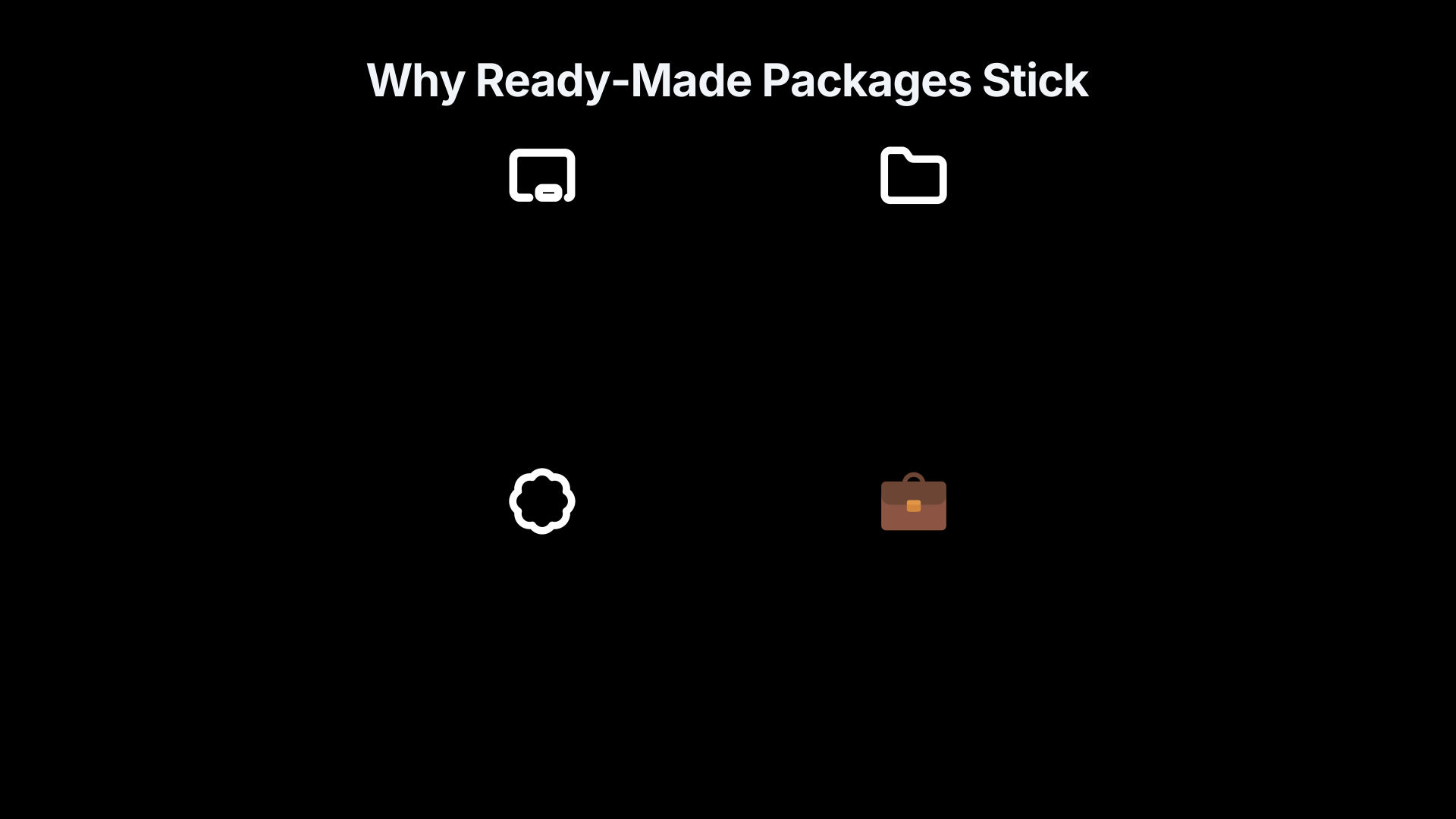
A packaged programme typically includes:
- Staff training sessions.
- Lesson resources and templates.
- Implementation guidance.
- Assessment tools.
- Coaching or consultancy support.
- Promotional claims about impact.
These features address real operational needs. The challenge is that convenience and evidence are not the same thing. A programme may be easy to implement because its materials are highly developed, not because its central claims have been rigorously tested.
Implementation researchers have repeatedly noted that schools often seek interventions that can be adopted, embedded and sustained with manageable effort. The attractiveness of a programme can therefore depend as much on its implementation infrastructure as on the quality of its evidence base. PMC[EEF]educationendowmentfoundation.org.ukEEFPrioritise fewer things and do them well to make long-term,…24 Apr 2024 — The previous edition of the EEF's guidance on implementation…
The learning-styles industry illustrates this pattern. Despite repeated reviews finding no convincing evidence that matching instruction to a learner’s preferred style improves outcomes, learning-styles frameworks remained widely available through workshops, questionnaires, teacher training materials and classroom resources for many years. The practical package was often more visible than the research critique.[PMC]pmc.ncbi.nlm.nih.govAdoption, implementation and sustainability of school-based…by S Cassar · 2019 · Cited by 291 — We encourage schools and change age…[PMC]pmc.ncbi.nlm.nih.govPMCThe Learning Styles Myth is Thriving in Higher Educationby PM Newton · 2015 · Cited by 476 — The existence of 'Learning Styles' is a common 'neuromyth', and their use in all forms of educati…
How recommendations and training networks spread claims
The role of professional development
Many programmes reach schools through professional development rather than through direct examination of research evidence. Teachers and leaders frequently encounter new approaches at conferences, training days, webinars and continuing professional development events.
This pathway has advantages. Professional networks allow educators to share useful practices quickly. However, it can also allow weak claims to spread if presenters rely on persuasive stories, selective evidence or scientific-sounding language rather than robust evaluation.
Research on neuromyths shows that misconceptions linked to commercial educational programmes have been particularly persistent among educators. Notably, teachers often demonstrate reasonable general knowledge about learning and the brain while still accepting specific commercially promoted myths.[PMC]pmc.ncbi.nlm.nih.govModality-Specific Learning Style Hypothesis: A Mini-Reviewby K Aslaksen · 2018 · Cited by 98 — Several topical reviews have concluded tha…
Consultancy and peer recommendation effects
Schools rarely make decisions in isolation. Recommendations from trusted colleagues, local networks, academy trusts, consultants or school-improvement partners can strongly influence adoption decisions.
This can create a self-reinforcing cycle:
- A programme gains visibility through training and marketing.
- Early adopters report positive experiences.
- Other schools adopt the programme based on peer recommendations.
- Continued adoption becomes evidence of popularity.
- Popularity is mistaken for proof of effectiveness.
The programme’s survival then depends less on independent evaluation and more on professional circulation. Once enough schools have invested time, money and staff training, abandoning the programme can become difficult even when evidence remains weak.
Researchers studying implementation and school improvement have noted that schools often face a crowded marketplace of initiatives. In such environments, visibility and network effects can significantly shape adoption decisions.[Taylor & Francis Online]tandfonline.comWe sometimes feel like there's…Read more…
Why scientific language matters
Commercial programmes frequently borrow the language of research. Terms such as “brain-based”, “neuroscience-informed”, “evidence-driven” or “scientifically proven” can create an impression of authority.
The problem is not the use of science itself. Many evidence-based approaches legitimately draw on cognitive science, psychology or educational research. The problem arises when scientific terminology functions primarily as marketing.
Studies of educational neuromyths suggest that misconceptions often gain credibility precisely because they appear connected to neuroscience. The learning-styles myth, left-brain/right-brain claims and similar ideas have frequently benefited from this scientific halo effect.[Frontiers]frontiersin.orgFrontiersThe persistence of matching teaching and learning stylesby SBRE Brown · 2023 · Cited by 39 — One such neuromyth claims that matc…[Frontiers]frontiersin.orgFrontiersThe persistence of matching teaching and learning stylesby SBRE Brown · 2023 · Cited by 39 — One such neuromyth claims that matc…

How programmes become embedded after adoption
Once a school adopts a programme, several organisational forces can keep it alive.
First, staff invest time in training. Teachers who have completed certification courses or extensive professional development may understandably wish to see value in that investment.
Second, schools often purchase associated materials, assessment tools and consultancy support. Replacing the programme may require additional spending.
Third, implementation itself can generate positive impressions. Staff may observe improved consistency, better planning or stronger professional discussion. These improvements may result from increased attention and coordination rather than from the programme’s specific theoretical claims.
Implementation research consistently emphasises that change processes themselves influence outcomes. A well-organised implementation effort can create benefits even when the programme being implemented is not especially strong. This makes evaluation more complicated than simply asking whether staff liked the initiative. EEF[Digital Education Resource Archive]dera.ioe.ac.ukDigital Education Resource ArchiveEEF-Implementation-Guidance-Report.pdfThe guide can be used to help implement any school improvement de…
Another challenge is that weak programmes often survive through adaptation. When expected results do not appear, schools may modify delivery, add extra components or redefine success measures. This flexibility can make failure difficult to recognise because the programme gradually changes while retaining its original branding.
What implementation checks can slow weak adoption
The goal is not to reject every external programme. Many commercially produced interventions are useful and evidence-informed. The key question is whether schools evaluate claims before large-scale adoption.
Several implementation safeguards are repeatedly recommended in evidence-informed school improvement guidance.
Separate the claim from the package
Schools can ask two distinct questions:
- Is the underlying theory supported by evidence?
- Is the implementation support useful?
A programme may offer excellent resources while making exaggerated claims about why it works. Evaluating these separately helps avoid treating polished materials as proof.
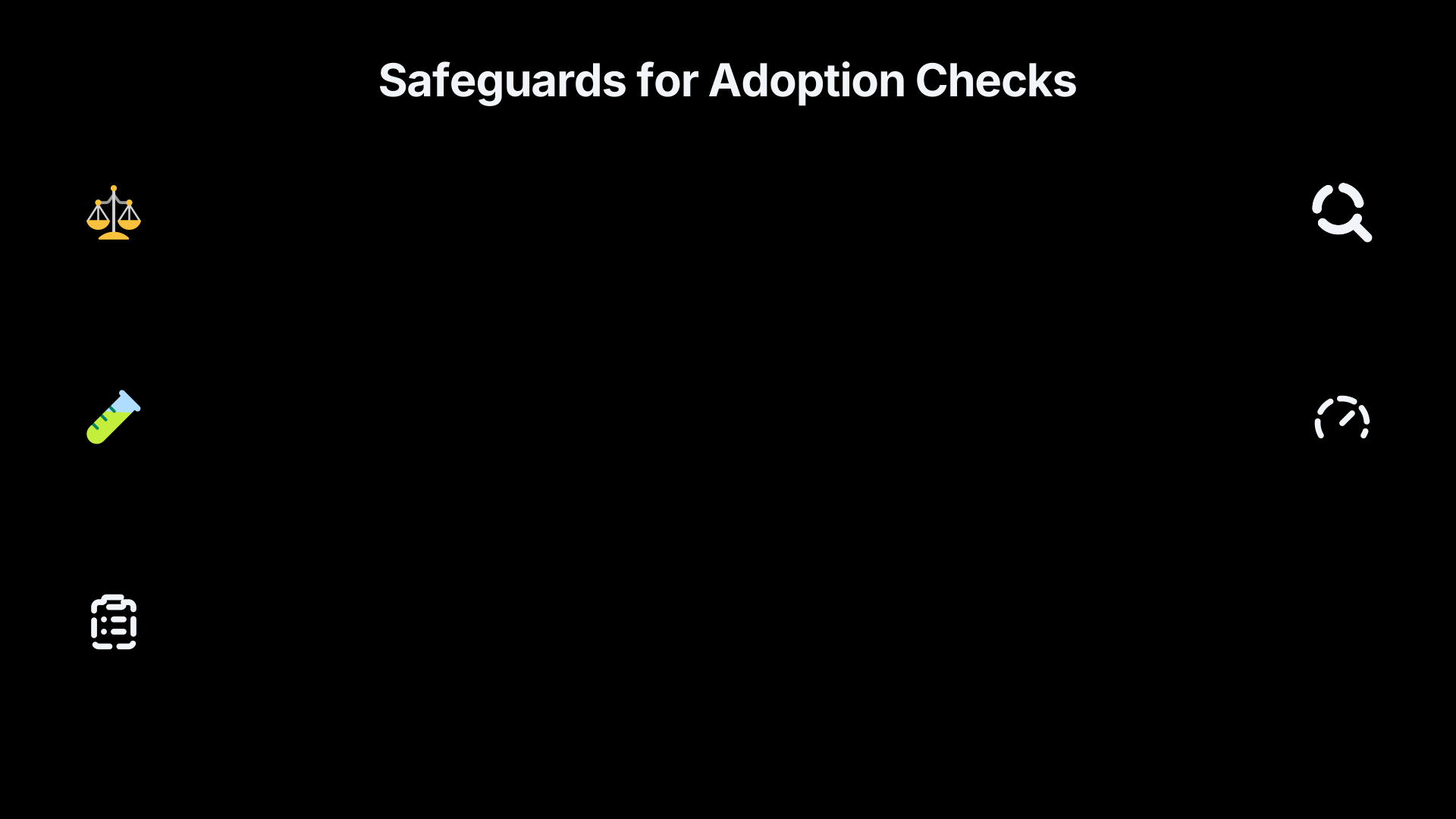
Look for independent evaluation
The strongest evidence usually comes from studies conducted independently of programme developers. Independent evaluation reduces the risk that positive findings result primarily from promotional incentives.
Schools should be particularly cautious when evidence consists mainly of testimonials, case studies or provider-generated reports.
Start small before scaling
Implementation guidance increasingly recommends disciplined exploration and testing before whole-school rollout. Pilot implementation allows schools to examine whether a programme works in their context before committing substantial resources.[EEF]educationendowmentfoundation.org.ukEEFPrioritise fewer things and do them well to make long-term,…24 Apr 2024 — The previous edition of the EEF's guidance on implementation…[EEF]educationendowmentfoundation.org.ukEEFPrioritise fewer things and do them well to make long-term,…24 Apr 2024 — The previous edition of the EEF's guidance on implementation…
Ask what would count as failure
Before adoption, leaders can identify measurable indicators that would justify discontinuing the programme.
Without predefined criteria, initiatives can continue indefinitely because stopping them becomes politically or professionally uncomfortable.
Prioritise fewer initiatives
Implementation research increasingly emphasises focusing on a limited number of priorities rather than continually adopting new programmes. A crowded improvement agenda makes critical evaluation harder and increases susceptibility to attractive but weak interventions.[EEF]educationendowmentfoundation.org.ukEEFPrioritise fewer things and do them well to make long-term,…24 Apr 2024 — The previous edition of the EEF's guidance on implementation…
The real lesson from adoption pathways
Weak educational programmes do not usually survive because schools deliberately ignore evidence. They survive because schools need practical solutions, and commercial programmes often excel at providing implementation support, professional development and ready-made materials. These strengths can create momentum that is largely independent of the quality of the underlying claims.
Understanding adoption pathways shifts attention from individual belief to institutional behaviour. A myth becomes durable not only when people accept it, but when it is packaged, recommended, trained, funded and woven into everyday school routines. Recognising those pathways helps schools distinguish between programmes that are easy to adopt and programmes that are genuinely supported by evidence. PMC[EEF]educationendowmentfoundation.org.ukEEFPrioritise fewer things and do them well to make long-term,…24 Apr 2024 — The previous edition of the EEF's guidance on implementation…
Amazon book picks
Further Reading
Books and field guides related to How packaged myths enter school routines. Use these as the next step if you want deeper reading beyond the article.

Seven Myths about Education
Challenges assumptions that often drive programme adoption.
Why Don't Students Like School?
Helps leaders judge whether educational claims fit learning science.

The Knowledge GAP
First published 2019. Subjects: Language arts (elementary), Education, elementary, curricula, Educational change, Children with social di...
eBay marketplace picks
Marketplace Samples
Example marketplace items related to this page. Use the search link to explore similar finds on eBay.



Endnotes
1.
Source: pmc.ncbi.nlm.nih.gov
Link:https://pmc.ncbi.nlm.nih.gov/articles/PMC3475349/
Source snippet
by S Dekker · 2012 · Cited by 1291 — Results showed that on average, teachers believed 49% of the neuromyths, particularly myths relat...
2.
Source: pmc.ncbi.nlm.nih.gov
Link:https://pmc.ncbi.nlm.nih.gov/articles/PMC6889569/
Source snippet
Adoption, implementation and sustainability of school-based...by S Cassar · 2019 · Cited by 291 — We encourage schools and change age...
3.
Source: pmc.ncbi.nlm.nih.gov
Title: PMCThe Learning Styles Myth is Thriving in Higher Education
Link:https://pmc.ncbi.nlm.nih.gov/articles/PMC4678182/
Source snippet
by PM Newton · 2015 · Cited by 476 — The existence of 'Learning Styles' is a common 'neuromyth', and their use in all forms of educati...
4.
Source: pmc.ncbi.nlm.nih.gov
Link:https://pmc.ncbi.nlm.nih.gov/articles/PMC6113575/
Source snippet
Modality-Specific Learning Style Hypothesis: A Mini-Reviewby K Aslaksen · 2018 · Cited by 98 — Several topical reviews have concluded tha...
5.
Source: educationendowmentfoundation.org.uk
Link:https://educationendowmentfoundation.org.uk/news/prioritise-fewer-things-and-do-them-well-to-make-long-term-positive-changes-to-teaching-practice
Source snippet
EEFPrioritise fewer things and do them well to make long-term,…24 Apr 2024 — The previous edition of the EEF's guidance on implementation...
6.
Source: frontiersin.org
Link:https://www.frontiersin.org/journals/education/articles/10.3389/feduc.2023.1147498/full
Source snippet
FrontiersThe persistence of matching teaching and learning stylesby SBRE Brown · 2023 · Cited by 39 — One such neuromyth claims that matc...
7.
Source: educationendowmentfoundation.org.uk
Link:https://educationendowmentfoundation.org.uk/education-evidence/guidance-reports/implementation
Source snippet
EEFA School's Guide to Implementation24 Apr 2024 — Our guidance on effective implementation - and its accompanying resources – help educa...
8.
Source: tandfonline.com
Link:https://www.tandfonline.com/doi/full/10.1080/02667363.2024.2414455
Source snippet
We sometimes feel like there's...Read more...
9.
Source: frontiersin.org
Link:https://www.frontiersin.org/journals/psychology/articles/10.3389/fpsyg.2020.591923/full
Source snippet
The Persistence of Neuromyths in the Educational Settingsby M Torrijos-Muelas · 2021 · Cited by 273 — After two decades of publications o...
10.
Source: frontiersin.org
Link:https://www.frontiersin.org/journals/psychology/articles/10.3389/fpsyg.2017.01314/full
Source snippet
Dispelling the Myth: Training in Education or Neuroscience...by K Macdonald · 2017 · Cited by 455 — These findings suggest that training...
11.
Source: dera.ioe.ac.uk
Link:https://dera.ioe.ac.uk/id/eprint/31088/1/EEF-Implementation-Guidance-Report.pdf
Source snippet
Digital Education Resource ArchiveEEF-Implementation-Guidance-Report.pdfThe guide can be used to help implement any school improvement de...
Additional References
12.
Source: educationendowmentfoundation.org.uk
Link:https://educationendowmentfoundation.org.uk/projects-and-evaluation/evaluation/eef-evaluation-reports-and-research-papers
Source snippet
EEF evaluation reports and research papersTo support the conduct of rigorous, high-quality evaluations, we have published a collection of...
13.
Source: educationendowmentfoundation.org.uk
Link:https://educationendowmentfoundation.org.uk/projects-and-evaluation/evaluation/process-and-people/pipeline-of-eef-trials
Source snippet
EEF's programme pipeline of evidence generationThe EEF's programme grant funding generates new evidence to enhance our understanding of w...
14.
Source: linkedin.com
Link:https://www.linkedin.com/posts/education-endowment-foundation_new-edition-eef-guidance-report-a-school-activity-7188823072638935040-13kr
Source snippet
Education Endowment Foundation (EEF)'s PostNEW EDITION EEF guidance report – “A School's Guide to Implementation" Based on a new and exte...
15.
Source: innerdrive.co.uk
Link:https://www.innerdrive.co.uk/blog/combat-neuromyths/
Source snippet
Neuromyths and how to combat them: An educator's guideNeuromyths are misconceptions about how the brain functions and learns. These myths...
16.
Source: educationendowmentfoundation.org.uk
Link:https://educationendowmentfoundation.org.uk/projects-and-evaluation/capability-building-and-scaling-support-for-delivery-teams/scaling-guidance-and-resources
Source snippet
Scaling guidance and resourcesWe work with capability building support providers and delivery teams at scale to produce guidance and tool...
17.
Source: discovery.ucl.ac.uk
Link:https://discovery.ucl.ac.uk/10068468/
Source snippet
UCL DiscoveryPutting Evidence to Work: A School's Guide to ImplementationThe guide can be used to help implement any school improvement d...
18.
Source: my.chartered.college
Link:https://my.chartered.college/impact_article/teachers-understanding-of-neuromyths-a-role-for-educational-neuroscience-in-teacher-training/
Source snippet
chartered.collegeTeachers' understanding of neuromyths: A role for...20 Sept 2022 — The current study aimed to understand the degree to...
19.
Source: dremilywhitehorse.com
Link:https://www.dremilywhitehorse.com/blog/did-you-know-that-learning-styles-are-considered-a-neuromyth
Source snippet
A neuromyth is a misconception, misunderstanding, or misuse of information about the brain, which leads to false conclusions.Read more...
20.
Source: educationendowmentfoundation.org.uk
Link:https://educationendowmentfoundation.org.uk/news/new-report-finds-pilot-to-support-evidence-informed-school-improvement-shows-promise
Source snippet
New report finds pilot to support evidence-informed school…7 Dec 2023 — The Education Endowment Foundation (EEF) has published the indepe...
21.
Source: researchgate.net
Link:https://www.researchgate.net/publication/332566211School_Adoption_by_School-University_Partnerships-_an_example_from_Germany
Source snippet
(PDF) School Adoption by School-University Partnerships22 Apr 2019 — The partnership model 'School Adoption' was developed in Norway as a...
Topic Tree