Within Familiarity
Why one headline can feel familiar enough
Even a single prior encounter with a headline can make it feel more accurate later, especially when people read in passing.
On this page
- What repeated headline studies found
- Why passing exposure matters online
- How accuracy prompts interrupt sharing
Page outline Jump by section
Introduction
A fake-news headline does not need to persuade someone immediately to become more influential later. Research suggests that even a single prior encounter can make a false headline feel more accurate when people see it again. The effect is usually small, but it is remarkably consistent. In online environments where people scroll rapidly past hundreds of headlines, memes and posts, that matters because many encounters are brief and forgettable. The headline may not be believed at first, yet the next time it appears it arrives with a feeling of familiarity that can be mistaken for evidence.[PMC]pmc.ncbi.nlm.nih.govPrior exposure increases perceived accuracy of fake newsby G Pennycook · 2018 · Cited by 1884 — This may have consequences for whether…
 This finding sits within the broader pattern of myths and misconceptions becoming more believable through familiarity. What makes fake-news headline studies distinctive is that they show how little exposure is needed. A person does not have to read the article, endorse it publicly or remember seeing it before. In many experiments, a single earlier glimpse was enough to raise later accuracy ratings.[PMC]pmc.ncbi.nlm.nih.govThe illusory truth effect leads to the spread of misinformationby V Vellani · 2023 · Cited by 116 — That is, repeated information seem…
What repeated-headline studies found
One of the most influential studies on this question was conducted by psychologists Gordon Pennycook, Tyrone Cannon and David Rand. Participants were shown a mixture of real and fake news headlines similar to those found on social media. Later, they rated the accuracy of headlines, some of which they had already encountered. The key result was straightforward: previously seen fake headlines were judged as more accurate than new fake headlines. This increase appeared after only one prior exposure and remained detectable after a delay of about a week. PMC PubMed The finding was important because the fake headlines used in the study were often implausible or politically charged. Familiarity still incre[online.ucpress.edu]online.ucpress.eduThis illusory truth… D. G.. (. 2018.). Prior exposure increases perceived accuracy of fake…Read more… ased perceived accuracy even when the stories were broadly unbelievable overall. The researchers argued that social-media environments may unintentionally incubate belief simply by repeatedly placing headlines in front of users.[PubMed]pubmed.ncbi.nlm.nih.govPrior exposure increases perceived accuracy of fake newsby G Pennycook · 2018 · Cited by 1884 — Moreover, this "illusory truth effe…
Another striking detail was that political disagreement did not eliminate the effect. Familiarity influenced judgments even when headlines conflicted with participants’ political preferences. Prior knowledge and ideology still mattered, but repetition exerted an additional influence. The familiar headline gained a subtle advantage over the unfamiliar one.[PMC]pmc.ncbi.nlm.nih.govPrior exposure increases perceived accuracy of fake newsby G Pennycook · 2018 · Cited by 1884 — This may have consequences for whether…
Subsequent reviews of the illusory truth effect have repeatedly cited these fake-news experiments as evidence that familiarity can alter perceived credibility in modern information environments, not just in laboratory trivia tasks.[ScienceDirect]sciencedirect.comPrior exposure increases perceived accuracy of fake news. J Exp Psychol Gen. (2018). J. Béna et al. Repetition could increase the perceiv…[ScienceDirect]sciencedirect.comPrior exposure increases perceived accuracy of fake news. J Exp Psychol Gen. (2018). J. Béna et al. Repetition could increase the perceiv…
Why passing exposure matters online
The most unsettling aspect of these findings is that exposure can be extremely shallow.
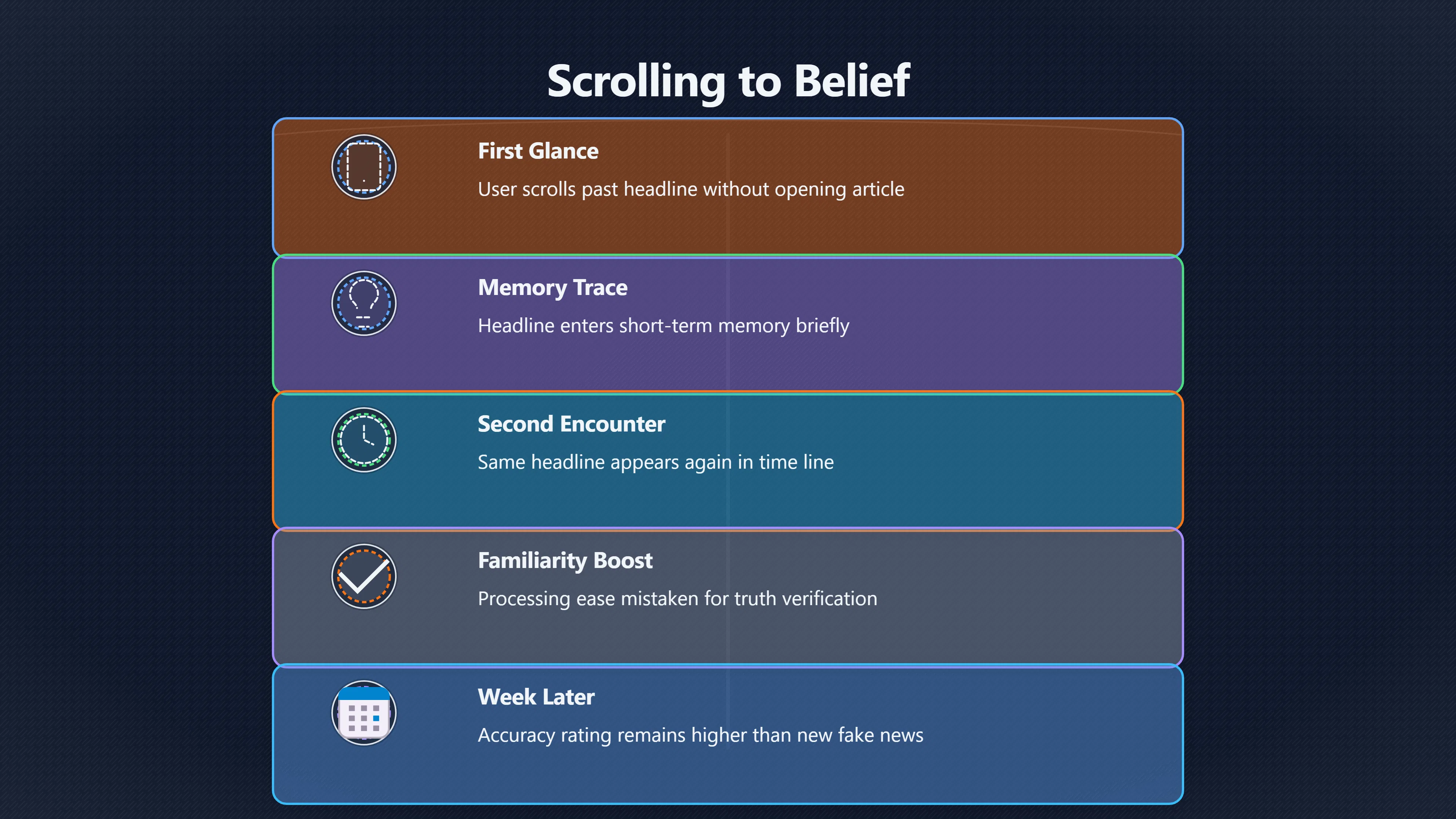
In many online settings, people encounter headlines while scrolling, browsing search results or glancing at social feeds. They may never open the article. They may not consciously evaluate whether the claim is true. Yet the headline still enters memory. When it appears again, processing it requires less effort. That ease creates a weak signal of familiarity, and the brain can misinterpret familiarity as credibility.[PMC]pmc.ncbi.nlm.nih.govThe illusory truth effect leads to the spread of misinformationby V Vellani · 2023 · Cited by 116 — That is, repeated information seem…[ScienceDirect]sciencedirect.comtrue and false content ('falling for fake news'). Another approach is to focus on overall belief, or the extent to which news – regardles…
This helps explain why misinformation often spreads through exposure rather than persuasion. The mechanism does not require a dramatic conversion experience. Instead, it operates through accumulation:
- A headline appears in a feed.
- The user scrolls past it.
- The headline is encountered again later.
- Recognition becomes easier.
- The familiar statement feels slightly more plausible.
Each step is modest, but social-media platforms can generate thousands of such encounters every day.[PMC]nih.govPMC10637098PMCby V Capraro · 2022 · Cited by 53 — In sum, Study 1 reveals that endorsing accuracy decreases intentions to share fake news, increases…[PMC]nih.govPMC10637098PMCby V Capraro · 2022 · Cited by 53 — In sum, Study 1 reveals that endorsing accuracy decreases intentions to share fake news, increases…
Researchers have therefore emphasised that misinformation can benefit from visibility alone. A person may reject a headline when first seeing it yet still experience a familiarity boost later. The danger is not that every exposure creates belief. The danger is that repeated exposure gradually weakens the distinction between “I have heard this before” and “this has been verified”.[PMC]nih.govPMC10637098PMCby V Capraro · 2022 · Cited by 53 — In sum, Study 1 reveals that endorsing accuracy decreases intentions to share fake news, increases…[ScienceDirect]sciencedirect.comJournal of Experimental Psychology: General, 147 (12) (2018), p. 1865. Crossref View in Scopus…Read mo…

Why people often do not notice the shift
The familiarity effect is largely unconscious. People generally do not think, “I saw this headline last week, therefore it must be true.”
Instead, the headline simply feels easier to process. Psychologists describe this as processing fluency: information that is easier to recognise or understand can feel more trustworthy even when no evidence has changed. The judgement emerges from a feeling rather than a deliberate argument.[ScienceDirect]sciencedirect.comPrior exposure increases perceived accuracy of fake news. J Exp Psychol Gen. (2018). J. Béna et al. Repetition could increase the perceiv…[Springer]link.springer.comeffects of repetition frequency on the illusory truth effectby A Hassan · 2021 · Cited by 402 — This is known as the illusory truth effec…
This is one reason the effect can survive fact-check labels or scepticism. In the original fake-news experiments, repeated headlines gained perceived accuracy even when they carried disputed-story warnings. The warning helped somewhat, but familiarity still exerted influence. The repeated headline retained its advantage over a completely new one.[PubMed]pubmed.ncbi.nlm.nih.govPrior exposure increases perceived accuracy of fake newsby G Pennycook · 2018 · Cited by 1884 — Moreover, this "illusory truth effe…
The effect is also not limited to people who strongly identify with a false claim. Someone can remain uncertain about a headline and still experience an increase in perceived plausibility after seeing it before. The mechanism concerns familiarity more than commitment.[PMC]nih.govPMC10637098PMCby V Capraro · 2022 · Cited by 53 — In sum, Study 1 reveals that endorsing accuracy decreases intentions to share fake news, increases…
How accuracy prompts interrupt sharing
Researchers have tested whether small interventions can interrupt this familiarity-driven process. One of the most promising approaches is surprisingly simple: ask people to think about accuracy before they decide whether to share information.[Misinformation Review]misinforeview.hks.harvard.edupausing reduce false newsJournal of Experimental Psychology: General, 147(12), 1865-1880. doi:10.1037…Read more…
Studies from the misinformation literature have found that brief accuracy prompts improve people’s ability to distinguish between true and false headlines. Instead of focusing attention on social reactions, outrage or entertainment value, the prompt redirects attention to the question of whether a claim is actually correct.[ScienceDirect]sciencedirect.comPrior exposure increases perceived accuracy of fake news. J Exp Psychol Gen. (2018). J. Béna et al. Repetition could increase the perceiv…
Related research suggests that repetition increases sharing partly because repeated statements feel more accurate. When familiarity boosts perceived truth, willingness to share tends to rise as well. Accuracy-focused interventions appear to weaken this chain by encouraging a more deliberate evaluation.[PMC]nih.govPMC10637098PMCby V Capraro · 2022 · Cited by 53 — In sum, Study 1 reveals that endorsing accuracy decreases intentions to share fake news, increases…
Other experiments have found benefits when participants explain why a headline is true or false rather than making a quick judgement. Requiring even a brief explanation can reduce the influence of misleading headlines because it forces attention away from familiarity and towards evidence.[online.ucpress.edu]online.ucpress.eduExplaining Why Headlines Are True or False Reduces11 Sept 2023 — Thus, explanation prompts may help people realize that false information is actually unsubstantiated, reducing their incli…
The broader lesson is that familiarity works best when attention is elsewhere. A headline glimpsed in passing can gain credibility through recognition alone. Asking people to pause and assess accuracy creates a competing process: instead of relying on the feeling that a claim is known, they are encouraged to ask whether it is actually supported.
Why this finding matters beyond fake news
The single-exposure effect changes how misinformation should be understood. It suggests that false beliefs do not always spread because people carefully evaluate bad evidence and choose the wrong conclusion. Sometimes the first step is much simpler: a headline becomes familiar.
That insight helps explain why corrections often struggle to keep pace with viral content. False headlines can benefit from countless brief encounters across feeds, screenshots, reposts and recommendations. Each exposure may seem trivial, yet together they create a familiarity advantage that later judgments must overcome.[PMC]nih.govPMC10637098PMCby V Capraro · 2022 · Cited by 53 — In sum, Study 1 reveals that endorsing accuracy decreases intentions to share fake news, increases…[PMC]nih.govPMC10637098PMCby V Capraro · 2022 · Cited by 53 — In sum, Study 1 reveals that endorsing accuracy decreases intentions to share fake news, increases…
For myths and misconceptions, the lesson is not that people are helpless against repetition. Rather, it is that recognition and truth are not the same thing. A headline can feel known long before it has earned credibility, and sometimes one passing encounter is enough to start that process.[PMC]nih.govPMC10637098PMCby V Capraro · 2022 · Cited by 53 — In sum, Study 1 reveals that endorsing accuracy decreases intentions to share fake news, increases…[ScienceDirect]sciencedirect.comRepetition increases both the perceived truth and fakeness…by O Corneille · 2020 · Cited by 87 — Experiment 3 then tests the possibili…
eBay marketplace picks
Marketplace Samples
Example marketplace items related to this page. Use the search link to explore similar finds on eBay.




Endnotes
1.
Source: pmc.ncbi.nlm.nih.gov
Link:https://pmc.ncbi.nlm.nih.gov/articles/PMC6279465/
Source snippet
Prior exposure increases perceived accuracy of fake newsby G Pennycook · 2018 · Cited by 1884 — This may have consequences for whether...
2.
Source: sciencedirect.com
Link:https://www.sciencedirect.com/science/article/abs/pii/S2352250X23001811
Source snippet
Prior exposure increases perceived accuracy of fake news. J Exp Psychol Gen. (2018). J. Béna et al. Repetition could increase the perceiv...
3.
Source: sciencedirect.com
Link:https://www.sciencedirect.com/science/article/pii/S1364661321000516
Source snippet
true and false content ('falling for fake news'). Another approach is to focus on overall belief, or the extent to which news – regardles...
4.
Source: link.springer.com
Link:https://link.springer.com/article/10.1186/s41235-021-00301-5
Source snippet
effects of repetition frequency on the illusory truth effectby A Hassan · 2021 · Cited by 402 — This is known as the illusory truth effec...
5.
Source: pmc.ncbi.nlm.nih.gov
Link:https://pmc.ncbi.nlm.nih.gov/articles/PMC10636596/
Source snippet
The illusory truth effect leads to the spread of misinformationby V Vellani · 2023 · Cited by 116 — That is, repeated information seem...
6.
Source: online.ucpress.edu
Title: Explaining Why Headlines Are True or False Reduces
Link:https://online.ucpress.edu/collabra/article/9/1/87617/197211/Explaining-Why-Headlines-Are-True-or-False-Reduces
Source snippet
11 Sept 2023 — Thus, explanation prompts may help people realize that false information is actually unsubstantiated, reducing their incli...
7.
Source: sciencedirect.com
Link:https://www.sciencedirect.com/science/article/pii/S0010027723000550
Source snippet
Journal of Experimental Psychology: General, 147 (12) (2018), p. 1865. Crossref View in Scopus...Read mo...
8.
Source: sciencedirect.com
Link:https://www.sciencedirect.com/science/article/abs/pii/S0010027720302894
Source snippet
Repetition increases both the perceived truth and fakeness...by O Corneille · 2020 · Cited by 87 — Experiment 3 then tests the possibili...
9.
Source: link.springer.com
Link:https://link.springer.com/article/10.1186/s41235-020-00257-y
Source snippet
Previous studies have demonstrated the...Read more...
10.
Source: link.springer.com
Link:https://link.springer.com/article/10.1186/s41235-024-00585-3
Source snippet
In fact, more fake news exposure improved younger and...Read more...
11.
Source: online.ucpress.edu
Link:https://online.ucpress.edu/collabra/article/6/1/38/114468/Repetition-Increases-Perceived-Truth-Even-for
Source snippet
This illusory truth... D. G.. (. 2018.). Prior exposure increases perceived accuracy of fake...Read more...
12.
Source: pubmed.ncbi.nlm.nih.gov
Link:https://pubmed.ncbi.nlm.nih.gov/30247057/
Source snippet
Prior exposure increases perceived accuracy of fake newsby G Pennycook · 2018 · Cited by 1884 — Moreover, this "illusory truth effe...
13.
Source: thedecisionlab.com
Title: The Decision Lab Illusory Truth Effect
Link:https://thedecisionlab.com/biases/illusory-truth-effect
Source snippet
Illusory truth effect - The Decision...Illusory Truth Effect is the positive feeling when we hear information that we believe to be true...
14.
Source: ebsco.com
Link:https://www.ebsco.com/research-starters/psychology/illusory-truth-effect
Source snippet
It adds a theoretical understanding of why people believe fake news...Read more...
15.
Source: misinforeview.hks.harvard.edu
Title: pausing reduce false news
Link:https://misinforeview.hks.harvard.edu/article/pausing-reduce-false-news/
Source snippet
Journal of Experimental Psychology: General, 147(12), 1865-1880. doi:10.1037...Read more...
Additional References
16.
Source: researchgate.net
Link:https://www.researchgate.net/publication/345396954_An_initial_accuracy_focus_reduces_the_effect_of_prior_exposure_on_perceived_accuracy_of_news_headlines
Source snippet
(PDF) An initial accuracy focus reduces the effect of prior...8 May 2026 — The present study examined the effects that different ratings...
Published: May 2026
17.
Source: researchgate.net
Link:https://www.researchgate.net/publication/383424465_Correcting_fake_news_headlines_after_repeated_exposure_memory_and_belief_accuracy_in_younger_and_older_adults
Source snippet
memory and belief accuracy in younger and older adults8 Aug 2024 — The efficacy of fake news corrections in improving memory and belief a...
18.
Source: researchgate.net
Link:https://www.researchgate.net/figure/The-illusory-truth-effect-for-fake-news-is-persistent-lasting-over-a-longer-filler-stage_fig2_317069544
Source snippet
The illusory truth effect for fake news is persistent, lasting...The illusory truth effect for fake news is persistent, lasting over a l...
19.
Source: facebook.com
Title: prompting people to reflect on the accuracy of news headlines increases the qual
Link:https://www.facebook.com/NaturePortfolioJournals/posts/prompting-people-to-reflect-on-the-accuracy-of-news-headlines-increases-the-qual/10158484080983167/
Source snippet
Prompting people to reflect on the accuracy of news...20 Mar 2021 — Prompting people to reflect on the accuracy of news headlines increa...
20.
Source: semanticscholar.org
Title: Semantic Scholar Prior Exposure Increases Perceived Accuracy of Fake News
Link:https://www.semanticscholar.org/paper/Prior-Exposure-Increases-Perceived-Accuracy-of-Fake-Pennycook-Cannon/9f9afe1dbfea155096635f0fb3ac126e6464de38
Source snippet
exposure increases subsequent perceptions of accuracy, both within the same session and after a week. Moreover, this “illusory truth effe...
21.
Source: scienceopen.com
Link:https://www.scienceopen.com/document?vid=e4d5f2d5-e027-4d6f-bc1b-84bfbb37cfb5
Source snippet
Author(s): Gordon Pennycook, Tyrone D Cannon, David G. Rand. Publication date (Print): 2017.Read more...
22.
Source: researchgate.net
Title: 317069544 Prior Exposure Increases Perceived Accuracy of Fake News
Link:https://www.researchgate.net/publication/317069544_Prior_Exposure_Increases_Perceived_Accuracy_of_Fake_News
Source snippet
Prior Exposure Increases Perceived Accuracy of Fake News9 Feb 2026 — Moreover, this “illusory truth effect” for fake news headlines occur...
23.
Source: fondationdescartes.org
Link:https://www.fondationdescartes.org/en/2020/05/why-do-people-believe-in-fake-news/
Source snippet
It should be noted that this study was carried out in English, and...Read more...
24.
Source: journalistsresource.org
Title: fake news conspiracy theories journalism research
Link:https://journalistsresource.org/[politics
Source snippet
Fake news and the spread of misinformation: A research...Sep 1, 2017 — Using survey data collected during the 2006 Israeli election camp...
25.
Source: osf.io
Link:https://osf.io/download/nkpgz/
Source snippet
47 politics. An important research goal is to understand how...Read more...
Topic Tree